

When your car's air conditioning begins blowing lukewarm air during a relentless Texas summer, a professional AC recharge in Plano is often the necessary solution. This service is the most common remedy for a system that has gradually lost its cooling capability. This educational guide will explain the science behind your car's AC, the recharge process, and why professional service is critical for your vehicle's health.
Why Is My Car AC Blowing Hot Air? A Scientific Explanation
We’ve all experienced it. It's a sweltering Plano afternoon, you activate the AC expecting a refreshing blast of cold air, and instead, you're met with warm, humid air. It's a dreaded moment for any Texas driver, but understanding the underlying cause can demystify the repair process.

The Primary Cause of AC Performance Loss
Many drivers assume a failing AC system signifies an impending, expensive repair. However, the true culprit is often much simpler: a slow, progressive loss of refrigerant.
Consider refrigerant the essential medium for heat transfer in your air conditioning system. Without the precise volume specified by the manufacturer, the system cannot effectively absorb heat from the cabin and transfer it outside.
This is a universal automotive issue. The full refrigerant market research shows a massive and growing global demand, underscoring how vital this service is for drivers everywhere. Here in Plano, where high heat and humidity persist for months, local automotive shops often see AC service requests increase by as much as 50% during peak summer months.
Your car’s AC is engineered as a sealed system. However, over years of operation, minuscule amounts of refrigerant can permeate through porous seals and hoses. This gradual loss is often why a system that functioned flawlessly last summer now struggles to cool.
An AC recharge is the process of restoring the system to its correct refrigerant level, ensuring it can operate efficiently again. In this guide, we will explore the warning signs of a low system, the critical differences between DIY kits and professional service, and the meticulous steps involved in a professional recharge.
Understanding Your Car's AC System: The Core Components
To grasp why you might need an AC recharge in Plano, it's helpful to understand the fundamental principles of your car's air conditioning. Your car's AC is a sophisticated thermal management system operating within a closed loop. It relies on a few key components working in concert to extract heat from your vehicle's cabin and expel it into the atmosphere.
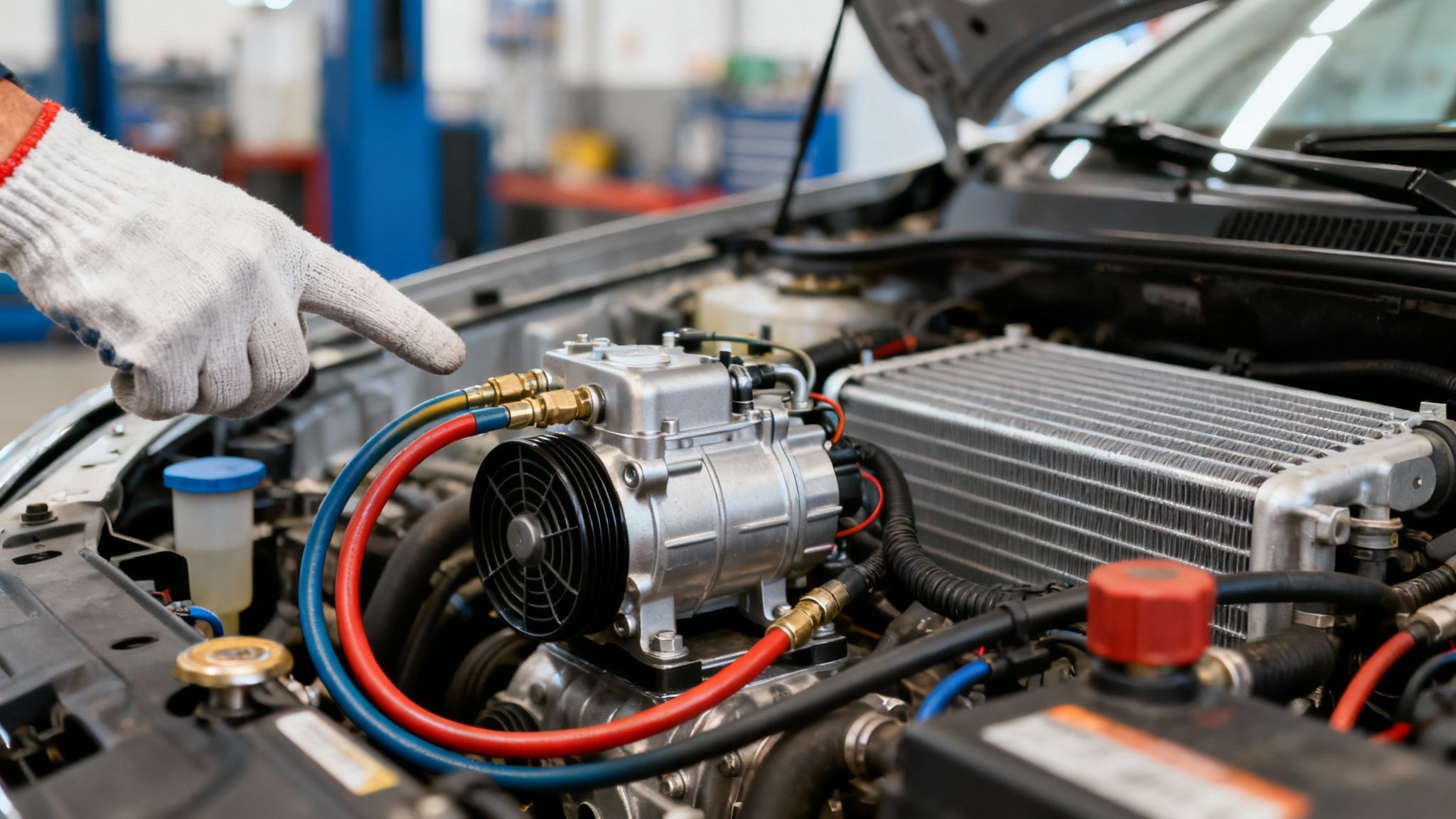
The central element is the refrigerant, a chemical compound with a low boiling point that allows it to change state between liquid and gas easily. In its gaseous state, it absorbs heat from the air inside your car. The compressor then pressurizes this hot gas, converting it into a hot liquid. This liquid flows to the condenser at the front of the car, where a fan helps dissipate the heat into the surrounding air.
This thermodynamic cycle repeats continuously, providing the cold air you rely on during a Texas summer. However, even a sealed system can experience gradual degradation.
The Science Behind Refrigerant Loss
Over time, the rubber hoses, seals, and O-rings within the AC system can degrade due to heat and vibration. This allows microscopic amounts of refrigerant gas to permeate and escape—sometimes as little as 10-15% per year. This isn't a sudden leak but a slow, cumulative loss that eventually compromises cooling performance.
This explains why an AC that performed well last summer might seem weak this year. It is a common issue, particularly in vehicles over five years old. An AC recharge is not just about "topping off" the system; it’s about restoring it to the precise pressure and volume specifications set by the manufacturer.
An AC recharge is not analogous to filling a fuel tank. The system requires an exact mass of refrigerant to operate correctly. Both overcharging and undercharging can lead to poor cooling and potentially damage critical components like the compressor.
More Than Just a Refill: The Importance of Dehydration
A professional AC service is a comprehensive procedure. One of the most crucial steps is removing all moisture from the system. If water vapor mixes with refrigerant, it forms a corrosive acid that can degrade internal components, leading to catastrophic failure and significant repair costs.
A proper, professional recharge service always includes:
- Evacuation: A high-powered vacuum pump removes all old refrigerant, lubricating oil, and contaminants from the system.
- Dehydration: This deep vacuum lowers the boiling point of water, causing any trapped moisture to vaporize and be extracted, ensuring the internal components are completely dry.
- Recharging: Only after the system is clean and dry is the precise, factory-specified mass of new refrigerant and lubricating oil introduced.
Adhering to these steps is the only way to guarantee optimal AC performance and prevent long-term damage. This process also contributes to better cabin air quality. For related issues like musty odors, it's also wise to learn how often to change your cabin air filter, as this filter is the first line of defense for the air you breathe.
Spotting the Warning Signs of a Failing AC
Your vehicle’s AC system rarely fails without warning. Long before it ceases to function on a hot Plano day, it will exhibit subtle signs of declining performance. Recognizing these early indicators is key to addressing minor issues before they escalate into major, costly repairs.
The most obvious symptom is a gradual reduction in cooling effectiveness. The air from the vents is no longer cold, just cool or even lukewarm. This forces you to run the fan at higher speeds to achieve minimal comfort and is a classic sign of low refrigerant levels.
Auditory and Olfactory Clues to AC Issues
Beyond temperature changes, your senses of hearing and smell can alert you to potential AC problems. Pay close attention to any new or unusual noises that manifest only when the air conditioner is running.
A common auditory signal is a distinct clicking noise from the engine bay as the AC engages. This sound often indicates that the AC compressor clutch is attempting to engage but failing, which can be due to low system pressure or an electrical issue. In either case, it signals that a core component is under stress.
Another significant red flag is a musty or mildew-like odor emanating from the vents.
This "dirty sock" smell is a tell-tale sign of moisture accumulation and potential microbial growth on the evaporator core. This not only creates an unpleasant odor but can also negatively impact your cabin's air quality and should be addressed promptly.
A Diagnostic Guide to Common AC Problems
Interpreting your car's symptoms can be challenging. This chart provides a simple guide to connect common issues with their likely causes.
| Symptom | Potential Cause | Recommended Action |
|---|---|---|
| Weak Cooling | Low refrigerant, failing compressor, or clogged condenser | Schedule a professional AC performance check. |
| Musty Smell | Mold/mildew in the evaporator core or dirty cabin air filter | Have the system professionally cleaned and the cabin filter replaced. |
| Clicking/Grinding Noise | Failing compressor clutch or internal compressor damage | Deactivate the AC and seek immediate inspection by a technician. |
| Water on Floorboard | Clogged evaporator drain hose | Clear the drain hose to prevent water damage to the interior. |
| Greasy Film on Hoses | Refrigerant/oil leak | A technician must locate and repair the leak source. |
If you notice any of these signs, don't delay. The sooner the system is inspected, the more likely the solution will be simple and affordable.
Less Obvious Indicators
Some symptoms are more subtle but equally important. For instance, a puddle of water on the passenger-side floor mat typically indicates a clogged evaporator drain hose. Condensation, a normal byproduct of the cooling process, is unable to drain outside the vehicle and is instead backing up into the cabin.
Finally, perform a visual inspection under the hood. While refrigerant itself is an invisible gas, it is circulated with a special lubricant oil. A greasy, grimy residue on AC hoses, fittings, or components is a clear sign of a leak. Identifying any of these symptoms means it's time to schedule a professional inspection for your AC recharge in Plano before a minor issue becomes a major failure.
DIY Recharge Kits vs. Professional AC Service: An Analysis
When your car’s AC performance declines, a DIY recharge kit from a Plano auto parts store might seem like an inexpensive and convenient solution. These kits, typically costing under $50, promise a quick fix. However, this approach carries significant risks and often fails to address the root cause of the problem.
Using a DIY kit is like applying a bandage to a wound that requires stitches. It may temporarily mask the symptom (warm air), but it ignores the underlying issue and can lead to more severe complications.
The Technical Risks of a DIY Approach
The single greatest danger of using a DIY kit is overcharging the system. Your car’s AC requires a precise mass of refrigerant, measured by weight. Even a small excess can cause system pressures to rise to dangerous levels, potentially leading to the catastrophic failure of the AC compressor—the system's most expensive component. A seemingly cheap fix could result in a repair bill exceeding $1,000.
Furthermore, many DIY kits contain "stop leak" additives. While seemingly beneficial, these sealants can congeal and obstruct critical components like the expansion valve or orifice tube, impeding refrigerant flow. This not only leads to poor cooling but also places additional strain on the compressor.
Most importantly, a DIY kit cannot diagnose why the refrigerant was low. A refrigerant loss indicates a leak, which a professional technician can locate and repair. Simply adding more refrigerant without fixing the leak is a temporary solution at best; the problem will inevitably return.
A professional service is not just a recharge; it's a comprehensive diagnostic procedure. Technicians use specialized gauges, vacuum pumps, and leak detection equipment to identify the root cause of the problem and ensure a lasting repair.
The popularity of these kits is undeniable; the global refrigerant market for them has surpassed USD 1.14 billion. With up to 70% of cars over five years old being low on refrigerant, the demand is vast. However, an improperly charged system can suffer a 20-30% loss in efficiency, increasing fuel consumption and engine load.
The Value of a Professional Service
Choosing a professional AC recharge in Plano provides a level of precision and safety that a DIY kit cannot match. A certified technician adheres to a strict protocol to restore your AC system to factory specifications.
Here’s what distinguishes a professional service:
- Accurate Diagnosis: Manifold gauges are connected to both high and low-pressure ports, providing a detailed assessment of the system's operational health.
- System Evacuation: A powerful vacuum pump removes all old refrigerant, air, and moisture. This step is critical, as residual moisture can form corrosive acids that damage internal components.
- Leak Detection: Before recharging, a vacuum decay test or UV dye is used to identify any leaks, ensuring the integrity of the system.
- Precise Recharge: The system is refilled with the exact weight and type of refrigerant specified by the manufacturer, along with the correct volume of compressor oil.
Ultimately, a professional service is a complete restoration of your car's AC system, ensuring it operates efficiently and reliably through the demanding Texas summer.
The Professional AC Recharge Process Explained
Have you ever wondered what the technical process for a professional AC recharge in Plano entails? It is a meticulous, multi-step procedure far more complex than simply adding fluid. It is best understood as a precise technical service designed to restore your vehicle's cooling system to its original factory specifications.
The process begins with a comprehensive inspection. A certified technician connects a specialized set of manifold gauges to the AC system’s high- and low-pressure service ports. This initial step provides a diagnostic snapshot of the system's internal pressures, revealing potential issues like low refrigerant or a blockage.
System Recovery and Dehydration
If low refrigerant is confirmed, the next step is not to add more but to remove the old charge. Using an EPA-approved recovery machine, the technician safely extracts all remaining refrigerant from the system. This ensures environmental compliance and prepares the system for the most critical phase.
This leads to the crucial step of placing the system under a deep vacuum. A powerful vacuum pump is connected to lower the internal pressure significantly. This accomplishes two things: it removes all air and, more importantly, it lowers the boiling point of water. This causes any trapped moisture inside the lines and components to vaporize and be completely evacuated.
The presence of even trace amounts of moisture in an AC system can be catastrophic. When moisture combines with refrigerant, it forms hydrofluoric acid, a highly corrosive substance that can destroy expensive components like the compressor from within. The vacuum dehydration step is non-negotiable for a lasting, high-quality repair.
The infographic below illustrates this methodical procedure.
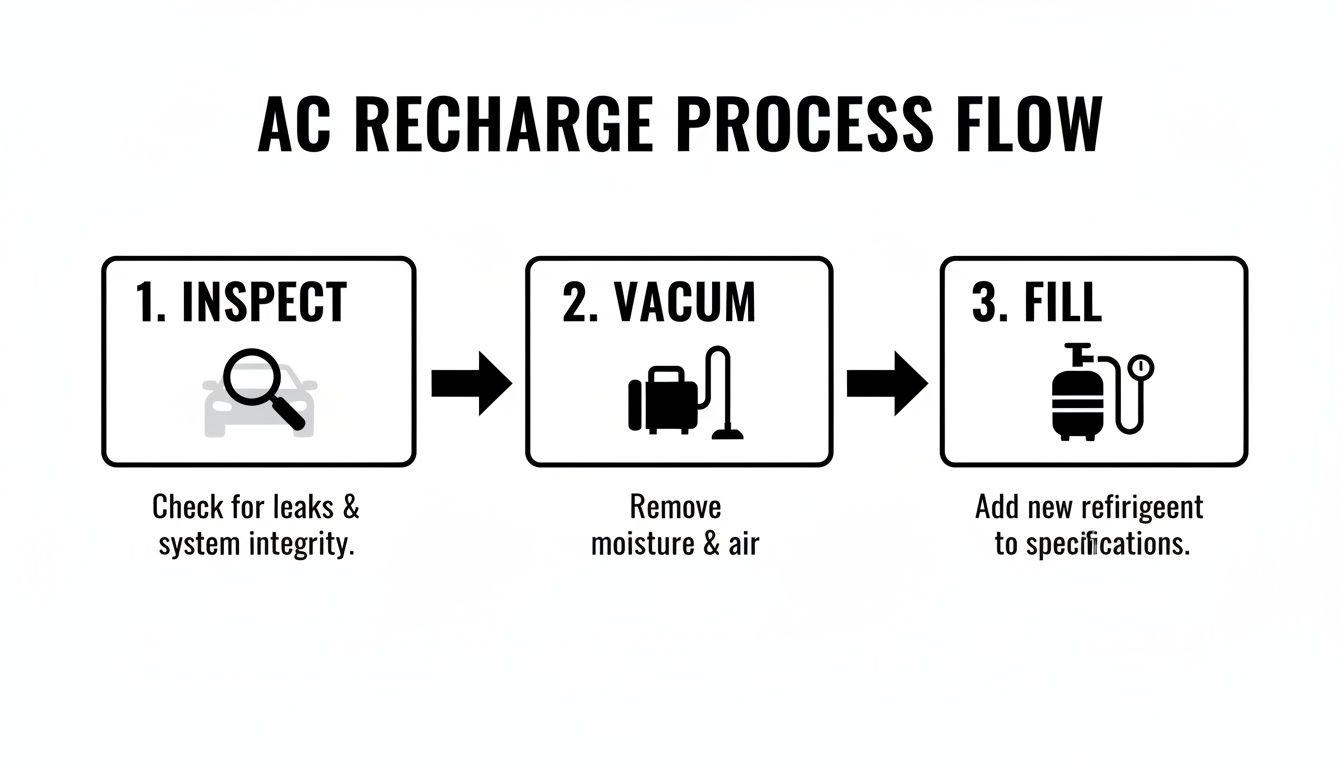
This systematic approach—inspect, evacuate, and refill—is what separates a professional service from a high-risk DIY attempt that can inflict more damage than it solves.
The Final Charge for Optimal Cooling
After the system successfully holds a vacuum (confirming the absence of significant leaks), the technician introduces a small amount of UV dye and the correct type and quantity of compressor oil. The UV dye is a diagnostic aid that makes any future leaks easily visible under a blacklight. The oil is vital for lubricating the compressor's internal moving parts.
Finally, new refrigerant is added. It is measured precisely by weight, not by pressure, to match the exact specification provided by your vehicle's manufacturer. This precision guarantees the system is not undercharged or overcharged, both of which severely impair performance and can cause damage.
A final performance test confirms that the air temperature at the vents meets specifications, ensuring you are ready to face another Texas summer. For more information on our complete methodology, please review our automotive heating and cooling services.
Your Local Solution for an AC Recharge in Plano
When your car's AC fails during a Texas summer, you require a fast, dependable AC recharge in Plano from a local expert who values your time. At Express Lube & Car Care, we prioritize efficiency and expertise to get you back on the road comfortably.
Our service model is designed for your convenience. We understand the demands of a busy schedule, which is why we proudly offer a no-appointment-needed policy. You can visit us at your convenience, avoiding the rigid scheduling often required by larger dealerships.
Expertise You Can Trust
At Express Lube & Car Care, all services are performed by ASE-certified technicians. This certification is your assurance that the individual servicing your vehicle has demonstrated a high level of technical proficiency in complex automotive systems, including air conditioning. They utilize state-of-the-art diagnostic equipment to accurately identify the root cause of the problem and perform the correct repair the first time.
Choosing a local, certified shop provides more than just a repair. It allows you to build a trusted relationship with a team that understands your vehicle and stands behind their work, giving you confidence and peace of mind on the road.
This dedication to quality has a tangible impact on our community. For Plano's fleet managers, reliable AC maintenance can prevent an estimated 25% of summer vehicle breakdowns, ensuring business continuity. Our walk-in service model provides significant time savings for busy families, while programs like our Ladies Day specials make professional automotive care more accessible. You can explore automotive service trends to understand the growing importance of efficient and reliable vehicle maintenance.
We are more than just a business in Plano; we are your neighbors, committed to delivering honest, high-quality service. When the Texas heat becomes unbearable, you know where to turn for professional and prompt relief. Learn more about our specialized AC repair services in Plano and let our experts restore your comfort.
Your Top Car AC Questions Answered
Automotive AC systems can seem complex, but understanding the basics can empower you to make informed decisions about your vehicle's care. Here are answers to the most common questions we receive from Plano drivers.
How Often Should a Car AC Be Recharged?
There is no predetermined maintenance schedule for an AC recharge. A properly functioning, perfectly sealed AC system should theoretically never need a recharge. You should only consider an AC recharge in Plano when you observe a noticeable decline in cooling performance. This is the primary indicator that a small amount of refrigerant has escaped over time.
However, if your AC performance degrades rapidly—from cold to warm overnight—this suggests a significant leak. In this scenario, simply adding more refrigerant is ineffective. The leak must be located and repaired first to ensure a lasting solution.
How Much Does an AC Recharge Cost in Plano?
The cost of a professional AC service varies based on several factors, including your vehicle's make and model and the type of refrigerant it requires. Most vehicles manufactured before 2015 use R-134a refrigerant, whereas newer models use the more environmentally friendly but more expensive R-1234yf.
A standard recharge service fee typically covers the initial diagnostic check and the labor and materials for the recharge itself. If our diagnostics reveal leaks or failed components, the cost of those repairs would be additional. At Express Lube & Car Care, we are committed to transparency and will always provide a detailed, upfront estimate before any work begins.
Key Takeaway: Recharging an AC system with an active leak is a waste of resources. The foundational repair is always to fix the leak itself, thereby ensuring the system can maintain its refrigerant charge and function correctly.
Can Low Refrigerant Damage My Car AC?
Absolutely. This is a critical point that many vehicle owners overlook. The refrigerant in your AC system does more than just cool the air; it also acts as a carrier for PAG oil, a special lubricant essential for the AC compressor.
When the refrigerant level drops too low, the circulation of this oil is diminished, effectively starving the compressor of lubrication. This causes the compressor to run hotter and wear out prematurely, leading to seizure and catastrophic failure. Replacing a seized compressor is one of the most expensive automotive AC repairs. Addressing cooling issues promptly is the best way to prevent this costly outcome.
When you need fast, reliable AC service without the hassle of an appointment, turn to the ASE-certified team at Express Lube & Car Care. We'll diagnose the problem, explain your options clearly, and get you back on the road feeling cool and comfortable. Visit us today at https://www.expresslubeplano.com