

Your car is a complex machine that communicates its health through various signals. Subtle shifts in performance, new sounds, and changes in fuel consumption are all important messages. Understanding these indicators is key to preventative maintenance. A professional tune-up is more than just a routine task; it's a comprehensive health check that addresses the vital systems responsible for your vehicle's efficiency and your safety on the road. Many drivers overlook the gradual decline in performance that signals a need for service, often leading to more significant and costly repairs later.
This guide provides an educational breakdown of the eight most critical signs your car needs a tune-up. We will examine the underlying cause of each symptom, explain its mechanical significance, and outline the appropriate diagnostic and corrective actions. By learning to recognize these warning signs, you can transition from reactive repairs to proactive care, thereby improving safety, saving money, and extending the operational life of your vehicle. This essential checklist will empower you with the knowledge to manage your car's maintenance and drive with greater confidence.
1. Engine Misfiring or Rough Idle
One of the most perceptible signs your vehicle requires a tune-up is a rough or unstable engine operation, particularly when the car is stationary (idling). This condition, known as an engine misfire, occurs when one or more of the engine's cylinders fails to properly combust the air-fuel mixture. The direct result is a loss of power, a noticeable vibration felt through the chassis and steering wheel, and inconsistent engine performance. For a daily commuter, a misfiring engine is a clear diagnostic signal that core ignition or fuel system components require inspection to prevent stalling or a no-start scenario.
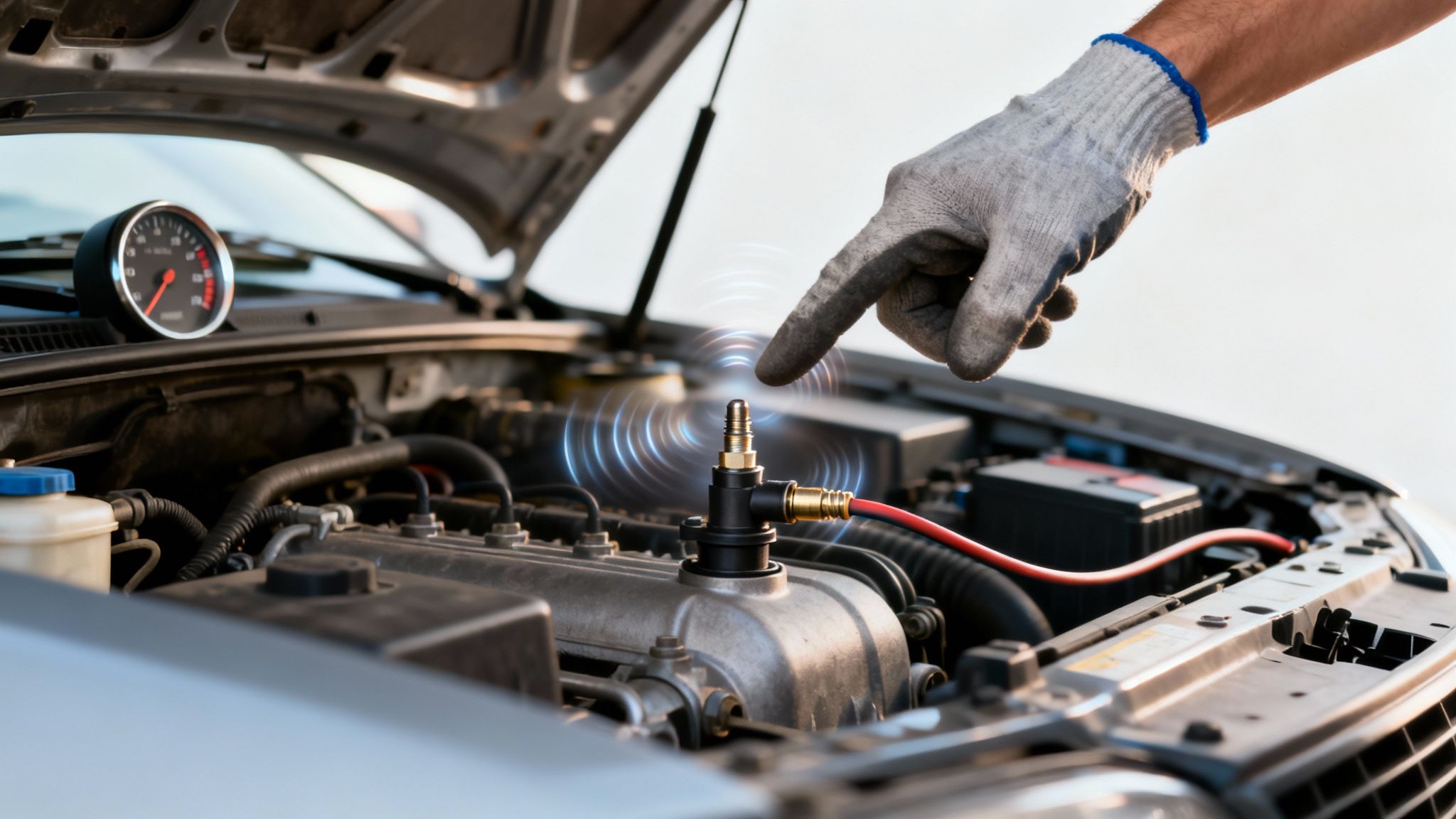
What Causes a Rough Idle?
An internal combustion engine's smooth operation depends on the precise timing and balance of fuel, air, and spark. A misfire disrupts this equilibrium. The most common causes are components that degrade through normal operational wear, including:
- Worn Spark Plugs: As the primary instigators of combustion, spark plugs are frequent culprits. Over thousands of cycles, their electrodes erode, increasing the gap and weakening the spark.
- Faulty Ignition Coils or Wires: These components are responsible for delivering high-voltage electricity to the spark plugs. A failure in a coil or wire prevents the corresponding cylinder's plug from firing.
- Clogged Fuel Injectors: Fuel injectors can accumulate deposits, impeding their ability to atomize fuel correctly. This leads to an improper air-fuel ratio and incomplete combustion.
Actionable Steps for Vehicle Owners
If you observe this characteristic shudder, it warrants immediate attention. A professional tune-up is the standard procedure for resolving these issues and restoring engine health.
Technical Note: While spark plugs are a common cause, a professional diagnosis is essential. Modern vehicles utilize On-Board Diagnostics (OBD-II) scanners to isolate the specific cylinder and identify the root cause of the misfire, ensuring accurate and efficient repairs.
The first step should be a diagnostic check performed by an ASE-certified technician. A comprehensive tune-up will typically involve replacing spark plugs and thoroughly inspecting the entire ignition system. To prevent recurrence, a fuel system cleaning service is often recommended to clear injector deposits. Adhering to a regular maintenance schedule, including timely oil changes, is fundamental to engine longevity. You can learn more about how regular fluid maintenance supports overall engine health on our blog.
2. Reduced Fuel Economy
A noticeable increase in fuel consumption is a clear indicator that your vehicle's engine is not operating at peak efficiency. A sudden or gradual decline in miles-per-gallon (MPG) is one of the most common signs your car needs a tune-up. This happens because the engine must work harder and consume more fuel to produce its standard power output. For any vehicle owner, restoring optimal fuel economy can quickly offset the cost of a tune-up. A seemingly small drop from 22 MPG to 18 MPG, for instance, represents a significant increase in annual fuel expenditure.
What Causes Poor Fuel Economy?
Optimal fuel efficiency is the result of several interconnected systems functioning correctly. A decline in performance is often due to the degradation of key components over time. Common causes include:
- Clogged Air Filter: A dirty filter restricts the volume of air entering the engine. To maintain the correct air-fuel ratio, the engine management system compensates by injecting more fuel, which reduces efficiency.
- Worn Spark Plugs: As with misfires, old spark plugs lead to incomplete combustion, meaning not all the fuel in the cylinder is burned to generate power. This wasted fuel directly impacts MPG.
- Faulty Oxygen Sensors: These sensors monitor the amount of unburned oxygen in the exhaust. If they malfunction, they provide incorrect data to the engine's computer, leading to an inefficiently rich or lean fuel mixture.
Actionable Steps for Vehicle Owners
Do not allow poor fuel efficiency to become an unnecessary expense. The first step is to monitor your fuel consumption to confirm a problem exists; a professional tune-up is the most effective solution.
Technical Note: Tire pressure is a critical, often overlooked factor in fuel economy. The U.S. Department of Energy states that for every 1 PSI your tires are underinflated, gas mileage can decrease by 0.2%. Regular pressure checks are a simple, effective maintenance task.
A comprehensive tune-up from an ASE-certified technician will involve inspecting and replacing worn components like the air filter and spark plugs. We also recommend a professional fuel system cleaning to remove deposits from injectors, which further optimizes fuel atomization and combustion efficiency. Consistent maintenance is the key to maximizing your vehicle's fuel economy.
3. Difficulty Starting or Slow Engine Cranking
When an engine struggles to turn over, cranks more slowly than usual, or requires multiple attempts to start, it is a clear warning sign that a tune-up is needed. This sluggish start, often characterized by a labored "rur-rur-rur" sound, points to potential issues within the electrical or fuel delivery systems. High ambient temperatures can be particularly stressful for automotive batteries, accelerating their degradation. Addressing slow cranking early is crucial for ensuring vehicle reliability.
What Causes a Slow Start?
A successful engine start relies on a powerful electrical current from the battery and an adequate supply of fuel. When this process falters, it's typically due to one of these common causes:
- Weak or Failing Battery: This is the most frequent cause. Over time, batteries lose their capacity to hold a sufficient charge. Extreme heat significantly shortens a battery's lifespan.
- Corroded Battery Terminals: A buildup of sulfate on the battery posts creates resistance, obstructing the flow of electricity and preventing the starter motor from receiving full power.
- Worn Starter Motor: The starter is a high-torque electric motor. As its internal components wear, it draws more current and turns more slowly, eventually leading to complete failure.
- Fuel System Problems: A clogged fuel filter or a failing fuel pump can restrict the flow of gasoline, preventing the engine from receiving the necessary fuel to start.
Actionable Steps for Vehicle Owners
If your vehicle is becoming difficult to start, a proactive diagnosis can prevent a future no-start situation.
Technical Note: Do not automatically assume a slow start is a battery issue. While it is the most common cause, a professional electrical system test can determine if the fault lies with the battery, alternator, or starter, ensuring the correct component is replaced.
Begin with a complimentary battery test to check its state of health and charge level. ASE-certified technicians can also inspect and clean terminals to ensure a solid connection. As part of a comprehensive tune-up, the entire starting and charging system should be evaluated. This check is a vital part of your vehicle's care, as detailed in our routine car maintenance checklist. For optimal reliability, consider replacing your vehicle's battery every 3-5 years as a preventative measure.
4. Check Engine Light Illumination
The illumination of the check engine light is one of the most direct signs your car needs a tune-up. This dashboard warning, technically known as the Malfunction Indicator Lamp (MIL), activates when the vehicle's On-Board Diagnostics (OBD-II) system detects a fault in the engine, transmission, or emissions control systems. While the underlying cause can range from minor to severe, the light is an explicit communication that something is operating outside of its normal parameters. Ignoring this warning can lead to more extensive damage and costly repairs.
What Causes the Check Engine Light?
The OBD-II system continuously monitors hundreds of vehicle functions. Any sensor reading that deviates from the manufacturer's specified range can trigger the light. Many of these issues are directly related to components addressed during a tune-up. Common culprits include:
- Loose Gas Cap: The simplest cause. A loose cap breaks the seal on the fuel system, allowing vapors to escape and triggering an alert from the evaporative emission control (EVAP) system.
- Failing Oxygen (O2) Sensor: This sensor measures the oxygen content in the exhaust. A failure prevents the system from properly regulating the air-fuel mixture, leading to reduced fuel economy and potential damage to the catalytic converter.
- Worn Spark Plugs or Ignition Coils: Failing ignition components cause engine misfires, which are immediately detected and logged as a fault by the OBD-II system.
- Mass Airflow (MAF) Sensor Failure: This sensor measures the mass of air entering the engine. Contamination can cause it to send inaccurate data, leading to rough idling and poor acceleration.
Actionable Steps for Vehicle Owners
An illuminated check engine light requires a prompt and professional diagnosis to identify the underlying problem. While checking the gas cap is a good first step, further investigation is typically necessary.
Technical Note: A solid, steady check engine light indicates a fault that should be inspected soon. A flashing light signifies a severe problem, such as a major engine misfire that could rapidly damage the catalytic converter. In this case, you should pull over safely and have the vehicle towed for service.
An ASE-certified technician can perform a quick and accurate diagnostic scan using a professional-grade OBD-II scanner to read the specific trouble codes. They will then diagnose the root cause and recommend the necessary tune-up services to resolve the issue. Addressing these warnings promptly is the best practice for preventing minor problems from escalating into major repairs.
5. Dirty or Clogged Air Filter
An engine requires a precise mixture of air and fuel for combustion, and a dirty air filter disrupts this balance. This component's function is to prevent dust, debris, and other contaminants from entering the engine. When it becomes clogged, it restricts the volume of clean air needed for efficient combustion, leading to noticeable decreases in performance and fuel economy. For vehicles operating in dusty or high-pollen environments, a clogged air filter is a common but easily rectified issue that is a clear sign your car needs a tune-up.

What Causes a Clogged Air Filter?
An engine air filter is designed to trap airborne particulates. Over time, it becomes saturated with the contaminants it has filtered from the air. This process can be accelerated by specific environmental factors, including:
- High Pollen and Dust Levels: Local climates with high particulate matter in the air will cause a filter to clog more quickly.
- Driving on Unpaved or Rural Roads: These surfaces generate significant amounts of dust that rapidly saturate a filter.
- Heavy Stop-and-Go Traffic: Constant idling in congested areas can draw in higher concentrations of exhaust soot and road grime from surrounding vehicles.
Actionable Steps for Vehicle Owners
Inspecting the engine air filter is one of the most straightforward and effective maintenance tasks. It is an inexpensive component of any tune-up that provides immediate benefits to engine performance.
Technical Note: A simple visual check is highly effective. During each oil change, have your technician inspect the air filter. A quick test is to hold it up to a light source; if you cannot see light passing through the filter media, it is too clogged and requires replacement.
An ASE-certified technician can inspect and replace your engine air filter in minutes, often during a routine oil change. A clean filter helps restore engine power, improve gas mileage, and prolong the life of sensitive internal engine components like the mass airflow sensor and pistons. You can learn more about the importance of changing your car air filter and its impact on performance on our blog.
6. Worn or Fouled Spark Plugs
One of the most fundamental signs your car needs a tune-up is related to the condition of its spark plugs. These components are responsible for creating the high-energy spark that ignites the air-fuel mixture, initiating the power stroke of the engine. Over time, they either wear down or become contaminated with deposits, a condition known as "fouling." When this occurs, they cannot produce a strong, consistent spark, which leads to a range of performance issues including sluggish acceleration, difficulty starting, and poor fuel economy. For vehicles with over 50,000 miles, spark plugs are a primary suspect for declining performance.
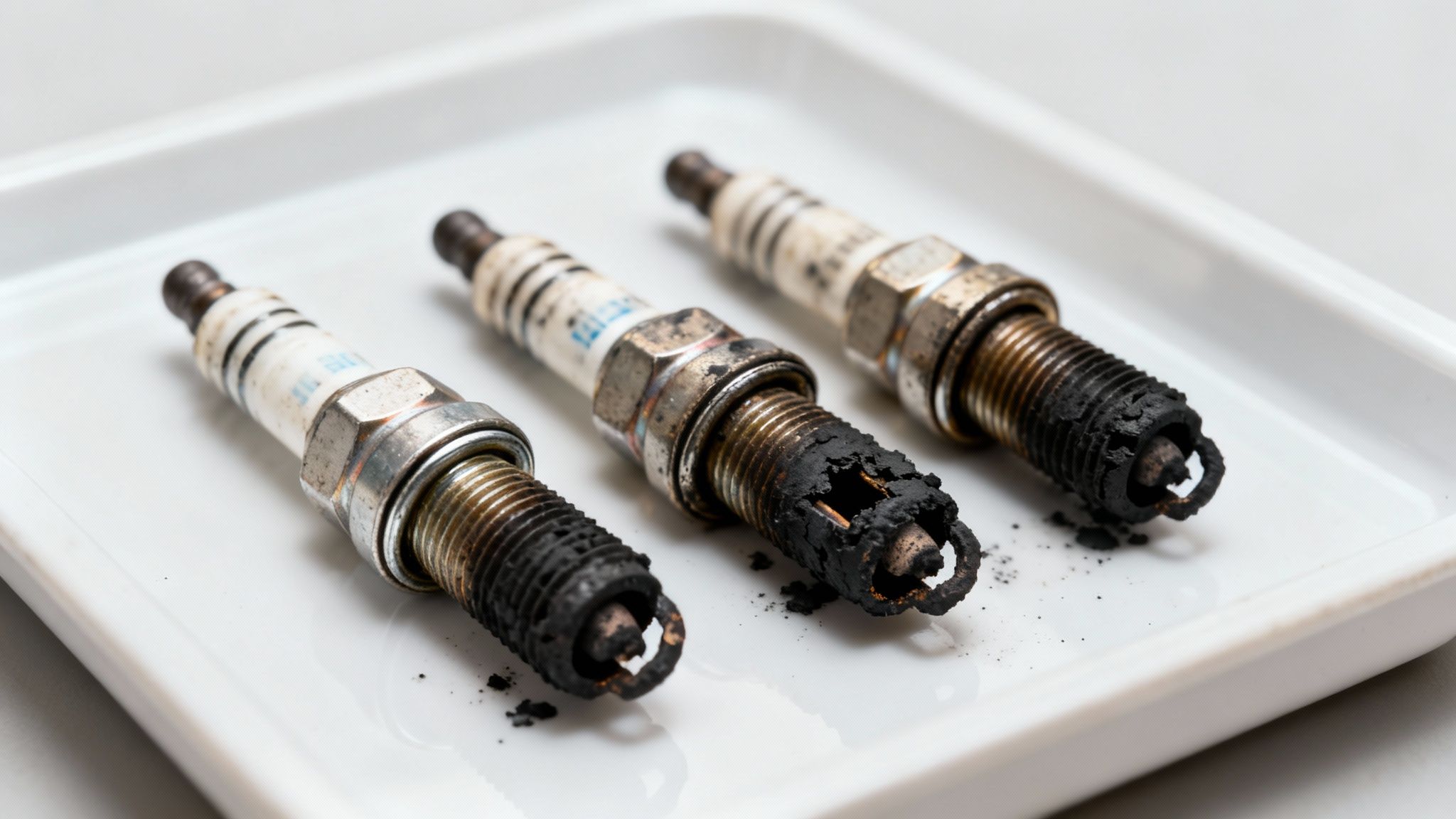
Why Do Spark Plugs Fail?
Spark plugs operate under the extreme heat and pressure of the engine's combustion chamber, making gradual wear unavoidable. The performance issues they cause indicate that the ignition system is no longer functioning at optimal efficiency.
- Electrode Wear: The metal tip (electrode) of the spark plug erodes with each firing, which gradually increases the gap the spark must cross. A wider gap requires higher voltage, which strains the ignition coil and can result in a weak or intermittent spark.
- Carbon Fouling: Incomplete combustion can leave black, sooty carbon deposits on the plug's insulator nose, providing a path for the electrical current to ground itself without creating a spark.
- Oil or Fuel Deposits: Internal engine leaks from valve seals or piston rings can coat the plugs in oil, while fuel system issues can leave wet fuel deposits. Both conditions inhibit proper ignition.
Actionable Steps for Vehicle Owners
Replacing spark plugs is a core component of a professional tune-up and is essential for maintaining engine health and efficiency. It is a preventative measure that should not be delayed until a failure occurs.
Technical Note: It is best practice to replace all spark plugs simultaneously. Replacing only a single faulty plug can create an imbalance in engine operation, as the new plug will fire more efficiently than the older ones. A full set ensures consistent performance across all cylinders.
If your vehicle is approaching its manufacturer-recommended service interval (typically every 30,000 to 100,000 miles, depending on the type of spark plug), it is time for an inspection. Our ASE-certified technicians can inspect your spark plugs, recommend the correct type for your specific engine, and ensure they are installed to the proper torque and gap specifications.
7. Sluggish Acceleration or Loss of Power
When you depress the accelerator pedal, you expect a prompt response from the engine. If your vehicle hesitates, struggles to gain speed, or feels demonstrably weaker than it once did, it is a classic sign your car needs a tune-up. This degradation in power often occurs gradually, making it less noticeable day-to-day. However, a responsive engine is critical for safe driving maneuvers such as merging into fast-moving traffic.
What Causes a Loss of Power?
An engine's power output is a direct result of efficient combustion. When key tune-up components degrade, this efficiency declines, and the vehicle's performance suffers. Several common issues are responsible for this sluggish feeling:
- Clogged Air Filter: An engine must ingest a large volume of air to operate. A restricted air filter essentially starves the engine, preventing it from generating its rated horsepower.
- Worn Spark Plugs: A weak or inconsistent spark results in incomplete fuel combustion, which directly reduces the amount of power generated during each power stroke and wastes fuel.
- Dirty Fuel System: Over time, deposits can accumulate in fuel injectors and the fuel filter. This restricts the flow of gasoline to the cylinders, causing hesitation and a lean condition during acceleration.
Actionable Steps for Vehicle Owners
If your car feels underpowered, a comprehensive tune-up can often restore its performance. Ignoring this symptom can lead to worsening fuel economy and place additional strain on engine components.
Technical Note: Do not immediately assume a major engine or transmission failure. In many instances, sluggish acceleration is caused by basic maintenance items that a professional tune-up can easily correct, preventing the need for more complex and expensive repairs.
The initial step should be a professional diagnostic evaluation. ASE-certified technicians can quickly determine if the issue is tune-up related. A standard tune-up addresses these power-robbing problems by replacing the air filter and spark plugs and inspecting the fuel system. For maximum effectiveness, a fuel system cleaning service is often recommended to remove stubborn deposits and restore your vehicle’s responsiveness.
8. Strange Noises or Knocking from Engine
One of the more alarming signs your car needs a tune-up is the sound of pinging, knocking, or rattling from the engine, particularly during acceleration. This phenomenon, known as engine knock or detonation, is caused by the premature ignition of the air-fuel mixture inside the cylinders. Instead of a controlled burn, the mixture explodes violently, which places extreme stress on internal engine components. Ignoring an engine knock can lead to severe, and often catastrophic, engine damage.
What Causes Engine Knocking?
A healthy engine operates with precise ignition timing. Several tune-up-related issues can disrupt this process and lead to detonation. The audible knock is the sound of shockwaves impacting the pistons and cylinder walls. The most common causes include:
- Incorrect Spark Plugs: Using spark plugs with the wrong heat range for your specific engine can cause them to overheat and become a source of pre-ignition.
- Carbon Buildup: Deposits on the piston crowns and cylinder head can create "hot spots" that ignite the fuel mixture before the spark plug fires.
- Low-Octane Fuel: Using a fuel with a lower octane rating than specified by the manufacturer can cause it to detonate prematurely under the engine's normal compression.
- Faulty Timing or Sensors: Incorrect ignition timing or a malfunctioning knock sensor can fail to make the necessary adjustments for engine load and conditions, leading to detonation.
Actionable Steps for Vehicle Owners
If you hear a persistent knocking sound, it is critical to have it diagnosed immediately to prevent costly damage to pistons, connecting rods, and bearings. A comprehensive tune-up can often resolve the underlying cause.
Technical Note: As a preliminary diagnostic step, you can try filling the fuel tank with a higher-octane gasoline. If the knocking sound is reduced or eliminated, the problem is likely related to fuel quality or carbon buildup. A professional fuel system cleaning service can often resolve this.
An ASE-certified technician should perform an immediate diagnostic check. A tune-up to address knocking will involve inspecting and replacing spark plugs with manufacturer-specified parts, verifying ignition timing, and potentially performing a carbon cleaning service to restore proper combustion. Addressing these signs your car needs a tune-up promptly is the best way to protect your engine's long-term health.
8-Point Tune-Up Signs Comparison
| Item | 🔄 Implementation Complexity | ⚡ Resource Requirements | 📊 Expected Outcomes | Ideal Use Cases | ⭐ Key Advantages | 💡 Quick Tip |
|---|---|---|---|---|---|---|
| Engine Misfiring or Rough Idle | 🔄 Medium–High — multiple possible causes (plugs, coils, injectors) | ⚡ Moderate — diagnostics, spark plugs, ignition coils, injector cleaning | 📊 Restored smooth idle, reduced misfires, improved MPG (~5–10%) | Commuters, fleet vehicles, 60k+ mile cars | ⭐ Rapid drivability improvement; prevents engine damage | 💡 Diagnose before replacing parts; replace plugs every 30–50k |
| Reduced Fuel Economy | 🔄 Medium — many contributing factors to isolate | ⚡ Low–Moderate — air filter, plugs, fuel cleaning, tire check | 📊 5–20% MPG recovery typical after tune-up | Budget-conscious families, daily commuters, fleets | ⭐ Quick ROI at the pump; lowers emissions | 💡 Track MPG regularly; check filter and tire pressure |
| Difficulty Starting or Slow Engine Cranking | 🔄 Low–Medium — battery vs starter vs fuel diagnosis | ⚡ Low–Moderate — battery test/replacement, starter inspection, fuel checks | 📊 Reliable starting; fewer roadside failures | Hot-climate drivers, older batteries, infrequently used vehicles | ⭐ Immediate reliability gains; fast diagnostics | 💡 Test battery free; replace at 3–5 years; clean terminals |
| Check Engine Light Illumination | 🔄 Medium — varies by trouble code complexity | ⚡ Low — OBD-II scan initially; repairs as indicated | 📊 Pinpoints faults; prevents larger failures; may be simple fix | Any vehicle with CEL on (constant or flashing) | ⭐ Early warning with targeted diagnostics | 💡 Scan promptly; check gas cap first; don't ignore flashing CEL |
| Dirty or Clogged Air Filter | 🔄 Low — simple inspection and replacement | ⚡ Low — inexpensive filter, minutes to replace | 📊 Immediate power and MPG improvement (~5–10%) | Dusty areas, heavy commuters, fleet vehicles | ⭐ Fast, low-cost performance and longevity boost | 💡 Check every oil change; replace every 15–30k miles (more often in dust) |
| Worn or Fouled Spark Plugs | 🔄 Low–Medium — straightforward but may be hard to access | ⚡ Moderate — new plugs, possible ignition coil replacement, labor | 📊 Better combustion, smoother idle, improved acceleration and MPG | Vehicles >30–50k miles, rough idle, misfiring | ⭐ Significant and immediate engine performance improvement | 💡 Replace all plugs at once; consider iridium/platinum for longevity |
| Sluggish Acceleration or Loss of Power | 🔄 Medium — multiple tune-up and non-tune-up causes | ⚡ Moderate — diagnostics, fuel system cleaning, plugs, filter | 📊 Restored throttle response; improved safety for merging/passing | High-mileage cars, vehicles with deposit buildup, commuters | ⭐ Comprehensive tune-up often resolves common causes | 💡 Ask for fuel system cleaning and full diagnostic early |
| Strange Noises or Knocking from Engine | 🔄 High — can indicate serious internal issues | ⚡ Moderate–High — diagnostics, carbon cleaning, possible major repair | 📊 Eliminates tunable causes of knock; prevents severe engine damage | Vehicles with pinging under load, after low-octane fuel, high-mileage | ⭐ Early diagnosis avoids costly engine repairs | 💡 Stop driving if severe; try higher-octane fuel and get immediate diagnosis |
Your Next Step: Drive with Confidence
A reliable vehicle is essential for modern life. This guide has detailed the specific indicators your car provides when it requires professional service. From the subtle inefficiency of a rough idle and declining fuel economy to the more urgent warnings of a flashing check engine light or engine knock, each of these symptoms is a valuable piece of data about your vehicle's condition. Learning to interpret these signs your car needs a tune-up is the first and most critical step toward effective preventative maintenance.
Ignoring these warnings compromises your vehicle's efficiency, safety, and longevity, and often leads to more costly repairs. A simple engine misfire from a worn spark plug, if left unaddressed, can cause damage to the catalytic converter—a significantly more expensive component to replace. Proactive care should not be viewed as an expense, but rather as a strategic investment in your vehicle's future performance and your own peace of mind.
Key Takeaways for Vehicle Owners
To achieve effective vehicle ownership, it is crucial to adopt a proactive rather than reactive maintenance philosophy. Here is a summary of the most important takeaways:
- Interpret Vehicle Signals: Acknowledge that strange noises, changes in performance, and dashboard warning lights are direct communications about the vehicle's state of health.
- Monitor Performance Metrics: Keep a record of your fuel economy. An unexplained drop is one of the most reliable indicators of an underlying issue requiring investigation.
- Address Minor Symptoms Promptly: A dirty air filter or fouled spark plugs are relatively minor issues that have a significant impact on performance. Correcting them early prevents a cascade of more serious problems.
- Do Not Delay Diagnostics: The check engine light is your vehicle's most direct request for attention. Modern diagnostic tools can quickly and accurately pinpoint the cause, saving time and eliminating guesswork.
By recognizing these symptoms early, you can take decisive action. Instead of waiting for a component to fail completely, you can schedule maintenance on your own terms, avoiding the stress and inconvenience of an emergency repair. This approach ensures you remain in control, extending the life of your vehicle and ensuring it operates at its peak potential.
Do not let uncertainty about your vehicle's health disrupt your daily life. If you've observed any of the signs your car needs a tune-up, the ASE-certified technicians at Express Lube & Car Care can provide a professional diagnosis and restore its performance. Visit us in Plano today for fast, reliable service that will get you back on the road with confidence. Express Lube & Car Care