

The voltage of your car’s battery is a direct indicator of its health and state of charge. A healthy, fully charged 12-volt car battery should register a voltage between 12.6 to 12.7 volts when the engine is off. This value serves as the baseline for a properly functioning battery.
If the voltage reading drops to 12.2V, the battery is at approximately 50% charge. This is a critical indicator that it needs to be recharged soon to prevent damage. A reading below 12.0V signifies a deeply discharged state, where the battery may not have sufficient power to start the engine.
Your Go-To Car Battery Voltage Chart
Voltage can be conceptualized as the “electrical pressure” within your battery, but it’s important to note that voltage readings and their interpretation can vary depending on the battery type, such as lead-acid or lithium-ion. A higher voltage reading indicates more stored energy, ready to power your vehicle’s starter and electronic systems. Understanding the meaning behind these voltage figures is the first step in diagnosing potential battery issues and maintaining your vehicle’s battery health before they lead to a breakdown.
This chart serves as a quick-reference guide, translating multimeter readings into a clear assessment of your battery’s State of Charge (SoC), and provides a detailed battery voltage chart as a comprehensive reference for different battery types.
12V Battery State of Charge (SoC) Voltage Chart
This chart outlines the approximate State of Charge (SoC) for a standard 12V lead-acid or AGM battery, based on its nominal voltage at rest, measured at room temperature.
Resting Voltage (Volts) | State of Charge (%) | Condition and Recommended Action |
|---|---|---|
12.6V – 12.7V+ | 100% (Full) | Excellent. Your battery is fully charged and in optimal condition. |
12.4V | 75% | Good. The battery maintains a healthy charge, but may benefit from charging if not driven regularly. |
12.2V | 50% | Fair. Charge as soon as possible to prevent sulfation and prolong battery lifespan. |
12.0V | 25% | Low. The battery is critically discharged. Immediate charging is required to avoid permanent damage. |
11.9V or Less | 0% (Empty) | Very Low. The battery may be permanently damaged. A slow recovery charge can be attempted, but replacement is likely necessary. |
It is crucial to note that these values apply to a resting battery—one that has not been charged or discharged for a few hours. Waiting a few hours after turning off your vehicle allows any surface charge to dissipate, ensuring an accurate measurement of its true condition.
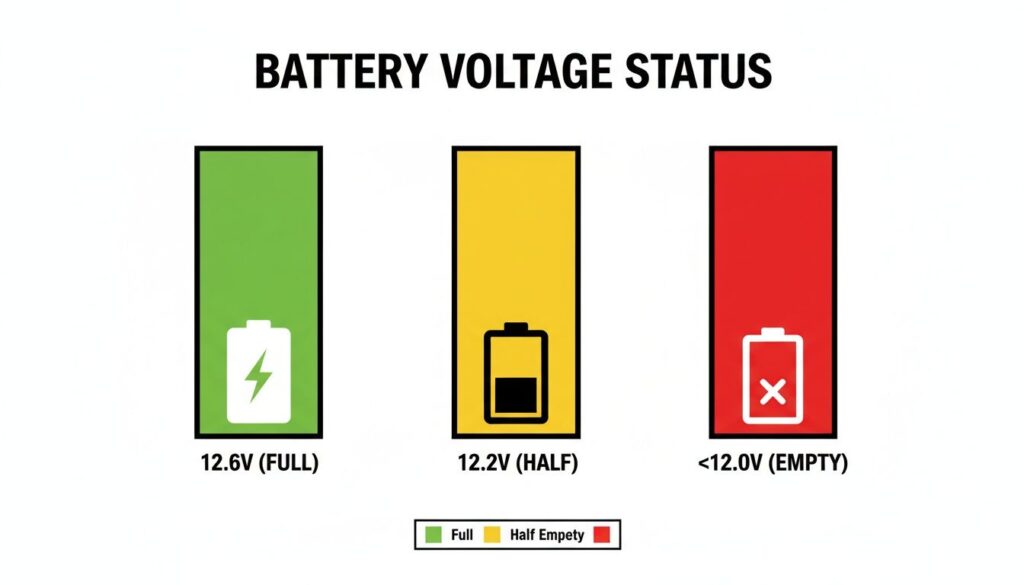
Automotive industry data reveals that nearly 50% of all vehicle breakdowns are attributed to battery failure. This underscores the importance of voltage testing as a quick and effective diagnostic tool. Understanding the relationship between battery voltage and its overall health is fundamental to preventing an unexpected no-start situation.
What Your Battery's Voltage Tells You

The figures displayed on a battery voltage chart provide a direct insight into your vehicle’s electrical system. For most vehicles, a healthy car battery should measure around 12.6V to 12.8V when fully charged and at rest. Voltage represents the “potential difference” or “electrical pressure” available to start the engine and operate accessories. A high reading signifies sufficient pressure, while a low reading indicates a diminished capacity.
To properly interpret these readings, it is helpful to understand that voltage readings help determine the battery’s state, including its charge level and overall health, as well as to differentiate between voltage, current, and capacity.
Breaking Down Key Electrical Concepts
Understanding these distinct but related electrical measurements is key to interpreting your multimeter’s readings. A hydraulic analogy is often used for clarity:
Voltage (Volts): This is analogous to the water pressure in a pipe. Higher pressure enables more work to be done, just as higher voltage provides greater starting power. A healthy 12.6V reading indicates strong electrical potential.
Current (Amps): This is the flow rate, or the amount of water moving through the pipe. Your starter motor requires a large, instantaneous flow of current (amperage) to crank the engine.
Capacity (Amp-Hours): This represents the size of the water reservoir. The battery’s capacity refers to the total amount of energy a battery can store and deliver. It measures how long a battery can sustain a specific current flow before it is depleted. Factors like high temperatures and battery age can reduce the battery’s capacity, causing it to store and deliver less energy over time.
Rechargeable batteries, such as those used in automotive applications, are designed to be recharged and reused, making their capacity and performance critical for reliable operation.
This analogy helps illustrate how even a minor decrease in voltage (“pressure”) can significantly affect the current (“flow”) available to start your vehicle.
The Science Inside Your 12V Battery
Most automotive batteries are lead-acid batteries, widely used for their reliability and ability to deliver high starting currents. A standard “12-volt” automotive battery is not a single entity. It is composed of six individual 2.1-volt cells connected in series. When all cells are fully charged and functioning correctly, their combined voltage totals approximately 12.6 volts.
A voltage reading below 12.4V often suggests that at least one of these cells is underperforming or failing. This directly affects the battery’s health, as a single faulty cell can compromise the entire battery, preventing it from holding a charge or delivering reliable power.
How to Accurately Test Your Battery Voltage
Obtaining a precise voltage reading is essential for accurately assessing your battery’s condition. Measuring the battery’s resting voltage—after the vehicle has been parked for several hours—is crucial for an accurate assessment of its charge level. Using a digital multimeter, you can perform this test yourself and compare the results to a standard car battery voltage chart. However, proper procedure is vital for an accurate diagnosis.
First, prioritize safety. Ensure the engine is off and the key is removed from the ignition. Always wear safety glasses and gloves. Automotive batteries contain sulfuric acid and can emit flammable hydrogen gas, so conduct testing in a well-ventilated area. For an accurate resting voltage reading, allow the car to sit idle for several hours or overnight before testing to eliminate surface charge.
Preparing for the Test
A common mistake is testing the battery immediately after driving. This measures “surface charge,” an artificially inflated voltage that masks the battery’s true state of health. Waiting before testing is crucial because it allows you to measure the battery’s true state and actual state of charge.
To obtain an accurate ‘resting voltage,’ the vehicle must sit for a minimum of four to six hours with the engine off. This allows the temporary surface charge to dissipate, revealing the battery’s actual state of charge and providing a true reading of the battery's condition.
This resting period is non-negotiable for a trustworthy reading.
Step-by-Step Measurement Guide
With safety precautions in place and after the vehicle has rested, you are ready to test. The process is straightforward and takes only a minute.
Set Your Multimeter: Turn the multimeter dial to the DC Voltage setting, denoted by V⎓ or DCV. Select the 20V range, as a car battery’s voltage falls within this scale.
Connect the Probes: Identify the positive (+) and negative (-) battery terminals. The positive terminal is typically red and marked with a “+”, while the negative is black with a “-“.
Touch the Probes to the Terminals: Connect the multimeter’s red probe to the positive (+) terminal and the black probe to the negative (-) terminal. Ensure a firm, clean metal-to-metal connection for an accurate reading.
Read the Voltage: The multimeter display will now show the battery’s resting voltage. A healthy, fully charged battery will read between 12.6V and 12.7V.
If your reading is below 12.4V, the battery requires attention. A reading under 12.2V indicates a significant discharge (50% or less), necessitating immediate charging to prevent permanent sulfation damage.
Decoding Different Types of Voltage Readings

The voltage reading from your multimeter is only part of the diagnostic puzzle. The context in which the reading is taken—whether the battery is resting, actively charging, or under load—is critical for an accurate interpretation. When the alternator is actively charging the battery, the voltage will be higher than at rest, typically ranging from 13.7 to 14.7 volts.
A battery’s voltage fluctuates significantly based on its operational state. Confusing these different readings is a common error that can lead to misdiagnosis. For example, a good voltage for a fully charged car battery at rest is around 12.6 volts, which indicates a healthy battery, but this alone does not guarantee performance under load. This is similar to measuring a person’s heart rate; the resting rate and post-exercise rate provide different types of health information.
Resting Voltage: The True Baseline
As previously discussed, Resting Voltage is measured when the vehicle has been inactive for several hours, ideally overnight. This provides the most accurate assessment of the battery’s true state of charge and is the value you should compare against a standard battery voltage chart.
For a healthy 12V battery, the resting voltage should be 12.6V or higher. This measurement reflects the battery’s fundamental ability to store energy, independent of any temporary charge from the alternator.
Charging Voltage: A Look at Your Alternator
Charging Voltage is measured while the engine is running. This reading primarily indicates the health of the vehicle’s charging system, specifically the alternator, rather than the battery itself.
With the engine running, a multimeter should show a voltage between 13.7 and 14.7 volts. This elevated voltage is necessary for the alternator to overcome the battery’s internal resistance and effectively recharge it.
A lower voltage reading below 13.7V may indicate alternator underperformance, increased electrical load, or other issues that prevent the battery from being adequately charged. Conversely, a reading above 14.9V indicates overcharging, a condition that can damage the battery by boiling its electrolyte. If you suspect a charging system issue, consult our detailed guide on how to tell if your alternator is bad.
Cranking Voltage: The Ultimate Stress Test
Cranking Voltage is the most demanding real-world assessment of a battery’s health. This measurement is taken at the moment the ignition key is turned to start the engine, placing the battery under a significant and sudden load.
During this test, a healthy battery’s voltage will dip, but it should never drop below 9.6 volts. A reading below this threshold is a definitive sign that the battery is failing internally, even if its resting voltage appears normal. Performing a load test simulates the electrical demand of starting the engine and can reveal if a battery will completely fail under stress, even when the resting voltage seems adequate. This test effectively distinguishes a truly healthy battery from one that is nearing the end of its service life.
How Temperature Messes With Your Battery's Performance
A car battery’s voltage is not a static value; it is highly susceptible to ambient temperature. Both extreme heat and cold significantly affect the electrochemical reactions within the battery, thereby altering its voltage output and performance. In cold weather, batteries can become deeply discharged, as low temperatures reduce their ability to deliver current and may cause the voltage to drop significantly.
Understanding how temperature influences your battery is crucial for accurately interpreting voltage readings and avoiding a misdiagnosis. Batteries exposed to extreme temperatures for extended periods may suffer permanent performance loss.
The Impact of Hot Weather
High temperatures act as a catalyst for the battery’s internal chemical reactions, accelerating its degradation. Heat causes faster corrosion of the internal lead plates and increases the rate of electrolyte evaporation.
Furthermore, the rate of self-discharge—the natural loss of charge when a battery is not in use—increases dramatically in hot weather. A battery can lose its charge twice as fast at 95°F (35°C) compared to 77°F (25°C).
Expert Insight: Sustained exposure to high heat is a primary cause of premature battery failure. It permanently reduces the battery's capacity to store and deliver energy.
How Cold Weather Affects Your Battery
Cold temperatures have the opposite effect, slowing down the chemical reactions inside the battery. This retardation reduces its ability to produce the high current required to start a cold engine.
This creates a challenging scenario: cold thickens the engine oil, which increases the power required from the starter motor, precisely when the battery’s available power is significantly reduced. This is a common reason for no-start situations on cold mornings. A battery can lose 30-50% of its starting power at freezing temperatures.
It is important to adjust voltage expectations based on the ambient temperature:
A fully charged battery at 80°F will read 12.6V.
The same battery at 32°F (0°C) might read only 12.4V but still be in good condition.
Factoring temperature into your analysis of a battery voltage chart is essential. Without this context, you might mistakenly replace a healthy battery that is simply affected by the cold.
Troubleshooting Common Issues With Voltage Readings

With a solid understanding of the car battery voltage chart, you can now use your multimeter as a diagnostic tool. The voltage readings are clues that can point directly to the source of an electrical problem.
This section serves as a diagnostic guide. Whether the voltage is too low, too high, or drops excessively under load, each scenario reveals something specific about your car’s electrical health. If your battery fails or you need emergency power, consider portable power stations or backup power systems as reliable alternatives for temporary or off-grid use.
Low Resting Voltage That Won't Stay Charged
A common issue is when a battery is charged overnight, but its resting voltage quickly drops to 12.2V or lower. This is a classic symptom of a battery that can no longer hold a charge, similar to a leaky container.
This condition typically points to one of two problems:
Internal Sulfation: Over time, lead sulfate crystals can form on the battery plates, impeding their ability to accept and hold a charge. This is a common cause of premature battery failure.
A Weak or Dead Cell: As a 12V battery consists of six cells, the failure of a single cell will permanently lower the battery’s maximum voltage, often limiting it to around 10.5V.
In either case, if a battery cannot maintain a charge above 12.4V after being fully recharged, replacement is imminent.
Voltage Plummets During Cranking
This scenario can be deceptive. The resting voltage may appear healthy at 12.6V, but upon turning the key, the voltage plummets below 9.6V. This indicates the battery has a good “surface charge” but lacks the internal capacity to deliver power under load.
This is often caused by a weak or dead cell. A healthy battery should maintain its voltage stability under pressure. A significant drop during cranking is a clear sign of internal failure, and the battery should be considered unreliable.
Abnormal Charging Voltage Readings
If abnormal voltage readings occur only when the engine is running, the problem likely lies with the alternator, not the battery. Lead-acid batteries, which are commonly used in vehicles, are also widely used in uninterruptible power supplies (UPS) for backup power due to their reliability.
Reading Too High (Over 14.9V): This indicates a malfunctioning voltage regulator within the alternator. It is overcharging the battery, which can cause the electrolyte to boil and lead to permanent, irreversible damage.
Reading Too Low (Under 13.7V): This means the alternator is not producing sufficient voltage to power the vehicle’s electronics and recharge the battery simultaneously. The car is effectively running off the battery, which will lead to it being drained. In this situation, our guide on how to safely jump-start a car battery may be helpful.
Signs It Is Time to Replace Your Car Battery
Recognizing the signs of a failing battery can prevent the inconvenience of being stranded. While the average lifespan of a car battery is 3-5 years, its daily performance is a more reliable indicator of its health than age alone.
The most common symptom of a failing battery is a slow or labored engine crank. If the engine turns over sluggishly, it is a sign that the battery is struggling to provide the necessary starting current.
Critical Voltage Thresholds
In addition to auditory cues, a multimeter provides quantitative data to confirm a battery’s condition. Specific voltage readings serve as clear indicators that a battery is nearing the end of its service life.
Key signs to monitor include:
Low Resting Voltage: If a fully charged battery consistently shows a resting voltage below 12.4V, it indicates a diminished capacity to hold a charge.
Poor Cranking Voltage: A healthy battery’s voltage should not fall below 9.6V during engine cranking. A reading below this level signifies that the battery lacks the internal strength to handle the load and is at high risk of failure.
Identifying these voltage drops allows for proactive replacement of the battery, preventing an unexpected breakdown.
If you observe any of these symptoms, it is advisable to have your battery professionally tested. You can learn more about our professional battery replacement service in Plano to ensure your vehicle remains reliable.
Common Questions About Your Car Battery's Voltage
Navigating automotive electrical systems can seem complex, but understanding a few key values on a battery voltage chart can provide quick, clear answers and help prevent more significant issues.
Here are some of the most frequently asked questions regarding car battery voltage.
How do voltage characteristics differ between battery types like 12V car, deep cycle, lithium ion, and lithium iron phosphate?
The voltage you see on a battery voltage chart depends on the battery type. For example, a standard 12V car battery (usually lead-acid) is fully charged at about 12.6–12.8V, while deep cycle batteries—designed for frequent discharges and recharges—are often used in off grid and renewable energy setups due to their long cycle life. Lithium ion batteries, common in portable electronics and electric vehicles, have a nominal voltage of 3.6–3.7V per cell, with lithium ion cells typically ranging from 4.2V (fully charged) to about 3.0V (discharged). Lithium iron phosphate (LiFePO4) batteries, a type of lithium-ion chemistry, offer enhanced safety, stability, and long cycle life, with a nominal voltage of 3.2–3.3V per cell and are popular in solar energy storage and electric vehicles. Each battery type has unique voltage characteristics and performance suited to specific applications.
What Should a 12V Battery Read When Fully Charged?
A healthy, fully charged 12V lead-acid car battery should have a resting voltage between 12.6 and 12.7 volts. This is perfectly normal for a fully charged lead-acid battery. This “resting” measurement must be taken after the engine has been off for several hours. A reading in this range indicates the battery is at or near a 100% State of Charge and has optimal starting power.
Is 12.2 Volts a Good Reading for a Car Battery?
No, a reading of 12.2 volts is a cause for concern. This voltage corresponds to a 50% State of Charge. At this level, a battery will struggle to start an engine, particularly in cold weather. It is imperative to charge the battery immediately to prevent damage from sulfation, a process that can permanently reduce its capacity.
Consistently leaving a battery in a discharged state can cause irreversible damage to its ability to hold a full charge. Regular voltage checks can help you identify and address this issue early.
Can a Bad Alternator Cause a Low Battery Voltage Reading?
Yes, a malfunctioning alternator is a common cause of a low battery voltage. If the alternator is not recharging the battery properly while the engine is running, the battery’s resting voltage will inevitably be low.
A simple diagnostic test is to measure the voltage across the battery terminals while the engine is running. A properly functioning alternator should produce a charging voltage between 13.7 and 14.7 volts. If the reading is below this range, the alternator is likely the source of the problem.
Does My Car Battery Charge While Idling?
Yes, the alternator charges the battery whenever the engine is running, including at idle. However, the charging process is more efficient at higher engine RPMs (i.e., when driving) compared to when the engine is idling.
If you have further questions or suspect an issue with your vehicle’s battery or charging system, do not rely on guesswork. The ASE-certified technicians at Express Lube & Car Care can perform a comprehensive electrical system test and provide an honest, professional recommendation. Visit us today for a reliable check-up and receive $20 off a new battery with our signature service. Learn more at https://www.expresslubeplano.com.