

Yes, you can change your BMW’s oil yourself — but only if you follow the BMW Longlife oil specification (LL-01, LL-04, or LL-17 FE+), use an OEM-quality filter with new seals, apply correct torque values, and perform a proper CBS (Condition Based Service) reset afterward. Skip any one of those four, and you risk engine damage, a voided warranty claim, or a service interval that’s calculating the next change on corrupted data. Here is what you must have in place before you start:
- BMW Longlife-approved oil matching your engine’s required spec (LL-01, LL-04, or LL-17 FE+)
- OEM-quality oil filter, new O-ring or seal, and a fresh crush washer for the drain plug
- Torque wrench to hit the correct values on the drain plug and filter housing cap
- Factory-compatible diagnostic tool or shop access for a proper CBS reset
- Documented service record listing oil spec, filter part number, date, mileage, and VIN
Under the Magnuson-Moss Warranty Act, a dealer cannot void your warranty solely because you performed your own maintenance — but only if you used the correct parts and fluids and kept records. When in doubt, a qualified shop is the safer call.
Table of Contents
- What tools and parts do you need before starting a BMW oil change?
- Step-by-step BMW oil change service steps
- How do you find the right BMW oil spec and capacity for your model?
- What safety precautions protect you and your BMW’s warranty?
- What should you check after an oil change, and how do you reset the CBS?
- How do you dispose of used BMW oil and filters legally?
- How long does a BMW oil change take, and what does it cost?
- Key Takeaways
- Why professional service makes sense for many BMW owners
- BMW oil changes done right, no appointment needed
- Useful sources
- FAQ
What tools and parts do you need before starting a BMW oil change?
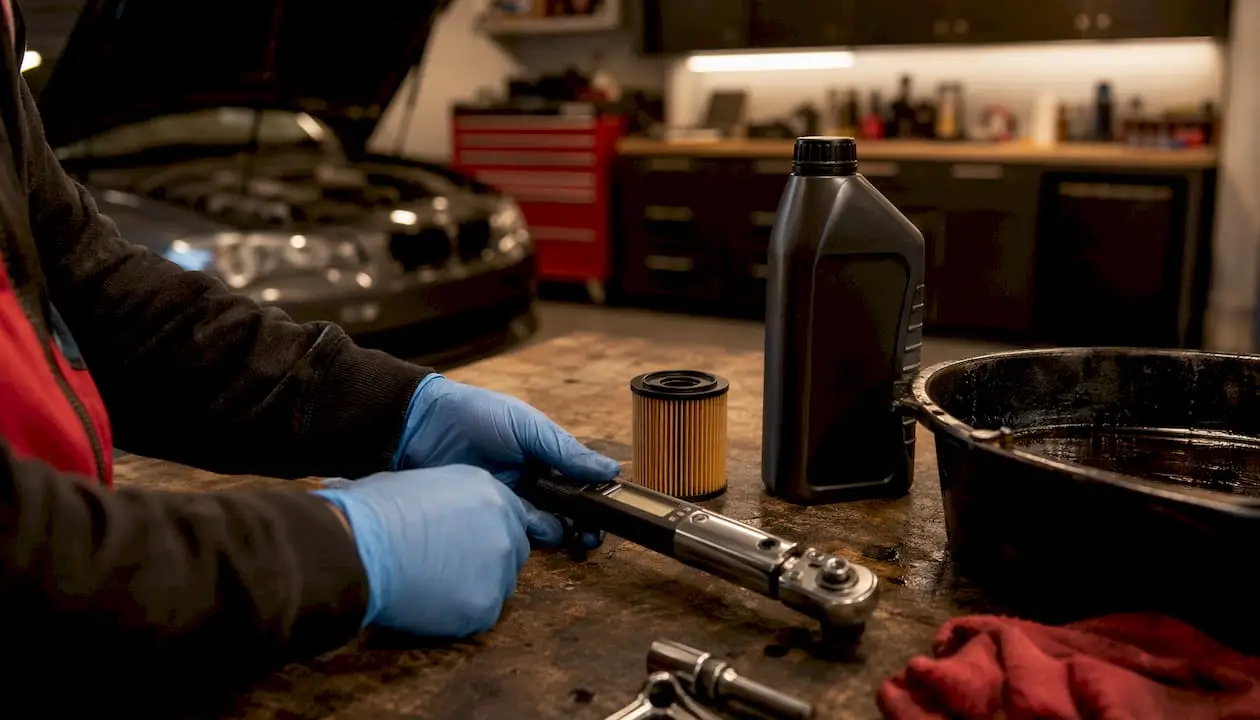
Gathering everything before you lift the car prevents mid-job surprises. Think of it like a commercial kitchen: a chef who starts a dish without all the ingredients on the counter makes costly mistakes. The same principle applies here.
Fluids and filter parts:
- Full-synthetic oil carrying the correct BMW Longlife approval for your engine (check the bottle’s label — the LL number must appear, not just “meets BMW standards”)
- OEM-quality oil filter cartridge (paper element style on most modern BMWs, not a spin-on)
- Replacement O-ring or seal for the filter housing cap
- New aluminum or copper crush washer for the drain plug — reusing the old one risks a slow leak
Tools:
- Torque wrench (capable of 18–25 Nm range for most filter housing caps; drain plug specs vary by model)
- Socket set with the correct filter housing cap socket (typically 36mm on N-series engines)
- Oil filter wrench for stubborn caps
- Drain pan with adequate capacity (7–8 quarts minimum for most 6-cylinder engines)
- Floor jack rated for your vehicle’s weight, plus two quality jack stands
- Funnel, shop rags, and nitrile gloves
- Wheel chocks
Pro Tip: Before buying oil, look up your engine code in the owner’s manual or on the oil filler cap. The LL spec printed there is non-negotiable. Many off-the-shelf synthetics do not carry the additive packages BMW requires, and using noncompliant oil can increase deposits and risk warranty issues even if the bottle says “full synthetic.”
If you don’t have a factory-compatible diagnostic tool for the CBS reset, identify a shop that can perform it before you start. Completing the oil change without resetting CBS leaves the system calculating intervals on stale data.
Step-by-step BMW oil change service steps
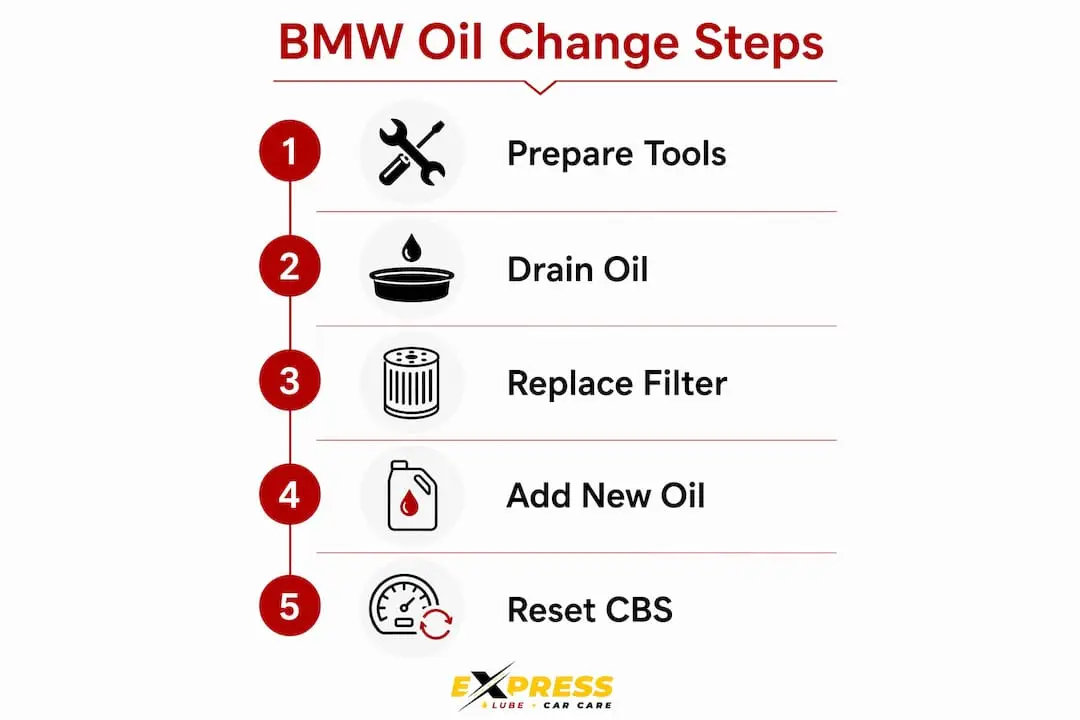
Follow this sequence and you’ll complete a correct BMW oil change. Deviating from the order — especially skipping the warm-up or torque steps — is where most DIY mistakes happen.
- Warm the engine. Run the car for 3–5 minutes. Warm oil drains faster and carries more suspended contaminants. Do not run it to full operating temperature; hot oil causes burns.
- Park on a level surface. Engage the parking brake, chock the rear wheels, and shut off the engine.
- Lift the vehicle safely. Use the factory jack points shown in your owner’s manual. Place rated jack stands under the designated support points before going under the car. Never rely on a floor jack alone.
- Position the drain pan under the oil pan drain plug.
- Remove the drain plug. Use the correct socket size. Let oil drain fully — typically 5–10 minutes. Watch for metal particles in the oil, which can indicate internal wear worth investigating.
- Inspect the drain plug and washer. Replace the crush washer. Inspect plug threads for damage. For metal-to-metal thread assembly, a small amount of assembly paste helps prevent galling.
- Replace the oil filter. Remove the filter housing cap (typically on top of the engine). Pull out the old cartridge, swap in the new one, replace the O-ring with the new seal, and lightly lubricate the O-ring with fresh oil before reinstalling. Torque the cap to spec — typically 18–25 Nm. Overtightening plastic housings cracks them.
- Reinstall the drain plug with the new crush washer. Torque to your model’s specification (commonly 25 Nm, but verify). Confirm no cross-threading by hand-starting the plug before applying the wrench.
- Lower the vehicle and refill with the correct oil volume through the filler cap. Use a funnel. Check your owner’s manual for the exact capacity — it varies by engine.
- Start the engine. Let it run for 2 minutes, then shut it off and wait 5 minutes before checking the level. Look under the car for any leaks at the drain plug and filter housing.
- Reset the CBS service indicator (see Section 6 for the full procedure) and document the service.
Post-step verification checklist:
- No oil visible at drain plug or filter housing
- Oil level reads correctly per BMW’s electronic gauge or dipstick procedure
- CBS reset confirmed and logged
- No smoke from the exhaust or burning smell after the test drive
Pro Tip: For a detailed walkthrough of general oil-and-filter technique, the DIY oil change guide at Express Lube & Car Care covers common mistakes and safety steps worth reviewing before your first attempt.
How do you find the right BMW oil spec and capacity for your model?
Always verify your engine code and owner’s manual first. The oil filler cap on many BMWs also prints the required viscosity. When in doubt, a dealer parts lookup by VIN gives the definitive answer.
How to confirm your spec:
- Check the oil filler cap for viscosity markings (e.g., 5W-30 or 0W-30)
- Open the owner’s manual to the fluids section — the LL approval number is listed there
- Use BMW’s online parts lookup or call a dealer with your VIN
The table below shows typical specs for common engine families. These are examples only — verify by your specific engine code before purchasing oil.
| Engine Family | Common Viscosity | Typical LL Spec | Approx. Capacity |
|---|---|---|---|
| 4-cyl N20 | 5W-30 | LL-01 | 5–6 qt |
| 4-cyl B48 (turbocharged) | 0W-30 or 5W-30 | LL-17 FE+ | 5–6 qt |
| 6-cyl N54 (turbocharged) | 5W-30 | LL-01 | 7–8 qt |
| 6-cyl B58 | 0W-30 | LL-17 FE+ | 7–8 qt |
Why the LL number matters: LL-01, LL-04, and LL-17 FE+ differ in additive chemistry. LL-04 is formulated for low-emission systems; LL-17 FE+ targets fuel economy in newer turbocharged engines. Putting LL-01 oil in an engine that calls for LL-17 FE+ can affect VANOS seals and turbocharger bearings over time.
What safety precautions protect you and your BMW’s warranty?
Proper parts, the correct oil spec, and documented service preserve your warranty. Poor practices risk engine damage and denied warranty claims.
Safety must-dos:
- Always use rated jack stands — never work under a car supported only by a floor jack
- Wear nitrile gloves; used motor oil contains combustion byproducts that are harmful with prolonged skin contact
- Allow the engine to cool partially before draining; hot oil above 150°F causes serious burns
- Store used oil in a sealed, labeled container away from heat sources
- Confirm the filter housing cap is fully seated before refilling
When professional service is the smarter choice:
- You don’t have a factory-compatible tool to reset CBS
- Your BMW has a turbocharged engine and you’re uncertain about the correct LL spec
- You lack a torque wrench or are unsure about filter housing fitment
- You want documented service records for warranty or resale purposes
Independent BMW specialists can perform safe oil changes without voiding your warranty, provided they use BMW-approved oil, OEM-equivalent filters, and record the service properly. The key is asking the right questions before you hand over the keys.
“Vetting a shop means asking specific questions: what exact BMW Longlife spec will you use, which filter brand and part number, and how will you reset the service indicator?” — AAutomotives
ASE-certified technicians bring the technical capability to handle electronic diagnostics and confirm services align with manufacturer engineering — which matters on a BMW more than on most vehicles.
What should you check after an oil change, and how do you reset the CBS?
Post-change checks prevent the kind of problems that send owners back to the shop within days. Verify no leaks, correct oil level at operating temperature, and that CBS has been properly reset.
Step-by-step post-change checks:
- Visual inspection under the car: look for drips at the drain plug and filter housing immediately after startup.
- Let the engine reach operating temperature, then shut it off and wait 5 minutes before checking the oil level.
- Take a 5–10 minute test drive. Listen for any unusual noises and watch for warning lights.
- Re-inspect for leaks after the drive.
Resetting the CBS service indicator:
Modern BMWs use a CBS system that tracks oil life using engine load, temperature cycles, and driving patterns. Simply clearing the dashboard warning is not a proper reset. Older models (pre-2010 on some platforms) allow a manual reset through the iDrive menu or instrument cluster. Most current BMWs require ISTA or equivalent factory-compatible diagnostic software to register the oil type and reset the interval correctly.
Documentation checklist for warranty protection:
- Oil brand and LL approval number (e.g., Castrol Edge 0W-30 LL-17 FE+)
- Filter part number and brand
- Date and mileage at service
- VIN
- Shop name and technician contact (if professionally serviced)
Keeping detailed invoices listing all of the above protects resale value and warranty integrity.
How do you dispose of used BMW oil and filters legally?
Used motor oil and filters must be collected and taken to an approved recycling center or participating auto shop. Pouring used oil down a drain or into the trash is illegal under federal EPA regulations and can contaminate groundwater.
Where to take used oil:
- Auto-parts stores with recycling programs (many accept used oil at no charge)
- Municipal household hazardous waste collection sites
- Licensed waste handlers — call ahead to confirm they accept used motor oil
How to store and transport safely:
- Pour used oil into a sealed, clean container (the original oil bottles work well)
- Label the container clearly as “used motor oil”
- Keep the container upright during transport
- Drain the used filter into the oil pan for at least 12 hours, then seal it in a plastic bag before disposal
Check your state’s environmental agency website or the EPA’s used-oil guidance for location-specific rules.
How long does a BMW oil change take, and what does it cost?
A practiced DIYer typically completes the job in about an hour to two hours. A first-timer should allow additional time for setup, locating the correct jack points, and cleanup.
Approximate DIY cost breakdown:
- BMW-spec synthetic oil (5–7 quarts): $50–$90 depending on brand and LL approval
- OEM-quality filter and O-ring kit: $15–$35
- Crush washer: $2–$5
- Tool amortization (torque wrench, filter socket): one-time cost spread across multiple services
Professional service cost range:
- Independent BMW specialist: $120–$200, typically including OEM-quality parts and CBS reset
- Dealer service: $180–$300+, with OEM parts, multi-point inspection, and documented service history
The price gap between DIY and professional service narrows considerably once you factor in the cost of a factory-compatible diagnostic tool for CBS reset. Some BMW specialists recommend oil changes every 5,000–7,000 miles, especially for turbocharged engines in stop-and-go conditions, rather than the typical CBS interval of 7,500–12,000 miles seen by most owners. That conservative approach costs more annually but reduces deposit formation. Catching a small gasket leak or coolant issue during a routine oil service can avoid large repairs costing thousands of dollars later — which is the real argument for not skipping the inspection component.
Key Takeaways
A correct BMW oil change requires the right LL-spec oil, an OEM-quality filter, proper torque, a verified CBS reset, and a documented service record to protect your warranty and resale value.
| Point | Details |
|---|---|
| Use the correct LL spec | Match LL-01, LL-04, or LL-17 FE+ to your engine code — wrong additive chemistry risks VANOS and turbo damage. |
| Torque every fastener | Drain plug and filter housing cap must be torqued to spec; overtightening plastic housings causes cracks. |
| Reset CBS properly | A dashboard clear is not a CBS reset; most modern BMWs require factory-compatible diagnostic software. |
| Document every service | Record oil brand, LL number, filter part number, date, mileage, and VIN to preserve warranty and resale value. |
| Express Lube & Car Care | Offers BMW-compliant oil changes with ASE-certified technicians, CBS reset, and a 24-month/24,000-mile warranty. |
Why professional service makes sense for many BMW owners
Most BMW owners underestimate how much the CBS reset changes the calculus on DIY oil changes. The fluid swap itself is manageable for a mechanically confident person. The CBS system is where things get complicated. Resetting the service lamp without registering the specific oil type can corrupt the algorithm that schedules the next interval — and that’s a problem that won’t announce itself until the engine has been running on an incorrect schedule for thousands of miles.
Express Lube & Car Care’s position is straightforward: if you have the correct LL-spec oil, a torque wrench, and factory-compatible diagnostic access, a DIY service done by the book is legitimate. But for owners who are uncertain about any of those three, professional service isn’t just more convenient — it’s the choice that protects a precision-engineered investment. A professional service also includes a visual inspection of known BMW failure points: the oil filter housing, valve cover, and oil pan gaskets. Those are the spots where small leaks start quietly and become expensive if missed. ASE-certified technicians bring both the diagnostic tools and the trained eye to catch those issues during a routine service.
BMW oil changes done right, no appointment needed
BMW owners in Plano and Collin County have a faster path to a warranty-safe oil change than scheduling a dealer appointment weeks out. Express Lube & Car Care performs BMW-compliant oil changes using the correct BMW Longlife-spec synthetic oil, OEM-quality filters and seals, and a CBS reset when required — all handled by ASE-certified technicians.

Every service includes a digital multi-point inspection with photos and technician notes, so you leave with documentation that protects both your warranty and resale value. The shop’s 24-month/24,000-mile warranty backs every oil change. No appointment is needed, and current oil change specials are available online. Stop in when it works for your schedule.
Useful sources
- BMW Service Intervals Explained — Patrick BMW Schaumburg
- BMW Oil Change Guide: Tips, Maintenance & Service Secrets — BimmerTech
- BMW MINI Oil Change Myths — The HAUS Auto
- Can I Take My BMW Anywhere for an Oil Change? — Southside Euro
- Common BMW Issues from Improper Oil Changes — Highline Motorsports
- ASE — National Institute for Automotive Excellence
- EPA Used-Oil Recycling Guidance
Always confirm your oil spec by VIN and owner’s manual before purchasing. Keep every service invoice — oil spec, filter part number, date, mileage, and shop contact — as your primary warranty protection document.
FAQ
What BMW Longlife oil spec does my car need?
Check the oil filler cap and owner’s manual for the LL number (LL-01, LL-04, or LL-17 FE+); when in doubt, use your VIN with a dealer parts lookup to confirm the exact approval your engine requires.
How often should a BMW oil change be performed?
CBS-determined intervals typically range from 7,500–12,000 miles in mixed driving, but many BMW specialists recommend 5,000–7,000 miles for turbocharged engines or vehicles driven primarily on short trips. For maximum longevity, consider the conservative end of that range if your driving is mostly short trips or stop-and-go.
Can a DIY oil change void my BMW warranty?
No, under the Magnuson-Moss Warranty Act a dealer cannot void your warranty solely for owner-performed maintenance, provided you used the correct BMW-approved oil and OEM-quality parts and kept a documented service record.
Do I need special software to reset the BMW service light?
Most modern BMWs require factory-compatible diagnostic software such as ISTA to perform a proper CBS reset; simply clearing the dashboard warning does not register the oil type or recalibrate the service interval.
What does Express Lube & Car Care include in a BMW oil change?
Express Lube & Car Care uses BMW Longlife-spec synthetic oil, OEM-quality filters and seals, performs a CBS reset when required, and provides a digital inspection report and a 24-month/24,000-mile warranty — with no appointment needed.