

Tire rotation is a fundamental aspect of vehicle maintenance, yet the specifics of when and why it’s necessary are often misunderstood. Properly rotating your tires is crucial for ensuring safety, optimizing performance, and maximizing the lifespan of your tire investment.
As a general guideline, tires should be rotated every 5,000 to 8,000 miles. This interval serves as a reliable baseline for most vehicles and driving conditions. However, understanding the factors that influence this recommendation will help you establish a maintenance schedule perfectly tailored to your vehicle.
Understanding Tire Rotation Frequency

While the 5,000-to-8,000-mile range is a standard industry recommendation, the optimal frequency depends on several variables, most notably your vehicle’s drivetrain. Whether your car is front-wheel drive (FWD), rear-wheel drive (RWD), or all-wheel drive (AWD) determines how force is distributed and, consequently, how your tires wear.
For example, on a FWD vehicle, the front tires bear the primary load of steering, acceleration, and braking forces. This increased workload causes them to wear at a significantly faster rate than the rear tires. An established rotation schedule is the only way to counteract this imbalance.
A consistent rotation schedule is the key to balanced tread wear. This not only improves safety and handling but also maximizes the return on your tire investment by helping them last as long as possible.
To clarify these guidelines, the following table breaks down common recommendations by drivetrain.
Recommended Tire Rotation Intervals by Drivetrain
This table offers a summary of standard intervals to help you determine the appropriate schedule for your vehicle.
| Vehicle Drivetrain | Recommended Mileage Interval | Rationale for Schedule |
|---|---|---|
| Front-Wheel Drive (FWD) | Every 5,000 – 7,500 miles | Aligns with most oil change intervals |
| Rear-Wheel Drive (RWD) | Every 5,000 – 7,500 miles | Similar wear dynamics to FWD, often paired with oil changes |
| All-Wheel Drive (AWD) | Every 3,000 – 5,000 miles | More frequent rotation is needed to prevent drivetrain damage from uneven wear |
It is crucial to consult your vehicle manufacturer’s owner’s manual for the definitive recommendation. Additionally, tire manufacturers like Michelin also offer great insights on caring for your specific tire model.
The Importance of Regular Tire Rotation
The wear pattern on your vehicle’s tires is analogous to the wear on the soles of shoes—it reflects where the most pressure is applied. In most passenger vehicles, the front axle supports the significant weight of the engine and endures the stress of steering and braking forces, leading to accelerated wear on the front tires.
Neglecting to address this imbalance results in uneven tread depth, which can significantly compromise vehicle handling, braking distance, and overall safety.
The Benefits of Balanced Tire Wear
Systematically rotating your tires allows each one to occupy every position on the vehicle, promoting uniform wear across the entire set. This simple maintenance procedure yields substantial benefits.
A consistent rotation schedule delivers:
- Extended Tire Lifespan: Evenly worn tires can last for thousands of additional miles, providing a direct financial saving.
- Predictable Handling: Uniform tread depth ensures the vehicle grips the road surface consistently, especially during cornering and evasive maneuvers.
- Enhanced Traction: Balanced tires provide a more reliable contact patch with the road, improving grip in adverse weather conditions.
- Optimized Fuel Efficiency: Tires with even wear patterns exhibit lower rolling resistance, reducing the energy required to propel the vehicle.
This routine maintenance is one of the most cost-effective investments you can make in your vehicle’s long-term performance and safety.
A regular tire rotation is one of the most effective ways to lower your per-mile tire cost. By promoting even wear, you delay the need for premature replacements and ensure you get the full value out of your investment.
Furthermore, adhering to a documented rotation schedule is often a requirement for validating your tire manufacturer’s treadwear warranty. Skipping rotations can lead to purchasing two new tires prematurely, which negatively impacts both your vehicle’s handling dynamics and your budget. You can learn more about tire life extension from Consumer Reports.
Understanding Tire Rotation Patterns
Tire rotation is not an arbitrary swapping of wheels; it is a methodical process designed to counteract the specific wear patterns created by a vehicle’s drivetrain. The correct pattern depends on the drivetrain configuration—front-wheel, rear-wheel, all-wheel, or four-wheel drive.
Common Patterns for Different Drivetrains
For most front-wheel drive (FWD) vehicles, the Forward Cross pattern is standard. In this procedure, the front tires move directly to the rear, while the rear tires move to the opposite sides of the front axle. This method specifically addresses the accelerated wear on the front tires caused by steering and drive forces.
Conversely, rear-wheel drive (RWD) and four-wheel drive (4WD) vehicles often utilize the Rearward Cross. Here, the rear tires are moved directly forward, and the front tires are moved to the opposite rear positions. This balances the wear from the drive axle.
All-wheel drive (AWD) systems, which deliver power to all four wheels, typically require the X-Pattern. As the name suggests, each tire is moved to the diagonally opposite corner, ensuring comprehensive wear distribution.
Considerations for Specialized Tires
Certain tire types require specific rotation procedures.
- Directional Tires: These tires feature a tread pattern engineered to rotate in a single direction for optimal performance. Consequently, they can only be moved from the front to the back on the same side of the vehicle.
- Staggered Setups: Some performance vehicles are equipped with different-sized wheels and tires on the front and rear axles. If these tires are non-directional, they can only be swapped from side to side on the same axle.
You can see more visual examples of rotation patterns from Car and Driver to better understand these configurations.
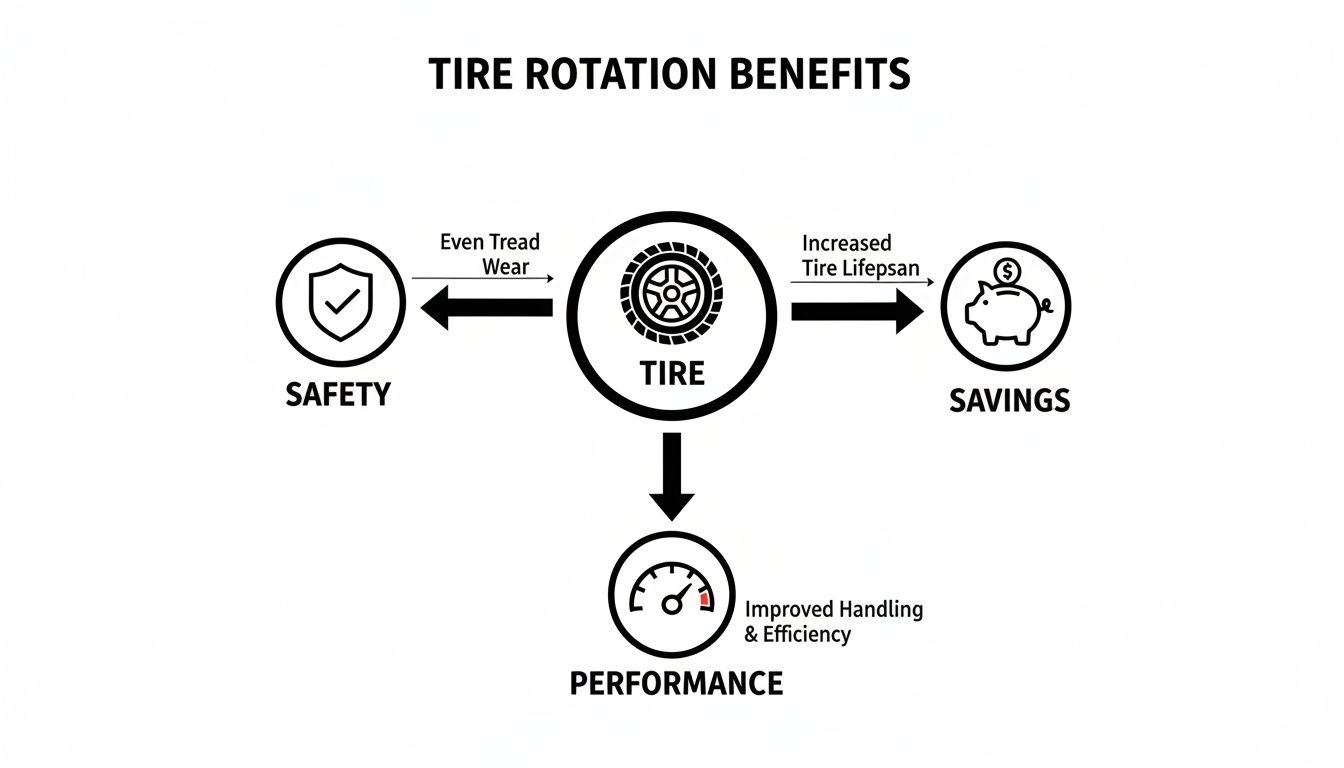
Ultimately, the objective of any rotation pattern is to enhance vehicle safety, improve performance, and extend the functional life of your tires.
Factors That Influence Your Rotation Schedule
The 5,000-to-8,000-mile guideline serves as a starting point, not an inflexible rule. This baseline should be adjusted based on your specific vehicle and driving habits. Several key factors can accelerate tire wear, necessitating more frequent rotations to maintain even tread depth.
As mentioned, the vehicle’s drivetrain is the primary mechanical factor. A front-wheel drive (FWD) vehicle places a disproportionate amount of stress on its front tires, as they manage the forces of steering, braking, and acceleration. This leads to much faster wear compared to the rear tires.
Your Driving Habits and Conditions
Beyond vehicle mechanics, your personal driving style and typical road conditions have a significant impact on tire longevity.
Certain driving behaviors are inherently more demanding on tires. You should consider more frequent rotations if your habits include:
- Aggressive Driving: Rapid acceleration and hard braking significantly increase wear on the tires located on the drive axle.
- Poor Road Conditions: Frequent travel on rough, unpaved, or pothole-ridden roads can cause irregular wear patterns.
- Heavy Loads: Consistently carrying heavy cargo or towing trailers increases the pressure and heat on your tires, particularly the rear set, accelerating wear.
The following table provides a clearer comparison of how driving style affects rotation frequency.
How Driving Style Affects Rotation Frequency
| Driving Factor | Typical Rotation Interval | Reason for Adjustment |
|---|---|---|
| Gentle Highway Commuting | 7,500 – 8,000 miles | Smooth, consistent driving causes minimal stress and even wear. |
| Stop-and-Go City Driving | 5,000 – 6,000 miles | Frequent braking and accelerating wears down drive-axle tires faster. |
| Aggressive Driving | ~5,000 miles | Hard cornering, braking, and acceleration cause rapid, uneven tread wear. |
| Towing/Hauling Heavy Loads | ~5,000 miles | Extra weight increases friction and heat, accelerating wear on all tires. |
A driver who primarily commutes on a smooth highway will experience vastly different tire wear than a delivery driver navigating urban stop-and-go traffic.
The more demand placed on your tires, the more frequently they require service. For heavy-duty use or aggressive driving, reducing your rotation interval from 8,000 miles down to 5,000 miles can significantly extend the life of your tread.
Ultimately, establishing a maintenance schedule that reflects your actual vehicle use is paramount. By considering both your car and your driving habits, you can adapt standard recommendations to maximize the service life and performance of your tires. This proactive approach is a core principle of the comprehensive automotive maintenance services we provide.
DIY vs. Professional Tire Rotation: An Analysis
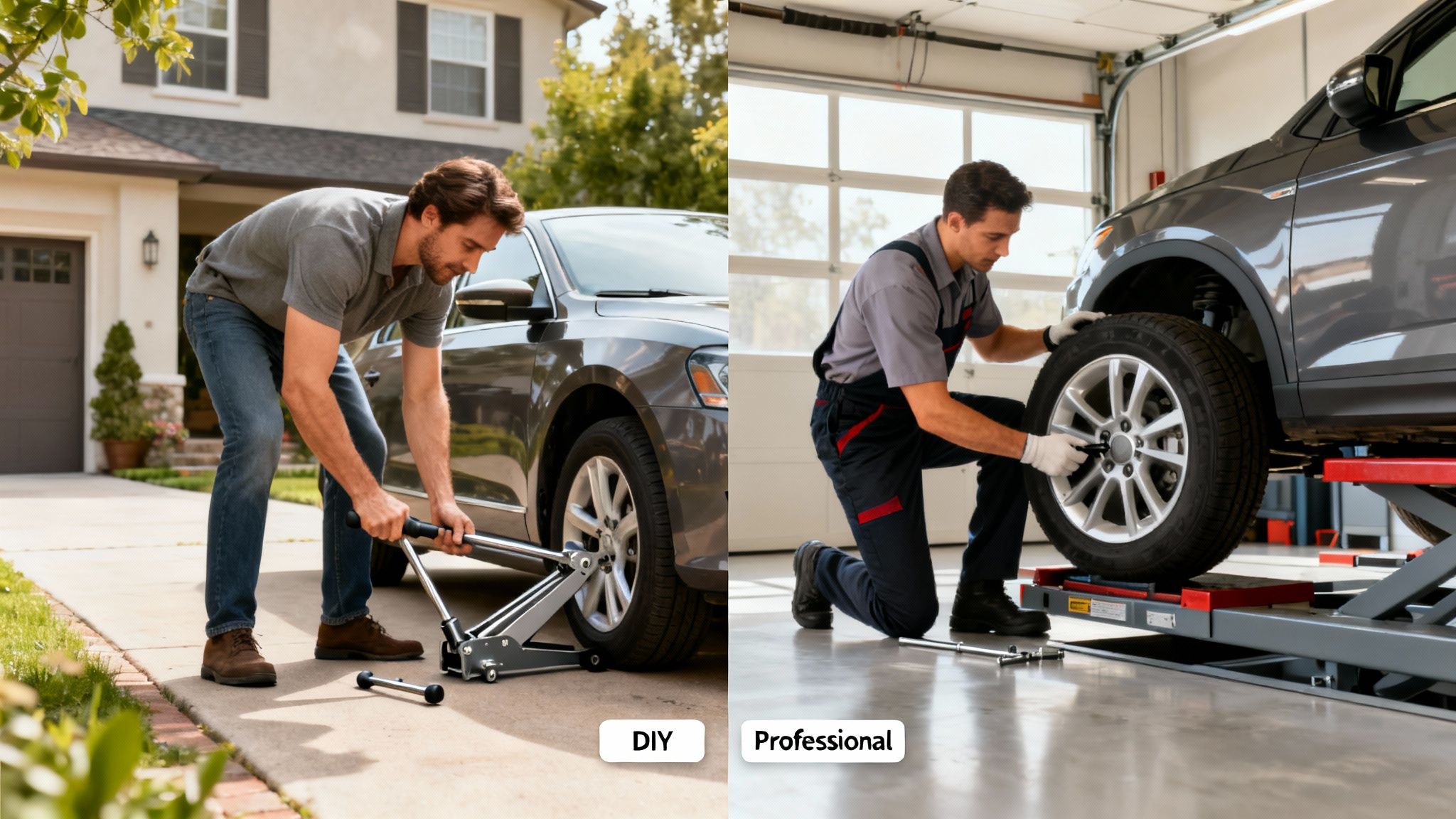
When a tire rotation is due, vehicle owners must decide between performing the task themselves (DIY) or entrusting it to a professional technician. The best choice depends on your equipment, available time, and mechanical proficiency.
A DIY approach can be cost-effective for those who are comfortable with basic vehicle maintenance and possess the necessary tools, including a hydraulic car jack, sturdy jack stands, and a lug wrench.
However, safety and precision are critical. This is where a professional service provides significant advantages beyond mere convenience.
The Professional Advantage
Choosing a professional service ensures the procedure is performed correctly and offers an opportunity for a broader vehicle inspection. Technicians utilize specialized equipment to guarantee safety and accuracy.
Here is what a professional rotation includes:
- Precision Equipment: We use vehicle lifts for safe access and calibrated torque wrenches to tighten lug nuts to the manufacturer’s exact specifications. This prevents over-tightening, which can damage wheel studs.
- Expert Inspections: While the wheels are removed, a trained mechanic can identify other potential issues that may not be readily visible, such as uneven brake pad wear, suspension component issues, or early signs of misalignment.
- Guaranteed Accuracy: You can be confident that the correct rotation pattern was applied and that every component was secured properly before the vehicle is returned to service.
Consider a professional tire rotation not just as maintenance, but as a preventative health check for your vehicle. The expert oversight can detect minor issues before they escalate into major, costly repairs.
While the DIY method is a viable option for experienced owners with proper equipment, a professional rotation provides an essential layer of safety and diagnostic expertise.
Should you discover your tires have reached the end of their service life, you can explore our current specials on a set of tires, which typically include professional mounting and balancing services.
Your Trusted Tire Rotation Experts in Plano
For drivers in the Plano area, maintaining your vehicle’s tires is a straightforward process at Express Lube & Car Care. We provide efficient, professional tire rotation services designed to keep your vehicle operating safely.
Our certified technicians understand the specific requirements of your vehicle. We apply the correct rotation pattern for your drivetrain and use a torque wrench to tighten each lug nut to precise factory specifications, ensuring your wheels are properly secured.
We also take the opportunity to perform a complimentary visual inspection of your brakes and suspension components while the wheels are off. This allows us to identify potential wear and tear before it evolves into a more significant problem.
Do not leave the safety and longevity of your tires to chance. Our team is prepared to provide the expert care your vehicle requires. You are welcome to visit our facility, or you can schedule a quick appointment online to ensure your vehicle remains safe and reliable.
Tire Rotation FAQs
Even with a clear understanding of the process, specific questions often arise. Here are answers to some of the most common inquiries we receive.
Can I Rotate My Tires When I Get an Oil Change?
Yes, and this is highly recommended. Aligning your tire rotation with your oil change is an effective strategy for consistent vehicle maintenance.
The service intervals for both tasks typically overlap in the 5,000 to 7,500-mile range. Combining them into a single service appointment is efficient and helps ensure neither task is forgotten.
Do New Tires Need to Be Rotated?
Absolutely. It is a common misconception that new tires do not require rotation for an extended period.
Initiating a regular rotation schedule from the first service interval is the best way to establish an even wear pattern from the beginning. This practice is essential for maximizing the lifespan and performance of your new tire investment.
What Happens if I Never Rotate My Tires?
The consequences of neglecting tire rotation are significant. The tread will wear unevenly and rapidly. It is common for the front tires on a FWD vehicle to wear out twice as fast as the rear tires.
This not only forces you to purchase new tires prematurely but also creates a serious safety hazard. Uneven tread wear reduces traction, negatively affects vehicle handling, and can increase road noise and vibration.
For professional tire care you can trust, visit Express Lube & Car Care in Plano, TX. Our team will keep your vehicle running smoothly and safely. Learn more about our services at https://www.expresslubeplano.com.