

Shocks and struts are not the same part, even though drivers use the terms interchangeably. A shock absorber only controls motion by damping bounce and vibration, while a strut does that same damping job plus doubles as a structural piece of the suspension, bolting directly to the steering knuckle and supporting the coil spring. Most passenger cars run struts up front and either shocks or struts in the rear, and knowing which one your vehicle has changes how you read symptoms and plan a repair.
TL;DR:
- Shocks only dampen motion and do not support vehicle weight, while struts combine damping with structural functions that influence suspension geometry.
- Replacing shocks is straightforward and generally does not require realignment, unlike struts, which often necessitate a professional auto shop visit for proper alignment after installation.
- Most front suspensions use struts, identifiable by the coil spring wrapping around the damper, while rear shocks sit separately in many vehicles, especially trucks and SUVs.
- Common symptoms such as excessive bouncing, body sway, or tire uneven wear indicate significant wear and should prompt an inspection, particularly if multiple signs appear simultaneously.
- When replacing, always do so in pairs on the same axle and consider full assembly replacements for struts to avoid handling risks and ensure correct suspension geometry.
Table of Contents
- Shock Vs Strut: The Damping Component Explained
- What Makes a Strut Different From a Shock
- Do You Have Shocks or Struts? Here’s How to Check
- Warning Signs You Shouldn’t Ignore
- Replacing Shocks and Struts: What to Know Before You Book
- How Express Lube & Car Care Handles Shock and Strut Service
- Our Take: Stop Treating Symptoms Like a Coin Flip
- Sources
- FAQ
Shock Vs Strut: The Damping Component Explained
A shock absorber is a standalone damping device. It does not bear the vehicle’s weight and does not hold the wheel in position. Its only job is to slow down the spring’s motion after your tires hit a bump, dip, or pothole. Inside the shock, hydraulic fluid gets forced through small valves as the piston moves, and that resistance converts the spring’s kinetic energy into heat, which is why a shock that’s been working hard for a long drive can feel warm to the touch.
Shocks come in a few common configurations, and the differences matter more than most drivers realize:
- Twin-tube shocks use two nested cylinders and are common on factory-equipped vehicles because they run cooler and cost less to produce.
- Monotube shocks use a single larger cylinder, which improves heat dissipation and responsiveness, often at a higher price point.
- Gas-charged shocks add pressurized nitrogen to reduce fluid aeration, which helps prevent the fade you’d otherwise feel on rough roads or long descents.
Because a worn shock only affects damping, a bad one usually shows up as excessive bounce rather than a change in ride height or alignment.
What Makes a Strut Different From a Shock
A strut is a complete structural assembly. It combines a damping unit with a coil spring, a spring seat, and a mounting plate, and in many designs it replaces the upper control arm entirely. Struts are non-structural in appearance only. Once installed, they carry real weight and directly influence how the wheel points.
That structural role changes everything about how the part behaves and how it gets serviced:
- Struts often serve as the mounting point for the steering knuckle, so the strut body is physically tied into your steering geometry.
- They bear side loads during cornering, not just up and down motion, according to Monroe’s technical resources.
- Because struts affect ride height and steering angle, replacing one typically requires a professional alignment afterward.
That last point is the biggest practical difference between the two parts. Swap a shock and you’re done. Swap a strut and you’ve changed the geometry the wheel sits at, which means alignment is not optional if you want even tire wear and predictable handling. UTI’s breakdown of struts versus shocks confirms that struts function as structural chassis components precisely because they take over the job normally handled by an upper control arm and ball joint.
Do You Have Shocks or Struts? Here’s How to Check
You don’t need a lift or a diagnostic scanner to figure out what your vehicle uses. A quick look under the wheel well tells most of the story.
- Check your front suspension first. The majority of unibody passenger cars, sedans, and crossovers run a MacPherson strut design up front, where the coil spring wraps directly around the damper.
- Look for the spring’s position. If the coil spring encircles the cylindrical damper as one unit, you’re looking at a strut. If the spring sits separately, often mounted to a control arm with the damper positioned alongside it, that’s a shock.
- Check the rear separately. Trucks, body-on-frame SUVs, and some sedans use shocks at the rear even when struts handle the front axle, so don’t assume the same part exists at all four corners.
- Confirm with your owner’s manual or a parts lookup using your VIN, since suspension layout varies by trim and drivetrain even within the same model line.
A simple bounce test at each corner (press down firmly on the bumper and watch how many times it rebounds) also gives you a rough sense of how much resistance is left in whichever component you’re dealing with.
Warning Signs You Shouldn’t Ignore
Worn shocks and struts rarely fail all at once. They degrade gradually, and that slow decline is exactly what makes them dangerous, because drivers tend to adjust their driving style without noticing how much stopping distance and steering precision they’ve already lost.
Watch for these signs, which apply whether the worn part is a shock or a strut:
- Excessive bouncing after hitting a bump, especially if the vehicle keeps rocking instead of settling quickly
- Nose dive under braking or noticeable rear squat under acceleration
- Body roll or swaying during turns, particularly at highway speeds
- Visible fluid leaking down the shock or strut body
- Clunking or knocking noises over rough pavement
- Uneven “cupping” wear patterns on your tires
- Vibration through the steering wheel or floor at speed
A vehicle showing three or more of these symptoms at once has almost certainly moved past the point of routine wear and into a safety concern. Braking distance and steering response both degrade as damping fails, according to GEICO’s suspension safety guidance, which is exactly why a single symptom is worth a look and multiple symptoms warrant a same-day inspection. If any of this sounds familiar, our breakdown of common symptoms of bad shocks and struts walks through each one in more detail.
Replacing Shocks and Struts: What to Know Before You Book
Shocks and struts each carry roughly 50,000 to 100,000 miles of useful life, though heavier driving conditions like towing or frequent rough roads shorten that window considerably. Mileage is a guideline, not a deadline. Inspection based on the symptoms above matters more than hitting a specific odometer number.
When it’s time to replace either part, a few rules keep the job done right:
- Replace in axle-by-axle pairs. Monroe’s technical guidance recommends replacing both shocks or both struts on the same axle together, since one worn and one fresh component creates uneven damping that stresses tires and control arms unevenly.
- Choose a complete strut assembly over a cartridge rebuild when possible. Reusing an old spring and mount on a new strut body means compressing a spring under load, which introduces real risk of improper reassembly.
- Budget for an alignment after strut work. Skipping it after a strut swap leaves your new parts fighting a geometry they weren’t set up for.
- Shocks are the simpler job. They bolt in without touching ride height or steering geometry, which is part of why shock replacement tends to be faster and less labor intensive than strut replacement.
Pro Tip: If you’re only replacing one strut because of a leak or a single failed component, still budget for the pair. A fresh strut paired with a worn one on the same axle will handle noticeably differently in a hard turn, and that mismatch shows up exactly when you need predictable handling most.
Drivers comfortable with hand tools sometimes tackle shock replacement themselves, and our guide to replacing shock absorbers covers that process step by step. Strut work is a different story. Between spring compression, alignment requirements, and torque specifications on steering-critical bolts, it’s a job better suited to a shop with the right equipment.
How Express Lube & Car Care Handles Shock and Strut Service
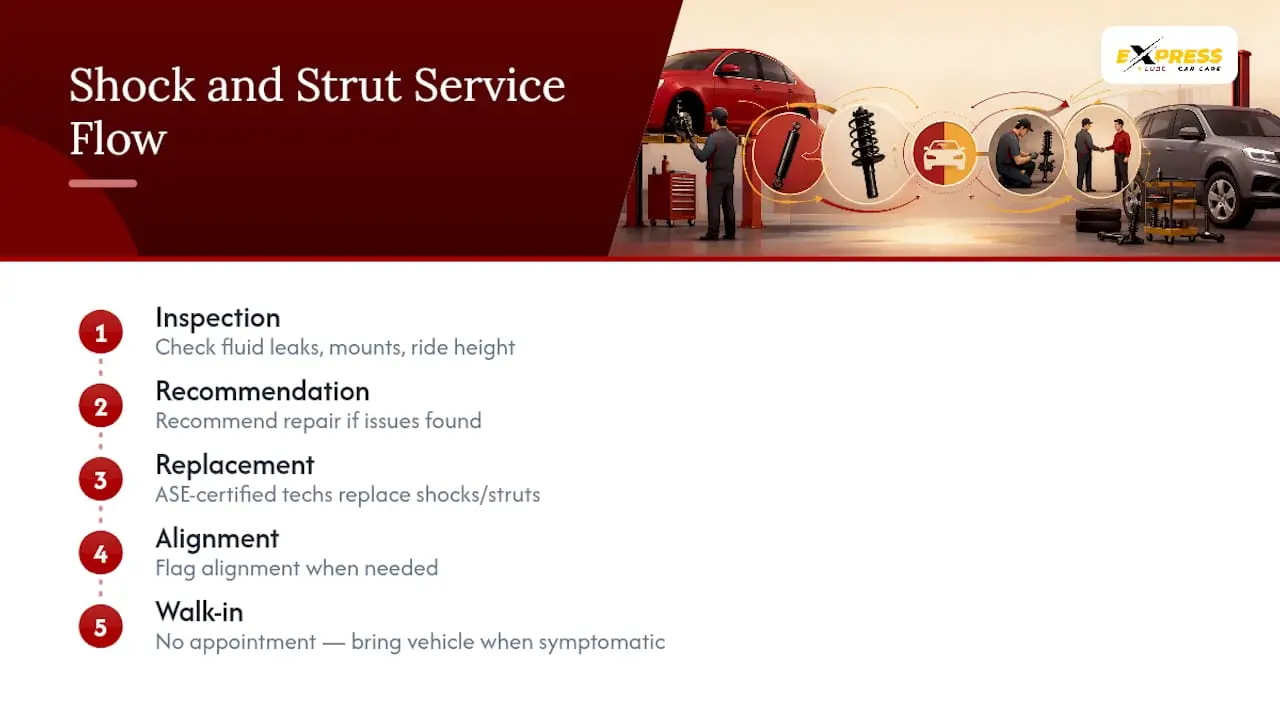
Express Lube & Car Care inspects shocks and struts as part of a broader suspension check, looking at fluid leaks, mounting wear, and ride height indicators before recommending any repair. Our ASE-certified technicians handle both shock replacement and full strut assembly installation, and we flag when an alignment is needed so the new parts wear correctly from day one.
Because we operate on a no-appointment-needed basis, you can bring your vehicle in when a symptom shows up rather than waiting for a scheduled slot. Visit our shocks and struts service page to see what a typical inspection covers before you come in.
Our Take: Stop Treating Symptoms Like a Coin Flip
The conventional advice on this topic usually stops at “replace shocks or struts when they’re worn,” which is true but incomplete. What actually matters is recognizing which part your vehicle has before you diagnose the symptom, because a bouncy ride and a wandering steering feel point to different root causes depending on whether you’re dealing with a shock or a strut.
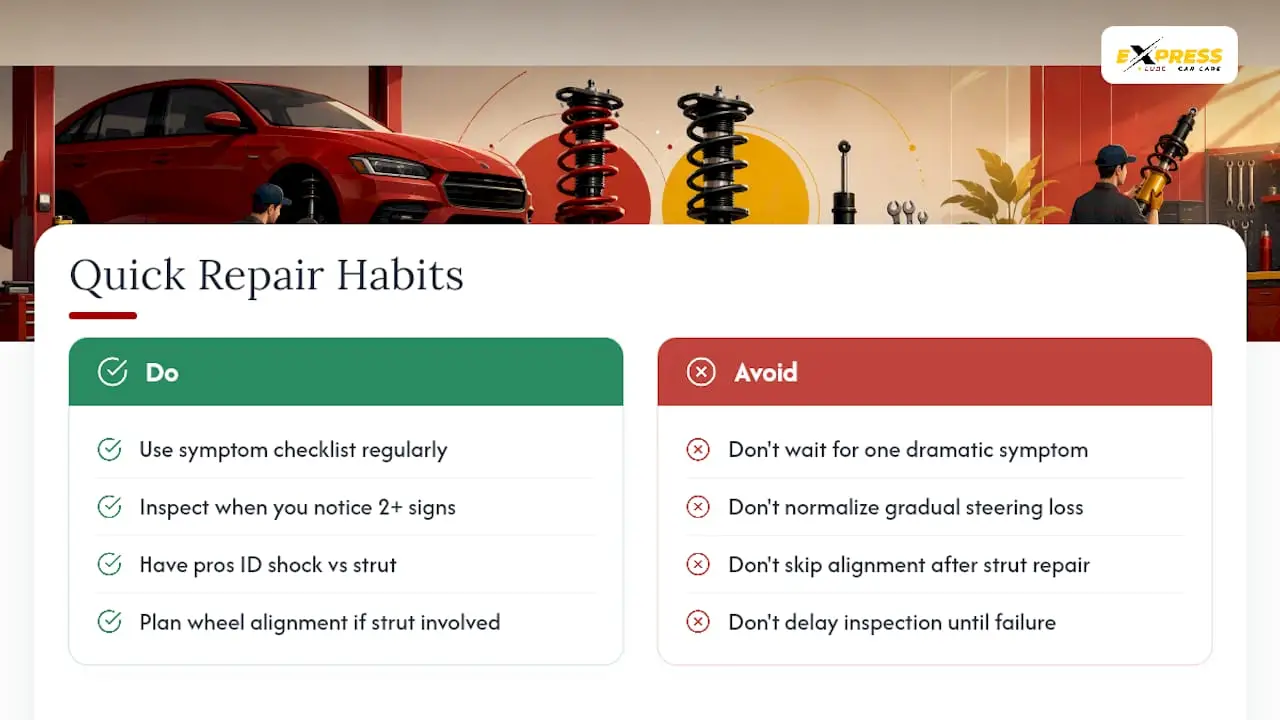
We think the biggest mistake drivers make is waiting for a single dramatic symptom, like a fluid leak, before acting. Wear on these components is progressive by nature, and the gradual loss of steering precision or added stopping distance often gets normalized because it happens slowly enough to adapt to. That’s the real risk, not the eventual full failure.
Our advice: use the symptom checklist as a standing habit, not a one-time diagnostic. If you notice two or more signs, get an inspection before you decide whether you’re looking at a shock, a strut, or both. And if a strut is involved, plan on the alignment. Skipping it undercuts the whole repair.
— Express Lube & Car Care
Sources
- Struts Vs. Shocks | UTI
- Shocks vs. struts: What’s the Difference? | Monroe
- Struts vs. shocks — RealTruck
- 7 signs of worn shocks and struts | GEICO
FAQ
How can I tell if I need shocks or struts?
Check your front suspension first: if the coil spring wraps directly around the damper as one unit, your vehicle uses struts there. Watch for bouncing, nose dive under braking, fluid leaks, or cupped tire wear, and confirm the exact part with your owner’s manual or a VIN-based parts lookup.
Is it better to replace shocks or struts?
Neither is inherently better; they solve different problems, and most vehicles need whichever part their suspension design actually uses. Struts handle both damping and structural support, while shocks only manage damping, so the right choice depends entirely on your vehicle’s layout rather than personal preference.
Can I replace shocks but not struts?
Yes, if your vehicle uses shocks on one axle and struts on another, you can replace them independently based on which one shows wear. Just replace shocks or struts in axle-by-axle pairs rather than swapping a single unit on one side.
Can I drive with bad shocks and struts?
Driving on worn shocks or struts increases braking distance and reduces steering precision, and that risk grows as wear progresses. It’s not a repair to postpone once you notice multiple symptoms like bouncing, swaying in turns, or visible fluid leaks; schedule an appointment for an inspection as soon as those signs appear.