

Understanding the difference between synthetic vs. conventional oil is crucial for proper vehicle maintenance. The choice often comes down to refinement, performance, and engine requirements. Synthetic oil is meticulously engineered in a laboratory for superior engine protection, whereas conventional oil is a refined crude oil product, offering a reliable and cost-effective solution for many vehicles.
Determining the appropriate oil for your car depends on its engine design, age, and the specific driving conditions it endures in a place like Plano.
Choosing the Right Oil for Your Car's Engine
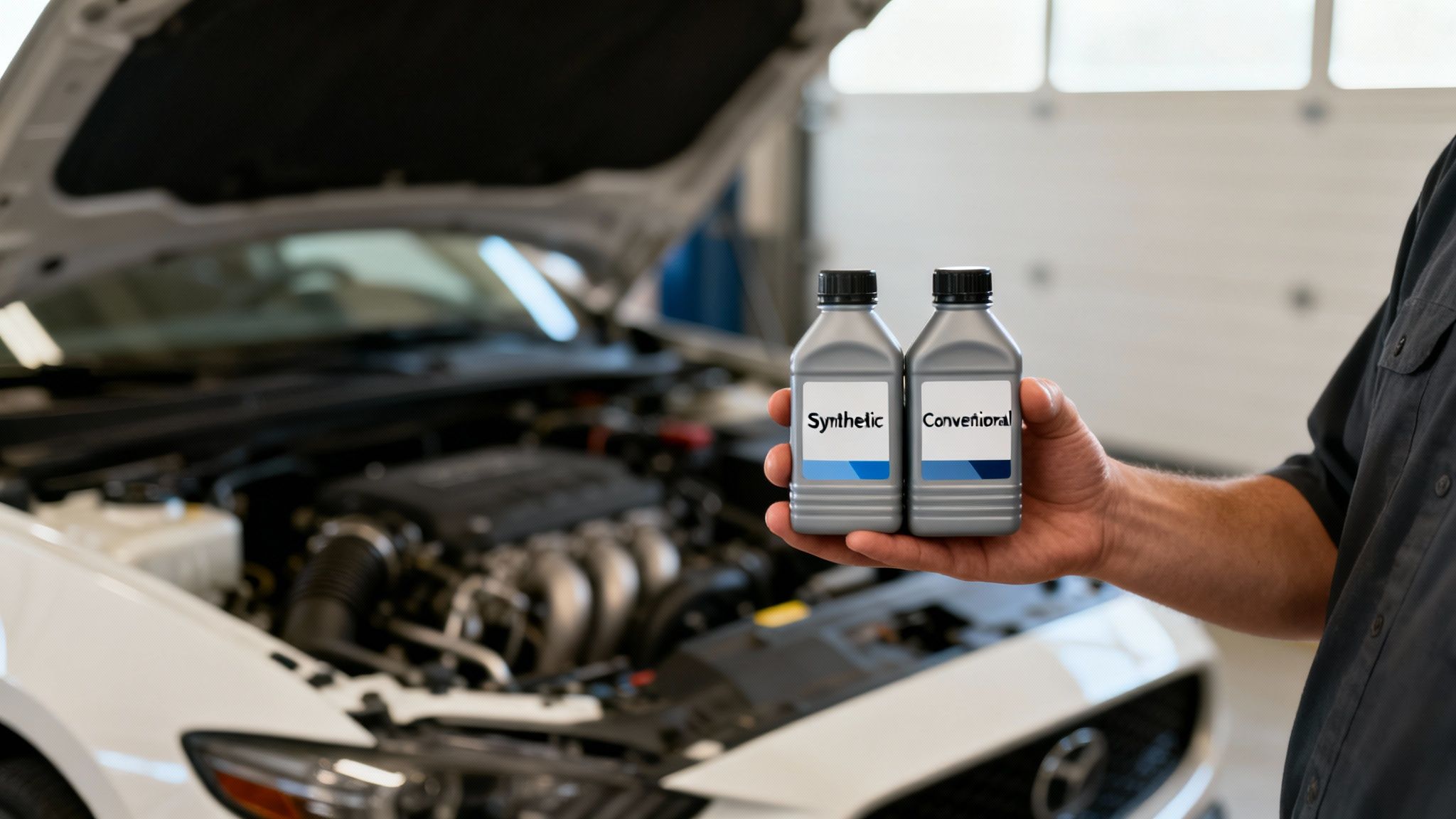
Selecting the correct motor oil is one of the most critical maintenance decisions a car owner can make. As the lifeblood of your engine, it lubricates moving components, reduces friction, helps maintain cleanliness, and prevents overheating. The debate almost always centers on two primary options: synthetic or conventional.
This guide provides a clear, educational comparison to help you make an informed decision. We will analyze how factors such as modern high-performance engines, the intense Texas heat, and your daily driving habits influence oil performance.
Key Factors in Your Decision
First, it is essential to understand the fundamental differences. Here is a high-level comparison of what distinguishes these two oil types.
| Feature | Conventional Oil | Synthetic Oil |
|---|---|---|
| Origin | Refined from crude oil | Chemically engineered in a lab |
| Purity | Contains more natural impurities | Highly uniform and pure molecules |
| Performance | Suitable for older, simpler engines | Superior in extreme temperatures |
| Cost | Lower upfront price | Higher upfront price |
| Change Interval | Typically 3,000-5,000 miles | Often 7,500-15,000 miles |
Our objective is to provide you with the knowledge to select the oil that offers optimal protection, extends your engine's lifespan, and delivers the greatest long-term value. This is a core component of our comprehensive fluid exchange services.
Ultimately, the best choice depends on your specific vehicle and driving style. A new car with a turbocharged engine has vastly different requirements than an older, low-mileage vehicle used for short trips. We will break down these scenarios to help you maintain your car's optimal performance for years to come.
The Core Difference Between Synthetic and Conventional Oil

To fully grasp the synthetic vs conventional oil debate, one must consider their molecular composition. The primary difference is not merely branding; it is rooted in their manufacturing process and its implications for engine performance.
Conventional oil is produced by refining crude oil extracted from the earth. While filtered, its molecular structure remains inconsistent, with molecules of varying shapes and sizes. This irregularity is its main limitation.
Full synthetic oil, in contrast, is engineered in a laboratory. Scientists deconstruct crude oil to its basic molecules and then reassemble them into uniform structures. This process removes nearly all impurities and allows for precise control over the oil's properties.
An Analogy: Rocks vs. Glass Beads
To simplify this concept, consider the following analogy:
-
Conventional Oil is like a tray of rocks: The rocks vary in size and shape. They do not fit together perfectly, creating gaps and increased friction as they move past one another. This illustrates the behavior of irregular molecules in conventional oil within an engine.
-
Synthetic Oil is like a tray of glass beads: Each bead is perfectly uniform and smooth. They roll over each other with minimal friction, forming a strong, consistent protective layer. This represents the function of uniform molecules in synthetic oil.
This molecular uniformity is why synthetic oil provides superior performance in extreme temperatures, reduces friction more effectively, and prevents sludge formation.
Purity and Performance Additives
Because synthetic base oils are exceptionally pure, the additives blended into them—such as detergents, anti-wear agents, and viscosity modifiers—can function more effectively. They are not hindered by the contaminants found in conventional oil.
This means a full synthetic oil not only starts cleaner but also maintains its integrity longer. It forms a stable, protective film over critical engine components and resists breakdown under the intense heat and pressure of a modern engine.
The key takeaway is that synthetic oil is not merely a "better version" of conventional oil; it is an entirely different class of product. It is engineered from the ground up to deliver a level of performance that naturally refined oil cannot achieve.
To provide a snapshot of these fundamental differences, here is a summary comparison:
Core Attributes of Synthetic Vs Conventional Oil
This table offers a high-level summary of the fundamental distinctions between synthetic and conventional motor oils, from their origin to their inherent properties.
| Attribute | Conventional Oil | Synthetic Oil |
|---|---|---|
| Origin | Refined directly from crude petroleum | Chemically engineered and rebuilt from base oil molecules |
| Molecular Structure | Inconsistent and irregular shapes/sizes | Uniform and consistent shapes/sizes |
| Purity | Contains naturally occurring impurities | Highly purified with virtually no impurities |
| Friction Level | Higher internal friction due to molecular irregularity | Lower internal friction due to molecular uniformity |
| Breakdown Resistance | More prone to breaking down under heat and stress | Highly resistant to thermal and oxidative breakdown |
As demonstrated, the differences at the molecular level translate directly into tangible performance advantages.
This transition toward engineered lubricants represents a significant shift in the automotive industry. Market analysis from Coherent Market Insights projects that synthetics will constitute approximately 38.5% of the global engine oil market by 2025. This trend indicates a clear preference among consumers and manufacturers for extended engine life and superior protection. Now that the underlying science is clear, let's examine its real-world impact.
Comparing Engine Protection and Performance
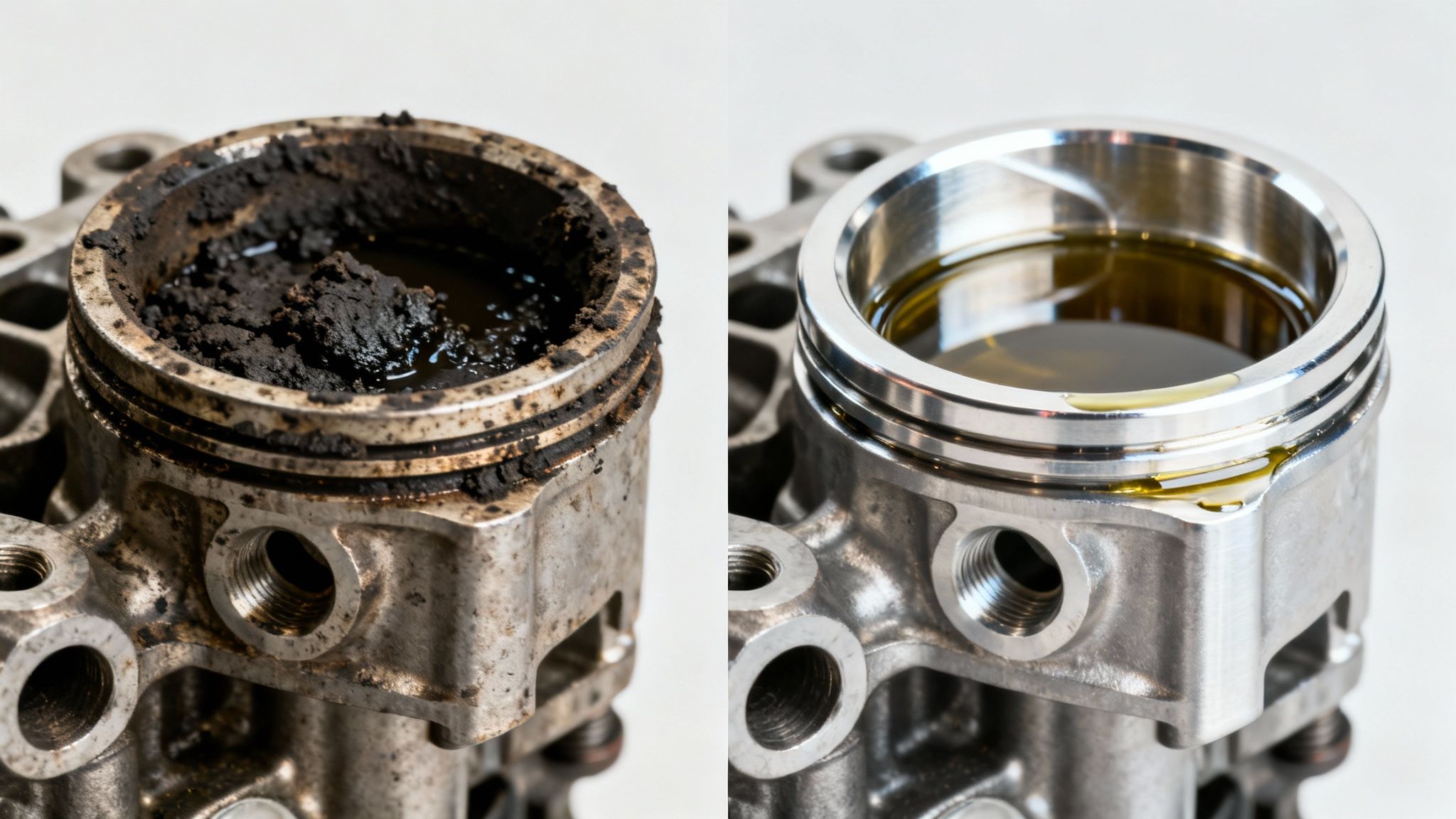
While the science of motor oil is compelling, its practical performance is what truly matters. The synthetic vs conventional oil debate ultimately centers on how well each protects an engine under stress. This is where synthetic oil's engineered precision provides a distinct advantage.
Let's examine the specifics—how each oil manages intense heat, maintains its consistency, and preserves engine cleanliness, particularly in demanding conditions like Plano traffic or towing during a Texas summer.
Thermal Stability Under Pressure
Heat is the primary adversary of motor oil. When oil overheats, it undergoes thermal degradation, a process that creates sludge and carbon deposits like those shown above. These byproducts can obstruct oil passages and deprive the engine of necessary lubrication.
Conventional oil, being refined from crude, contains less stable molecules that are more susceptible to breaking down under the high operating temperatures of modern engines. It oxidizes and degrades at a faster rate.
Conversely, full synthetic oil is engineered for high-temperature stability. Its uniform molecular structure enables it to resist breakdown far more effectively. This means it retains its protective properties even when the engine is operating at peak capacity, preventing harmful sludge formation. For a deeper analysis, refer to our guide on why regular oil changes matter in the Texas heat.
Key Insight: Synthetic oil's resistance to thermal breakdown is a fundamental feature, not a minor benefit. It directly contributes to a cleaner, healthier engine by significantly reducing the risk of sludge accumulation.
Viscosity Retention from Cold Starts to High Revs
An oil’s viscosity—its resistance to flow—is critical. The ideal oil is thin enough to flow immediately during a cold start yet thick enough to protect components at high engine temperatures. Here, synthetic oil demonstrates a clear superiority.
-
Cold-Start Performance: In cold weather, conventional oil can thicken and become sluggish. This brief delay in circulating to vital components is a primary cause of engine wear. Synthetics are designed to remain fluid in cold conditions, providing immediate lubrication upon ignition.
-
High-Temperature Performance: As an engine heats up, conventional oil can thin excessively, weakening the protective film between moving parts. Synthetic oil is formulated to maintain its ideal viscosity even in extreme heat, ensuring a strong, consistent layer of lubrication.
This ability to maintain stable viscosity means synthetic oil offers more dependable protection across a wider range of operating conditions, from a cold morning start to stop-and-go traffic on US-75.
Purity and Advanced Additive Performance
The final consideration is purity. As a derivative of crude oil, conventional oil contains inherent impurities like sulfur and wax, which can contribute to deposit formation over time.
Synthetic oil, being created in a controlled laboratory environment, is exceptionally pure. This clean base allows its advanced additives—detergents, dispersants, and anti-wear agents—to perform their functions more efficiently. The detergents actively clean existing deposits, while dispersants suspend contaminants until they can be trapped by the oil filter.
The result is an engine that not only operates more efficiently but also remains significantly cleaner internally. The enhanced additive package in synthetic oil provides a level of protection that conventional oil cannot match, leading to less wear on critical components like pistons, bearings, and camshafts.
Longevity, Cost, and Long-Term Value
Let's address the financial aspect. It is true that synthetic oil has a higher upfront cost than conventional oil. However, evaluating only the price of a single oil change provides an incomplete picture. When viewed from the perspective of the vehicle's total lifespan, the higher initial cost often proves to be a prudent investment.
The most significant differentiating factor is the oil's service life. Conventional oil typically requires replacement every 3,000 to 5,000 miles, a standard that has been in place for decades.
Synthetic oil, by contrast, is engineered for durability. Its pure, uniform structure resists breakdown, extending the oil change interval to 7,500, 10,000, or even 15,000 miles. This can reduce the frequency of oil change services by half or more.
Fewer Service Visits, Greater Savings
Longer service intervals translate directly into savings of both time and money. While a single synthetic oil change is more expensive, the reduced frequency can quickly offset the cost. This also means less time spent scheduling appointments and waiting for service, a valuable convenience.
Consider this simple comparison:
- Conventional Oil: Approximately four oil changes would be needed over 20,000 miles.
- Synthetic Oil: Only one or two changes might be required to cover the same distance.
This benefit extends beyond savings on oil and labor; it also encompasses the convenience of having your vehicle available more often.
The true value of synthetic oil lies not only in its extended lifespan but also in the superior protection it provides during that time. Enhanced wear protection reduces friction on critical engine components, helping to prevent costly repairs in the future.
Why More Drivers Are Making the Switch
The shift toward longer-lasting oils is a well-established trend. According to market data from Grand View Research, the global synthetic lubricants market was valued at USD 17.5 billion in 2022 and is projected to reach USD 23.4 billion by 2030. This growth demonstrates that both consumers and manufacturers recognize the long-term performance and value benefits.
Ultimately, it is necessary to shift perspective. Rather than viewing synthetic oil as a more expensive product, consider it an investment in your vehicle's health. The higher upfront cost secures longer service intervals, superior engine protection, and greater peace of mind, making it a clear winner for total cost of ownership.
How to Choose the Right Oil for Your Vehicle
Choosing between synthetic vs. conventional oil involves more than just price—it requires matching the appropriate level of protection to your vehicle's engine and your driving patterns. While the owner's manual provides the definitive recommendation, real-world conditions in Plano often warrant further consideration.
Making an informed choice is the best way to protect your automotive investment and maintain peak engine performance for years to come. The decision depends on understanding the demands placed on your vehicle daily.
When Synthetic Oil Is the Clear Winner
For most modern vehicles and demanding driving conditions, full synthetic oil is not a luxury but a necessity. Its engineered molecules deliver far greater protection when the engine is under significant stress.
You should choose synthetic oil if any of the following apply:
- You Have a Modern Turbocharged or High-Performance Engine: These engines operate at higher temperatures and under extreme pressure. Synthetic oil’s thermal stability is essential for preventing sludge and protecting sensitive components like turbochargers.
- You Drive in Extreme Temperatures: The Texas heat is a significant factor. Synthetic oil maintains its viscosity better in high temperatures, ensuring proper lubrication. It also flows more easily on cold mornings, which drastically reduces startup wear.
- You Frequently Tow or Haul Heavy Loads: Towing or carrying heavy cargo places immense strain on an engine, causing temperatures to rise. Synthetic oil’s stability provides a critical layer of defense against this intense friction and heat.
- You're Stuck in a Lot of Stop-and-Go Traffic: Urban driving is surprisingly hard on an engine. The advanced detergents in synthetic oil are more effective at keeping internal components clean under these low-speed, high-stress conditions.
In summary, if your driving involves anything more than light-duty use, synthetic oil is the most prudent choice. It provides modern, hard-working engines with the performance and protection for which they were designed.
When Conventional Oil Makes Sense
Despite the many advantages of synthetics, conventional oil remains a viable option in certain circumstances. For the right vehicle and driver, it is a perfectly adequate and budget-friendly choice.
Conventional oil is often a solid selection in these situations:
- Older, Low-Mileage Cars: For an older vehicle with a simple engine design that is not driven extensively, conventional oil provides sufficient lubrication without the additional expense.
- Simple Commutes Without Extremes: For drivers with a consistent, low-stress commute who adhere to a strict 3,000-5,000 mile oil change schedule, conventional oil can be perfectly effective.
The crucial factor is ensuring your owner's manual does not specifically require synthetic oil. Many older cars were engineered with the properties of conventional oil in mind.
This chart helps visualize how the lower upfront cost of conventional oil compares to the long-term value derived from synthetic oil's longer drain intervals.
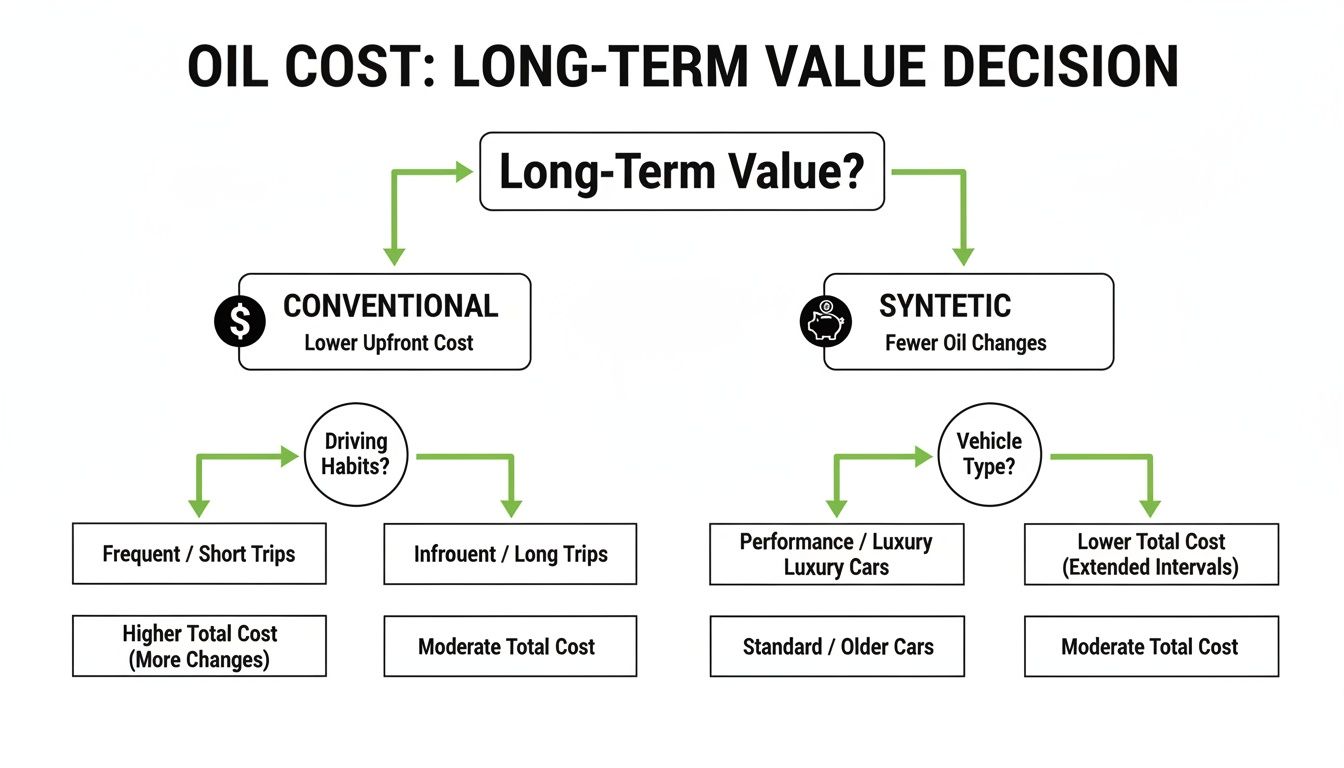
While conventional oil is less expensive per service, synthetic oil often provides better overall value by extending the time between services. Whether your priority is maximum engine protection or budget management, understanding these differences is key. For expert advice and service, review our full menu of oil change services to find the ideal match for your vehicle.
Common Questions About Motor Oil
Even after a detailed comparison of synthetic vs. conventional oil, certain questions often arise. We understand that making the correct choice is vital for your engine's longevity. Let's address some of the most common inquiries we receive from drivers in Plano.
Clarifying these final details will ensure you can make a confident decision at your next oil change.
Can I Switch From Conventional to Synthetic Oil?
Yes, absolutely. Transitioning from conventional to synthetic oil is not only safe but also beneficial for your engine. No special preparation or flushing is necessary; the change is performed during a standard oil change service.
The advanced detergents in full synthetic oil can even begin to clean some of the sludge and deposits left by conventional oil. After switching, however, it is advisable to continue using synthetic oil. Reverting to conventional is generally not recommended, especially if the vehicle manufacturer specifies synthetic.
Is a Synthetic Blend a Good Compromise?
For many drivers, a synthetic blend offers an ideal balance. It combines conventional and synthetic base oils to provide enhanced performance compared to standard conventional oil, but at a lower cost than a full synthetic product.
A synthetic blend can be viewed as an affordable upgrade. It offers greater resistance to heat and thermal breakdown, which is beneficial for daily drivers in stop-and-go traffic, without the premium price of a full synthetic.
It strikes an excellent balance between value and improved engine protection for a wide range of vehicles on the road today.
Will Using Synthetic Oil Void My Car's Warranty?
No, provided you use the correct type of oil. Using a synthetic oil will not void your vehicle's warranty, as long as it meets the specific grade and performance standards required by the manufacturer.
Always consult your owner's manual for the correct viscosity (e.g., 5W-30) and certification (e.g., API SP). In fact, many modern vehicles require synthetic oil to maintain warranty validity because their engines are specifically designed for it. As long as you adhere to the manufacturer's specifications, using a quality synthetic oil is one of the best ways to protect both your engine and your warranty.
Ready to give your car the professional care it needs? The ASE-certified techs at Express Lube & Car Care are here for fast, reliable oil changes and full auto repair services. We’ll give you honest advice and fair prices, every time. Swing by today—no appointment needed—and we’ll help you pick the perfect oil to keep your engine running like new. Visit us online to learn more and check out our current specials.