

Your car’s engine oil capacity is the specific volume of motor oil its engine is designed to hold for optimal performance and protection. It’s not an estimate; it’s a precise specification from the manufacturer. For most sedans, this capacity is typically 4 to 6 quarts, while many trucks and SUVs require 6 to 8 quarts. Adhering to this specification is a fundamental aspect of proper vehicle maintenance.
Understanding the Average Engine Oil Capacity for Cars: The ‘Goldilocks Zone’ of Engine Oil
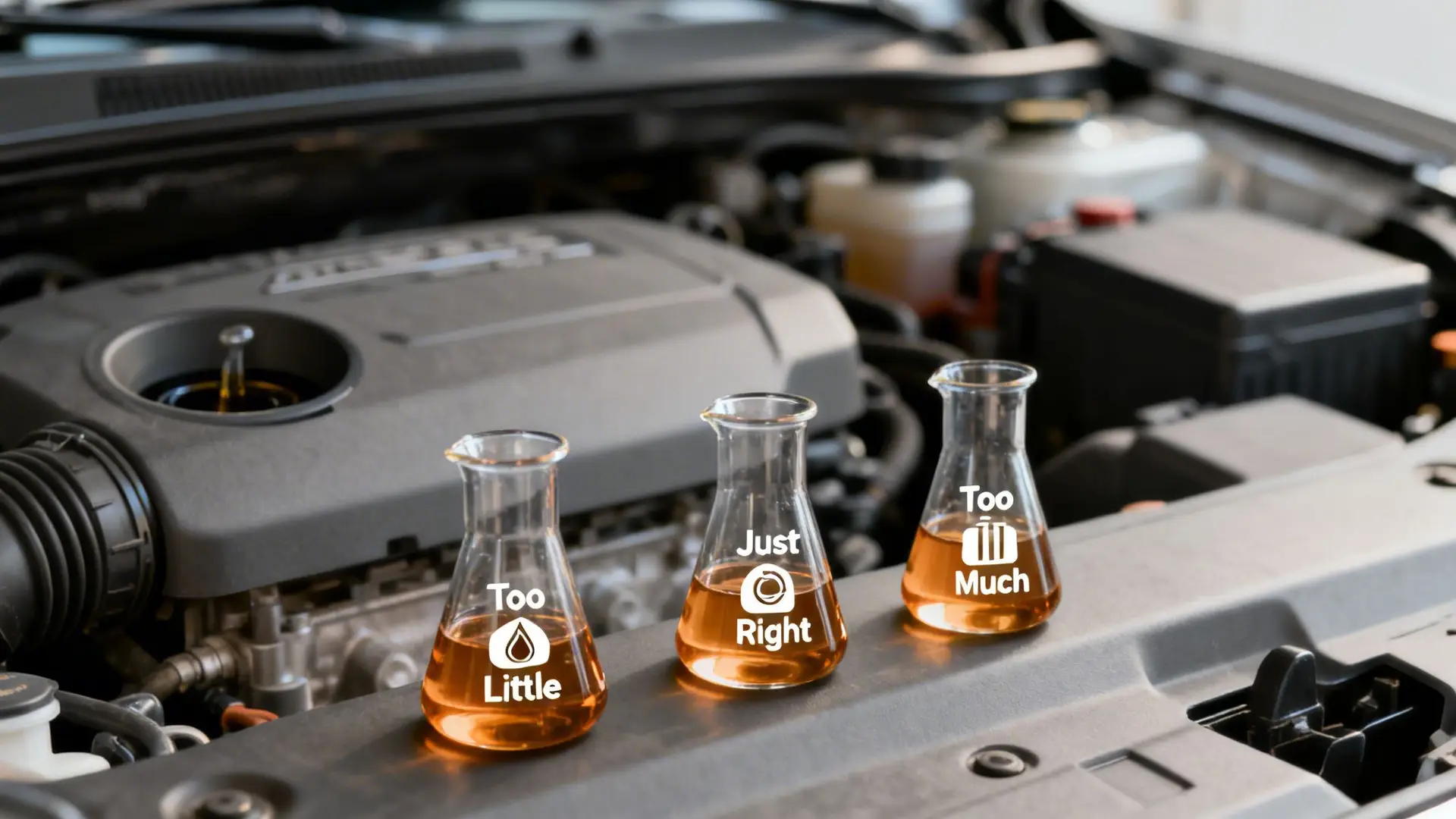
Think of your engine oil as a critical component of the engine system. The specified capacity ensures this component can circulate effectively to every internal part, providing the necessary protection and supporting optimal engine performance.
Engineers refer to this correct level as the “Goldilocks Zone”—not too much, not too little, but just right. Maintaining the correct oil level is essential for keeping your engine running smoothly. An oil level below the recommended minimum starves the engine of lubrication, which can impair engine performance. This leads to increased friction and heat, which can cause accelerated and catastrophic wear on internal components and affect the engine’s ability to stay cool.
Conversely, too much oil is equally detrimental. An overfilled crankcase allows the crankshaft to churn the excess oil into a foam. This aerated, frothy oil has significantly reduced lubricating properties and can lead to serious engine damage.
Why This Specification Matters
Following the manufacturer’s specified engine oil capacity is critical for the engine’s health and longevity. The correct volume of oil enables it to perform its three primary functions effectively:
-
Lubricate: It forms a durable, protective film between moving metal parts, preventing direct contact and minimizing friction and wear.
-
Cool: It absorbs and transfers heat away from high-temperature areas like pistons and bearings, helping to regulate the engine’s operating temperature.
-
Clean: It suspends and transports contaminants like dirt, sludge, and microscopic metal particles to the oil filter, where they are trapped and removed from circulation.
Maintaining the exact capacity creates the ideal operating environment within your engine, promoting maximum performance and durability. While volume is a key factor, the oil’s viscosity (its resistance to flow) is also vital. You can learn more about what oil viscosity means in our related educational guide.
To provide a general frame of reference, we’ve compiled a chart showing average capacities for different vehicle classes. Remember, these are general estimates; always consult the precise requirement for your vehicle.
Typical Engine Oil Capacity by Vehicle Type
This table displays the average engine oil capacity in quarts for common vehicle categories. Always confirm the exact capacity for your specific year, model, and engine configuration.
|
Vehicle Category |
Example Models |
Average Oil Capacity (Quarts) |
|---|---|---|
|
Compact Sedan |
Honda Civic, Toyota Corolla |
4.0 – 5.0 |
|
Mid-Size SUV |
Toyota RAV4, Ford Escape |
4.5 – 6.0 |
|
Full-Size Truck |
Ford F-150, Ram 1500 |
6.0 – 8.0 |
Performance cars often require even more oil—typically 7 to 10 quarts or more—due to their larger and more powerful engines.
Ultimately, whether you operate a compact car or a heavy-duty truck, using the correct oil volume is essential for maintaining the health and performance of your vehicle’s engine.
How to Find Your Car’s Exact Engine Oil Capacity
When maintaining your vehicle, precision is paramount—especially with engine oil. Knowing your car’s oil capacity is essential for proper maintenance and engine performance. Guessing your car’s engine oil capacity can lead to engine damage, but fortunately, manufacturers provide several reliable methods for finding this exact specification.
Avoid estimation and use these authoritative sources to find your vehicle’s precise oil capacity. Most car manufacturers include detailed information about your vehicle’s oil capacity in the owner’s manual.
Consult the Owner’s Manual
Your first and most reliable source of information is the car’s owner’s manual. This document, provided by the manufacturer, contains a comprehensive guide to your vehicle’s specifications and is the most accurate reference for determining your car’s engine oil capacity.
Navigate to the index and look for terms such as “Engine Oil,”****“Capacities,” or “Technical Specifications.” This section will direct you to a table that lists the exact engine oil capacity, typically providing volumes for an oil change with and without a filter replacement. For example, it might state, “Engine oil with filter change: 5.7 quarts.”
Use an Online VIN Lookup Tool
Your vehicle’s Vehicle Identification Number (VIN) is a unique 17-character alphanumeric code that contains detailed information about its factory configuration, including the specific engine installed. The VIN is typically located on a plate on the driver’s side of the dashboard, visible through the windshield, or on a sticker inside the driver’s doorjamb.
Once you have the VIN, you can use a free online VIN decoder. Many automotive parts retailers and service centers offer these tools. Inputting your VIN will retrieve the manufacturer’s official specifications, including the correct engine oil capacity.
Check Your Vehicle Directly
In some cases, the information may be located directly on the vehicle itself. Before consulting other sources, check these two locations under the hood:
-
The Oil Filler Cap: The cap you remove to add oil is often stamped with the recommended oil viscosity (e.g., “SAE 5W-30”) and, occasionally, the engine’s oil capacity.
-
The Oil Dipstick: While less common, some dipsticks may have the capacity printed on the handle.
A note of caution: While these on-vehicle markers are convenient, it is always best practice to cross-reference this information with your owner’s manual. This ensures you have the correct specification for your exact model and engine variant.
Search Trusted Online Databases
If your owner’s manual is unavailable and you cannot perform a VIN check, the internet can be a valuable resource. Online resources, such as digital tools and websites, are especially helpful for finding accurate oil capacity information when the manual is hard to access. To ensure accuracy, be specific in your search query.
Use your vehicle’s year, make, model, and engine size (e.g., “2019 Ford F-150 3.5L engine oil capacity”). This level of detail helps filter out incorrect information and directs you to reliable sources, such as OEM-affiliated sites or reputable automotive forums, ensuring you get the correct data.
The Dangers of an Incorrect Oil Level
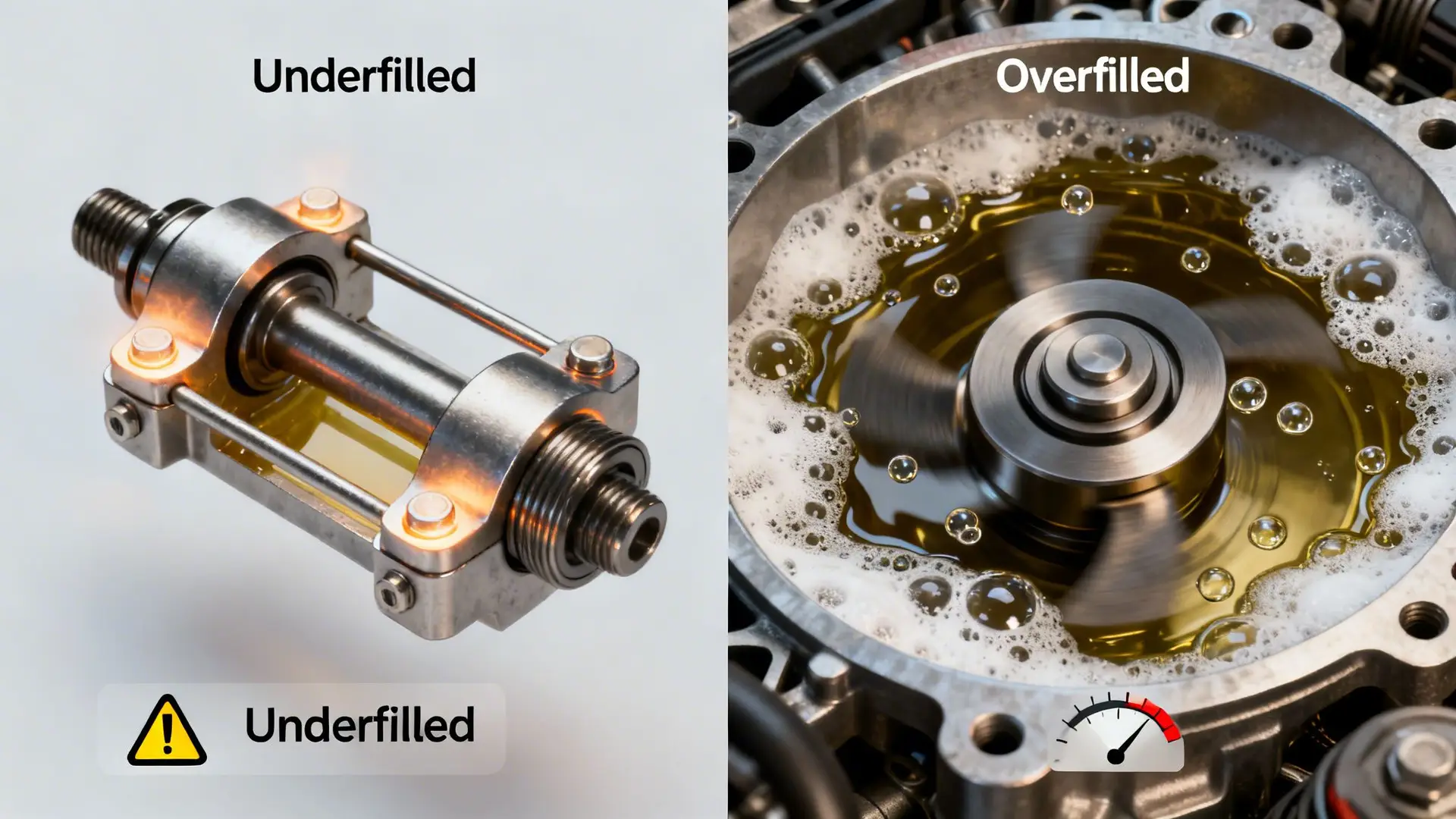
Maintaining the correct engine oil capacity is not a mere technicality—it is a critical measure to protect your engine from significant and costly damage. Incorrect oil levels can cause engine problems, including excessive heat, which may damage engine parts and lead to rapid mechanical failure. An incorrect oil level compromises the oil’s ability to lubricate, cool, and clean, which can lead to rapid mechanical failure.
The Consequences of Too Little Oil
When the engine oil level is too low, the oil pump struggles to circulate an adequate supply. This condition, known as oil starvation, prevents a sufficient lubricating film from forming between critical moving parts like pistons, bearings, and camshafts.
This lack of lubrication initiates a destructive chain reaction. Friction increases dramatically, causing operating temperatures to spike. The potential outcomes are severe and often irreversible.
-
Increased Friction and Wear: Direct metal-on-metal contact causes rapid wear of vital engine components.
-
Engine Overheating: Oil plays a key role in engine cooling. Insufficient oil leads to elevated temperatures that can warp or damage internal parts.
-
Component Seizure: In extreme cases, the heat generated from friction can become so intense that components fuse, causing the engine to seize completely.
According to the American Automobile Association (AAA), improper oil levels are a contributing factor in 15% of all engine failures. Such failures can result in repair costs averaging $4,000—a substantial expense for a preventable issue.
The Problem With Too Much Oil
Adding extra oil as a “safety measure” is a common misconception that can be just as destructive as underfilling. When the oil level is too high, the spinning crankshaft violently whips the oil, churning it into an aerated foam.
This foamy oil, filled with air bubbles, lacks the film strength necessary to protect the engine’s moving parts. This leads to a different set of equally damaging problems, including a dangerous increase in pressure within the crankcase. For an in-depth explanation, see our guide on the causes and symptoms of high oil pressure.
This excessive pressure seeks escape routes, often through the engine’s weakest points. The consequences can be both messy and expensive.
-
Blown Seals and Gaskets: High internal pressure can force oil past seals and gaskets, resulting in significant oil leaks.
-
Poor Lubrication: Aerated oil cannot effectively protect moving parts from friction and heat.
-
Catalytic Converter Damage: Excess oil can enter the combustion chamber, where it may foul spark plugs and, after burning, be forced into the exhaust system, causing fouling and damage to the expensive catalytic converter.
Common Engine Oil Capacities for Popular Vehicles
While the owner’s manual remains the definitive source, understanding typical capacities can be helpful. There is a clear correlation: smaller, more efficient engines require less oil, whereas larger, more powerful engines in trucks and performance vehicles require a greater volume.
An engine’s oil capacity is precisely engineered based on its displacement, engine type, the presence of a turbocharger, and its heat output. Turbocharged engines often require more oil than naturally aspirated engines due to additional cooling needs and the demands of their design. A larger engine has more surface area to lubricate and generates more heat that must be managed by the oil. Some vehicles may also require synthetic oil for optimal protection, especially under demanding driving conditions or in high-performance applications.
Capacities for Sedans and SUVs
Most passenger cars, such as compact and mid-size vehicles, are designed for a balance of power and efficiency. Consequently, their oil capacity requirements fall within a relatively standard range.
-
Compact Sedans (e.g., Honda Civic, Toyota Corolla): These vehicles, typically equipped with four-cylinder engines, usually require between 4.0 and 5.0 quarts of oil.
-
Mid-Size SUVs (e.g., Toyota RAV4, Ford Escape): With slightly larger engines, often including turbocharged or V6 options, these SUVs typically need 4.5 to 6.0 quarts.
Capacities for Trucks and Larger Vehicles
Trucks are engineered for demanding tasks like towing and hauling. Their larger engines, many of which are now turbocharged, operate under higher stress and generate more heat, necessitating a larger oil capacity for adequate cooling and protection.
It is interesting to note the evolution of engine oil capacity. In the 1980s, most cars required only 3.5 to 4.5 quarts. Today, a modern heavy-duty truck like a Ram 2500 can hold up to 10 quarts to protect its sophisticated powertrain. This engineering precision contributes to longer engine life and improved efficiency, a trend that influences long-term oil demand trends on vitoloutlook.com.
To provide a more specific reference, here are the typical capacities for common trucks.
|
Vehicle Type |
Example Models |
Average Oil Capacity (Quarts) |
|---|---|---|
|
Full-Size Trucks |
Ford F-150, Ram 1500 |
6.0 – 8.0 |
|
Heavy-Duty Trucks |
Ford F-250, Ram 2500 |
7.0 – 10.0+ |
Remember, these figures are general guidelines. Always verify the exact capacity for your specific year and engine configuration before performing an oil change.
How to Check and Top Off Your Oil Correctly
The engine oil dipstick is a simple but critical diagnostic tool. Learning to check your own oil is an important and empowering aspect of basic vehicle maintenance that helps protect your engine from damage.
For an accurate reading, ensure your vehicle is parked on level ground and the engine is cool. Checking oil when the engine is hot or the vehicle is on an incline will result in an inaccurate measurement. Make sure all the oil has settled in the oil pan before checking, so you get a true reading of the oil level.
When adding oil, add oil slowly and check the dipstick frequently to avoid overfilling. This ensures optimal lubrication and prevents engine issues. Remember, oil flows through the engine to lubricate moving parts, and a clogged filter can impede this flow, reducing engine performance and protection. Regularly replacing your oil filter is essential to maintain proper oil flow and engine health.
The 5 Steps for an Accurate Oil Check
This procedure takes less than five minutes and requires only a clean, lint-free cloth or paper towel.
-
Open the Hood and Locate the Dipstick. The dipstick is identifiable by its brightly colored handle, usually yellow or orange, designed for visibility. Pull it completely out of its tube.
-
Wipe the Dipstick Clean. Use your cloth to wipe the entire metal end of the dipstick, removing any residual oil that may have splashed onto it during operation.
-
Insert for a Fresh Reading. Reinsert the dipstick fully into its tube until it is completely seated. Immediately pull it back out.
-
Read the Oil Level. The end of the dipstick will have two marks or a cross-hatched area. The top mark indicates “Full,” and the bottom mark indicates “Add.” The ideal oil level is between these two marks.
-
Add Oil if Necessary. If the level is at or below the “Add” mark, you need to add oil. Unscrew the oil filler cap (often marked with an oil can symbol) and add oil in small increments—about half a quart at a time. Wait a minute for the oil to settle into the pan, then check the level again. Repeat this process until the level reaches the “Full” mark.
For a more comprehensive guide, see our detailed instructions on how to check the oil in your car
Treat the process of adding oil like pouring a beverage into a glass. It is far easier to add more than it is to remove an excess amount. Proceed slowly to avoid overfilling.
The chart below illustrates the general oil capacities for different vehicle types.
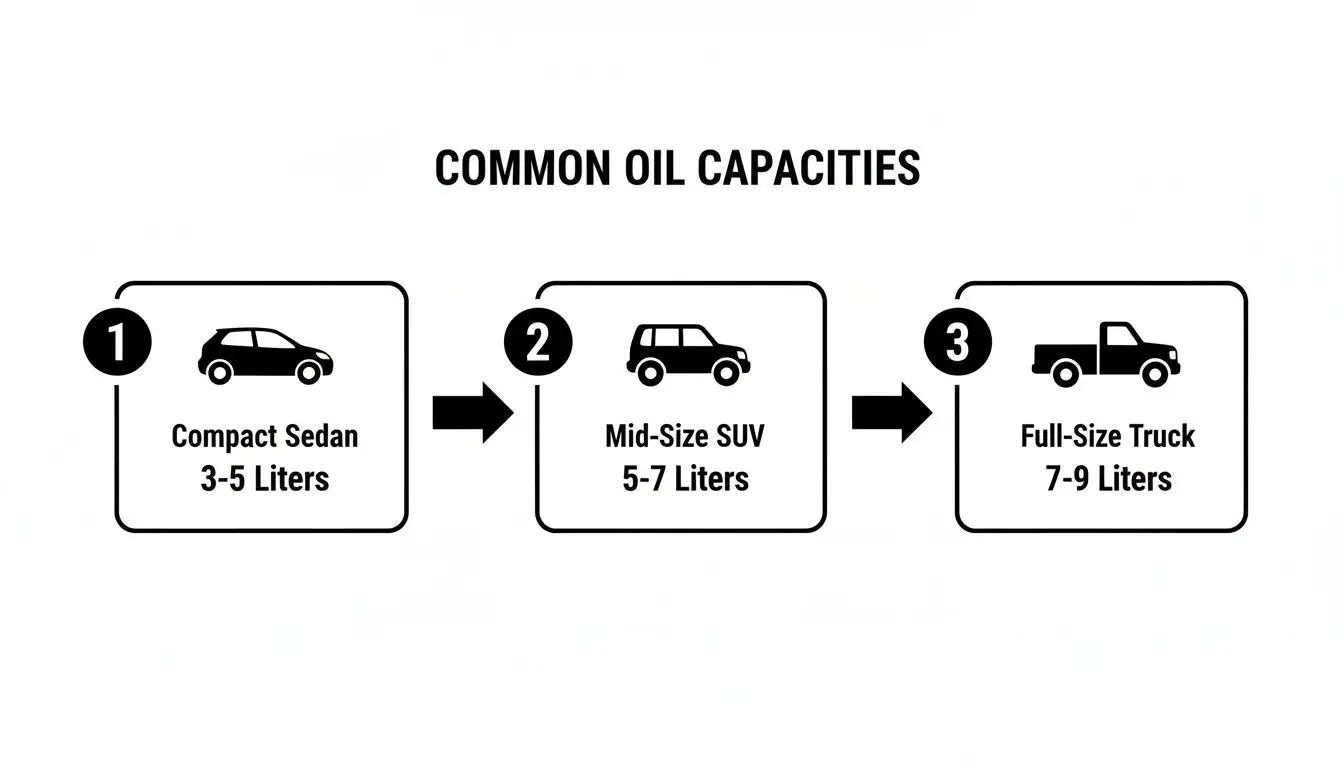
As shown, larger engines in trucks and SUVs require a greater volume of oil to ensure proper lubrication compared to smaller sedan engines. This directly correlates the oil capacity to the engine’s operational demands.
Why a Professional Oil Change Is a Prudent Choice
While checking and topping off your own oil is a valuable skill, a complete oil change is a more complex procedure. For many vehicle owners, entrusting this service to professional technicians is a practical decision that ensures accuracy and helps avoid costly errors related to the vehicle’s engine oil capacity.
The primary benefit is expertise. An ASE-certified technician utilizes professional-grade databases to access the exact oil type and capacity specified by the manufacturer for your vehicle’s year, make, and model. This systematic approach eliminates guesswork and mitigates the risk of overfilling or underfilling. Oil filter replacement is also a standard part of a professional oil change, ensuring proper oil flow and engine protection. Technicians can recommend the best oil for your vehicle, whether it’s regular oil for routine maintenance, synthetic oil for enhanced performance, or high mileage oil designed for older engines to help reduce leaks and wear. When draining old oil, professionals ensure that used oil is disposed of properly and recycled, preventing environmental hazards.
The Importance of Precision
Professional service provides a level of assurance that is difficult to replicate with a DIY approach. It ensures every step—from completely draining the old, contaminated oil to correctly tightening the new filter and refilling to the precise level—is executed according to industry standards.
This level of precision is more critical than ever with today’s sophisticated engine designs. Adhering to the correct oil capacity is a significant factor in determining an engine’s operational lifespan.
Consider this data: A 2024 SAE study indicated that engines maintained with the correct oil capacity and type can have a 40% longer lifespan. Furthermore, J.D. Power reports that 28% of all vehicle breakdowns are linked to lubrication issues—a figure that is substantially lower when services are performed by a certified shop.
More Than Just an Oil Change
A professional oil change offers benefits beyond fresh lubrication. Reputable quick-lube facilities like Express Lube are designed for efficiency and convenience. Our no-appointment service model allows you to receive maintenance whenever your schedule permits, minimizing downtime.
Additionally, professional service centers often provide extra value. Express Lube, for instance, offers special discounts for military members and first responders, making expert car care more accessible. As global oil consumption trends underscore the importance of efficiency, ensuring your engine runs optimally with professional service is an economically sound decision.
Ultimately, a professional oil change is a wise investment in your vehicle’s longevity. It combines expert precision with the speed and reliability modern drivers require, protecting your engine for thousands of miles. It is the most effective way to guarantee the job is done right, every time.
Frequently Asked Questions About Engine Oil
Even with a solid understanding of the fundamentals, you may have further questions about your car’s engine oil. Here are clear, concise answers to some of the most common inquiries we receive from drivers.
Q: How do I check my car’s engine oil level?
A: Park your car on level ground, turn off the engine, and wait a few minutes for the oil to settle. Pull out the dipstick, wipe it clean, reinsert it fully, then pull it out again to check the oil level. Maintaining the correct oil level ensures your engine is properly lubricated, which protects vital engine parts like seals, gaskets, and other components from wear and damage.
Q: Can the average engine oil capacity for cars change over time?
A: Yes, as your engine ages, factors like worn piston rings can cause increased oil consumption. Worn piston rings may allow oil to enter the combustion chamber and burn off, leading to symptoms such as blue exhaust smoke and rough engine performance. Always monitor your oil level and consult a technician if you notice frequent drops.
Q: What happens if I use the wrong type of oil?
A: Using the wrong oil viscosity or formulation can result in poor engine performance, reduced fuel efficiency, and even potential engine damage. Always use the oil type recommended in your owner’s manual to keep your engine running smoothly.
Q: What does the oil warning light or oil light mean, and what should I do if it comes on?
A: The oil warning light (sometimes called the oil light) on your dashboard is a critical indicator. It typically appears as an oil can symbol and may be orange or red, depending on the urgency. If this light comes on, it means your engine may have low oil level or low oil pressure—both of which can quickly lead to severe engine damage. If you see the oil warning light, stop your vehicle as soon as it’s safe, check your oil level, and add oil if needed. If the light remains on, have your vehicle inspected by a professional immediately to prevent damage to engine parts.
How Often Should I Check My Oil Level?
It is good practice to check your engine oil level every other time you refuel, or at minimum, once per month. This quick, two-minute inspection is the most effective way to detect a low oil level before it can cause engine damage. Consider it a routine health checkup for your vehicle that ensures your engine is properly lubricated for reliable operation.
An engine’s oil capacity is a fixed volume, but the oil level can decrease over time due to minor leaks or normal consumption during driving. This is why frequent checks are so important.
Does My Engine’s Oil Capacity Ever Change?
No. The manufacturer’s specified engine oil capacity is a fixed specification for the entire service life of a stock engine. This volume is precisely calculated based on the engine’s displacement, design, and thermal management requirements.
The only scenario in which this capacity would change is if you were to install a significant aftermarket component, such as a larger-volume oil pan. For a standard, unmodified engine, the capacity listed in the owner’s manual is the definitive figure.
What Happens If I Use the Wrong Type of Oil?
Using the correct amount of oil is only one part of the equation. Your engine is also engineered for a specific oil viscosity (e.g., 5W-30) and type (synthetic, conventional, or a blend).
Using the wrong type of oil, even in the correct quantity, can lead to inadequate lubrication, reduced fuel efficiency, and accelerated engine wear. Always adhere to the oil type and viscosity recommended in your owner’s manual.
Can I Mix Different Oils When Topping Off?
It is not advisable to mix different types, brands, or viscosities of oil. In an emergency, adding a small amount of a similar oil is preferable to allowing the engine to run with a critically low oil level. However, this should not be a regular practice.
Different oil formulations contain unique additive packages. Mixing them can dilute these protective additives, reducing their effectiveness. If you do not know what type of oil is currently in your engine, the safest course of action is to have a complete oil and filter change performed.
For a fast, precise oil change that ensures the correct capacity and oil type every time, trust the ASE-certified technicians at . We utilize manufacturer-specific data to perform the service correctly, with no appointment necessary. Visit us in Plano, Texas, and drive with confidence. Learn more about our services.