

If your steering wheel shakes at highway speed, that’s almost always a balance problem. If your car pulls to one side or the tires show uneven shoulder wear, that’s an alignment problem. Many vehicles need both, especially after new tire installation or a hard pothole hit, so the smartest move is to note exactly what you feel and when, then let a shop confirm it with real diagnostic readings.
TL;DR:
- Shaking at highway speed usually indicates a wheel balance problem, especially if the vibration occurs within a specific speed range like 55 to 65 mph.
- Uneven tire shoulder wear and pulling to one side are clear signs of misalignment, often caused by impacts, suspension changes, or regular check intervals.
- Balancing corrects rotational weight issues, performed during tire mounting or rotation, costing $15 to $50 per tire and taking less than 30 minutes each.
- Wheel alignment adjusts camber, toe, and caster angles to factory specs, costing $75 to $150 and typically needed after hitting potholes, installing new tires, or suspension work.
- Proper diagnosis involves road testing, visual inspection, and machine checks, preventing unnecessary service and saving money on tires and repairs.
Table of Contents
- Wheel Alignment vs Balance: A Quick Comparison
- What Tire Balancing Actually Does
- What Wheel Alignment Actually Does
- Symptoms: Balancing, Alignment, or Both?
- When to Schedule Service, What It Costs, and What to Ask
- How Express Lube & Car Care Diagnoses Vibration and Geometry Issues
- Getting This Right Saves You Money on Tires
- Schedule Your Diagnostic, Balancing, or Alignment Visit
- Sources
- FAQ
Wheel Alignment vs Balance: A Quick Comparison
Balancing corrects rotational weight distribution in the tire and wheel assembly. Alignment corrects the angles of your suspension so tires meet the road the way the manufacturer intended. One affects vibration and ride comfort; the other affects tire wear and straight-line tracking. Here’s how they stack up at a glance:
- What it fixes: Balancing corrects uneven weight around the tire/wheel; alignment corrects camber, caster, and toe angles.
- Main symptoms: Balancing addresses vibration that occurs at certain driving speeds; alignment addresses pulling, off-center steering, and uneven shoulder wear.
- When to schedule: Balance with every new tire and at rotation intervals; align with new tires, after suspension repairs, or after curb and pothole impacts.
- Typical cost range: Balancing runs roughly $15 to $50 per tire, while a four-wheel alignment typically costs $75 to $150.
- Typical time to complete: Balancing usually takes under 30 minutes per tire; alignment typically takes 45 minutes to an hour.
What Tire Balancing Actually Does
Balancing corrects uneven weight distribution in the tire and wheel assembly so it spins smoothly instead of hopping or oscillating at speed. A technician mounts the wheel on a balancing machine, spins it, and the machine’s sensors pinpoint exactly where the assembly is heavy. Small clip-on or adhesive weights go on the rim opposite that heavy spot to even things out.
There are two flavors of imbalance worth knowing:
- Static imbalance causes a vertical bouncing sensation, like the tire is hopping slightly as it rotates.
- Dynamic imbalance causes side-to-side wobble, which is what most drivers actually feel as steering wheel shake.
Most shops today use dynamic spin balancers that catch both types in one pass, which is standard for passenger vehicle service. Balancing is typically performed when new tires are mounted, when a driver reports vibration, or as a routine check during rotation.
Pro Tip: Note the speed where the shaking starts and stops. Balance-related vibration usually appears in a specific speed band, like 55 to 65 mph, and fades outside it. That detail helps a technician isolate the problem faster. Our tire mounting and balancing guide walks through the full process in more detail.
What Wheel Alignment Actually Does
Alignment adjusts the angles of your wheels so they meet the road exactly as the manufacturer specified, which protects tires from premature, uneven wear and keeps the car tracking straight. Unlike balancing, which deals with rotating weight, alignment deals with suspension geometry. Three measurements matter most:
- Camber is the inward or outward tilt of the tire when viewed from the front.
- Toe is whether the tires point slightly inward or outward relative to each other.
- Caster is the angle of the steering axis, which affects stability and steering return.
A technician adjusts these angles back to factory specification using an alignment rack, correcting whatever geometry has shifted out of range. Common triggers for alignment service include installing new tires, hitting a pothole or curb, replacing suspension or steering components, or simply reaching the manufacturer’s recommended check interval. Our guide to signs your car needs alignment covers the warning signs in depth.
Symptoms: Balancing, Alignment, or Both?
Matching the right service to the right symptom the first time saves you money and an extra trip. Here’s how to read what your car is telling you:
- Steering wheel shakes at highway speed, especially in a narrow speed range. That’s a front tire balance issue. If the vibration shows up in the seat or floor instead, check the rear tires.
- Car pulls to one side on a flat, level road. That points to alignment, not balance. Test it by briefly letting go of the wheel on an empty stretch of road to confirm the pull.
- Steering wheel sits off center when driving straight. Another clear alignment sign, even if the car doesn’t pull noticeably.
- One shoulder of the tire tread is wearing faster than the rest. Uneven shoulder wear almost always signals alignment, though cupped or scalloped wear can point to either balance issues or worn suspension parts, so both should be checked.
- You recently hit a pothole, curbed a wheel, or had suspension work done. Expect to need both services, since impacts can knock weights loose and shift suspension angles at the same time.
Our breakdown of steering wheel vibration causes can help you narrow down the source before you even schedule an appointment.
When to Schedule Service, What It Costs, and What to Ask
Balancing belongs on your calendar every time you mount new tires and again at rotation intervals if vibration shows up between visits. Alignment checks make sense with new tire installation, after any suspension repair, following a hard impact, and roughly once a year even without symptoms. Many technicians recommend doing both when installing new tires, so new rubber starts out spinning true and pointed correctly.
On cost, expect balancing to run about $15 to $50 per tire and a four-wheel alignment to fall around $75 to $150, though exact pricing varies by shop and region. Time-wise, balancing is the quicker of the two.
Before you approve either service, ask the shop these questions:
- Can I see an alignment printout with before-and-after readings?
- Can I see the balancer readout showing where weights were placed?
- What certifications does the technician performing this work hold?
- Does the service include a road test to confirm the fix worked?
A shop that can’t produce a printout or a machine readout on request, or gives vague answers about what was actually adjusted, is a red flag worth walking away from.
How Express Lube & Car Care Diagnoses Vibration and Geometry Issues
A proper diagnosis starts before a wheel ever touches a machine. Our process typically includes:
- A road test to reproduce and confirm the reported symptom.
- A visual inspection of tire wear patterns, suspension components, and wheel condition.
- Digital photos and technician notes documenting what’s found.
- Balancer and alignment machine checks to pinpoint the exact issue.
Customers working with Express Lube & Car Care can expect ASE-certified technicians, no-appointment-required service, and digital inspection notes that back up every recommendation with evidence rather than guesswork.
Getting This Right Saves You Money on Tires
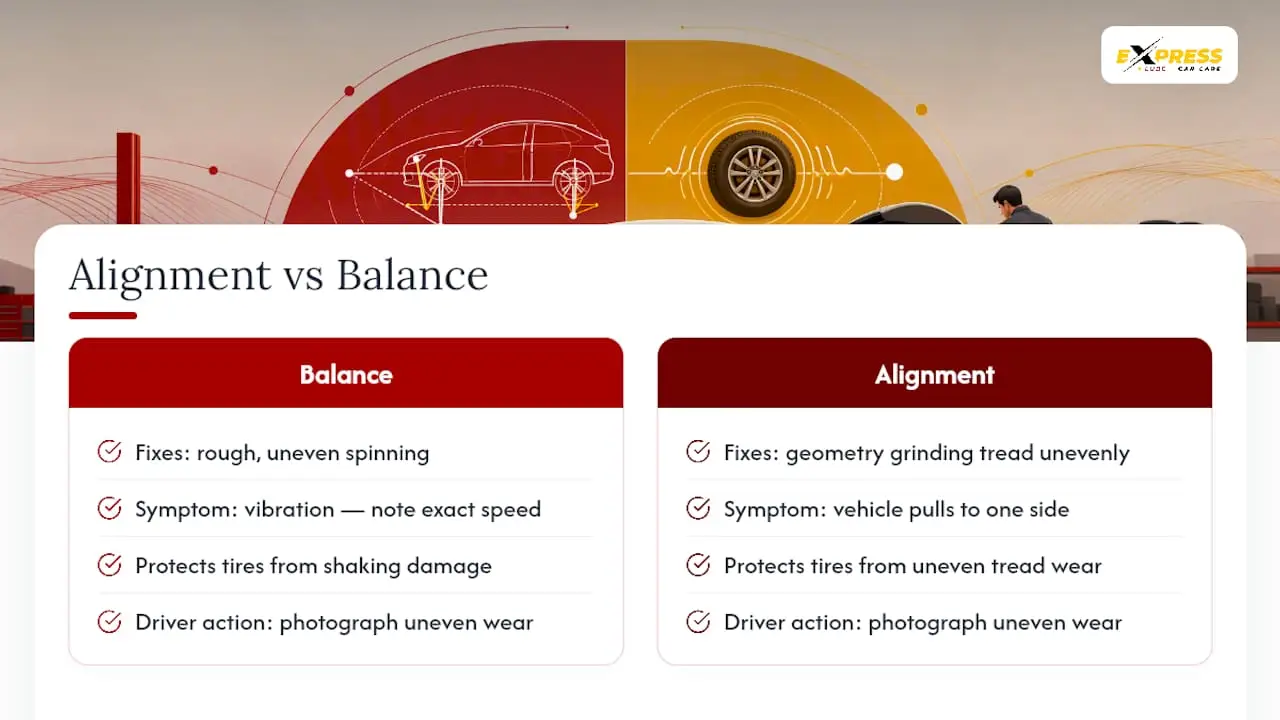
Misdiagnosing a vibration as an alignment problem, or a pull as a balance problem, wastes money and delays the actual fix. The two services protect your tires in different ways, one against rough, uneven spinning and the other against geometry that grinds down tread unevenly, and they often need to happen together rather than as a choice between one or the other. Photograph any uneven wear you notice, and write down the exact speed where vibration starts. That single habit turns a vague complaint into a diagnosis a technician can act on immediately.
Schedule Your Diagnostic, Balancing, or Alignment Visit
Express Lube & Car Care gives Plano drivers a faster path to answers than guessing at symptoms yourself or waiting days for a scheduled slot elsewhere. Walk in with no appointment needed, and our ASE-certified technicians will road test the vehicle, inspect tire wear, and run the balancer or alignment machine to show you exactly what’s happening, backed by a 24 month/24,000 mile warranty on the work performed.

Whether you’re dealing with a shaky steering wheel, a car that pulls to one side, or you just installed new tires and want both checked, our team documents findings with digital photos and technician notes so you see the evidence, not just a bill. Between routine maintenance visits, keeping brake dust and grime off your wheels also helps you spot uneven wear sooner; a quick wheel cleaning routine makes tread issues easier to catch early. If suspension or steering components turn out to be the culprit, our engine and related repair services can handle it in the same visit. Check our current oil change and service specials or head straight to the appointment page to get your tires checked today.
Sources
For readers who want to dig deeper into the mechanics behind these two services, these sources informed the definitions and cost ranges used above:
- Wheel alignment and wheel balancing — Michelinman
- Tire Balancing vs Alignment: Which Service Do You Actually Need? – Tire Advise
- Wheel Alignment vs. Balancing: Key Differences — UTI Blog
FAQ
How Do I Know if I Need Balancing or Alignment?
Speed-sensitive vibration in the steering wheel or seat points to balancing, while pulling, an off-center steering wheel, or uneven shoulder tire wear points to alignment.
What Should I Get Done First, Alignment or Balancing?
There’s no fixed order. Get whichever service matches your symptom, but if you’re installing new tires or recovering from a hard impact, plan on both at the same visit.
How Much Does a Full Alignment Cost?
A four-wheel alignment typically costs between $75 and $150, though exact pricing depends on the shop and your vehicle.
How Often Do Tires Need Balancing?
Tires should be balanced when they’re first mounted and rechecked at rotation intervals, or sooner if you notice new vibration at speed.
Can a Car Be Aligned and Still Vibrate?
Yes. Alignment and balancing fix different problems, so a perfectly aligned car can still shake if a wheel is out of balance.