

A humming, growling, or roaring sound that gets louder as you accelerate is almost always a wheel bearing wearing out, not tire noise or a drivetrain problem. If the sound is a steady hum, you can typically drive carefully to a shop within a few days. If you feel grinding, a clunk over bumps, or looseness in the steering, treat it as urgent and get the vehicle inspected before your next long drive.
TL;DR:
- Wheel bearing noise increases with speed and changes pitch during turns, unlike tire or transmission issues, which stay constant or react differently.
- A lane-sway test at high speeds can identify the failing side by noting which load increases the noise, but must be performed safely on an empty road.
- Confirming a worn bearing involves physical checks such as a spin test, wiggle test, and heat inspection, usually done at a repair shop with proper tools.
- Excessive driving on a bad bearing risks severe damage, especially if noise is loud, there is wheel looseness, or warning lights appear, requiring immediate inspection.
Table of Contents
- What Does Wheel Bearing Noise Sound Like?
- How Do You Tell Which Wheel Bearing Is Bad?
- How Do Technicians Confirm a Bad Wheel Bearing?
- What Causes a Wheel Bearing to Fail?
- When Is It Safe to Keep Driving?
- What Does Wheel Bearing Replacement Cost?
- Our Diagnostic Approach at Express Lube & Car Care
- Get Your Wheel Bearing Noise Diagnosed Today
- Sources
- FAQ
What Does Wheel Bearing Noise Sound Like?
A failing wheel bearing produces a distinct signature, and once you’ve heard it, you won’t mistake it for much else. It starts as a low hum or a soft rumble around highway speeds and builds into a growling or roaring sound as wear progresses, growing louder the faster you go. That speed relationship is the key diagnostic clue.
Pro Tip: Coast in neutral on a safe, empty stretch of road. If the noise stays present without the engine driving the wheels, it’s tied to vehicle speed, not engine RPM, which points straight at a bearing rather than the transmission or engine.
Turning often changes the pitch or volume, too. Weight shifts onto one side of the vehicle during a turn, loading the bearing on that side and making a marginal bearing sound louder or rougher for a second or two.
Bearing noise gets confused with a handful of other sounds constantly, so it helps to know the differences before you assume the worst (or the wrong thing):
- Tire noise: usually a consistent hum that doesn’t change with steering input and often fades with a tire rotation or air pressure check.
- CV joint problems: produce a clicking or popping sound specifically during turns, especially at low speed in a parking lot, rather than a continuous hum at highway speed.
- Transmission whine: tracks with engine RPM, not vehicle speed. It changes when you shift gears, whereas bearing noise does not.
- Wheel bearing growl: rises steadily with speed and often shifts in volume when you turn left versus right.
If you’re still unsure after listening for these patterns, a quick driving test can narrow things down before you even open the hood.
How Do You Tell Which Wheel Bearing Is Bad?
Once you suspect a bearing, the next question is which corner. A simple driving test called the lane-sway or lateral-load test can pinpoint the failing side in seconds, and it costs you nothing but a quiet stretch of road.
- Find an empty, legal road where you can drive at the speed where the noise is loudest, usually somewhere between 40 and 60 mph.
- Check your mirrors and gently sway the car within your lane, first easing weight onto the left side, then the right, without crossing lane lines.
- Listen closely as weight shifts. If the noise gets louder when you load a particular side, that side’s bearing is carrying more stress and is likely the culprit.
- If the noise gets quieter when you load one side, the problem is probably on the opposite side, since easing weight off a bad bearing reduces the load it’s straining against.
- Repeat once or twice to confirm the pattern before drawing a conclusion.
This works because a worn bearing has internal play, and shifting the car’s weight changes how much force presses through that damaged component. Loading it makes existing roughness more pronounced; unloading it gives temporary relief. It’s the same principle a technician uses on a lift, just with the road doing the load-bearing work instead of a jack.
Pro Tip: Rear bearing noise can trick your ears. It sometimes sounds like it’s coming from the center of the cabin, leading drivers to blame the front wheels when the rear corner is the actual source. Don’t rule out the back until you’ve tested both ends.
Keep speeds reasonable and never perform this test in traffic or on a wet, icy, or unfamiliar road. The goal is a controlled, gentle sway, not an aggressive swerve.
How Do Technicians Confirm a Bad Wheel Bearing?
The lane-sway test narrows things down, but confirming the diagnosis takes hands-on inspection. Technicians combine a road test with physical checks that expose exactly what’s happening inside the hub.
- Jack and wiggle test: with the vehicle safely supported on a lift or jack stands, a technician grips the tire at the 12 and 6 o’clock positions and rocks it in and out, feeling for play that shouldn’t be there.
- Spin test: spinning the wheel by hand while listening and feeling for roughness, grinding, or a rumble that shouldn’t exist in a smooth-rolling hub.
- Stethoscope or screwdriver probe: placing a mechanic’s stethoscope or the tip of a screwdriver against the hub or knuckle while the wheel spins amplifies internal bearing noise dramatically, making it easy to isolate the exact corner.
- Heat check after a road test: feeling near the hub for unusual warmth, since a bearing grinding against damaged rollers generates friction and heat that a healthy bearing won’t produce.
You can safely check for play yourself if the car is properly supported, but leave spinning and probing to someone with the right lift access. If your steering wheel shakes at speed, you feel looseness when cornering, or you hear a clunk over bumps, mention it. Those symptoms often point to a tie rod, ball joint, or CV joint instead of a bearing, and telling the technician exactly what you feel saves diagnostic time.
What Causes a Wheel Bearing to Fail?
Every bearing wears out eventually. What varies is how fast, and several everyday habits shorten the timeline.
- Mileage and age: most bearings are engineered to last well past 100,000 miles, but heat cycles, road vibration, and time gradually break down the internal grease and rollers regardless of how carefully you drive.
- Contamination: road salt, water, and sand work past aging seals and corrode the rollers from the inside, which is why bearing failures spike in regions with harsh winters.
- Impact damage: hitting a deep pothole or curb hard enough sends a shock through the hub that can dent races or knock rollers out of alignment, even if nothing looks visibly bent.
- Oversized tires and heavy towing: wider tires and frequent towing increase the load a bearing carries, accelerating wear well beyond what the factory anticipated.
- Poor installation or cheap parts: an improperly torqued hub nut or a bargain-bin bearing with looser tolerances can fail in a fraction of the time a quality replacement would last.
When Is It Safe to Keep Driving?
Wheel bearing failure moves through stages, and your action window shrinks fast as it progresses. A quiet, steady hum with no play or vibration is early stage. You can usually drive carefully for a few days while you schedule a repair, though waiting too long risks turning a simple fix into a bigger one. A louder growl with occasional vibration is mid stage and deserves attention within days, not weeks.
Certain signs mean stop driving now, not later:
- Noticeable play or looseness felt through the steering wheel
- Grinding, clunking, or a wheel that feels like it’s catching
- Severe vibration that worsens with speed
- An ABS or traction control warning light appearing suddenly, since many hub assemblies house the wheel speed sensor that trips these lights when the bearing fails
Continuing to drive on a badly worn bearing risks damage to the CV axle, brake rotor, and ABS sensor, and in worst-case scenarios, the wheel can separate from the vehicle entirely.
What Does Wheel Bearing Replacement Cost?
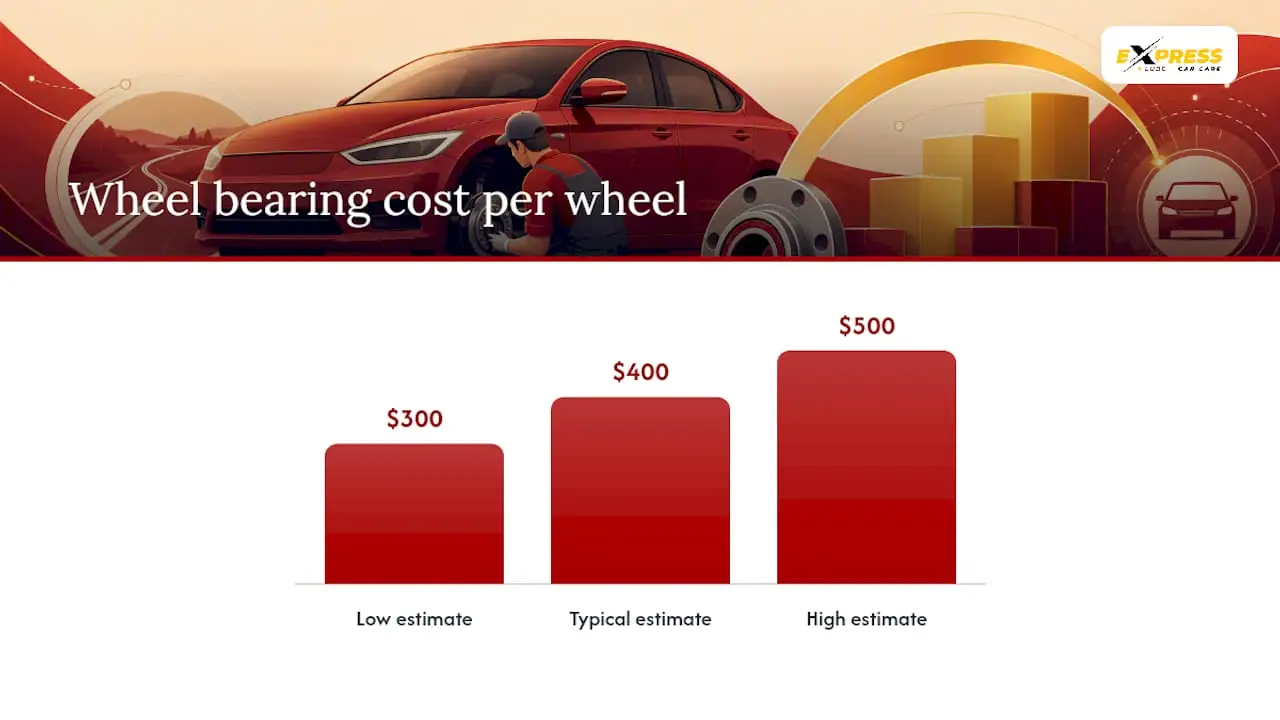
Most modern vehicles use a sealed hub assembly rather than a serviceable pressed-in bearing, which affects both parts cost and labor time. Hub assemblies bundle the bearing, hub, and sometimes the ABS sensor into one unit that bolts in as a whole, while older pressed-bearing designs require pressing the old bearing out and a new one in, adding shop time.
Nationally, wheel bearing replacement commonly runs between about three hundred and five hundred dollars per wheel, though your exact price depends on:
- Whether the job is a full hub assembly or a pressed bearing
- Front versus rear positioning, since some rear setups involve more disassembly
- Vehicle make and model, with certain European and all-wheel-drive platforms running higher on labor
Ask your technician whether the quote is for a hub assembly or a bearing-only replacement, and confirm what warranty backs the parts and labor before you approve the work.
Our Diagnostic Approach at Express Lube & Car Care
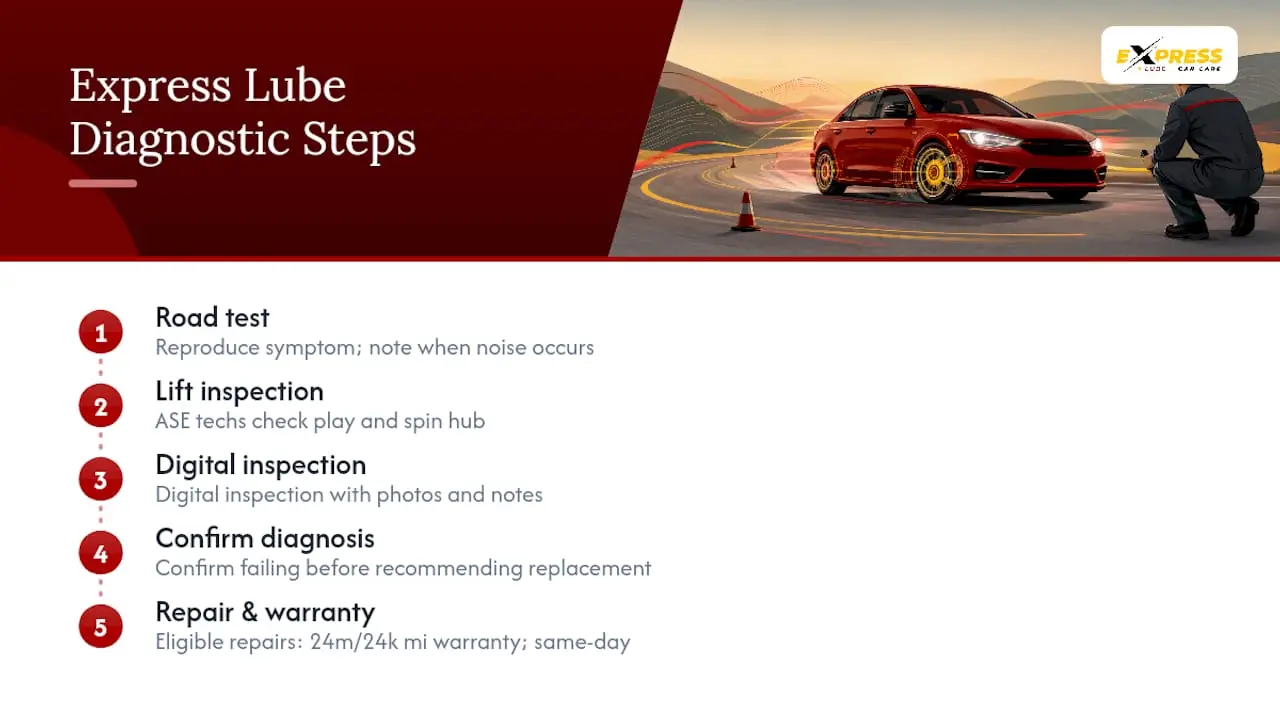
At Express Lube & Car Care, diagnosing wheel bearing noise starts with a road test to reproduce the symptom, followed by a lift inspection where our ASE-certified technicians check for play, spin the hub, and confirm findings with a digital vehicle inspection, complete with photos and written notes you can review yourself.
We’d rather confirm a bearing is failing before recommending replacement than guess and swap parts unnecessarily. Every eligible repair is backed by our 24-month/24,000-mile warranty. When you bring your vehicle in, tell us exactly when the noise happens (turning, straight-line, only above a certain speed), and expect most bearing diagnostics to finish the same day.
— Express Lube & Car Care
Get Your Wheel Bearing Noise Diagnosed Today
If that hum has been nagging at you on the highway, waiting rarely makes it cheaper or safer to fix. Express Lube & Car Care offers no-appointment-needed diagnostics for wheel bearing noise, meaning you can drive in the same day you notice the problem instead of waiting on a scheduled slot.
Our ASE-certified technicians handle the full diagnostic workflow described above, from the road test to the lift inspection, and if a bearing or hub assembly needs replacing, that repair is backed by our 24-month/24,000-mile warranty. We also check wheel-speed sensors and ABS components while we’re in there, since a failing bearing frequently affects both. If cost is a factor, take a look at our current service specials before you book. If the noise has turned into grinding, wheel play, or a warning light, don’t wait on a slow tow truck search. Schedule a diagnostic visit or ask us directly about safe transport options if the vehicle shouldn’t be driven any further.
Sources
- How to Tell Which Wheel Bearing Is Bad in Six Simple Steps – Tire Advise
- Wheel Bearing Replacement Cost Estimate – RepairPal
- Can You Drive With A Bad Wheel Bearing? Honest Mechanic Advice | The Motor Guy
- 3 reasons ABS light turns on – Holstein Parts
FAQ
What Does a Wheel Bearing Sound Like When It’s Going Bad?
A failing wheel bearing typically produces a hum, growl, or roaring sound that increases with vehicle speed and often changes pitch when you turn, unlike tire noise, which stays fairly constant regardless of steering input.
Is It Safe to Drive With Wheel Bearing Noise?
A steady, mild hum with no play or vibration is usually safe to drive carefully for a few days while you schedule a repair, but grinding, clunking, noticeable steering play, or a sudden ABS light means you should stop driving and get the vehicle inspected right away.
How Much Does It Cost to Replace a Wheel Bearing?
Wheel bearing replacement commonly costs between $349 and $510 per wheel in the U.S., with the final price depending on whether the vehicle uses a full hub assembly or a pressed bearing, and whether the repair is on the front or rear axle.
How Do I Know Which Wheel Bearing Is Bad?
A gentle lane-sway test at highway speed often reveals which side is failing. The noise typically gets louder when you shift weight onto the bad side and quieter when you shift weight away from it, though a shop confirms the exact corner with a lift inspection and stethoscope check.
Can I Keep Driving on a Bad Wheel Bearing Until I Get It Fixed?
Early-stage humming can usually be driven on briefly while you arrange service, but any grinding, looseness, or wheel play means you should stop driving immediately, since continued driving risks damage to the CV axle, brakes, and ABS sensor, and in severe cases, wheel separation.