

Use a plug only to get safely to a repair shop, not as a long-term fix. A professionally installed patch, or a combination plug-and-patch unit that seals the inner liner, is the accepted permanent repair once the puncture is checked against industry limits. If the damage sits in the shoulder or sidewall, measures larger than a quarter inch, or the tire shows prior repair damage, replacement is the only safe option.
TL;DR:
- A tire plug is a temporary roadside fix that never bonds with the inner liner and should only be used to reach a repair shop at speeds under 50 mph.
- A patch or a plug-and-patch combination provides a durable, permanent repair that can last the remaining life of the tire when applied correctly in the proper conditions.
- Repairs are only safe if the puncture measures no larger than a quarter inch (6 mm), is centrally located in the tread, and is not on the shoulder or sidewall.
- Demounting the tire and inspecting the inner liner, belts, and ply cords is essential for a proper, reliable repair, especially before applying a patch or combination unit.
- Once the damage exceeds industry limits or involves the shoulder, sidewall, or interior damage, replacing the tire is the safest and most effective option.
Table of Contents
- Tire Plug vs Patch: A Quick Comparison
- What Is a Tire Plug and How Does It Work?
- What Is a Tire Patch and Why the Plug-and-Patch Combination Matters
- Industry Safety Limits: When a Tire Can (and Can’t) Be Repaired
- DIY Kits vs Professional Repair: Where the Line Really Is
- Tire Repair Lifespan and Cost: What to Realistically Expect
- Why Demounting and Internal Inspection Matter
- What to Do Right Now If You Found a Puncture
- Some service providers adopt a safety-first, no-shortcuts policy: offering no-appointment service to avoid extended use of a plug, performing demount-and-inspect procedures before recommending repairs or replacements, and documenting inspections digitally with photos and notes. Such providers may offer same-day answers about tire repair eligibility.
- Get Your Tire Checked Today
- Sources
- FAQ
Tire Plug vs Patch: A Quick Comparison
Choosing between a plug, a patch, or the combination of both comes down to where the damage is, how big it is, and whether you need a fix right now or a fix that lasts. Here’s how the three approaches stack up against each other on the factors that matter most.
- Durability and permanence: A standalone plug is unpredictable. It can hold for days or fail within an hour, because it never bonds to the inner liner. A properly installed patch, or plug-and-patch combination, is built to last the remaining life of the tire when the repair meets industry criteria, according to USTMA.
- Repair process: A plug goes in from the outside, pushed through the tread with no inspection of the tire’s interior. A patch works from the inside out, which requires demounting the tire from the wheel and inspecting the inner liner before anything gets sealed.
- Use case: A plug is a roadside stopgap to reach a shop. A patch, or the combined plug-and-patch unit, is the fix you want once the tire is off the vehicle and on a repair stand.
- Practical limits: Repairable punctures must sit in the center tread, measure a quarter inch (6 mm) or less in diameter, and show no sign of a prior improper repair.
The bottom line on tire plug vs patch: one buys you time, the other buys you miles. Mixing up which one you rely on is where drivers get into trouble.
What Is a Tire Plug and How Does It Work?
A tire plug is a sticky rope of rubber or fibrous cord, often called a string plug, that gets forced into a puncture from the tread side. A technician, or a driver with a roadside kit, first reams out the hole with a small tool to rough up the rubber, then jams the plug in with an insertion needle until it seats snugly.
That process is fast, and it’s the reason plug kits ride in glove boxes and trunks across Plano. But speed comes with a tradeoff. The plug never gets vulcanized, or chemically bonded, to the inner liner. It’s held in place by friction and the tire’s own air pressure, not a permanent seal. AAA is blunt about it: a plug is a temporary roadside fix meant only to get you to a repair shop, not a substitute for a real repair.
Three things every driver should keep in mind about a plugged tire:
- Keep speeds under 50 mph and drive straight to a shop, not around town for a few more days.
- Watch for slow leaks or pressure loss, since a plug seal can degrade without warning.
- Understand that moisture can work its way past a plug over weeks or months, reaching the steel belts and causing corrosion from the inside out.
That corrosion risk is the real danger. A belt that’s rusting from trapped moisture won’t show any outward sign until the tire fails, often without warning.
What Is a Tire Patch and Why the Plug-and-Patch Combination Matters
A tire patch repairs a puncture from the inside, which means the wheel has to come off the vehicle and the tire has to come off the wheel. That single step, demounting, is what separates a patch from a plug and what makes it a repair rather than a plug’s borrowed time.
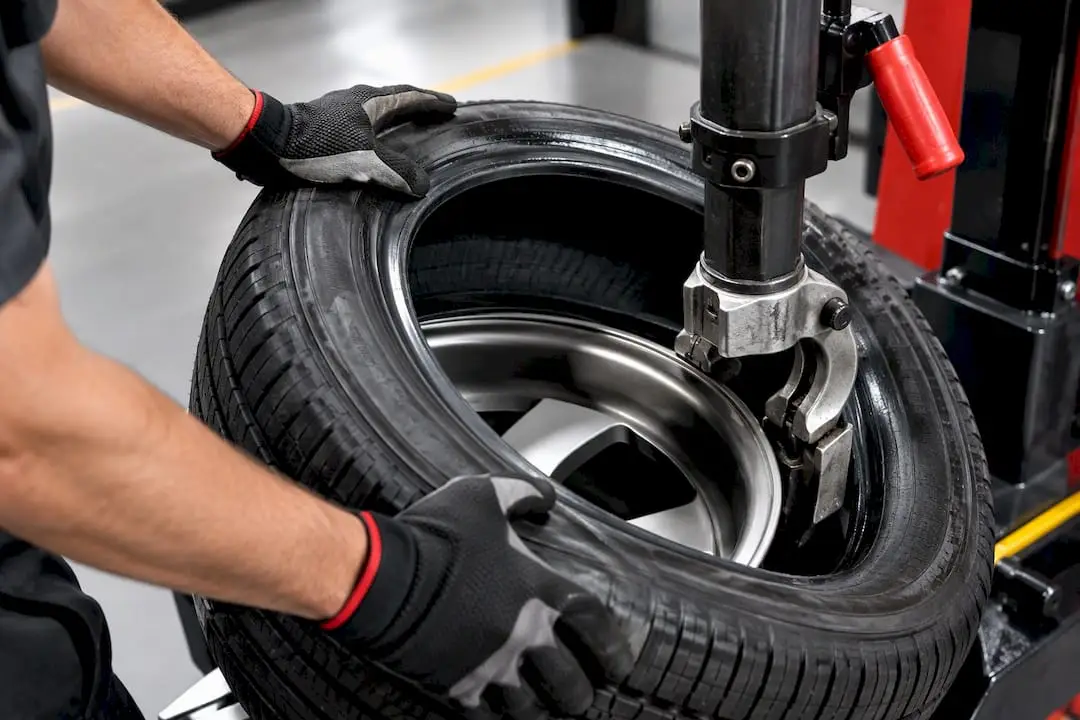
Once the tire is off, a technician inspects the entire inner liner for hidden damage, then buffs the area around the puncture to a specific texture so cement and rubber can bond properly. Continental’s repair guidance calls for buffing at controlled low speeds, compatible cement, and a curing period before the tire goes back into service.
The most common professional approach combines both methods into one unit:
- A plug-and-patch (sometimes called a combination repair) fills the puncture channel with a plug-style stem while a patch on the same unit seals the inner liner.
- The stem fills the void left by the puncture; the patch handles the sealing job a standalone plug can’t do.
- Stitching the patch down and allowing proper cure time locks the bond in place, according to USTMA.
Done correctly, on a tire that meets the size and location criteria, a combination repair restores the tire’s usable service life and speed rating. That’s a meaningfully different outcome than a plug alone can offer.
Industry Safety Limits: When a Tire Can (and Can’t) Be Repaired
Every reputable repair follows the same baseline rule: the puncture has to measure a quarter inch (6 mm) in diameter or smaller, and it has to sit in the central tread area. Anything outside those two conditions turns a repair job into a replacement conversation.
Why the shoulder and sidewall are off-limits. Those zones flex and generate heat every time the tire rolls, and a patch bond simply can’t hold up under that repeated stress. USTMA’s guidance confirms that shoulder and sidewall injuries are not repairable, and if you’re wondering whether you can patch a tire sidewall after hitting a pothole or curb, the answer is no, regardless of how small the damage looks.
A quarter inch is the line. A puncture larger than 6 mm, or one located outside the center tread, disqualifies a tire from repair under widely followed industry standards. There’s no gray area here.
Beyond size and location, a handful of other conditions push a tire straight to replacement:
- Tread depth at or below 2/32 inch, since a worn tire has already lost the margin needed for safe repair. Check your tread depth before assuming a puncture is the only issue.
- Multiple punctures spaced too close together, which weakens the surrounding structure even if each hole is individually small.
- Evidence of a prior improper repair, like an old plug that was never backed by a patch.
- Visible belt separation, ply exposure, or inner liner damage found during inspection.
DIY Kits vs Professional Repair: Where the Line Really Is
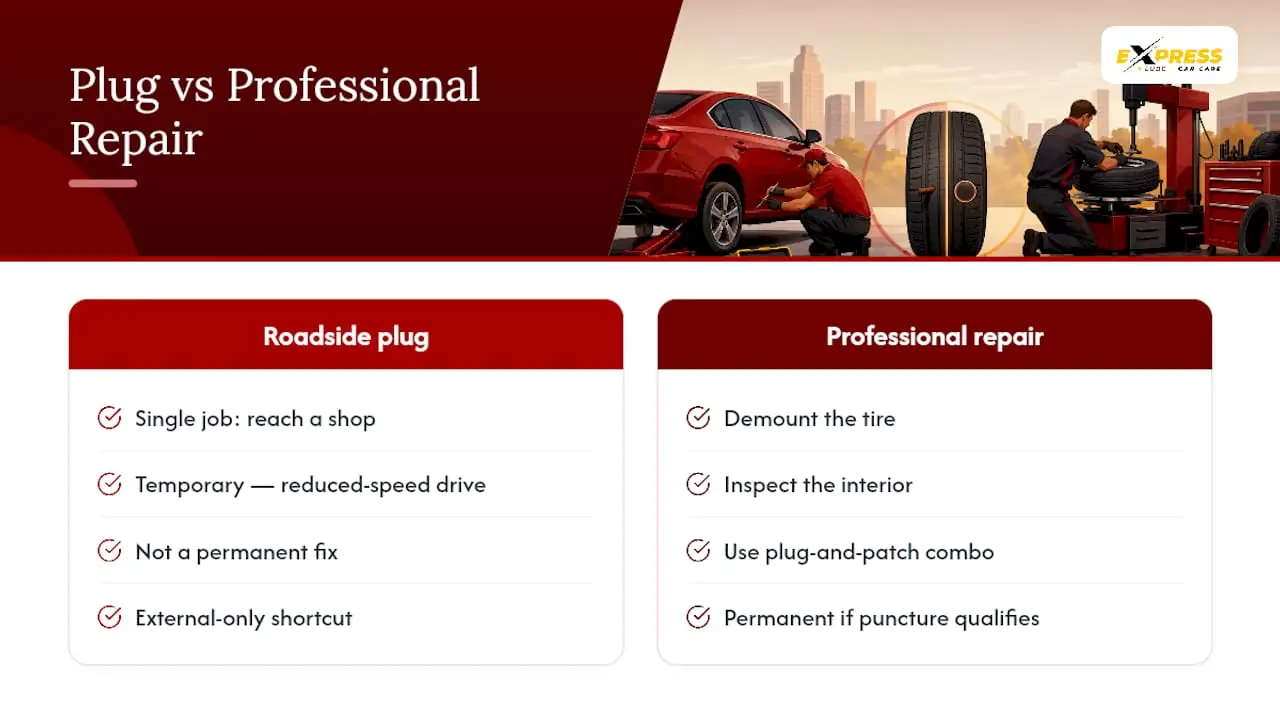
A roadside plug kit has exactly one job: get you off the shoulder and to a shop without stranding you. Used that way, for a short, careful drive at reduced speed, it’s a reasonable tool to keep in the trunk. Used as a permanent fix, it’s a gamble with worse odds every week that passes.
A shop doing the job right will always demount the tire, inspect the interior, and use a plug-and-patch combination when the puncture qualifies. If a technician refuses to pull the tire off the rim and just plugs it from outside, that’s a shortcut, not a repair, and it’s exactly the external-only approach the Tire Industry Association warns against.
One more trap worth knowing about: canned sealants like fix-a-flat. They stop air loss in a pinch, but the foam residue coats the inside of the tire, contaminating the surface a technician needs clean for a proper patch. That contamination can be enough to force a shop to scrap a tire that otherwise would have been repairable.
Pro Tip: If you’ve used a sealant can, tell the shop before they start. It changes what they can safely attempt and saves everyone time.
Tire Repair Lifespan and Cost: What to Realistically Expect
A standalone plug’s lifespan is genuinely unpredictable. It might hold until your next scheduled service, or it might start leaking on the drive home. A properly done plug-and-patch combination, by contrast, is designed to last for the rest of the tire’s usable service life, according to USTMA.
Cost and time follow a similar pattern:
- A DIY roadside kit is inexpensive and quick, usually a matter of minutes, which is exactly why it exists for emergencies.
- A shop-performed combination repair involves modest labor and parts, and the full process, including demounting and inspection, typically wraps up in under an hour.
- Replacement becomes the more sensible option once damage falls outside repair criteria, since paying for a repair that won’t hold or won’t pass inspection wastes both time and money.
Several factors push the decision toward replacement rather than repair: puncture size beyond a quarter inch, damage in the shoulder or sidewall, tread worn down near the legal minimum, or interior damage discovered once the tire is off the rim. None of these are judgment calls once a technician can see the tire from the inside.
Why Demounting and Internal Inspection Matter
A tire can look perfectly fine from the outside and still be unsafe to return to the road. That’s the entire argument for demounting, and it’s why a technician’s checklist looks different from a quick roadside glance.
A thorough internal inspection typically covers:
- The inner liner, checked for separation or moisture intrusion that never shows on the tread side.
- The steel belts, checked for corrosion or edge looseness that can develop silently after a puncture.
- The ply cords, checked for exposure or fraying near the injury site.
- Any signs of a previous repair, since overlapping repairs are one of the most common reasons a tire fails inspection.
Preparation matters just as much as detection, and using the right products like the best tyre dressing UK can contribute to overall tire care. Buffing the inner liner to the correct texture, using cement compatible with the repair unit, and allowing proper stitching and curing time are what actually create a permanent bond, not just a temporary patch job.
Some shops have ASE-certified technicians who handle this inspection as standard practice, and no-appointment, same-day service can help you avoid waiting days to find out whether your tire is repairable or needs replacing. Digital vehicle inspections with photos and notes give you a clear look at exactly what our technicians found before any work begins.
What to Do Right Now If You Found a Puncture
Stop the vehicle in a safe spot and check the tire before doing anything else. Leave the object in place. Don’t yank a nail out. If you must drive, use a plug only as a stopgap, keep speeds low, and head straight to a shop rather than running errands first.
Once you’re at the shop, insist on a full demount and internal inspection rather than an external-only plug. A plug-only repair should be treated as a temporary measure if a shop can’t perform a combination repair right away. And if your tire falls outside the size, location, or tread-depth limits, replacement is the safer call. Checking your tire’s air pressure regularly after any repair helps catch a failing seal before it becomes a roadside emergency again.
Some service providers adopt a safety-first, no-shortcuts policy: offering no-appointment service to avoid extended use of a plug, performing demount-and-inspect procedures before recommending repairs or replacements, and documenting inspections digitally with photos and notes. Such providers may offer same-day answers about tire repair eligibility.
Get Your Tire Checked Today
A punctured tire doesn’t fix itself, and the difference between a plug that fails on the highway and a repair that lasts the life of your tire usually comes down to who’s doing the work and how thoroughly they check it. Many service providers offer no-appointment, same-day service options so you don’t have to plan your week around a flat tire.

Technicians may demount the tire, inspect the inner liner and belts, and evaluate whether a plug-and-patch repair meets industry criteria or whether replacement is the safer call, often providing digital inspection photos for clarity. Bring the vehicle in, along with the punctured tire if it’s already off the car, and most inspections and repairs wrap up the same visit. Explore our full lineup of tire and repair services or head to our homepage to see current offerings. If you’re not sure whether your tire is safe to drive on right now, don’t guess. Call the shop or stop by today, and skip the risk of driving too far on a plug alone.
Sources
- Tire Plug vs. Patch: Get the Right Tire Repair | AAA
- Tire Repair – Tire Industry Association
- Tire repair for passenger car and light truck tires | Continental
FAQ
How Long Can You Drive on a Tire With a Plug?
A plug is meant to get you safely to a repair shop, not for extended driving, according to AAA. Keep speeds low, avoid highway driving if possible, and have the tire properly inspected and patched as soon as you can.
Are Tire Plugs a Permanent Fix?
No. A plug never bonds to the inner liner, so it can’t be considered a permanent repair under USTMA guidance. A permanent repair requires demounting the tire and applying a patch or plug-and-patch combination that seals the interior.
At What Point Should You Not Plug a Tire?
Skip the plug entirely if the puncture is larger than a quarter inch (6 mm), located in the shoulder or sidewall, or if the tire already shows tread wear near 2/32 inch. Any of these conditions calls for professional inspection and likely replacement rather than a plug.
Can I Plug My Tire With a Nail in It?
Leave the nail in place until a technician can assess it properly. Removing it yourself can make the hole harder to evaluate, and a technician needs to see the exact puncture to determine whether a repair or replacement is the right call.
What Does a Tire Repair Cost at Express Lube & Car Care?
Pricing depends on the tire and the repair needed, so current pricing is available on our website or by calling ahead. Our ASE-certified technicians will always inspect the tire first and explain your options before any work begins.