

The question of how often you should rotate your tires is fundamental to proper vehicle maintenance. A straightforward answer is essential for extending tire life and ensuring vehicle safety.
The generally accepted guideline for most vehicles is to perform a tire rotation every 6,000 to 8,000 miles. For the average driver in Plano, this interval typically corresponds to every six months.
The purpose of this procedure is to counteract the effects of uneven tire wear. The front tires, which manage steering, braking, and support the engine's weight, wear at a different rate than the rear tires. A rotation systematically changes each tire's position to distribute wear more evenly.
A Guide to Tire Rotation Frequency

A vehicle's smooth operation relies on the balanced performance of all four tires. Without regular rotations, the front tires on a front-wheel-drive vehicle can wear down 20-30% faster than the rear tires.
This simple maintenance task is one of the most effective methods for protecting your investment in a quality set of tires. Many vehicle owners synchronize tire rotations with their oil changes to create a consistent and easy-to-remember maintenance schedule.
A Baseline Schedule for Your Vehicle
While the 6,000 to 8,000-mile interval is a reliable starting point, it is not a universal rule. Different vehicle types and drivetrains necessitate different schedules. For example, an all-wheel-drive SUV may require more frequent rotations than a front-wheel-drive sedan.
To develop a comprehensive service plan for your specific vehicle, our routine car maintenance checklist serves as a valuable resource.
General Tire Rotation Intervals at a Glance
For quick reference, the following table outlines recommended rotation schedules for various vehicle types. This can serve as a foundational guide for your tire maintenance.
| Vehicle Type | Recommended Mileage Interval | Estimated Timeframe |
|---|---|---|
| Most Passenger Cars (FWD/RWD) | 6,000 – 8,000 miles | Every 6 months |
| All-Wheel Drive (AWD) Vehicles | 5,000 – 7,000 miles | Every 5-6 months |
| High-Performance/Sports Cars | 3,000 – 5,000 miles | Every 3-4 months |
This table provides a reliable baseline, but it is crucial to consult your vehicle's owner's manual for the manufacturer's specific recommendations.
Key Takeaway: Adhering to a consistent tire rotation schedule is a prudent and cost-effective strategy to extend tire longevity, enhance fuel efficiency, and ensure your vehicle handles safely and predictably on Texas roads.
The Purpose and Benefits of Tire Rotation
We have established the recommended frequency, but understanding the underlying reasons for tire rotation is equally important. Viewing this procedure as a core component of vehicle maintenance is a wise approach, as this minor service prevents significant and costly issues.
Consider the analogy of a four-person relay team where two members are required to sprint while the other two jog. The sprinters will inevitably experience fatigue first. This is precisely what happens to your tires with every mile driven.
Balancing the Workload on Your Tires
In a typical front-wheel-drive vehicle—the most common configuration on the road—the front tires bear a disproportionate amount of the workload. They are responsible for steering, acceleration, and the majority of the braking forces. This uneven distribution of labor causes them to wear significantly faster than the rear tires.
Tire rotation is the solution. By systematically moving each tire to a new position, you ensure that the operational stresses are distributed evenly across all four tires. This simple act of redistribution promotes balanced wear and extends the life of the entire set.
A study from the National Highway Traffic Safety Administration (NHTSA) found that proper tire maintenance, including rotations and pressure checks, could prevent thousands of accidents each year by improving vehicle stability and grip.
This practice is not solely about financial savings; it is also about enhancing vehicle safety and handling predictability, particularly during adverse weather conditions like a sudden North Texas downpour.
The Financial and Performance Benefits
The return on investment for this routine service is substantial. By ensuring uniform tread wear, you can achieve the maximum possible lifespan from your tires, delaying the significant expense of purchasing a new set.
It is a clear example of preventative maintenance—a small, regular expenditure that prevents a much larger future cost.
Furthermore, evenly worn tires create less rolling resistance, which can contribute to improved fuel economy. As tires wear uniformly, the vehicle maintains optimal contact with the road surface, resulting in a smoother, more stable ride.
Neglecting rotations has a tangible cost. Most vehicle manufacturers recommend rotation every 5,000 to 7,500 miles to prevent the front tires from shouldering up to 70% of the wear burden. This oversight costs U.S. drivers an estimated $2.5 billion annually in avoidable repairs and replacements. The experts at Radial Tire Company offer further insights on how this maintenance saves money.
Ultimately, a consistent rotation schedule is a sound financial decision that also improves vehicle performance.
Tailoring a Rotation Schedule to Your Vehicle
The 6,000-mile guideline is an excellent starting point, but it is not a universal rule for every vehicle. It should be considered a baseline that requires adjustment based on your specific vehicle and driving habits.
The most significant factor influencing rotation frequency is the vehicle's drivetrain. Front-wheel drive (FWD), rear-wheel drive (RWD), and all-wheel drive (AWD) systems subject tires to different forces, resulting in distinct wear patterns.
For instance, an FWD car places the majority of acceleration, steering, and braking stress on its front tires. Conversely, an RWD vehicle divides these tasks—the front tires steer while the rear tires provide propulsion. Understanding these dynamics is essential to determining how often you should rotate your tires.
How Drivetrains Affect Rotation Needs
All-wheel drive (AWD) systems present a unique challenge. Because power is delivered to all four wheels, the system is highly sensitive to differences in tire circumference. It is critical to maintain nearly identical tread depth on all four tires to avoid placing undue strain on the drivetrain components.
Due to the sensitivity of AWD and 4×4 systems to variations in tire diameter, they often require more frequent rotations—sometimes as often as every 3,000 to 5,000 miles. Postponing this service can cause premature wear not only on the tires but also on critical and expensive drivetrain components.
This underscores the importance of a personalized rotation schedule that moves beyond a generic rule to a plan that actively protects your vehicle's specific mechanical systems.
Adjusting for Driving Style and Conditions
In addition to your vehicle's mechanics, your personal driving habits significantly impact tire wear. Aggressive acceleration, hard cornering, and towing heavy loads all accelerate the rate at which tires degrade.
Your schedule should be adjusted for factors such as:
- Aggressive Driving: Hard cornering and rapid acceleration place additional stress on the outer edges of the tires.
- Heavy Loads: Towing or carrying heavy cargo places a much greater burden on the rear tires.
- High-Performance Tires: The softer rubber compounds that provide superior grip also cause these tires to wear down much faster.
Tire manufacturers have found that rotations every 6,200 to 8,000 miles can extend tread life by 20-40%. For powerful luxury or performance vehicles, the higher torque can demand a tighter 3-6 month schedule. The intense Texas heat can also accelerate rubber degradation by an additional 15-25%. For more details, consult this guide on how driving conditions impact tire life. Factoring in these variables helps create a maintenance plan tailored to your needs.
Understanding Tire Rotation Patterns
When a vehicle undergoes a tire rotation, the process is not a random shuffling of wheels. Technicians employ specific, established patterns designed to counteract the unique wear forces generated by the vehicle's drivetrain. This is a precise procedure, and using the correct pattern is crucial for achieving balanced wear and maximizing tire life.
The concept is analogous to strategically rotating players in a sports game to manage fatigue and maintain peak team performance. Each tire rotation pattern is chosen to move tires from high-stress positions (like the front of an FWD car) to lower-stress ones, thereby extending their collective lifespan.
The Most Common Rotation Patterns
For the majority of cars, trucks, and SUVs, one of several primary patterns is used. The appropriate choice is determined by whether the vehicle is front-wheel drive (FWD), rear-wheel drive (RWD), or all-wheel drive (AWD).
Forward Cross: This is the standard pattern for most FWD vehicles. The front tires are moved directly to the rear, while the rear tires are moved to the opposite sides of the front axle. This provides the hardworking front tires a necessary reprieve in the back.
Rearward Cross: As the name suggests, this is the standard for RWD and most 4WD/AWD vehicles. In this pattern, the rear drive tires are moved straight to the front, and the front tires cross over to opposite sides on the rear axle.
X-Pattern: This is another effective method for FWD vehicles that involves swapping all four tires diagonally. The left-front tire moves to the right-rear position, the right-front to the left-rear, and so on. This pattern is particularly useful for addressing more noticeable or uneven wear.
This chart provides a visual representation of how these patterns function based on the vehicle's drivetrain.
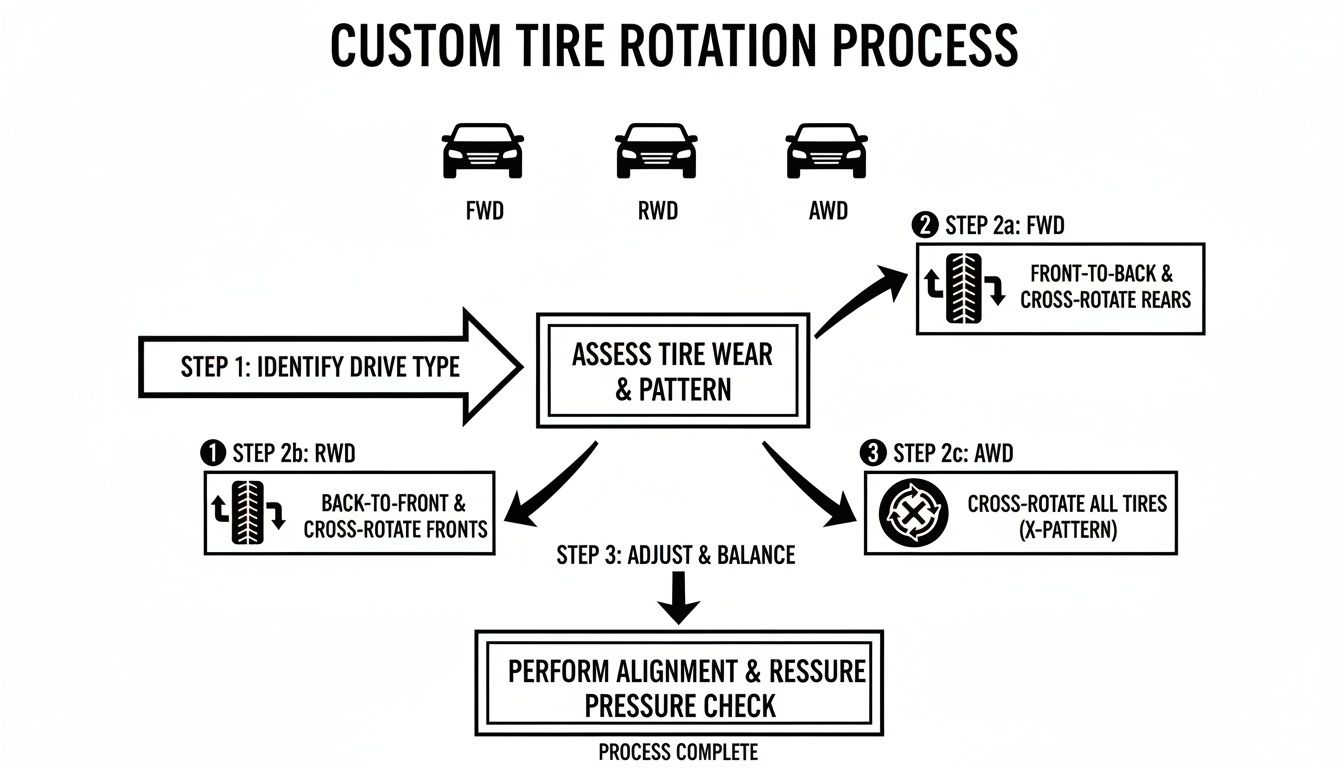
As illustrated, the objective is always to move the tires in a systematic way that equalizes wear over thousands of miles.
To provide further clarity, here is a breakdown of the most common patterns used in a professional auto shop.
Common Tire Rotation Patterns by Drivetrain
| Drivetrain Type | Primary Rotation Pattern | Description of Movement |
|---|---|---|
| Front-Wheel Drive (FWD) | Forward Cross | Front tires move straight back; rear tires cross to the front. |
| Rear-Wheel Drive (RWD) | Rearward Cross | Rear tires move straight forward; front tires cross to the rear. |
| All-Wheel Drive (AWD) | Rearward Cross or X-Pattern | The goal is to keep tread depth as even as possible across all four tires. |
| Directional Tires | Front-to-Rear (Same Side) | Tires can only move from front to back on the same side to maintain tread direction. |
Selecting the correct pattern is what makes a tire rotation effective, preventing premature wear and maintaining a smooth ride.
Special Cases and Considerations
Not all tire sets can be rotated using these common cross patterns. There are two important exceptions where rotation options are more limited.
A professional technician can immediately identify the type of tires and drivetrain your vehicle has, ensuring the correct rotation pattern is used every single time. This expertise prevents accidental damage and maximizes the effectiveness of the service.
For example, some high-performance vehicles are equipped with directional tires. These tires feature a tread pattern designed to roll in a specific direction for optimal performance. Consequently, they can only be moved from the front to the back on the same side of the vehicle.
Another special case is a staggered setup, common on sports cars, where the rear tires are physically wider than the front tires. With this configuration, a front-to-back swap is impossible. A side-to-side swap may be an option if the tires are non-directional, but in some cases, these tires cannot be rotated at all—a factor to consider when purchasing new tires.
Warning Signs that Indicate a Need for Tire Rotation
Your vehicle provides continuous feedback on its condition; learning to interpret these signals is key to preventative maintenance. Long before the 5,000-mile reminder sticker is due, your car will often exhibit physical symptoms indicating that a tire rotation is overdue. Recognizing these signs allows you to be proactive, ensuring safety and promoting even tire wear.
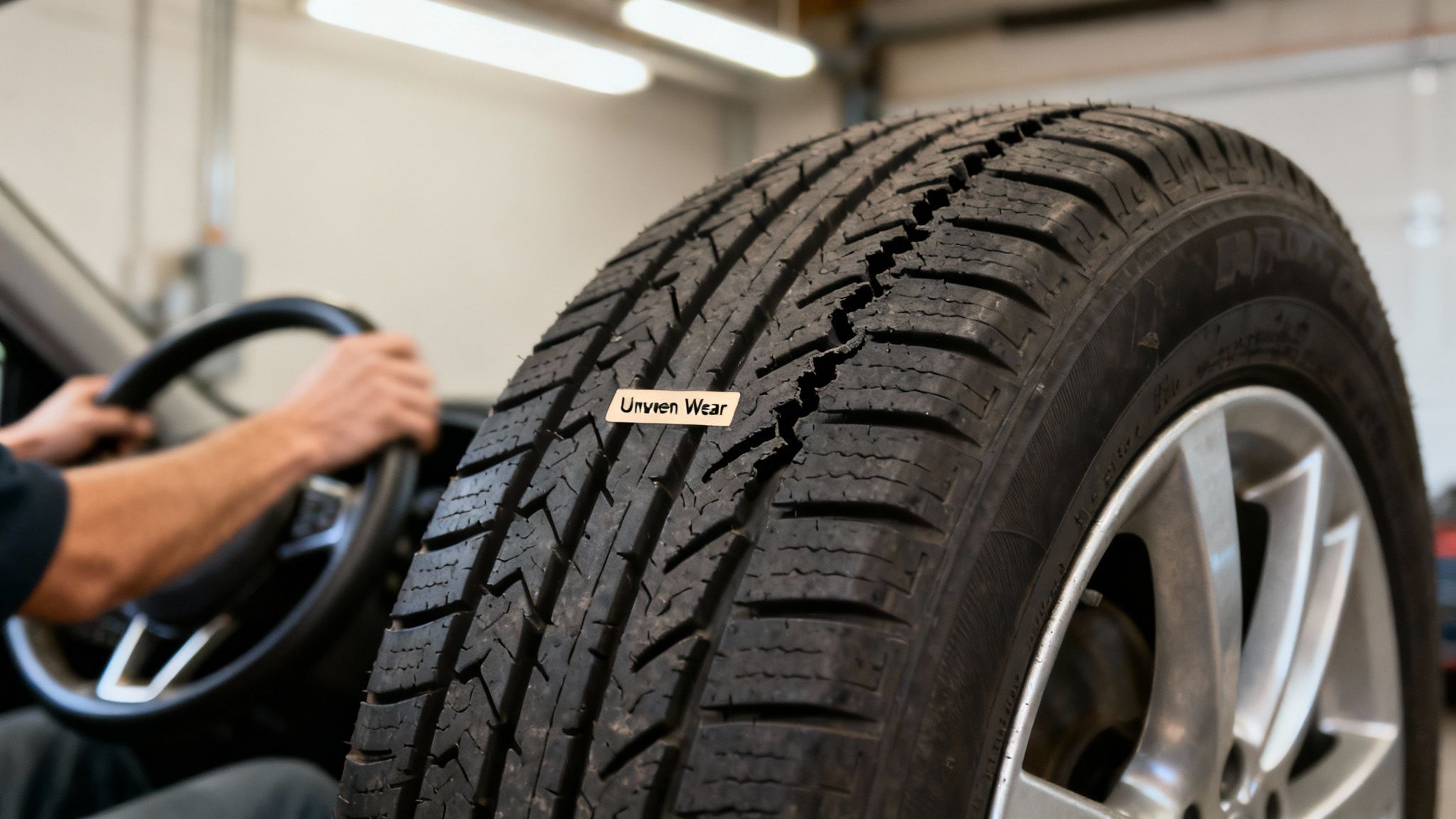
The most definitive sign is uneven tread wear. A simple visual inspection of your tires can be very revealing. If the tread on the front tires appears significantly more worn than the tread on the rear tires, it is a classic indicator that a rotation is needed.
You may also observe more specific wear patterns, such as "feathering" (saw-tooth appearance) or "cupping" (scalloped dips), where the tread wears down only on the inner or outer edges. This is a clear sign that the tires have remained in the same position for too long.
Physical and Auditory Clues
Another common symptom is a subtle but persistent vibration felt through the steering wheel. This typically becomes noticeable at higher speeds, such as when driving on a highway. This shaking is almost always caused by an imbalance resulting from uneven wear on the front tires, which disrupts the entire wheel assembly.
These vibrations are more than just a minor annoyance; they are a direct communication from your vehicle that the tires are wearing unevenly. Ignoring this can place additional stress on suspension components, potentially leading to more complex and expensive repairs.
This highlights the importance of also understanding the symptoms of bad shocks and struts, as tire health and suspension integrity are closely linked.
Finally, listen to your vehicle. A new humming or whirring sound that increases in volume with speed can also point directly to irregular tire wear. Keep these simple sensory clues in mind:
- Visual Check: Look for obvious differences in tread depth between your front and rear tires.
- Feel the Ride: Pay attention to any new vibrations in the steering wheel, especially over 45 mph.
- Listen Closely: Note any unusual humming noises that change with your speed.
Identifying these signs early and scheduling a tire rotation is one of the most effective ways to prevent more serious wear and tear on your vehicle.
Your Go-To for Expert Tire Care in Plano
Knowing when to rotate your tires is the first step. The next is finding a trusted local shop to perform the service correctly. That's where Express Lube & Car Care comes in, offering the expert knowledge and convenient service that Plano drivers rely on.
Our ASE-certified technicians perform tire rotations quickly and precisely. We use the exact pattern required for your vehicle's drivetrain to guarantee even tread wear and help you maximize the life of your tires. A key benefit of our service is that no appointment is needed. You can visit our shop at your convenience.
Maximize Your Time with Bundled Services
To make maintenance even more efficient, we recommend pairing your tire rotation with your next oil change. This is the most effective way to address two critical maintenance tasks in a single visit, saving you an extra trip and keeping your vehicle on a consistent care schedule.
This screenshot from our website reflects our commitment to making quality auto care accessible to our community.
The professional and welcoming atmosphere shown here is central to our philosophy. We aim to make vehicle maintenance a completely stress-free experience.
At Express Lube & Car Care, we believe essential vehicle maintenance should be convenient and affordable. Combining your tire rotation with an oil change isn't just a time-saver—it's a smart way to stay ahead of your car's needs without disrupting your day.
Making Car Care Affordable for Plano Drivers
We are proud to be a part of the Plano community, and this includes making essential car care affordable for everyone. We offer a variety of specials to help you save money while keeping your vehicle safe and reliable.
Our current savings include:
- $20 off a full-service oil change.
- Special discounts for our military members and first responders.
- A $25 discount on oil changes during our Ladies Day special every Wednesday.
If you are in the market for new tires, you can explore our current specials on a set of tires to find excellent value.
Visit our shop today and experience the friendly, expert service that keeps our neighbors driving safely. We are here to help you get the most out of your tires and your vehicle, mile after mile.
Frequently Asked Questions About Tire Rotation
Even with a solid understanding of the basics, you may have some practical questions. This is perfectly normal. Let's address some of the most common inquiries we receive from drivers to clarify any remaining points.
Can I Rotate My Tires at Home?
Technically, yes. If you possess a quality car jack, sturdy jack stands, and a lug wrench, a DIY rotation is possible. However, having a professional perform the service is a significantly safer and more reliable option. Our technicians use specialized equipment to lift your vehicle correctly, eliminating the risk of it falling.
The most critical reason to entrust this job to a professional is the use of a torque wrench. We tighten your lug nuts to the precise specifications recommended by your vehicle's manufacturer. Over-tightening can damage the wheel studs, while under-tightening can lead to a wheel detaching while driving. Furthermore, a professional rotation includes an expert inspection of your tires for any hidden damage you might otherwise miss.
Does a Rotation Include Tire Balancing?
This is an excellent question, and the answer is no—they are two distinct services, though they are often performed together. It is important to understand the difference.
- Tire Rotation: This service involves changing the position of each wheel on the vehicle to promote even tread wear.
- Tire Balancing: This procedure corrects weight imbalances within the tire and wheel assembly itself. Small counterweights are added to ensure the wheel spins smoothly without vibration.
If you are experiencing a vibration, particularly at highway speeds, it is a classic sign that your tires require balancing. It is always a good practice to have them balanced when you get them rotated, especially if a significant amount of time has passed since the last balancing.
What Happens if I Never Rotate My Tires?
Neglecting tire rotations has significant consequences, both for your finances and your safety. The most immediate effect is accelerated and uneven tire wear, forcing you to purchase a new set of tires much sooner than expected.
Neglecting tire rotation is a financially imprudent decision. The resulting uneven wear compromises your vehicle's handling, reduces stability in wet conditions, and creates vibrations that place undue stress on the entire suspension system.
Ultimately, this simple, inexpensive maintenance task prevents much larger problems. Your tires will last thousands of miles longer, your ride will be smoother, and your vehicle will be safer for you and your passengers.
For fast, expert tire care that keeps you driving safely, trust the ASE-certified technicians at Express Lube & Car Care. We handle rotations, balancing, and alignments with precision, and you never need an appointment. Stop by our Plano shop today or visit us online at https://www.expresslubeplano.com to learn more about our specials.