

So, when is the correct time to replace your vehicle's shocks? There isn't a single definitive mileage, but a widely accepted guideline is to have them inspected between 50,000 and 100,000 miles.
The lifespan of your shocks, or shock absorbers, is directly related to the distance they've traveled and the conditions of the roads they've encountered.
Your Guide to Shock Absorber Replacement

Many drivers only consider their shocks when the ride becomes noticeably rough, but by that stage, vehicle safety may already be compromised. Shock absorbers do much more than mitigate the feeling of bumps; they are critical for maintaining vehicle stability, control, and optimal braking performance.
A vehicle with worn-out shocks doesn't just provide a poor ride quality—it becomes more difficult to handle and can cause accelerated and uneven tire wear.
For a daily commuter on a mix of roads like the George Bush Turnpike and Plano's local streets, the 50,000-mile inspection point can arrive quickly. This combination of smooth highways and varied urban road surfaces places significant stress on a vehicle's suspension system.
Key Symptoms of Failing Shocks
Before scheduling a replacement, it's essential to understand the warning signs. Recognizing the early indicators of wear is the most effective way to maintain safety and prevent more costly repairs in the future.
A healthy suspension system provides a firm and responsive driving feel. Worn shocks, by contrast, can make the vehicle feel disconnected, unstable, and less predictable.
Observe your vehicle's behavior in these specific situations:
- Hard Braking: Does the front of the vehicle dip excessively, an action known as "nose-diving"?
- Turning and Cornering: Does the vehicle's body lean or sway significantly during turns?
- Driving Over Bumps: Does the vehicle oscillate up and down multiple times before stabilizing?
An affirmative answer to any of these questions is a strong indication that a professional suspension inspection is warranted.
To better understand what to look for, the following table compares a healthy suspension system to one that requires attention.
Worn Shocks vs. Healthy Shocks: A Comparative Overview
| Symptom / Performance Metric | Worn Shocks (Requires Attention) | Healthy Shocks (Good Condition) |
|---|---|---|
| Ride Quality | Bouncy, rough, and uncomfortable. | Smooth and stable ride. |
| Braking | Vehicle "nose-dives" forward during braking. | Minimal dipping, vehicle remains level. |
| Steering and Handling | Feels loose, sways in turns or crosswinds. | Responsive, firm, and controlled handling. |
| Tire Wear | Uneven wear patterns, often called "cupping." | Even and consistent tire wear. |
| Visual Inspection | Leaking hydraulic fluid; dented or damaged housing. | Clean and dry unit, no visible damage. |
This table serves as a diagnostic tool. If your vehicle exhibits symptoms from the "Worn Shocks" column, it is advisable to seek a professional evaluation without delay.
What’s Next? Replacement and Planning
When a replacement is deemed necessary, you will have decisions to make, such as choosing between original equipment manufacturer (OEM) and aftermarket parts. It is beneficial to research the difference between OEM and aftermarket parts to make an informed choice for your vehicle and budget.
The primary function of a shock absorber is to maintain firm contact between the tires and the road surface. When shocks fail, the tires can lose this contact, significantly increasing the risk of losing vehicle control.
Adhering to a regular maintenance schedule is the most effective way to manage suspension health. You can align shock inspections with other key service intervals, a topic our guide to a car maintenance schedule by mileage explains in greater detail.
Ultimately, replacing shocks in a timely manner is a critical aspect of vehicle safety and control, not merely a matter of ride comfort.
How Your Shocks Maintain Vehicle Control
Many people believe a shock absorber's purpose is simply to smooth out bumps. While they do improve comfort, their primary function is far more critical: maintaining vehicle control.
Without functional shock absorbers, a vehicle would oscillate uncontrollably after encountering road imperfections. They are a key component that separates a stable, predictable vehicle from a dangerous one.
Your suspension's springs are what actually absorb the initial impact from a pothole. However, a spring, once compressed, will continue to oscillate until its stored energy dissipates. This is where the shock absorber performs its vital role.
The Science of Damping Motion
A shock absorber's purpose is to dampen, or control, the spring's oscillation. This action keeps the tires pressed firmly against the road surface instead of bouncing after an impact. This continuous tire-to-road contact is essential for safe steering, braking, and overall handling.
An effective analogy is the pneumatic closer on a screen door. Without this device, the door's powerful spring would cause it to slam shut. The closer slows this motion, allowing the door to close in a controlled manner.
Your shock absorbers function in the same way for your suspension. They use hydraulic fluid to convert the kinetic energy of the bouncing spring into thermal energy (heat), thereby calming the vehicle's motion almost instantly.
When shock absorbers wear out, they lose their ability to manage this energy effectively. This results not just in a rough ride, but a significant loss of vehicle control.
Why Healthy Shocks Are a Safety Imperative
When your shocks are functioning correctly, your vehicle handles as it was designed to. When they fail, safety is compromised in three key areas.
- Effective Braking: During hard braking, a vehicle’s weight shifts forward. Functional shocks keep the vehicle level, allowing all four tires to maintain grip. Worn front shocks permit the front end to "nose-dive," which can substantially increase stopping distance.
- Stable Cornering: In a turn, a vehicle’s body naturally leans due to centrifugal force. Shocks counteract this "body roll" to keep the vehicle balanced. With worn shocks, the vehicle may feel unstable and lean excessively in curves.
- Overall Control: Whether you encounter a sudden crosswind or must perform an evasive maneuver, your shocks keep the vehicle settled and responsive. Without them, the car can feel "floaty" and difficult to control in an emergency.
Ultimately, knowing when to replace shocks is about ensuring these critical safety systems are fully functional. A good set of shocks is not a luxury—it is fundamental to the safety of you, your passengers, and other drivers on the road.
The Top 7 Symptoms of Worn Shocks
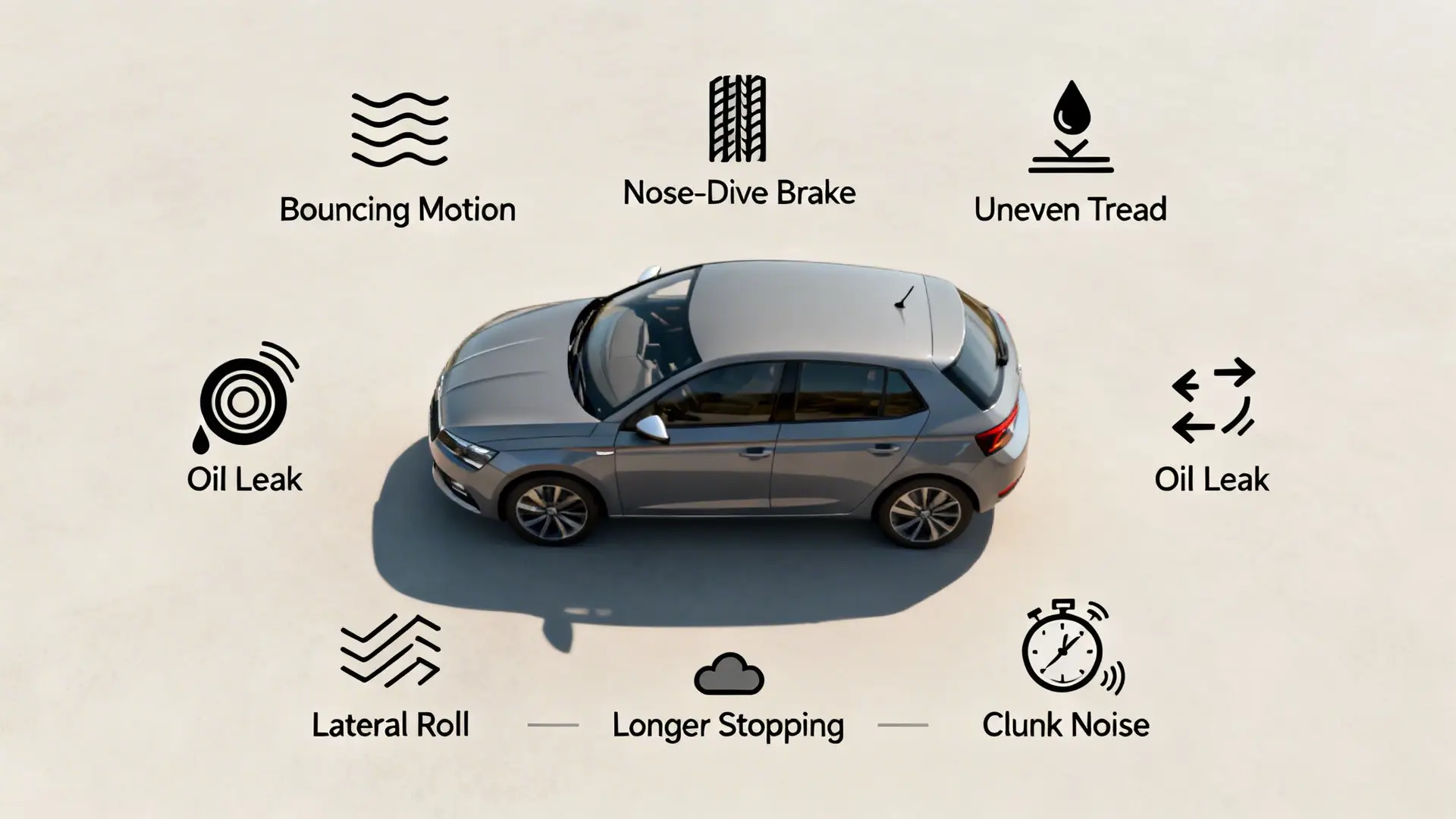
When a vehicle's suspension begins to degrade, it almost always provides warning signs. Learning to identify these symptoms is the key to knowing when to replace shocks before a minor issue escalates into a major safety risk.
Consider these signs as your vehicle communicating its condition. Here are the seven most common indicators that your shocks are worn and require professional attention.
1. Excessive Bouncing and a Floaty Ride
This is typically the first and most noticeable symptom. After driving over a bump or railroad tracks, does your vehicle continue to oscillate? It should settle almost immediately.
If the ride feels more like a boat on choppy water, it is a classic sign of failed shocks. They are no longer controlling the spring's energy, resulting in a floaty, uncontrolled sensation, particularly at highway speeds.
2. Nose Diving When You Brake
When you apply the brakes, do you feel the front end of your car lurch forward and dip down? This phenomenon, known as nose diving, is a significant red flag.
Your shocks are designed to keep the vehicle level and stable during braking. When worn, they cannot manage the forward weight transfer, causing the front to dip sharply. This is not only unsettling but can also negatively affect braking distance and control.
Ignoring worn shocks can be more dangerous than you might think. Independent tests have shown that worn shocks can increase braking distance by 10 to 20 feet at 60 mph—a margin that could be the difference between a safe stop and a collision.
3. Swaying and Leaning in Turns
When you navigate a corner or a highway exit ramp, does your vehicle feel like it’s leaning or swaying excessively to the outside of the turn? This sensation, often called body roll, indicates that your shocks are no longer providing adequate stability.
Functional shocks keep the vehicle's body flat and balanced through turns. When they fail, the car can feel unstable and less responsive, often forcing the driver to reduce speed to feel in control. This is particularly hazardous during sudden evasive maneuvers.
4. Unusual Tire Wear Patterns
Your tires can reveal much about your suspension's health. If you observe an unusual wear pattern known as "cupping" or "scalloping"—which appears as dips or scoops in the tread—worn shocks are the most probable cause.
This occurs because a failing shock allows the tire to bounce off the road surface while driving, causing it to strike the pavement unevenly. Data indicates that worn shocks contribute to up to 12% of tire wear issues. Identifying this early can prevent the premature replacement of an expensive set of tires. You can learn more by reviewing this guide on shock absorbers and when to replace them.
5. Visible Fluid Leaks
Perform a visual inspection of the shock absorbers themselves—they should be clean and dry. If you see an oily film coating the body of the shock, it is a definitive sign that the internal seal has failed and hydraulic fluid is leaking.
Shocks are filled with hydraulic fluid to perform their damping function. Once this fluid begins to leak, the shock can no longer operate as designed. Even a minor leak is an indication that a replacement will be necessary soon.
6. Clunking or Knocking Noises
If you hear a clunking or knocking sound from the corners of your car when driving over bumps, it can often be traced to worn-out suspension components.
The noise could originate from the shock's failing internal parts or from worn mounting bushings that allow the shock to make contact with the vehicle's frame. Do not ignore these sounds; they are a clear signal that a component is loose or broken.
7. Vibrations in the Steering Wheel
While a vibrating steering wheel can have several causes, worn shocks are a common one. As shocks wear out, they lose their ability to keep your tires planted firmly on the road.
The resulting bouncing and instability can transmit vibrations through the steering system to the steering wheel, especially on uneven road surfaces.
Performing the At-Home Bounce Test
If you have observed some of these symptoms from the driver's seat, how can you further assess the situation without an immediate trip to a mechanic?
There is a classic, no-tools-required diagnostic you can perform in your driveway: the bounce test. It is a quick and effective method to gauge how well your shocks are controlling your vehicle’s springs.
How to Do the Bounce Test
Ensure your vehicle is parked on a level surface for an accurate result. You should check each corner of the vehicle individually to test the front and rear shocks separately.
- Get in Position: Go to one corner of your car, such as the front driver's side, directly over the wheel.
- Push Down Firmly: Place both hands on the hood or trunk and use your body weight to push that corner down as far as it will go.
- Let Go Quickly: As soon as the car is at its lowest point of compression, release your hands and step back.
- Watch What Happens: Carefully observe the vehicle's reaction. The number of bounces provides the answer.
You are looking for how many times the car oscillates before it comes to a rest.
A vehicle with healthy shocks should rebound up once and then immediately settle back to its normal ride height. A slight secondary movement might be visible, but it should stop in no more than one to one-and-a-half bounces.
Interpreting the Results
If you press down on a corner and the vehicle continues to oscillate up and down multiple times, it is a clear sign of failure. The shock absorber on that corner is no longer damping the spring's energy.
For many technicians, any movement beyond the first rebound indicates a worn shock. This quick check is particularly useful for fleet managers, who often use a 2-inch bounce test failure—where the rebound is excessive—as a definitive indicator. When a shock is leaking badly enough to fail a bounce test, it has likely lost up to 80% of its internal fluid. You can learn more about professional evaluation methods by reading about myths surrounding replacement intervals.
While the bounce test is an excellent preliminary diagnostic, it is not a substitute for a professional inspection. A trained technician can identify other issues, such as worn bushings or hidden leaks, that this simple test may not reveal.
Understanding Shocks vs. Struts
When discussing your car's suspension, the terms "shocks" and "struts" are often used interchangeably, but they are not the same component. Understanding the difference is important, as the repair complexity and cost vary significantly between the two.
A shock absorber is a dedicated damping component. Its sole function is to control the oscillation of your vehicle's springs, ensuring a smooth and stable ride. It is a standalone part that can be replaced independently.
A strut, on the other hand, is a major structural component of the suspension and steering system. It is a complete assembly that integrates a shock absorber and a coil spring into a single unit. Struts not only dampen impacts but also support the vehicle's weight and are a pivotal part of the car's steering and alignment geometry.
Spotting the Difference Visually
A quick visual inspection is usually sufficient to determine which components your vehicle uses.
- Shock Absorber: You will see a separate, large coil spring located near the shock. The shock is a relatively slim cylinder that can be unbolted and replaced on its own.
- Strut Assembly: You will see the large coil spring wrapped around the shock absorber housing. The entire assembly is one large, integrated unit bolted directly to the vehicle's chassis.
You can get an idea of the condition of either component with a simple "bounce test" at home.

Press down firmly on one corner of your car and release it. A healthy suspension should settle quickly, within one to one-and-a-half bounces. More than that is a sign of wear.
Why the Distinction Matters for Repairs
The difference between these components becomes most apparent in terms of repair cost and complexity. Replacing a strut is a far more involved procedure than replacing a shock.
Because a strut is an integral part of your car’s steering and suspension geometry, its removal disrupts the wheel alignment. Consequently, after replacing a strut, a full four-wheel alignment is not merely recommended—it is mandatory. This adds both time and cost to the service but is essential for safe driving and to prevent premature tire wear.
In contrast, replacing a standalone shock absorber does not affect the wheel alignment. The job is simpler, faster, and almost always less expensive because it eliminates the need for this additional step.
Knowing which system your car is equipped with makes you a more informed vehicle owner. It helps you understand repair estimates and the scope of the work involved. If you wish to learn more, our guide on how to change a strut provides a detailed breakdown of the process.
How Much Does Shock Replacement Cost?
Once it has been determined that your shocks or struts require replacement, the next logical question is: "How much will this cost?"
The final expense can vary significantly based on whether you perform the repair yourself or enlist a professional service center. Let's examine the costs associated with each option.
The DIY Route: Parts and Pitfalls
If you are mechanically inclined, the do-it-yourself approach limits your primary expense to the cost of parts.
A single, standard shock absorber may cost as little as $50, while a high-performance or heavy-duty model could exceed $200. Strut assemblies are more complex and typically start around $150 each, with prices increasing based on the vehicle model.
While this path saves on labor costs, it requires specific tools. For strut replacement, this includes highly specialized equipment.
The most critical tool is a spring compressor. This device is absolutely necessary for safely compressing the high-tension coil spring to disassemble the strut. If the tool slips or fails, the spring can release with enough force to cause catastrophic damage or severe personal injury.
A Word of Caution: Using a spring compressor is one of the most dangerous tasks a DIY mechanic can undertake due to the immense stored energy in the spring. For this reason, even many experienced home mechanics delegate strut replacement to professionals.
The Cost of Professional Installation
Choosing a trusted service center like Express Lube & Car Care means you are paying for expertise, proper equipment, and safety. The labor cost will depend on several factors:
- Your Vehicle: A common sedan is typically less labor-intensive and less expensive to service than a large truck or a complex European vehicle.
- Shocks vs. Struts: Struts require more time to replace and necessitate a wheel alignment, which increases the final cost.
- Choice of Parts: We can install customer-provided parts, or we can source high-quality aftermarket or OEM parts. OEM parts generally have a higher cost.
Typically, you can expect professional labor for a pair of shocks to range from $150 to $350.
For a pair of struts, the labor is more involved, often ranging from $300 to $600. This does not include the mandatory wheel alignment, which typically adds another $80 to $150 to the total. If you are curious about the technical aspects of the job, you can learn more about how to replace shock absorbers on our blog.
While the DIY approach may appear to save money initially, professional installation ensures the job is performed safely and correctly. Our technicians have the experience to execute the repair properly and identify any other underlying suspension issues, ensuring your vehicle is not just comfortable, but safe.
Frequently Asked Questions About Shock Replacement
Let's address some of the most common questions drivers have regarding shock and strut service. Understanding these points will help you make more confident and informed decisions about your vehicle's maintenance.
Should I Replace All Four Shocks At Once?
While replacing all four simultaneously is the ideal approach for perfectly balanced handling, it is not always mandatory. The non-negotiable rule, however, is to always replace them in pairs on the same axle—either both front shocks or both rear shocks together.
Replacing only one shock on an axle creates a dangerous imbalance. This results in one side of the vehicle being stiff and responsive while the other is soft and worn, leading to unpredictable steering and instability, especially in turns or during emergency maneuvers.
An effective analogy is purchasing new shoes. You would not replace only the left shoe while continuing to use a worn-out right one. For a balanced and stable foundation, both sides must match.
Can Bad Shocks Damage My Tires?
Absolutely. This is one of the most common and costly consequences of neglecting worn-out shocks. When a shock absorber fails, it can no longer keep the tire in firm, constant contact with the road.
The tire begins to bounce rapidly as you drive, which creates a distinctive wear pattern on the tread known as "cupping" or "scalloping." This appears as scooped-out patches and not only ruins the tire but also severely compromises its grip, reducing vehicle safety.
How Long Does Shock and Strut Replacement Take?
The duration of the service depends on whether your vehicle is equipped with shocks or the more complex strut assemblies.
- Shocks: Replacing a pair of shocks is a relatively straightforward job for a professional technician, typically taking 1-2 hours.
- Struts: Strut replacement is more labor-intensive. Because struts are a structural part of the suspension, replacing a pair takes 2-4 hours, plus the additional time required for the mandatory post-installation wheel alignment.
The additional labor and the required alignment are why strut replacement is more expensive. It is a more comprehensive job that involves recalibrating your vehicle's geometry to ensure it drives straight and true.
What Is The Difference Between OEM and Aftermarket Shocks?
When it is time for new parts, you will generally have two main options.
- OEM (Original Equipment Manufacturer): These are the identical parts that your vehicle was assembled with at the factory. They are engineered to replicate the original ride quality and handling characteristics of your specific model.
- Aftermarket: These parts are produced by third-party companies. The aftermarket offers a wide spectrum of choices, from budget-friendly replacements to high-performance upgrades that can alter your ride to be stiffer or smoother than the original factory setup.
The correct choice depends on your budget and desired vehicle performance. OEM parts guarantee the original feel, while aftermarket parts provide greater variety and customization potential.
Still have questions or have noticed some of the symptoms we've discussed? The ASE-certified technicians at Express Lube & Car Care are here to help. Stop by our Plano shop for a professional suspension inspection and honest advice you can trust. Drive with confidence knowing your vehicle is safe and road-ready. Learn more about our full range of services at https://www.expresslubeplano.com.