

Call or book Express Lube & Car Care for same-day urgent car repair before you do anything else. ASE-certified technicians are available without an appointment, and the shop’s fast service workflow means you spend less time waiting and more time moving. Here is what you get when you call:
- ASE-certified technicians trained to diagnose and repair on the spot
- No-appointment-needed service for same-day, walk-in, or urgent visits
- Digital vehicle inspections with photos and technician notes sent directly to you
- 24-month/24,000-mile warranty on covered repairs
- Financing available for customers who need payment flexibility
Pro Tip: Before you call, have your exact location, vehicle year/make/model, and a brief description of the symptoms ready. That single step cuts dispatch time significantly.
Table of Contents
- What counts as an emergency car repair?
- Safety steps to take right now while you wait for help
- What can a mobile mechanic fix on-site?
- When should you call a tow truck instead?
- How long will repairs take, and what will they cost?
- How do you vet an urgent repair provider quickly?
- Why Express Lube & Car Care is a reliable choice for urgent repairs
- Key takeaways for urgent car repair
- What most urgent repair guides get wrong
- Same-day urgent repair in Plano, with no appointment needed
- Sources
- FAQ
What counts as an emergency car repair?
An emergency repair is any symptom that makes the vehicle unsafe to drive or that will cause significantly greater damage if you keep driving. The distinction matters because not every warning light or strange sound requires you to pull over immediately.
Symptoms that make a repair urgent:
- Smoke or steam rising from under the hood
- Any visible fire or burning smell
- Active fluid leaks (oil, coolant, brake fluid, transmission fluid)
- Loss of steering response or brake pedal feel
- Engine stalling or sudden complete power loss
- A flashing check-engine light (steady light is lower urgency)
- Temperature gauge in the red or an overheating warning
- Severe vibration that affects vehicle control
Symptoms that can usually wait for a scheduled visit:
- A steady (non-flashing) check-engine light with no driveability issues
- Minor squeaks or rattles with no change in handling
- Small cosmetic damage with no mechanical effect
Do not drive with a flashing check-engine light or any sign of brake failure. A trusted diagnostic guide notes that strange noises, persistent warning lights, fluid leaks, overheating, and loss of power are the clearest signals that a repair cannot wait — and that erring on the side of caution is always the right call.
Safety steps to take right now while you wait for help
Getting yourself and your vehicle to a safe position is the first priority, ahead of diagnosing the problem or calling anyone.
- Move off the road if the vehicle is still mobile. A parking lot, side street, or highway shoulder past the white line is far safer than a travel lane.
- Turn on your hazard lights immediately, even before you stop.
- Set the parking brake once stopped.
- Shut off the engine if you smell burning, see smoke, or notice fluid pooling under the vehicle.
- Exit away from traffic and stand behind a guardrail or barrier if one is available.
- Call for help once you are in a safe position.
What not to do is just as important. Do not keep driving with a flashing check-engine light hoping the problem resolves itself. Do not open a hot radiator cap — pressurized coolant causes serious burns. Do not attempt complex repairs on a highway shoulder where traffic is moving at speed.
Pro Tip: Use your phone to photograph the dashboard warning lights, any fluid on the ground, and the surrounding area before the technician arrives. Those photos give the tech a clearer picture of what happened and can speed up the diagnosis.
What can a mobile mechanic fix on-site?
Mobile repair services typically dispatch a stocked van and can resolve a wide range of common problems without a tow. According to operational guidance on mobile repair workflows, technicians commonly reach customers within 30–60 minutes depending on location and traffic, then run diagnostics and provide an upfront quote before any work begins.
Common on-site fixes and rough time estimates:
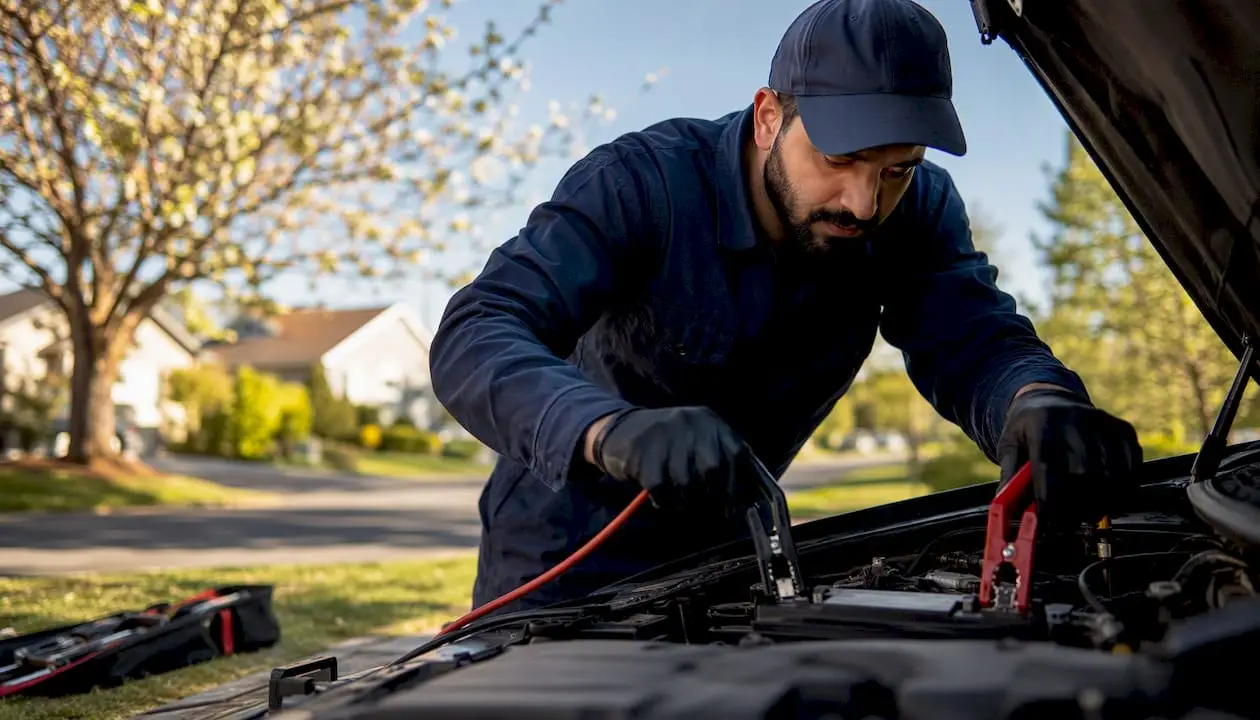
- Battery jump-start or replacement: 15–30 minutes; replacement batteries are standard van stock
- Flat tire repair or change: 10–30 minutes
- Fuel delivery: 15–20 minutes once the tech arrives
- Starter or alternator diagnosis and minor replacement: 45–90 minutes
- Minor electrical fixes (blown fuses, loose connections): 20–45 minutes
- Cooling system top-off (coolant, water): 15–20 minutes
- Basic diagnostics and error-code resets: 20–40 minutes
Practical rule of thumb: If your car cranks but won’t start, that is often an on-site fix (fuel, spark, sensor). If it doesn’t crank at all and there is no electrical response, a tow to a shop with a lift is likely the faster path.
Some repairs genuinely require shop equipment. Major engine rebuilds, full transmission work, major structural or body repairs, and anything requiring a two-post or four-post lift fall outside what a mobile tech can safely complete on a roadside or in a parking lot. Knowing that boundary upfront saves everyone time. For a clear breakdown of mobile repair versus a workshop visit, the decision usually comes down to whether the repair needs the vehicle raised off the ground.
When should you call a tow truck instead?
Some situations make on-site repair unsafe or physically impossible. Call a tow truck directly in any of these cases:
- Heavy smoke, active fire, or a burning electrical smell that persists after shutdown
- Complete brake failure or loss of steering
- Driveline damage (broken axle, seized wheel)
- Major fluid loss that leaves the vehicle unable to run safely even for a short distance
- Severe collision damage affecting structural integrity
- Vehicle submerged or partially submerged in water
- No crank, no electrical response, and no obvious cause
The decision rule is straightforward: if safety is compromised or the repair requires specialized shop equipment, tow first and diagnose second. Trade standards also prohibit referral-fee arrangements between repair shops and towing services, so a reputable shop will never pressure you toward a specific tow company for financial reasons. You have the right to choose your own tow provider.
For a direct comparison of when a mobile mechanic makes more sense than a tow truck, this practical guide walks through the decision criteria clearly.
How long will repairs take, and what will they cost?
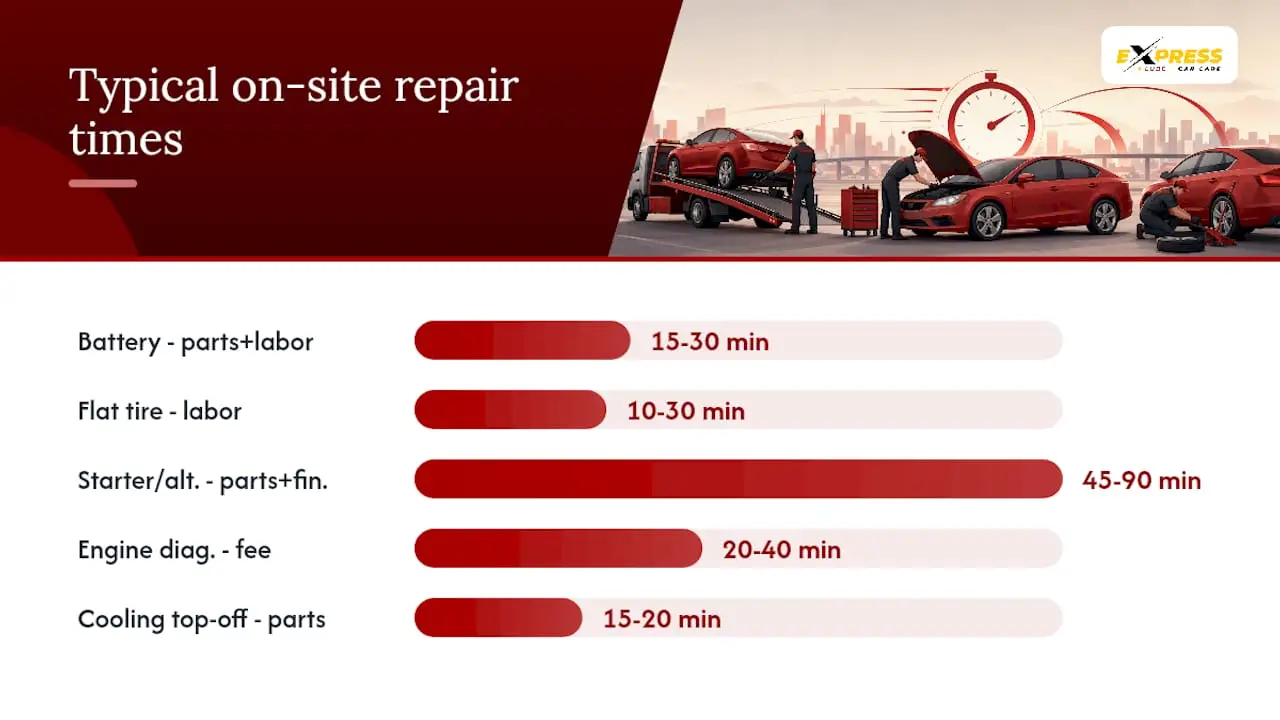
Typical response and repair windows:
- Mobile tech dispatch: 30–60 minutes under normal conditions; urban areas are often faster
- Battery jump or replacement: 15–30 minutes on-site
- Flat tire change: 10–30 minutes
- Starter or alternator replacement: 45–90 minutes
- Engine diagnostic scan: 20–40 minutes
Traffic, weather, and parts availability all affect actual arrival time. A tech who stocks the needed part will always finish faster than one who has to source it mid-job.
Cost and payment:
Diagnostic fees vary by provider and repair type. The most reliable way to avoid surprises is to request an itemized, upfront estimate before any work begins. Digital inspections with photos and written technician notes, a standard part of Express Lube & Car Care’s process, reduce disputes because both parties can see exactly what was found and what was done.
| Repair Type | Typical Time on Site | Payment Notes |
|---|---|---|
| Battery jump/replace | 15–30 min | Parts + labor; upfront estimate |
| Flat tire change | 10–30 min | Labor; upfront estimate |
| Starter/alternator | 45–90 min | Parts + labor; financing available |
| Engine diagnostic | 20–40 min | Diagnostic fee; estimate before repair |
| Cooling system top-off | 15–20 min | Parts cost; upfront estimate |
Auto repair financing is available for customers who need to spread the cost of a larger repair. The New York Times has documented the rise of mobile and on-demand repair booking as a convenience trend that helps drivers avoid shop waits and get transparent pricing upfront.
How do you vet an urgent repair provider quickly?
Speed matters when you are stranded, but a rushed decision can lead to shoddy work or inflated bills. Run through this checklist while you are still on the phone:
- Ask for ASE certification. The ASE Blue Seal of Excellence identifies shops where a substantial share of staff hold current ASE credentials. A certified tech is trained to follow OEM repair procedures, which matters for both quality and your warranty.
- Confirm the response time. Get an estimated arrival window before you agree to anything.
- Ask about the warranty. A reputable provider backs labor and parts. Express Lube & Car Care’s repair warranty is published and verifiable.
- Request a digital inspection with photos. This protects you and the technician.
- Get an itemized estimate before work starts. No legitimate shop refuses this.
- Confirm accepted payment methods and whether financing is available.
Red flags to watch for:
- Refuses to provide a written estimate before starting work
- Demands full payment upfront before any diagnosis
- Cannot name a certification or credential when asked
- Provides no receipt, inspection report, or photos after the job
Finding a reliable local or mobile mechanic quickly is easier when you know what questions to ask. The checklist above takes under two minutes and filters out the providers most likely to cause problems.
Why Express Lube & Car Care is a reliable choice for urgent repairs
Express Lube & Car Care offers same-day in-shop service with no appointment required, backed by ASE-certified technicians and a 24-month/24,000-mile warranty on covered repairs. That combination of speed, credentials, and a written guarantee is what separates a dependable urgent repair option from a gamble.
What you get at Express Lube & Car Care:
- No-appointment-needed service for immediate, walk-in visits
- Digital vehicle inspections with photos and technician notes
- ASE-certified technicians across all service categories
- Services covering oil changes, brake repairs, engine diagnostics, battery replacement, tire service, A/C, and suspension
The digital inspection process deserves specific mention. When a technician photographs findings and attaches written notes, you have a clear record of what was found, what was repaired, and what was recommended for later. That documentation reduces disputes and gives you something concrete to reference if a related issue comes up down the road.
Pro Tip: Ask the service advisor to walk you through the digital inspection photos before you approve any repair. It takes two minutes and gives you full visibility into what the technician found.
Key takeaways for urgent car repair
When you need immediate help, the fastest path is a same-day, no-appointment service with ASE-certified technicians, a written warranty, and transparent upfront pricing.
| Point | Details |
|---|---|
| Act immediately on urgent symptoms | Smoke, fluid leaks, brake failure, and a flashing check-engine light all require a call now, not later. |
| Prioritize safety first | Move off the road, activate hazards, shut off the engine if needed, and document the scene before help arrives. |
| Know what mobile techs can fix | Battery, flat tire, starter, alternator, and basic diagnostics are common on-site fixes in 15–90 minutes. |
| Vet the provider in two minutes | Confirm ASE certification, response time, warranty, and upfront estimate before agreeing to any work. |
| Express Lube & Car Care | Same-day, no-appointment service with ASE-certified techs, a 24-month/24,000-mile warranty, and financing available. |
What most urgent repair guides get wrong
The standard advice in most emergency car repair articles follows a predictable pattern: pull over, call a tow truck, wait at a shop. That advice is not wrong, but it is incomplete in a way that costs drivers time and money.
The more useful insight is that the tow-first default is often unnecessary. A large share of roadside breakdowns involve a battery, a flat tire, a failed starter, or a simple sensor fault. All of those are resolvable on-site by a qualified technician with a stocked van, usually in under an hour. Defaulting to a tow when a mobile tech could handle the job means paying a tow fee, waiting for a shop opening, and potentially losing a full day.
The second gap in conventional advice is the vetting step. Most guides tell you to “find a reputable shop” without explaining what that means under pressure. ASE certification is the clearest single credential to ask for, because it ties the technician to a national standard with a verifiable credential. The Blue Seal of Excellence goes further, indicating that a shop has invested in certifying a meaningful portion of its staff, not just one person.
The third thing most guides underemphasize is documentation. A digital inspection with photos is not a luxury feature. It is the mechanism that keeps both the customer and the shop honest about what was found, what was done, and what was left for a future visit. Insisting on it takes thirty seconds and protects you from disputes later.
Same-day urgent repair in Plano, with no appointment needed
When a breakdown happens, you need a shop that can take you now, not next Tuesday. Express Lube & Car Care in Plano handles urgent repairs the same day, with no appointment required, ASE-certified technicians, and a 24-month/24,000-mile warranty on covered work. Whether you need brake service, an engine diagnostic, a battery swap, or a full inspection, the shop is set up to move quickly without cutting corners.
Financing is available for customers who need it, and every repair comes with a digital inspection report with photos so you know exactly what was done. Check current service specials or book your visit at Expresslubeplano to get same-day help today.
Sources
- About ASE – The National Institute for Automotive Excellence
- How to Tell Whether a Car Problem Is Urgent or Can Wait – Car Tech Upgrade
- Emergency Mobile Car Repair in Dubai: What You Need to Know
- Accepted trade standards – Bureau of Automotive Repair
- Car repairs a click away, without the fuss and bother – The New York Times
FAQ
What is considered an emergency car repair?
Any symptom that makes the vehicle unsafe to drive counts as an emergency: brake failure, loss of steering, active fluid leaks, overheating, a flashing check-engine light, or smoke from the engine bay. A steady check-engine light with no driveability issues is lower urgency and can usually wait for a scheduled visit.
What is the $3,000 rule for cars?
The rule of thumb is that if a repair costs more than the vehicle’s value, replacing the car may be more economical than repairing it. This is a rough guideline, and the actual decision depends on the vehicle’s overall condition, mileage, and remaining useful life.
How do you pay for car repairs when you have no money?
Many shops, including Express Lube & Car Care, offer auto repair financing that lets you spread the cost over time. Credit cards, roadside assistance plans, and manufacturer warranty coverage are other common options depending on the repair type and vehicle age.
Where can I work on my car if I have no garage?
Many municipalities allow minor repairs in a private driveway or a designated parking area, though local ordinances vary. For anything beyond a basic fluid check or tire swap, a professional shop with a lift is safer and faster. Express Lube & Car Care accepts walk-ins with no appointment, making it a practical option when you need a workspace and qualified tools.