

Hearing your vehicle needs a new transmission is a daunting experience, and the first question is always the same: How much is this going to cost?
For most drivers, the cost to replace a transmission falls between $3,000 and $8,000. On more complex luxury vehicles or heavy-duty trucks, that figure can climb to $10,000 or more. This wide range exists because a transmission replacement is not a one-size-fits-all procedure; it is a highly specialized repair tailored to your specific vehicle.

A Quick Guide to Transmission Replacement Costs
A transmission replacement is one of the most significant and expensive repairs a vehicle owner can face. Understanding the components of the price is the first step toward making an informed decision. The final estimate is not an arbitrary figure—it is a detailed combination of the replacement unit, the intensive labor required for installation, and the essential fluids needed for operation.
The transmission is a critical system that transfers power from the engine to the wheels, enabling your vehicle to move. The mechanical and electronic systems in a standard sedan are fundamentally different from those in a complex all-wheel-drive SUV, which is a primary reason for the wide variation in repair costs.
While the potential cost can be significant, understanding the breakdown of expenses—parts, labor, and fluids—allows you to evaluate an estimate with greater clarity and ask pertinent questions.
Estimated 2026 Transmission Replacement Costs by Vehicle Type
To provide a clearer picture of potential expenses, we have compiled typical cost ranges based on vehicle category. A major factor influencing the final cost is your choice between a rebuilt, remanufactured, or brand-new Original Equipment Manufacturer (OEM) transmission unit.
This table provides an overview of the average costs associated with each of these options.
| Vehicle Type | Rebuilt Transmission Cost | Remanufactured Transmission Cost | New (OEM) Transmission Cost |
|---|---|---|---|
| Compact Sedan (e.g., Honda Civic) | $2,500 – $4,000 | $3,000 – $5,000 | $4,500 – $6,500 |
| Mid-Size SUV (e.g., Toyota RAV4) | $3,000 – $5,500 | $3,500 – $6,000 | $5,500 – $7,500 |
| Full-Size Truck (e.g., Ford F-150) | $3,500 – $6,500 | $4,000 – $7,000 | $6,000 – $9,000+ |
| Luxury Vehicle (e.g., BMW 5 Series) | $4,500 – $7,500 | $5,000 – $8,500 | $7,000 – $10,000+ |
Note: These figures are estimated costs for 2026 and include both parts and labor. Actual prices will vary based on your specific vehicle, geographic location, and the chosen repair facility.
While these numbers serve as a helpful guide, it's important to view them as a starting point. The most effective way to manage repair expenses is to prevent major failures through consistent, preventative maintenance. You can learn more about proper transmission care in our guide to transmission service in Plano.
Next, we will explain in detail why these costs vary and which factors contribute to your final repair quote.
What Actually Goes Into Your Transmission Replacement Bill?
When a technician presents a quote for a transmission replacement, the total cost can be surprising. Why does one vehicle's replacement cost $3,000 while another is quoted over $7,000? This figure is not arbitrary; it is the sum of three distinct cost centers.
Your final bill is composed of the replacement transmission unit itself, the hours of skilled labor required for installation, and the specialized fluids that enable its function. Each element plays a crucial role in determining the final price.
- The Transmission Unit (Parts): This is the largest single expense. The cost varies significantly based on your vehicle's make and model and the type of replacement unit you select.
- Intensive Labor: This is a major, time-consuming procedure that demands a skilled technician and specialized tools.
- Essential Fluids and Supplies: A new transmission cannot operate without the correct type and volume of fluid, which is vital for its performance and longevity.
The Core of the Cost: The Transmission Unit Itself
The transmission assembly is almost always the most expensive component of the replacement. For example, a transmission for a common sedan like a Honda Civic is engineered for fuel efficiency and is produced in high volumes, which helps control its cost. In contrast, the transmission in a heavy-duty truck like the Ford F-150 is designed to manage immense torque for towing, requiring more robust—and therefore more expensive—materials and construction.
This cost is not just about physical size; it reflects the underlying engineering. The global transmission repair market was estimated at USD 141.69 billion in 2025 and is projected to reach USD 148.81 billion in 2026. With the average age of vehicles on the road now exceeding 12 years, complete transmission replacements are becoming increasingly common. You can explore how these trends impact consumer costs in this detailed industry report from Fortune Business Insights.
When you see the parts cost on an estimate, you are not just paying for a single component. You are paying for a complex electromechanical system specifically engineered for your vehicle's power, weight, and performance characteristics.
Understanding the Labor Charges
Many vehicle owners are surprised by the labor costs, but replacing a transmission is one of the most involved procedures a mechanic performs. It is far more complex than a simple parts swap.
The process is meticulous from start to finish. A technician must:
- Safely raise the vehicle on a lift.
- Drain all of the old transmission fluid.
- Systematically disconnect all components attached to the transmission, including driveshafts, axles, cooling lines, shift linkages, and the electronic wiring harness.
- Carefully lower the heavy, old transmission out of the vehicle, which often requires a specialized transmission jack.
- Maneuver the new transmission into place, ensuring precise alignment with the engine.
- Reconnect every hose, wire, and bolt to factory specifications.
- Fill the new unit with the exact type and amount of transmission fluid specified by the manufacturer.
- Program the vehicle's onboard computer (ECU/TCM) to communicate with the new transmission.
- Finally, perform an extensive road test to verify that all gears shift smoothly and the system functions correctly under various driving conditions.
This entire procedure takes anywhere from four to over ten hours, depending on the vehicle's design. All-wheel-drive (AWD) vehicles are even more labor-intensive because the transfer case and additional drivetrain components must also be removed and reinstalled, adding time and cost to the final bill.
New, Remanufactured, Rebuilt, or Used? Choosing Your Replacement
Receiving a diagnosis of complete transmission failure can be overwhelming, and the potential cost can seem prohibitive. However, you have several options. The final price of your repair will depend heavily on the type of replacement unit you choose.
Consider an analogy: if your smartphone breaks, you could buy a new one from the manufacturer, purchase a certified refurbished model, have a local shop repair your current one, or buy a used one from a third party. Each option presents a different balance of cost, reliability, and warranty coverage. Let’s examine the four main choices for your vehicle's transmission.
New OEM Transmissions: The Factory-Fresh Gold Standard
A new OEM (Original Equipment Manufacturer) transmission is exactly as it sounds—a brand-new unit produced by your vehicle's manufacturer. It is identical to the transmission that was installed in your vehicle at the factory.
This is the most expensive option, but it also guarantees the highest quality, perfect compatibility, and the latest engineering updates. Because it is new from the factory, it includes a comprehensive manufacturer warranty, offering the greatest peace of mind. If you intend to keep your vehicle for many years and want a no-compromise solution, a new OEM transmission is the premier choice.
Remanufactured Transmissions: The Smart-Value Pick
A remanufactured transmission is comparable to a factory-refurbished electronic device. A used transmission core is sent to a specialized facility where it is completely disassembled, professionally cleaned, and every component is inspected against factory specifications. Any worn, damaged, or outdated components are replaced with new or re-machined parts. Technicians often incorporate updated parts that correct known original design flaws, potentially making the unit more durable than the original.
This comprehensive process ensures that a remanufactured unit often provides reliability on par with a new one. These units typically come with excellent warranties, often for 1-3 years or more, making them an outstanding balance of cost and quality.
This flowchart illustrates how the type of part chosen is the first major decision point that influences the final cost.
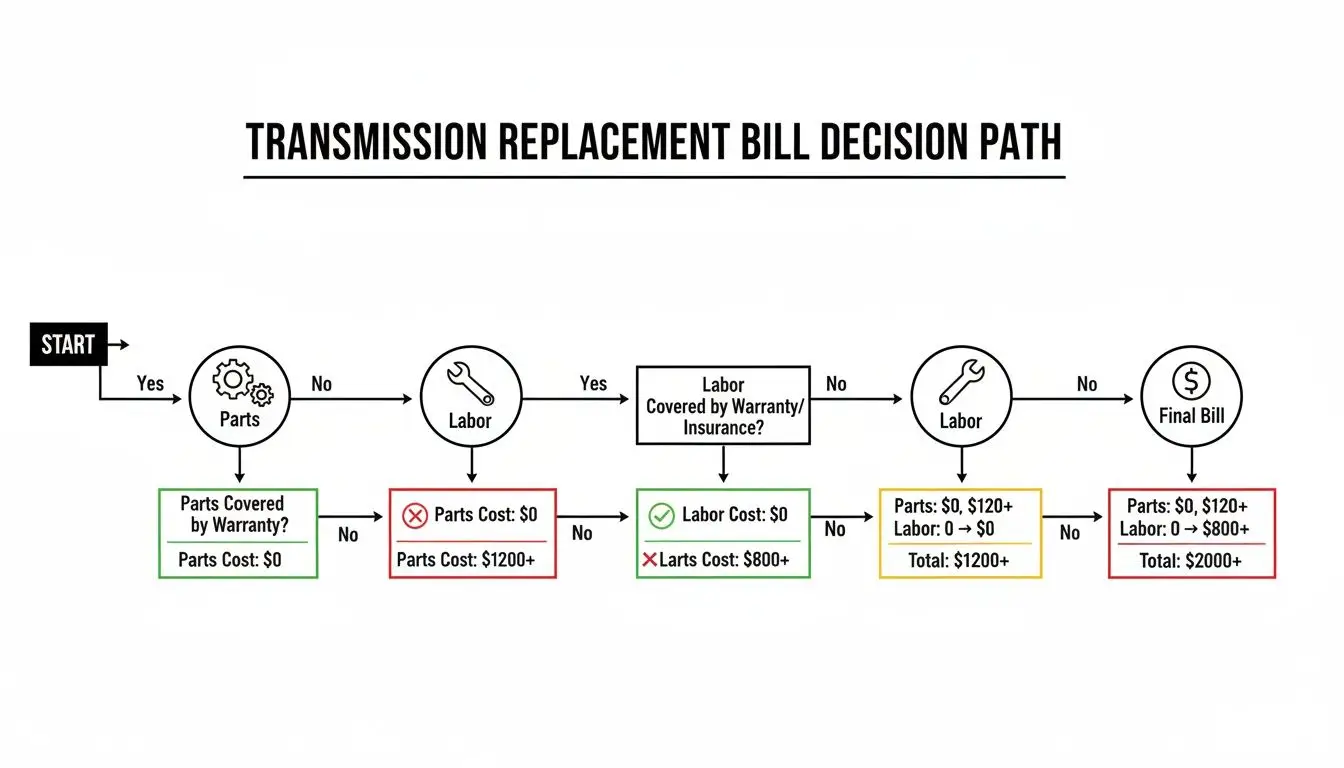
As shown, your choice of parts—new, remanufactured, rebuilt, or used—establishes the baseline cost for the entire repair before labor is even factored in.
Rebuilt Transmissions: The Hands-On Local Repair
A rebuilt transmission involves a technician removing your specific transmission from the vehicle, disassembling it on a workbench, identifying only the failed or worn-out components, and replacing them. The rest of the original parts are reused.
The quality of a rebuild is entirely dependent on the skill and experience of the individual mechanic. An expert technician can deliver a very reliable repair. The potential downside is that a rebuild might not address other components that are worn but have not yet failed. Furthermore, the warranty is typically provided by and limited to the specific shop that performed the work.
Used Transmissions: The Budget-Friendly Gamble
A used transmission is sourced directly from a salvaged or junked vehicle. This is, by a significant margin, the cheapest part available, and that is its primary (and often sole) advantage.
A used transmission represents the highest level of risk. While it offers the lowest upfront cost for the part, you risk having to pay for the same intensive labor a second time if the used unit fails prematurely.
The risk is substantial. You have no verifiable information about the unit's maintenance history, actual mileage, or the conditions under which it was operated. Warranties are typically very short—often 30 to 90 days—and usually cover only the cost of the part itself, not the expensive labor required to install a replacement if the first one proves defective.
Comparing Transmission Replacement Options
You have four distinct options, each with its own set of trade-offs. The best choice depends on your budget, how long you plan to own the vehicle, and your personal tolerance for risk. For many drivers, a remanufactured unit represents the optimal balance of value and reliability.
Choosing a remanufactured transmission can reduce the parts cost by up to 50% compared to a new OEM unit, while still delivering like-new performance and a robust warranty. It is a popular choice and a key segment of a market expected to grow from USD 8.85 billion in 2025 to USD 9.21 billion in 2026. You can explore more of the data by reviewing these transmission repair market insights.
This table summarizes the pros and cons of each option to help you make an informed decision.
Comparing Transmission Replacement Options
| Option | Average Cost | Typical Warranty | Pros | Cons |
|---|---|---|---|---|
| New (OEM) | Highest | Excellent (1-3 years) | Highest reliability; contains the latest factory-specified parts. | Most expensive option by a significant margin. |
| Remanufactured | High | Excellent (1-3 years+) | Like-new quality; includes engineering updates; great value. | More expensive than rebuilt or used options. |
| Rebuilt | Moderate | Varies (often limited) | More affordable than new or remanufactured units. | Quality depends on the technician; may not address all worn parts. |
| Used | Low | Very Limited (30-90 days) | The lowest upfront cost for the part. | High risk of premature failure; unknown history; minimal warranty. |
Ultimately, weighing these factors will help you determine the most appropriate solution for your vehicle and your financial situation.
An "average" cost for a transmission replacement provides a useful baseline, but it is rarely the final price you will pay. The total on your invoice can fluctuate significantly based on several key variables.
Think of it like booking air travel—the destination is fixed, but the final ticket price is influenced by your seat choice, the airline, and your travel dates. The same principle applies to your vehicle's repair. Understanding what drives the cost will help you establish a realistic budget and know what to ask when you receive a quote. Let’s examine the main factors.
Vehicle Make and Model
This is arguably the most significant cost driver. A transmission for a common domestic sedan is an entirely different component from one designed for a European luxury car or a heavy-duty truck.
Luxury and performance vehicles are engineered with highly specialized parts that are inherently more expensive. The engineering is also far more complex, meaning both the components and the labor to install them cost more. This is a classic example of high-performance engineering demanding high-cost components.
For trucks or luxury models, it is not uncommon for costs to reach the $4,000-$8,000 range. For instance, a Ford F-150 transmission rebuild can average $5,500 in Plano, reflecting parts inflation and the complexity of modern heavy-duty systems. This illustrates just how much vehicle choice impacts repair costs.
Transmission Type
Not all transmissions are engineered alike, and the specific type in your car directly affects the replacement price.
- Manual: Typically the simplest and most affordable to replace due to fewer complex internal parts.
- Automatic: The most common type in modern vehicles. Costs vary, but it is a well-understood repair for most experienced shops.
- Continuously Variable (CVT): Popular for their fuel efficiency, these transmissions are highly specialized. They often require a complete unit replacement rather than a repair, which increases the cost.
- Dual-Clutch (DCT): Found in many performance-oriented vehicles, these are extremely complex systems that require special tools and training to service, making them significantly more expensive to replace.
Drivetrain Configuration (FWD, RWD, or AWD)
How your car delivers power to its wheels also affects the amount of labor involved. A more complex drivetrain equates to more work—and thus more billable hours—for the technician.
Consider the task as a puzzle. A Front-Wheel Drive (FWD) vehicle is a 500-piece puzzle. An All-Wheel Drive (AWD) vehicle is a 1,000-piece puzzle with extra interlocking sections (like a transfer case) that must all be disassembled and reassembled with precision.
Due to this added complexity, an AWD or 4WD vehicle will almost always have a higher labor cost. Technicians must remove additional components like transfer cases and driveshafts just to access the transmission, adding hours to the job.
Your Geographic Location
Where the work is performed matters. Labor rates for skilled automotive technicians vary between cities and states.
A repair shop in a major metropolitan area with a high cost of living, such as Plano, TX, will naturally have higher hourly labor rates than a shop in a small, rural town. This difference alone can add several hundred dollars to the final bill.
Of course, the most effective way to avoid these high costs is to maintain your transmission's health. You can learn more about this in our educational guide on when to flush transmission fluid.
How to Save Money on Your Transmission Replacement
Learning you need a new transmission can feel like a major financial setback. However, even when faced with a significant repair bill, you have options to manage the final cost. The best strategy is always prevention, but if a failure has already occurred, you can still approach the replacement process intelligently.

Let's review some practical methods for reducing expenses, from proactive maintenance to making informed choices about repair shops and parts.
Prevention Is the Best Way to Save
The most affordable transmission replacement is the one you never have to perform. Think of regular maintenance as your primary defense against catastrophic failure. Your transmission fluid is its lifeblood; when it becomes old, contaminated, or low, it can no longer properly lubricate and cool the intricate moving parts, leading to accelerated wear and damage.
This is not just an opinion; it's supported by data. A 2024 industry report indicates that 60% of vehicle owners globally now prioritize preventive transmission service. The reason is financial: it can save them up to 30% on lifetime ownership costs by identifying and addressing small issues before they escalate. You can see the full findings in the transmission repair market report from SNS Insider.
If you notice red fluid spots under your vehicle, this is a critical warning sign. Refer to our guide on what to do if your car leaking transmission fluid to take immediate and appropriate action.
Shop Smart and Get Multiple Quotes
If a full replacement is unavoidable, do not accept the first price you receive. Treat this major repair like any other significant purchase and obtain at least two or three detailed, written estimates from reputable repair facilities.
However, do not base your decision solely on the final number. A low quote can conceal significant risks.
An excellent quote is about more than a low price. It details a quality part, includes a strong warranty, and comes from a shop with a reputation for standing behind its work. A low-ball offer with a 30-day warranty on a used part is a formula for paying for the same job twice.
Ensure every estimate clearly itemizes the costs for parts, labor, and fluids. Then, ask these critical questions:
- What type of part is being quoted? Is it a new, remanufactured, rebuilt, or used transmission?
- What is the duration and coverage of the warranty? A robust warranty (1-3 years) indicates the shop's confidence in its parts and workmanship.
- Does the warranty cover both parts and labor? This is a crucial detail. A "parts-only" warranty means you would still be responsible for labor costs if the replacement unit fails within the warranty period.
Look for Discounts and Special Offers
Many local auto shops offer programs to help community members save on services. At Express Lube & Car Care, we are proud to support those who serve the Plano area.
We offer $20 off oil changes and other services for:
- Military personnel
- First responders
- Healthcare workers
Taking advantage of discounts on routine maintenance can make it more manageable to afford larger, unexpected repairs. By combining consistent upkeep with intelligent consumer practices, you can mitigate the financial impact of a transmission replacement.
Answering Your Top Transmission Questions
Facing a major transmission repair is a stressful situation. Beyond the cost, you likely have questions about the repair timeline, whether the investment is worthwhile, and the next steps to take.
Here are straightforward answers to the questions we hear most frequently from drivers.
How Long Does a Transmission Replacement Take?
The timeline is dictated by the vehicle's complexity. A straightforward replacement on a common front-wheel-drive car can often be completed in one to two business days.
This typically translates to 4-8 labor hours.
For more complex all-wheel-drive systems or heavy-duty trucks, the job can easily extend to two or three days. Labor time can climb to 8-12 hours or more, especially if specific parts need to be ordered. A reputable shop will always provide a clear time estimate after performing an initial diagnosis.
Is It Worth Replacing a Transmission on an Older Car?
This is a critical question of value. A common guideline used by mechanics is the “50% rule.”
If the total cost of the repair exceeds 50% of the vehicle's current market value, replacing the vehicle may be a more financially sound decision.
However, cost is not the only factor. If the car's engine is in good condition, the body and frame are solid, and you have a consistent maintenance history, a new transmission could provide several more years of reliable service—for far less than the cost of a new vehicle. An honest mechanic can help you weigh the pros and cons for your specific situation.
What Are the Warning Signs of a Failing Transmission?
Identifying problems early is the best way to prevent a complete and costly failure. Your vehicle will almost always provide warning signs that a problem is developing.
Be vigilant for these key symptoms:
- Slipping Gears: The engine RPM increases, but the car fails to accelerate accordingly.
- Harsh or Delayed Shifting: You feel a noticeable jolt, clunk, or long pause when the transmission changes gears.
- A Burning Smell: This often indicates that the transmission fluid is overheating, a serious condition that can cause rapid damage.
- Whining or Clunking Noises: Any new or unusual sounds from the transmission area should be inspected immediately.
- Leaking Red Fluid: Automatic transmission fluid is typically bright red and has a distinct smell. A puddle under your car is a major red flag.
- Check Engine Light: The vehicle's onboard computer will often illuminate the light if it detects a fault within the transmission system.
If you notice any of these signs, have your vehicle inspected by a qualified technician as soon as possible. An early diagnosis can be the difference between a minor repair and a full replacement.
Can I Keep Driving with a Bad Transmission?
We strongly advise against it. Continuing to operate a vehicle with a faulty transmission is a significant risk that can escalate a repairable problem into a catastrophic failure, leaving you stranded.
You risk causing irreversible damage to internal components that might have otherwise been salvageable. The safest and most cost-effective action is to have your vehicle towed to a trusted repair shop for a professional diagnosis.
A potential transmission failure is a serious automotive issue, but you don't have to navigate it alone. The ASE-certified technicians at Express Lube & Car Care possess the expertise to accurately diagnose your vehicle and provide clear, honest options. Whether it requires a fluid service or a complete replacement, we are here to help you make the best decision for your vehicle and your budget. Visit us in Plano today for a professional inspection.