

When the check engine light illuminates your dashboard, it's a clear signal from your vehicle that something requires attention. For drivers seeking clear and reliable engine diagnostics in Plano, understanding this warning is the first step. The cause could range from something as simple as a loose gas cap to a more complex engine issue, and a professional diagnostic service is the definitive way to determine the cause.
The Check Engine Light is On — What Does It Mean?
Consider that glowing amber symbol as your car's primary method of communication, indicating a potential issue. It's a general alert generated by your vehicle's onboard computer system, not a specific diagnosis. This is analogous to a person having a fever; you know something is wrong, but you don't yet know the underlying cause or its severity.
This warning originates from the Engine Control Unit (ECU), which functions as the central computer of your vehicle. When any of the numerous sensors—monitoring the engine, transmission, or exhaust system—sends a reading that falls outside of its normal operational parameters, it triggers the check engine light. The purpose is not to cause alarm, but to prompt you to seek a professional evaluation before a minor issue can escalate into a significant repair.
Differentiating a Steady vs. a Flashing Light
It is essential to understand the distinction between a steady and a flashing check engine light, as they convey different levels of urgency.
- A Steady Light: This is the most common scenario. It indicates that a non-critical fault has been detected. While you do not need to pull over immediately, you should schedule an engine diagnostics appointment in Plano at your earliest convenience to prevent potential long-term damage.
- A Flashing Light: This signifies a serious issue. A blinking light almost always points to a severe engine misfire, a condition where one or more cylinders are not firing correctly. This can rapidly damage expensive components like the catalytic converter. If you see a flashing light, it is crucial to pull over safely and turn off the engine as soon as possible.
A flashing check engine light indicates a critical engine malfunction. Continuing to drive can lead to severe and costly damage. It is your vehicle's most urgent warning.
Ignoring either light is inadvisable. While a steady light might be due to a minor fault, it could also be an early indicator of a failing oxygen sensor. You can learn more about common causes in our detailed article here. Ultimately, the light is just a symptom. The necessary next step is to have a professional technician translate this general warning into a specific, actionable solution for your vehicle.
Understanding the Engine Diagnostics Process
What exactly does "engine diagnostics" entail? Let's examine the technology and methodology involved. Modern vehicles are sophisticated machines, essentially computers on wheels, equipped with an extensive network of sensors that continuously communicate with one another. These sensors monitor a vast array of parameters, from the engine's air-fuel mixture and ignition timing to the composition of exhaust gases.
Think of this network as your car's nervous system. Just as touching a hot surface sends an immediate signal to your brain, a sensor detecting an abnormal reading in your car sends a specific Diagnostic Trouble Code (DTC) to the Engine Control Unit (ECU). This code is the first piece of data in the diagnostic puzzle.
This infographic helps illustrate the two main signals your check engine light provides.
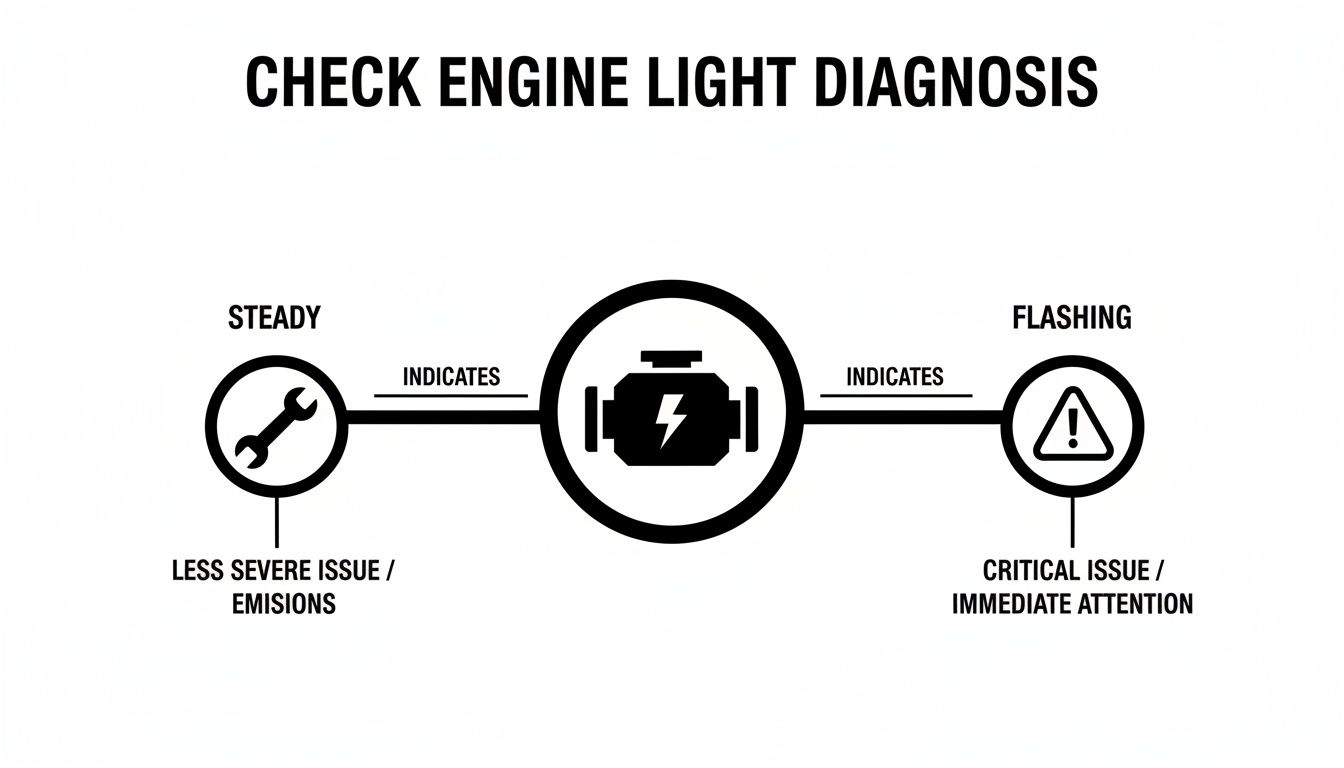
As shown, a steady light is a prompt for a timely check-up, whereas a flashing light is an urgent call for immediate action.
The Role of Professional Diagnostic Tools
When you bring your vehicle to a professional facility like Express Lube Plano, our ASE-certified technicians utilize advanced OBD-II (On-Board Diagnostics II) scanners. This specialized equipment interfaces directly with your car's ECU through a standardized port, allowing us to retrieve the stored DTCs.
However, retrieving the code is merely the first step in a comprehensive diagnostic process. A single code rarely provides the complete picture.
For example, a DTC might indicate a fault with an oxygen sensor. While the sensor itself could be failing, the root cause might be an underlying issue—such as a vacuum leak or a faulty fuel injector—that is causing the sensor to produce an incorrect reading. The global market for automotive diagnostic scan tools, valued at USD 33.1 billion in 2021 and projected to reach USD 41.4 billion by 2026, highlights the critical role these tools play in maintaining modern vehicles.
Beyond the Code: The Importance of Expert Interpretation
This is where the knowledge and experience of a skilled technician become indispensable. Reading a trouble code is not a diagnosis; it's the identification of a symptom. Our technicians in Plano use that code as a starting point for a more thorough investigation.
A Diagnostic Trouble Code indicates where a symptom is being reported but does not always explain why it is occurring. Expert analysis is required to identify the root cause and avoid unnecessary repairs.
Our technicians combine the data from the OBD-II scanner with a deep understanding of vehicle systems and hands-on expertise. This diagnostic investigation often involves:
- Analyzing live data streams to observe how various systems are performing in real-time.
- Conducting visual inspections of associated components for signs of wear, damage, or leaks.
- Performing targeted tests on specific parts to confirm whether a failure has occurred.
This systematic approach to engine diagnostics in Plano ensures we accurately identify the precise problem. By avoiding guesswork, we perform the correct repair the first time, saving you the frustration and expense of replacing parts that were not the source of the issue. To learn about some common triggers, check out our guide on what causes the check engine light.
Warning Signs That Your Car Needs a Diagnostic Test
While the check engine light is the most direct indicator, your vehicle often provides other clues that a problem is developing. Learning to recognize these signs can help you address a minor issue before it evolves into a major, costly repair here in Plano.
Think of these early warnings as your vehicle's attempt to communicate a problem. Ignoring them is like disregarding a persistent cough—it may be benign, but it could also be a symptom of a more significant underlying condition that requires professional attention.
Common Vehicle Warning Signs and Potential Causes
It can be challenging to link a specific sensation, sound, or smell to a particular vehicle component. This table serves as a quick reference for common symptoms that signal the need for a diagnostic test.
| Warning Sign | What It Feels/Sounds/Smells Like | Potential Problem Area |
|---|---|---|
| Check Engine Light | A steady or flashing light on your dashboard. | Can range from a loose gas cap to a severe engine misfire. |
| Rough Idling | The vehicle shakes, vibrates, or shudders when stationary. | Issues with spark plugs, ignition coils, or vacuum leaks. |
| Unusual Noises | Knocking, pinging, hissing, or grinding sounds from the engine. | Problems with engine timing, fluid leaks, or worn belts. |
| Decreased Fuel Economy | Needing to refuel more frequently than usual. | Faulty oxygen sensors or fuel system malfunctions. |
| Reduced Power | The vehicle feels sluggish and lacks acceleration. | Clogged filters, fuel pump issues, or exhaust system restrictions. |
| Difficulty Starting | The engine cranks but struggles to turn over. | Problems with the battery, starter, or fuel delivery system. |
| Strange Smells | Odors of burning oil, rotten eggs, or sweet syrup. | Oil leaks, catalytic converter failure, or coolant leaks. |
If you observe any of these signs, it is wise not to wait for them to worsen. A prompt diagnostic check can save you significant time and expense in the long run.
Performance and Fuel Efficiency Issues
A noticeable decline in your vehicle's performance is a major red flag. You are most familiar with how your car should operate, so pay attention when its behavior changes.
Is your vehicle consuming more fuel? If you find yourself at the gas station more often without a change in your driving habits, it's a sign your engine is operating inefficiently. This is often caused by a malfunctioning oxygen sensor, which is crucial for maintaining the correct air-fuel mixture. You can learn more in our guide to recognizing bad O2 sensor symptoms.
A sudden decrease in fuel economy is more than an inconvenience—it's a clear indicator that your engine's efficiency is compromised. A diagnostic test can quickly identify the electronic or mechanical fault responsible.
Other telltale signs include an engine that is hard to start, stalls at intersections, or feels unresponsive during acceleration. These symptoms can point to a range of issues, from a failing fuel pump to a clogged air filter. The only way for Plano drivers to know for certain is with an engine diagnostic service that can accurately pinpoint the cause.
What to Expect During Your Diagnostic Check at Our Shop

We understand that bringing your car in for a diagnostic test can seem daunting. At Express Lube Plano, we are committed to a transparent process, ensuring you are fully informed about your vehicle's condition from start to finish. Our objective is to demystify engine diagnostics for Plano drivers by providing clear, understandable information.
For your convenience, no appointment is ever necessary. Simply visit us when you notice a problem.
Our Step-by-Step Diagnostic Process
From the moment you arrive, our focus is on accurately identifying the issue with your car. Our process is designed for precision and efficiency.
-
Initial Consultation: The process begins with a conversation. We'll ask you to describe the symptoms you've noticed—any unusual sounds, changes in performance, or warning lights. Your firsthand account provides our technicians with valuable initial clues.
-
OBD-II Scan: An ASE-certified technician will connect a professional-grade OBD-II scanner to your vehicle's diagnostic port. This tool retrieves all logged Diagnostic Trouble Codes (DTCs), providing an immediate digital report from your car's sensors.
-
Expert Code Interpretation and Verification: This is where true expertise is applied. A trouble code is a starting point, not a final answer. Our technicians use the code to guide their investigation, analyzing live sensor data and performing a physical inspection to confirm the root cause of the fault.
A diagnostic code directs our attention, but accuracy is achieved by combining advanced technology with a mechanic's hands-on experience. We diagnose the cause, not just the symptom.
This methodical approach eliminates guesswork. Rather than replacing a part based solely on a code, we verify the component failure first. This practice saves you time and protects you from paying for unnecessary repairs.
Clear Explanations and Honest Estimates
Once we have pinpointed the issue, we will communicate our findings to you directly. We want you to feel confident and empowered to make an informed decision.
We will explain the problem in plain language, showing you the faulty component whenever possible. You will receive a clear, itemized estimate for the required repairs, free of pressure or hidden fees. Our goal is to provide honest advice so you can choose the best course of action for your vehicle and get back on the road safely.
How Diagnostics Save You Time and Money

While it might be tempting to view a diagnostic test as an added expense, it is one of the most cost-effective investments you can make in your vehicle's health. It is your best defense against the costly and frustrating cycle of trial-and-error repairs. Instead of a mechanic replacing parts based on speculation, diagnostics allow us to target the exact source of the problem.
Professional engine diagnostics in Plano precisely identify the issue, ensuring you only pay for the specific labor and parts your car truly needs. This makes it an invaluable tool for controlling repair costs.
Preventing Small Problems from Becoming Major Failures
Consider a diagnostic scan as a form of preventative care for your vehicle. Addressing a minor issue today—such as a failing sensor or a small vacuum leak—can prevent a catastrophic failure in the future. When left unaddressed, these small faults can cause a domino effect, leading to the failure of major, expensive components.
Here are a few examples of how diagnostics can prevent costly repairs:
- Protecting the Catalytic Converter: Early detection of an engine misfire prevents unburned fuel from entering the exhaust system, where it can overheat and destroy this critical and expensive emissions component.
- Saving the Engine: A simple test that identifies a failing oil pressure sensor can prevent you from operating the engine with insufficient lubrication, which would lead to complete engine failure.
- Preserving Fuel Efficiency: A faulty oxygen sensor can significantly increase fuel consumption. A quick diagnosis and replacement can save you hundreds of dollars at the gas pump annually.
By being proactive, you can transform a potential crisis costing thousands into a manageable, routine maintenance item.
Your vehicle's reliability is a matter of accuracy, not luck. A diagnostic test is your best defense against unexpected breakdowns and escalating repair bills.
The True Cost of Guesswork
For busy Plano drivers, time is as valuable as money. An unexpected breakdown on the Dallas North Tollway during peak traffic is more than an inconvenience—it can disrupt your entire schedule. Professional diagnostics are focused on returning you to the road safely and efficiently.
Modern vehicles contain complex electronic systems that require sophisticated tools for accurate assessment. In fact, industry data shows that early fault detection can reduce repair costs by up to 30% in some scenarios. This demonstrates that diagnostics effectively minimize downtime and keep you moving. You can learn more about how technology is advancing vehicle maintenance in this market report.
Common Questions About Engine Diagnostics
We understand that a warning light on your dashboard can bring up many questions. Here are clear answers to the inquiries we hear most often from Plano drivers.
How Much Does an Engine Diagnostic Test Cost?
The diagnostic fee covers the expert time of an ASE-certified technician and the use of specialized scanning equipment to accurately identify the problem with your vehicle.
Once we have determined the root cause, we will provide you with a clear, separate estimate for the actual repair. This ensures there are no surprises.
How Long Does a Diagnostic Check Take?
We respect your time. For most vehicles, the initial scan and code retrieval can be completed in under an hour. This provides you with a quick, reliable assessment so you can make an informed decision about the next steps without a lengthy wait.
The true value of a professional diagnostic is not just in reading a code, but in the expert analysis that follows. This ensures we fix the correct problem the first time.
Is It Safe to Drive with the Check Engine Light On?
Even if your car seems to be driving normally, ignoring the check engine light is a significant risk. It serves as your vehicle's early warning system.
A minor issue today, like a faulty sensor, can escalate into a major component failure tomorrow. This often results in a much higher repair bill and an increased risk of a breakdown.
What is the Difference Between a Free Scan and a Professional Diagnostic?
A complimentary scan offered by an auto parts store typically only retrieves the basic trouble code. It tells you which system has registered a fault, but not why.
A professional engine diagnostics service in Plano is far more comprehensive. Our technicians use the code as a starting point, then perform in-depth analysis of live data and conduct physical tests to confirm the true cause. This process prevents you from purchasing and installing parts you do not need.
Don't let a warning light create uncertainty. For fast, accurate, and honest diagnostics, trust the ASE-certified team at Express Lube & Car Care. We will identify the problem and get you back on the road with confidence. Stop by today—no appointment needed!
Learn more about our full range of automotive services here.