

If your engine stalls only at idle, restricted airflow or a failing idle-control sensor is almost always the reason, not a catastrophic engine failure. Normal idle sits between 600 and 800 RPM, and anything that drags the engine below roughly 400 to 500 RPM can kill it. Scan for trouble codes first. If the stalls repeat or the check engine light flashes, stop driving and get the car looked at rather than risk losing steering or braking assist in traffic.
TL;DR:
- Most idle stalls are caused by restricted airflow or faulty sensors, especially when RPM drops below 400 to 500, risking loss of steering and braking assist.
- Carbon buildup, vacuum leaks, and contaminated MAF sensors are the most common culprits, often recoverable with cleaning and inspection rather than part replacement.
- Diagnostic steps like scanning trouble codes, listening for intake hissing, and checking fuel pressure help pinpoint the cause before costly repairs.
- Engine stalls more often occur under load or after driving at high temperatures due to heat soak affecting sensors or electrical components.
- Transmission issues, such as a worn torque converter, can also cause stalls when shifting into drive, especially at low idle RPMs.
Table of Contents
- Why Engine Idle Problems Happen and What the RPM Numbers Mean
- Common Causes of Stalling Issues at Idle
- A Step-by-Step Diagnostic Checklist for Idle Stalling
- DIY Fixes and Cautions Before Calling a Technician
- When to Stop Driving or Call for a Tow
- What Express Lube & Car Care’s Technicians Check
- How Temperature and Altitude Affect Idle Stalling
- Could a Software or ECU Problem Be Causing the Stall?
- Can a Dirty EGR Valve Cause Idle Stalling?
- Can Transmission Problems Cause Stalling at Idle?
- Our Take on Chasing Idle Stalls the Right Way
- Schedule a Diagnostic Visit for Your Idle Stalling Issue
- Sources
- FAQ
Why Engine Idle Problems Happen and What the RPM Numbers Mean
Idle is the hardest speed for an engine to hold steady. At highway speed, the throttle is open and airflow is generous, so small sensor errors or minor vacuum leaks barely register. At idle, the engine survives on a thin, carefully metered trickle of air and fuel, which leaves almost no margin for error.
Pro Tip: If your car idles fine in park but stalls only when you shift into drive or stop at a light, focus on load-related causes like a failing torque converter or a vacuum leak that only becomes noticeable under engine load. Idle behavior in neutral versus in gear is one of the most useful diagnostic clues you can note before a technician even opens the hood.
Most gasoline engines idle between 600 and 800 RPM, and modern engine computers work constantly to hold that range against changing loads like the A/C compressor kicking on or the power steering pump working through a tight turn. Once RPM falls toward 400 to 500, the engine usually cannot generate enough momentum to keep spinning against friction and accessory drag, and it stalls.
Modern vehicles complicate this further with drive-by-wire throttle systems. There’s no physical cable connecting your gas pedal to the throttle plate anymore. Instead, a position sensor reads pedal input, the engine control module calculates the correct throttle angle, and a motor moves the throttle plate to match. An idle air control valve or an electronic throttle body handles the fine adjustments needed to hold idle speed. When any link in that chain reads wrong or responds late, the RPM can dip below the stall threshold before the system corrects.
A stalled engine at a stoplight isn’t just an inconvenience. It shuts off power steering assist and cuts vacuum-assisted brake boost, meaning your steering suddenly gets heavy and your brake pedal gets stiff right when you need both to work normally. That’s the real reason a repeat idle stall deserves prompt attention rather than a shrug.
Common Causes of Stalling Issues at Idle
Idle stalling almost always traces back to one of six systems. Working through them in order of likelihood saves time and avoids replacing parts that were never the problem.
- Throttle body and idle control carbon buildup: Carbon deposits from crankcase blow-by gases can restrict airflow passages in the throttle body or idle air control valve by 20 to 30 percent, which is often enough to choke idle airflow while leaving highway performance untouched.
- Vacuum leaks: A cracked hose, a loose intake gasket, or a failed PCV valve lets unmetered air into the engine, which shows up almost exclusively at idle because that’s when the engine is most sensitive to extra air throwing off the fuel mixture.
- MAF sensor contamination: Dust or oil residue on the mass airflow sensor’s hot wire sends a false reading to the computer; unplugging the MAF temporarily often smooths out or changes the stalling pattern, which is a useful field clue.
- Fuel delivery problems: A weak fuel pump or a clogged fuel filter usually causes stalling under load or acceleration rather than at idle alone, so this points more toward driving stalls than pure idle stalls.
- Ignition and sensor faults: An intermittent crankshaft or camshaft position sensor, or worn spark plugs, can cause misfires severe enough to stall the engine, often with no consistent pattern.
- Charging system issues: A failing alternator or a weak battery connection can starve the ignition and fuel systems of stable voltage, producing erratic stalls that seem to come and go for no reason.
A Step-by-Step Diagnostic Checklist for Idle Stalling
Work through these steps in order rather than jumping straight to parts replacement.
- Scan for trouble codes and capture freeze-frame data. Freeze-frame data records the exact RPM, coolant temperature, and throttle position at the moment a code set, which is far more useful than the code alone for pinpointing the failure.
- Note the conditions under which it stalls. Cold start versus fully warmed up, A/C running versus off, right after highway driving versus a short trip, all narrow the list of suspects considerably.
- Listen for a hissing sound near the intake or use a spray of carburetor cleaner around hose connections and gaskets. A sudden RPM change when the spray drifts near a leak point identifies the source.
- Unplug the MAF sensor briefly while idling, if your vehicle allows it safely, and note whether the idle changes noticeably.
- Check fuel pressure with a gauge if the earlier steps come up empty, or have a shop run this test if you don’t have one on hand.
DIY Fixes and Cautions Before Calling a Technician
A surprising number of idle-stall complaints clear up with cleaning alone, before anyone reaches for a wrench to swap parts.
- Clean the throttle body and idle air control valve with throttle-body cleaner and a soft brush, working carefully around the throttle plate edges where carbon builds thickest.
- Torque throttle body bolts to spec when reinstalling, typically in the 71 to 87 inch-pound range on many vehicles, since aluminum housings crack easily if you overtighten them.
- Use only MAF-specific sensor cleaner on the mass airflow sensor, and never touch the delicate wire element with a brush or cloth, since improper cleaning permanently damages it.
- Inspect and replace brittle or cracked vacuum hoses, which are cheap and often overlooked next to flashier suspects.
Pro Tip: Many vehicles need an idle relearn procedure after cleaning the throttle body or disconnecting the battery. Skip it and the computer may hold onto old idle values, making a fixed problem look unresolved.
When to Stop Driving or Call for a Tow
Some idle stalls are a nuisance. Others are a warning sign you shouldn’t drive past.
- Stop driving immediately if the check engine light flashes, if stalls happen more than once per trip, or if you notice the steering or brakes feel different right after a stall.
- Call for a tow if the engine stalls and won’t restart, or if it’s stalling repeatedly in moving traffic where a repeat failure puts you at real risk.
- Write down the pattern before you call a shop: which codes came up, whether it restarts right away, whether the A/C was running, and whether you’ve had any recent fuel fill-ups or fuel system work.
- Accurate symptom reporting paired with freeze-frame data lets a technician skip straight to testing rather than guessing.
What Express Lube & Car Care’s Technicians Check
Our ASE-certified technicians work through the same checklist outlined above: pulling codes and freeze-frame data, watching live sensor readings while the engine idles, running a vacuum test, checking fuel pressure, and inspecting the throttle body and MAF sensor. Because Express Lube & Car Care runs on a no-appointment-needed model, you can drive straight into the service lane with your notes on when and how the stalling happens, and we’ll take it from there.
How Temperature and Altitude Affect Idle Stalling
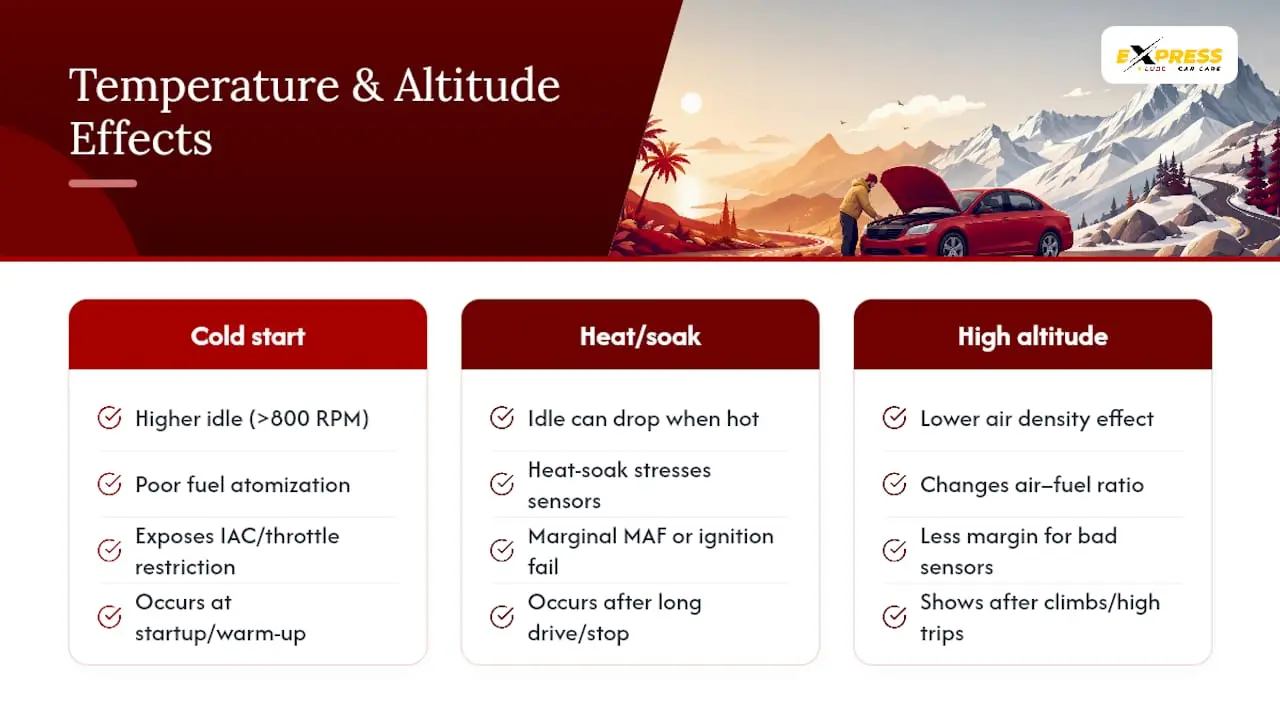
A cold engine idles differently than a warm one, and that difference matters more than most drivers realize. On startup, the engine control module commands a higher idle speed, often well above the normal 600 to 800 RPM range, to help the engine warm up faster and keep it running smoothly while fuel atomization is still poor in cold cylinders. If the idle air control valve or throttle body is already partially restricted by carbon, that extra demand can expose a stall that wouldn’t happen once the engine is fully warm.
Extreme heat creates a different problem. Under-hood temperatures climb, electrical connectors and sensors run hotter, and a marginal MAF sensor or a weak ignition component that works fine in cool weather can fail intermittently once things heat up. Heat soak after highway driving, where residual engine heat lingers around the throttle body and fuel system, is a common trigger for stalls that only show up after you’ve been driving a while and then stop.
Altitude plays a smaller but real role. Thinner air at higher elevations changes the air-to-fuel ratio the computer needs to calculate, and while modern engine control systems adjust automatically, a vehicle with an already struggling sensor has less margin to compensate. Drivers who notice stalling only after a long climb or a trip to higher elevation should mention that detail specifically when describing symptoms, since it points toward sensor calibration or airflow issues rather than a purely mechanical fault.
Could a Software or ECU Problem Be Causing the Stall?
Not every idle stall traces back to a physical part. Sometimes the engine control module itself is running on outdated calibration data or has lost its learned idle values, and the fix has nothing to do with cleaning or replacing anything.
Vehicles build a set of adaptive idle values over time, essentially a memory of what throttle position and fuel trim keep the engine running smoothly at rest. Disconnecting the battery, replacing the throttle body, or even a low battery voltage event can wipe or corrupt those learned values. When that happens, the engine may hunt for the right idle speed, surge, or stall until it relearns proper values, which sometimes requires a specific relearn procedure rather than just driving around and waiting.
Manufacturer software updates can also address idle stalling directly. Automakers occasionally issue calibration updates for the engine control module that adjust idle fuel trim tables or throttle response, particularly if a stalling pattern turns out to be a known issue across a model year. This isn’t something you can diagnose with a basic code reader. It requires a scan tool capable of reading manufacturer-specific calibration data and, in many cases, an internet connection to check for available updates. If cleaning, sensor checks, and vacuum tests all come back clean but the stalling continues, an ECU relearn or reprogramming check is worth raising with your technician.
Can a Dirty EGR Valve Cause Idle Stalling?
An EGR (exhaust gas recirculation) valve that sticks open at idle is a classic, if less common, cause of stalling that many owners overlook. The EGR valve’s job is to recirculate a small amount of exhaust gas back into the intake at specific driving conditions to reduce combustion temperatures and emissions. It’s supposed to stay closed at idle in most vehicles.
Carbon buildup inside the valve, the same kind of deposit that clogs throttle bodies, can prevent the EGR valve from seating fully closed. That lets exhaust gas leak into the intake at idle when the engine doesn’t want it there, diluting the air-fuel mixture with inert gas the engine can’t burn efficiently. The result is a rough, unstable idle that can drop low enough to stall, especially right after startup or when the engine is under the added load of the A/C compressor.
This symptom often mimics a vacuum leak or MAF problem closely enough that owners chase the wrong part first. One helpful distinguishing clue: EGR-related stalling tends to show up more consistently once the engine reaches operating temperature, since that’s when the EGR system is designed to be active, while a stuck-open valve keeps leaking exhaust gas even at idle when it shouldn’t. A technician can confirm this quickly by checking live EGR position data alongside RPM, which is exactly the kind of live-data monitoring covered in the diagnostic checklist above.
Can Transmission Problems Cause Stalling at Idle?
Automatic transmissions can absolutely contribute to idle stalling, and it’s a cause manual troubleshooting guides often skip entirely. The torque converter physically connects the engine to the transmission through fluid coupling, and when you shift from park into drive, that connection suddenly asks the engine to support a mechanical load it didn’t have moments before.
A torque converter with internal wear or a failing lockup clutch can create excessive drag at that moment, pulling RPM down sharply as soon as you shift into gear. If the engine was already idling on the low side, even a healthy load increase from the torque converter can be enough to drop it below the stall threshold. This is one reason a car that idles perfectly fine in park can stall the instant it’s shifted into drive or reverse.
Manual transmission vehicles face a related but different issue: a worn or improperly adjusted clutch can drag slightly even with the pedal depressed, adding unwanted load to the engine at idle. In either case, the fix isn’t in the engine bay at all, which is exactly why noting whether your stall happens in park, in neutral, or specifically after shifting into gear is one of the most valuable details you can hand a technician before diagnosis even begins.
Our Take on Chasing Idle Stalls the Right Way
Most idle-stall advice online jumps straight to replacing parts, and that’s backward. The research on this points clearly toward starting with cleaning and observation, not a parts cannon. A large share of stalling complaints trace back to carbon buildup or a vacuum leak that costs little to fix once you know where to look, and swapping a MAF sensor or throttle body before confirming the fault wastes money without fixing anything.
What gets underrated is the value of pattern recognition. Whether your car stalls only in park, only after shifting into gear, only when cold, or only after highway driving tells you more than any single trouble code. Write that pattern down before you touch anything.
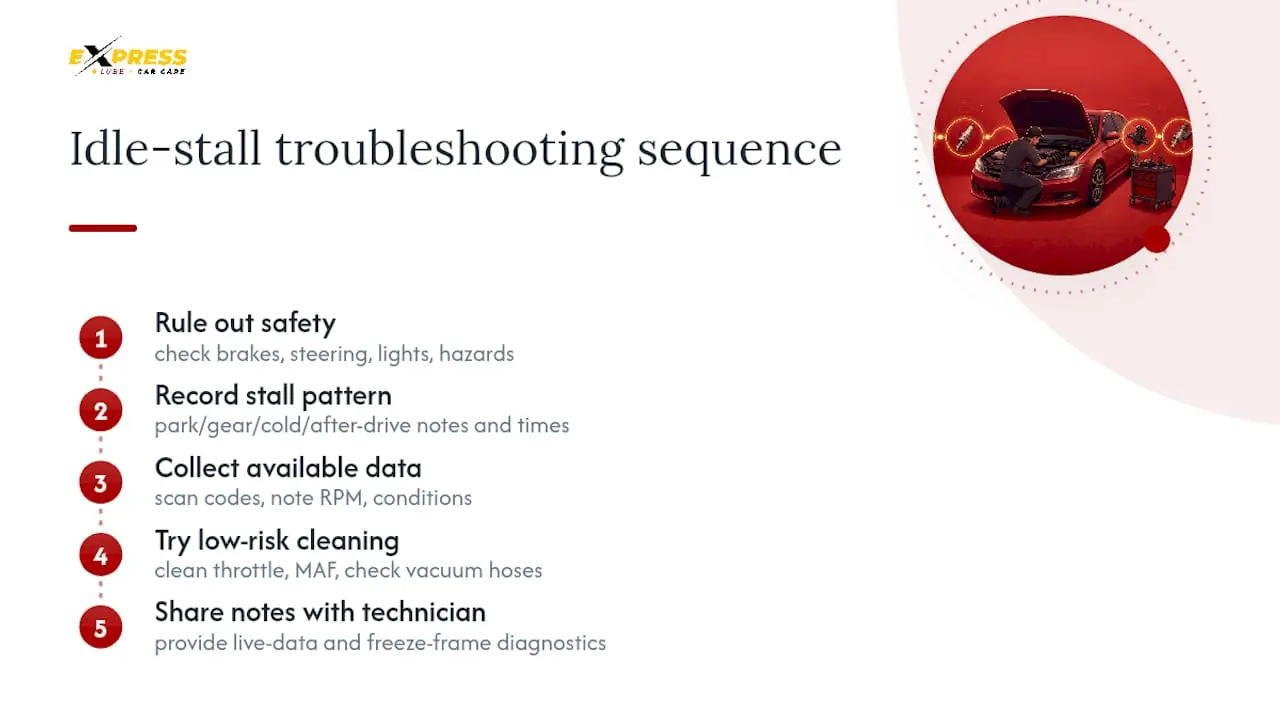
Our advice: rule out safety first, capture what data you can, try the low-risk cleaning steps, and bring your notes to a technician who can run live-data and freeze-frame diagnostics rather than guessing. That combination of owner observation and shop-level testing solves idle stalling faster than either one alone.
Schedule a Diagnostic Visit for Your Idle Stalling Issue
Express Lube & Car Care gives you a faster path to an answer than waiting on a scheduled appointment somewhere else. Drive straight into our no-appointment-needed service lane, and our ASE-certified technicians will run the same freeze-frame capture, live-data monitoring, vacuum testing, and fuel pressure checks covered throughout this article, no guesswork involved.
If your stalling issue turns out to be tied to worn plugs, a struggling alternator, or a clogged fuel filter, our team can address it the same visit in most cases. Bring whatever notes you’ve taken on when and how the stalling happens. It genuinely speeds up diagnosis. Check our current oil change and service specials before you come in, or head straight to our appointment page to lock in a time that works for you.
Sources
- Carbon buildup in diesel engines | Bell Performance
- Live data, freeze frame and graphing explained | Launch Tech USA
FAQ
Why does my car run fine but stall at idle?
Your engine likely gets enough airflow and fuel at higher RPM to mask a restriction or sensor fault that only becomes a problem when the engine relies on a much smaller, more precise idle circuit.
Why would a car stall when idling at a stoplight?
Shifting into gear at a stoplight adds load through the torque converter, and if the idle was already marginal from a vacuum leak, dirty throttle body, or weak idle control valve, that added load is often enough to drop RPM below the stall threshold.
Why is my car stalling at low RPM?
Low RPM stalling almost always means the engine isn’t getting enough clean airflow or an accurate sensor signal to maintain the normal 600 to 800 RPM idle range, whether from carbon buildup, a vacuum leak, or a failing idle control component.
Does stalling hurt an engine?
An occasional stall usually causes no lasting damage, but stalling shuts off power steering assist and vacuum brake boost immediately, so repeated stalls are a safety concern worth addressing quickly, not just a mechanical inconvenience.
When should I stop driving after an idle stall?
Stop driving and arrange service if the stall repeats more than once per trip, the check engine light flashes, or you notice heavier steering or a stiffer brake pedal right after the engine cuts out.