
Most drivers pay a range of prices for an EVAP smoke test in the United States, and that price usually bundles the OBD-II scan with the smoke test itself rather than charging for the smoke test alone. Some independent shops price the smoke test as a separate line item, adding it on top of a base diagnostic fee. Either way, the number climbs once a technician traces the leak to a failed part and repair work begins.
TL;DR:
- The typical cost for an EVAP smoke test ranges from $80 to $150, usually bundled with an OBD-II scan, with higher prices at dealerships due to labor and equipment costs.
- Repair costs vary widely depending on leak location, with simple fixes like a gas cap costing under $150, while charcoal canister replacements can exceed $500.
- Better access, higher quality equipment, and regional labor rates significantly influence the overall price, potentially adding $20 to $40 per hour in higher-cost areas.
- A proper diagnostic process involves an initial scan, pressure check, and then a targeted smoke test if needed, to avoid unnecessary repairs and charges.
- To avoid overpaying, check the gas cap first, request detailed quotes separating diagnostics and repairs, and use certified shops that document leaks before quoting repairs.
Table of Contents
- What Drives the Evap Smoke Test Cost Breakdown
- What Influences Your Smoke Test Price
- How the Diagnostic Process Actually Unfolds
- Common Evap Leak Locations and Repair Costs
- How to Avoid Paying More Than You Should
- Our Take on Smoke Testing Done Right
- Book Your Evap Diagnostic Without the Guesswork
- Sources
- FAQ
What Drives the Evap Smoke Test Cost Breakdown
The fee on your invoice is rarely just “smoke test.” It’s a bundle of diagnostic labor, specialized equipment use, and sometimes a repair estimate you haven’t authorized yet.
A typical diagnostic visit for a check engine light tied to an EVAP code runs $80 to $150 just to confirm the leak exists and locate it. Add the smoke test specifically, and many independent shops charge $45 to $100 for that step alone if it’s billed separately from the base diagnostic. Dealerships tend to sit at the higher end of pricing, partly because their labor rates and equipment costs run higher and partly because they use OEM-specified equipment for every step.
Labor pricing follows one of two models. Flat-rate diagnostic pricing charges a set fee regardless of how long the technician spends chasing the leak. Time-and-materials pricing bills by the hour, which can work in your favor if the leak is obvious (a loose gas cap) or against you if it’s buried deep in the fuel tank area.
Parts, when needed, add their own range:
- Gas cap: a low-cost replacement
- Vapor hose or fitting: costs vary based on section and labor
- Purge or vent solenoid valve: mid-range repair expense
- Charcoal canister: a relatively expensive replacement, depending on the vehicle
Statistic Callout: Aftermarket smoke machines used by professional shops aren’t cheap to buy or maintain, and that cost gets built into diagnostic rates rather than DIY kit pricing, which is one reason a shop visit costs more than a home smoke test attempt.
Before you approve any work, ask the shop for a written quote that separates the diagnostic fee, the smoke test charge, and any proposed repair. A shop that can’t break that down for you is one to question.
What Influences Your Smoke Test Price
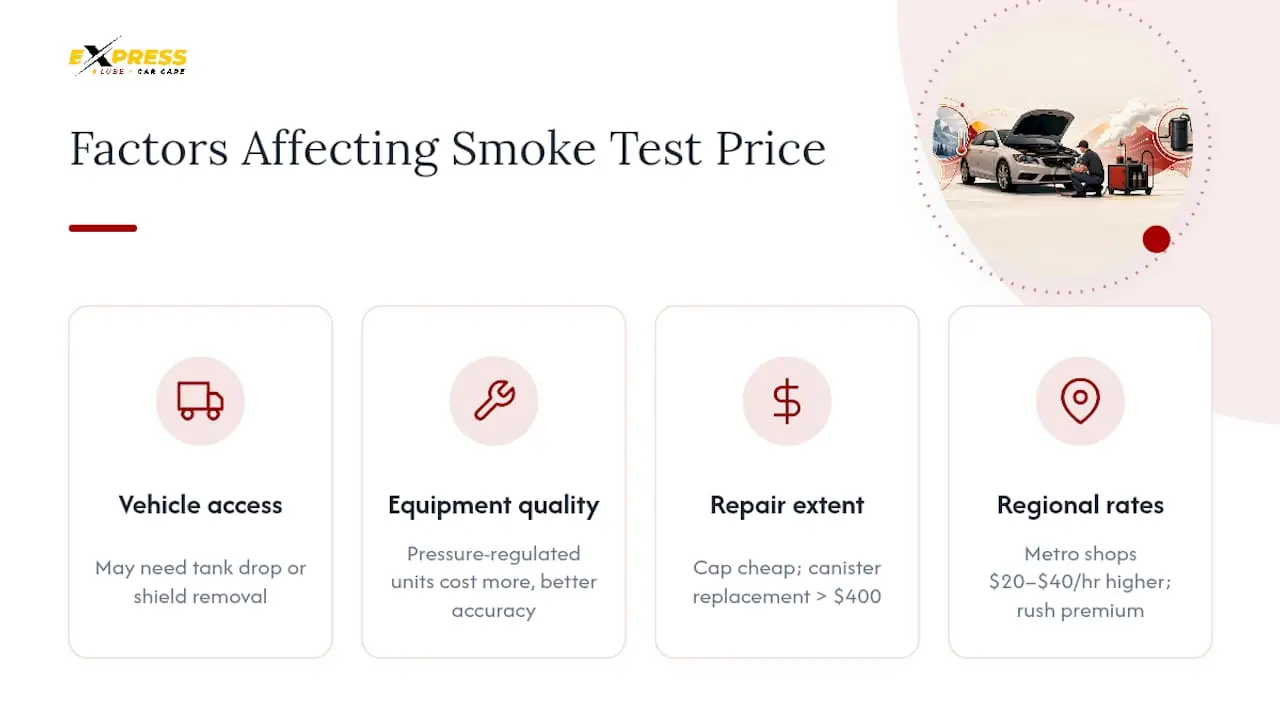
Two cars with the identical EVAP code can generate very different bills, and the gap usually comes down to four things.
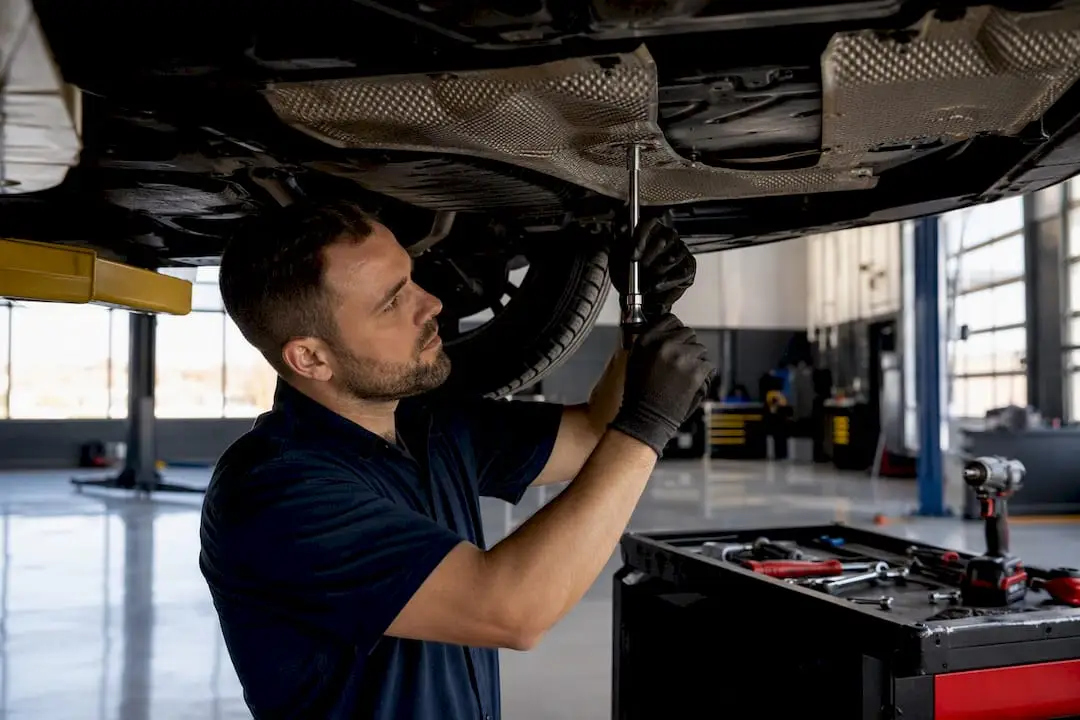
Vehicle access matters more than the leak itself. Some fuel tanks and canisters sit in easy-to-reach spots under the rear of the vehicle. Others require dropping a skid plate, removing a heat shield, or partially lowering the tank. European makes and certain trucks and SUVs often carry higher labor time here simply because of how the EVAP lines are routed.
Equipment quality changes both price and accuracy. A pressure-regulated smoke machine that holds steady near 0.5 to 1.0 psi costs more to buy and maintain than a generic unit, and shops that invest in one typically charge slightly more per visit. That premium buys you a more reliable result and less risk of the machine damaging a seal.
The extent of the fix drives most of the swing. A tightened gas cap costs almost nothing beyond the diagnostic fee. A canister replacement on a vehicle with limited parts availability can push the total repair well past $400.
Regional labor rates and scheduling add another layer. Shops in higher cost-of-living metro areas often run $20 to $40 more per hour than rural shops, and same-day or rush service can carry its own premium.
Pro Tip: Ask upfront whether the smoke test price includes the initial OBD-II scan. Shops that quote a single combined number are usually more transparent than ones that surprise you with add-on fees after the fact.
How the Diagnostic Process Actually Unfolds
A properly run EVAP diagnosis follows a specific order, and understanding it helps you spot a shop that’s doing things right versus one padding the invoice.
- OBD-II scan and live-data check (10 to 20 minutes). The technician pulls stored codes and watches live sensor data. This step alone rules out electrical or sensor faults that can mimic a leak, and it’s the same first move you’d expect from any car diagnostic test.
- DMTL pump run or pressure check (10 to 30 minutes). This confirms whether a leak genuinely exists before spending money on smoke.
- Pressure-regulated smoke test (15 to 45 minutes). Smoke gets introduced at low, controlled pressure and a UV light or visual inspection pinpoints exactly where it escapes.
- HC sniffing, verification, and documentation. The technician confirms the leak location, photographs it, and hands you a written estimate.
A straightforward case, like a bad gas cap found on the first pass, can wrap up in under an hour. A case requiring canister removal or parts ordering can stretch into a multi-day job, especially if the part isn’t in stock locally. This staged approach also avoids guesswork that otherwise turns into repeat visits and repeat charges.
Common Evap Leak Locations and Repair Costs
Once the smoke test finds the leak, the repair cost depends entirely on where it’s hiding. Smoke testing typically pinpoints leaks at a handful of predictable spots.
- Gas cap: The cheapest fix by far. Parts run $10 to $30, and labor is minutes. Total job with diagnostic: often under $150.
- Cracked vapor hoses or loose fittings: Parts run $20 to $80 per section depending on routing complexity. Total job: $150 to $300 including diagnostic and labor.
- Purge solenoid or vent valve: These wear out and stick. Parts and labor combined typically land between $150 and $350, varying by make.
- Charcoal canister or fuel tank issues: The most expensive category. Canisters range $150 to $500 installed, and tank-related repairs can exceed that on vehicles with tight access.
Statistic Callout: A vacuum-only leak, one that only appears when the engine draws negative pressure rather than under positive smoke pressure, can slip past a standard smoke test entirely. A complete diagnostic sometimes needs both positive-pressure smoke testing and a vacuum decay check to catch it, which is worth asking about if your leak code keeps returning after a “clean” smoke test.
How to Avoid Paying More Than You Should
You have more control over this bill than you might think.
- Check the obvious first. Make sure your gas cap is fully tightened and free of cracks. This alone resolves a real share of EVAP codes at zero cost.
- Ask what equipment the shop uses. A shop running a pressure-regulated smoke machine near safe PSI limits protects your car’s seals better than one using unregulated shop air.
- Get the estimate in writing before repairs start. Photos of the leak location and an itemized parts list protect you from surprise charges.
- Save complex tank or canister work for certified technicians. ASE-certified shops backed by a warranty are worth the labor rate on jobs that involve fuel system components.
- Look for service specials or weekday scheduling discounts that some shops offer to offset diagnostic fees.
Pro Tip: If your check engine light comes on, note whether it’s steady or flashing. A steady light tied to an EVAP code almost never requires an emergency visit, so you can schedule around a slower day and often pay less.
Our Take on Smoke Testing Done Right
Express Lube & Car Care runs EVAP diagnostics the way the sequence is meant to work: scan first, pump run or pressure check next, then a pressure-regulated smoke test only when it’s actually needed. Our ASE-certified technicians document every leak with photos before quoting a repair, and because we don’t require appointments, most common EVAP issues get diagnosed and often resolved the same day. We also offer service specials and discounts for qualifying customers, so a fair diagnostic doesn’t have to come with a padded bill.
— Express Lube & Car Care
Book Your Evap Diagnostic Without the Guesswork
Compared to guessing at a fix or paying for a smoke test you didn’t actually need yet, Express Lube & Car Care runs the full correct sequence in one visit: an OBD-II scan, a pressure-regulated smoke test only if the scan calls for it, a written estimate, and photo documentation of exactly what we found.
No appointment is required, and current customers can check our oil change and service specials for ways to lower the total cost of the visit. If the leak turns out to be tied to a bigger repair, our engine diagnostics and repair services pick up right where the smoke test leaves off, with the same technician who ran the test. Stop by or schedule your appointment and get a straight answer on what that check engine light actually means.
Sources
- EVAP system diagnosis – Apex Tech Nation
- How to smoke test for EVAP leaks — AutoLine Pro
- Why a smoke machine is your best EVAP diagnostic tool — ISN
FAQ
How Much Does an Evap Smoke Test Cost?
Most shops charge $80 to $150 total when the fee includes the OBD-II scan and the smoke test together, or $45 to $100 for the smoke test alone if billed separately from a base diagnostic fee.
Does the Smoke Test Price Include the Repair?
No. The smoke test fee only covers locating the leak. Parts and labor for the actual repair, whether it’s a gas cap or a canister, get quoted separately once the leak is found.
Why Do Dealerships Charge More Than Independent Shops?
Dealerships typically run higher hourly labor rates and use OEM-specified equipment for every step, which pushes combined diagnostic and smoke test pricing toward the higher end of local pricing ranges versus lower rates at many independent shops.
Can I Skip the Smoke Test and Just Replace the Gas Cap?
You can try tightening or replacing the cap first since it’s a common and cheap fix, but if the code returns, a proper scan followed by a smoke test is the only reliable way to pinpoint the actual leak location.
Is It Safe to Use a Shop Air Compressor Instead of a Smoke Machine?
No. EVAP systems operate at very low pressure, around 0.5 psi, and shop compressed air can exceed safe limits and damage seals, which is why professional shops use pressure-regulated smoke machines instead.