

The lifespan of a car battery is a critical piece of knowledge for any vehicle owner. So, how long do car batteries really last? The definitive answer is that a standard car battery will typically provide 3 to 5 years of reliable service.
Much like the battery in a smartphone, its capacity to hold a full charge diminishes with each charge and discharge cycle. Over time, its chemical components degrade, and it can no longer deliver the power required to start your vehicle.
How Long Do Car Batteries Last? The Lifespan of Your Car Battery Explained
Understanding the expected lifespan of your car battery is fundamental to preventing an unexpected breakdown. For most internal combustion engine (ICE) vehicles, the 12-volt lead-acid battery is the core of the electrical system. Planning for its replacement within a 3-to-5-year window is a standard aspect of vehicle maintenance.
This is a stark contrast to the high-voltage battery packs in modern electric vehicles (EVs). A traditional car battery operates on a much shorter timeline than an EV battery pack. While a gasoline-powered car will likely require several battery replacements over its operational life, an EV’s original battery can last 15-20 years or more. Instead of failing suddenly, EV batteries experience a gradual loss of maximum range. You can explore detailed information on EV battery technology from educational platforms like EV Connect
The difference in lifespan is rooted in their distinct functions. A standard car battery is designed for one primary purpose: delivering a massive burst of electrical current to crank the engine. Once the car is running, the alternator takes over, supplying power to the vehicle’s electronics and recharging the battery for the next start.
A helpful analogy is to think of a traditional car battery as a sprinter—engineered for a short, powerful burst of energy. An EV battery, conversely, is a marathon runner, designed for long-term endurance and capable of withstanding thousands of deep recharge cycles over its lifetime. Unlike starter batteries, EV batteries are deep cycle batteries, specifically built to handle repeated deep discharges and recharges without significant degradation.
Car Battery Lifespan at a Glance
To clarify the distinction, here is a comparative overview of the two primary types of automotive batteries in use today.
Battery Type | Average Lifespan | Common Failure Mode |
|---|---|---|
Traditional Lead-Acid | 3-5 Years | Sudden inability to start the engine |
Electric Vehicle (EV) Pack | 15-20+ Years | Gradual reduction in maximum range |
A battery’s health is defined not just by its age, but by its capacity to deliver the necessary power on demand. You can learn more about how a battery’s health is measured in our detailed guide on the car battery voltage chart. Understanding these principles allows you to proactively manage your vehicle’s health, regardless of its powertrain.
Factors That Shorten a Car Battery's Life
Have you ever wondered why one car battery lasts for five years while another fails after just two? The variance is almost always attributable to a few key factors, with climate being a primary influence, especially in regions like Plano, Texas. Understanding these factors can help you mitigate the risk of a premature failure.
A useful model is to visualize your battery as a reservoir of electrical energy. Each time you start the car, you draw from that reservoir. The alternator’s function is to replenish it. However, certain conditions can compromise the reservoir’s integrity or prevent it from being fully refilled.
Extreme Heat: The Primary Culprit of Battery Degradation
The most significant environmental threat to a car battery is not cold—it is extreme heat. While a cold spell may expose a pre-existing weakness in a battery, it is the prolonged, high temperatures of summer that inflict the most substantial and permanent damage.
Elevated heat accelerates the electrochemical reactions within the battery, causing internal components to degrade and corrode more rapidly. This process irreversibly diminishes its ability to hold a full charge.
A battery that might last five years in a temperate climate can fail in as little as two or three years when subjected to the intense heat of a Texas summer.
How Driving Habits Impact Battery Health
Your daily driving patterns have a direct impact on battery longevity. If your driving consists mainly of short trips, your alternator may not operate long enough to fully replenish the energy consumed during engine start-up.
This creates a state of chronic undercharging, where the battery is consistently left in a partially discharged state, leading to sulfation and a reduction in its overall lifespan.
Other common causes of premature battery failure include:
Parasitic Drains: Modern vehicles contain numerous electronic modules that draw a small amount of power even when the vehicle is off. A malfunctioning component can cause an excessive “parasitic drain,” depleting the battery overnight.
Excess Vibration: If a battery is not securely fastened in its tray, the constant vibration from driving can damage its sensitive internal plates and connections, leading to a shorter operational life. AGM (Absorbent Glass Mat) batteries are more resistant to vibration and deep cycling, making them a good choice for vehicles exposed to harsh conditions.
Heavy Accessory Use: Operating high-power accessories like stereos or charging multiple devices with the engine off deeply discharges the battery. Repeated deep discharges cause significant wear and shorten its lifespan.
This infographic illustrates the significant difference in lifespans between batteries in traditional gas-powered cars and those in electric vehicles (EVs).
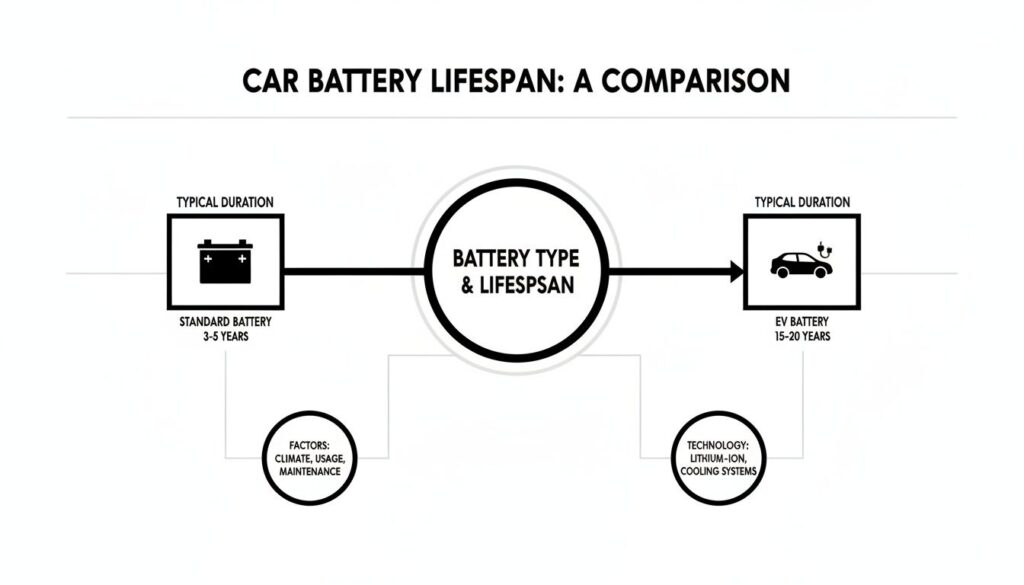
As shown, EV batteries are engineered for longevity, whereas standard car batteries have a much shorter, predictable replacement cycle.
However, even advanced EV batteries are not entirely immune to environmental effects. On average, an EV battery’s capacity degrades by approximately 2.3% annually, resulting in a typical lifespan of 15-20 years. In hotter climates, this degradation rate can increase by about 0.4% each year compared to vehicles in cooler regions. For a comprehensive analysis, you can review the full EV battery health analysis to see more data on how climate impacts battery longevity.
Warning Signs That Your Car Battery Is Failing May Take Time to Appear
A car battery rarely fails without providing preliminary warning signs. Learning to recognize these indicators is your best defense against being stranded by a vehicle that will not start.
The most common symptom is a change in the sound the engine makes during start-up. A healthy battery produces a strong, rapid cranking sound. A failing battery, by contrast, will cause the engine to crank slowly and laboriously.
If turning the key results in a rapid “click-click-click” sound, this is a definitive sign of insufficient power. The battery retains enough energy to activate the dashboard lights and relays, but lacks the amperage to engage the starter motor. This is often the final indication before complete failure.
You can also use a multimeter at home to check your battery’s voltage for an early indication of problems.
This behavior can be compared to a failing flashlight. When activated, the beam may flicker, appear dim, and then extinguish entirely. A vehicle’s electrical system exhibits similar signs of weakness when the battery is nearing the end of its service life.
Electrical and Physical Symptoms
Beyond engine starting, a weak battery will struggle to power the vehicle’s other electrical systems. You might observe that your headlights or interior dome lights appear dim, particularly during engine start-up or while idling.
A visual inspection of the battery itself is also a crucial diagnostic step. Look for these physical indicators of failure:
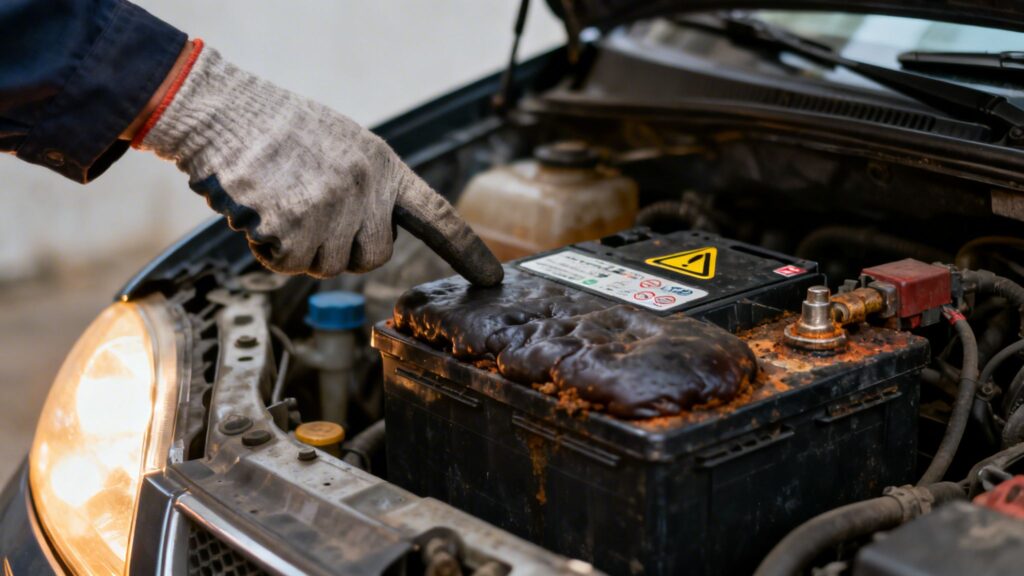
A Swollen or Bloated Case: Exposure to extreme heat can cause the battery’s plastic casing to swell or deform, often due to the expansion of the electrolyte inside the battery. This indicates severe internal damage and necessitates immediate replacement.
Corrosion on the Terminals: The presence of a white, blue, or greenish powdery substance on the metal battery posts is a classic sign of a problem. This corrosive buildup (sulfation) increases electrical resistance and impedes the flow of current.
A “Rotten Egg” Smell: A distinct sulfurous odor around the battery is a sign that it is overheating and venting dangerous sulfuric acid gas. This is a hazardous condition that requires immediate professional attention.
Recognizing what to look and listen for enables you to replace your battery proactively, rather than reactively when you are stranded.
How Professionals Diagnose Your Battery's Health
Waiting for your vehicle to fail to start is an inefficient and inconvenient way to determine your battery is depleted. A professional battery test is a proactive measure that eliminates guesswork, providing a clear assessment of its condition and remaining service life.
Consider this test a quick diagnostic for your car’s electrical heart. Technicians utilize specialized electronic testers to obtain precise measurements, including performing a load test to simulate the demands placed on the battery during engine start-up. This process goes far beyond a simple start-up test; it measures the core health indicators that determine a battery’s reliability.
Measuring Voltage and Cranking Amps May Take a Few Seconds
Two key metrics reveal the complete picture of a battery’s health: voltage and Cold Cranking Amps (CCA)
Voltage can be thought of as the battery’s baseline energy level. A healthy, fully charged 12-volt battery should have an open-circuit voltage of approximately 12.6 volts or slightly higher. A reading below 12.4 volts indicates that it is not holding a full charge, which could point to an internal defect or an issue with the vehicle’s charging system. You can learn more about interpreting these values in our guide to car diagnostic tests
Cold Cranking Amps (CCA), in contrast, is the critical performance test. This metric measures the battery’s ability to deliver sufficient current to start the engine in cold conditions—its most demanding task. Our testers simulate this high-load scenario to verify the battery’s real-world capability.
A battery can exhibit a healthy resting voltage but fail a CCA load test. This means it has enough energy for low-power electronics but lacks the power to start the engine, rendering it unreliable and in need of replacement.
Failing a CCA test serves as an unequivocal warning. It allows you to replace the battery on your terms, preventing a failure at an inopportune moment.
Simple Habits to Extend Your Battery's Lifespan
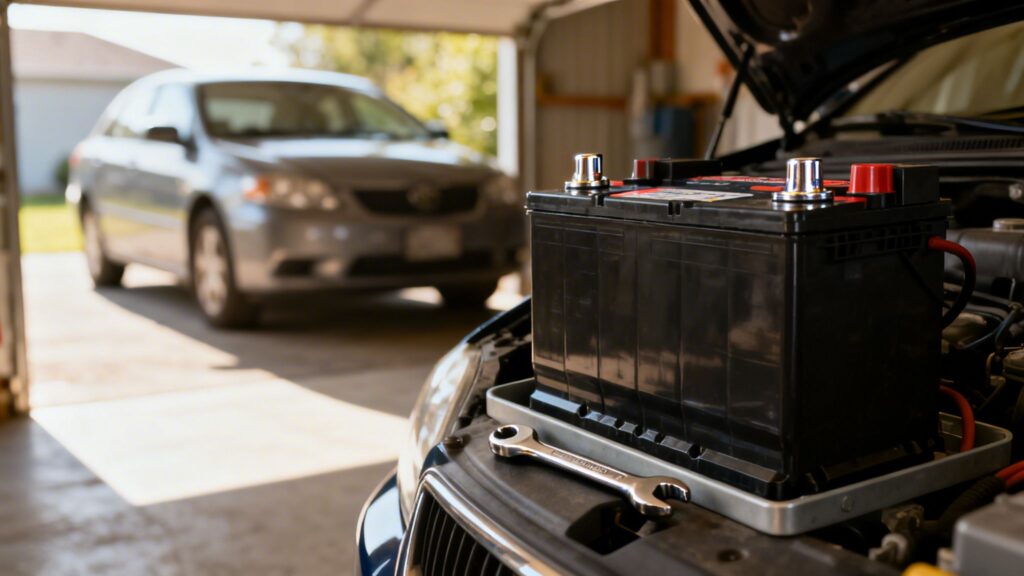
While you cannot stop the natural aging process of a battery, you can adopt several best practices to maximize its service life. If your vehicle will be parked for an extended period, using a trickle charger is a good option to maintain battery charge and prevent it from draining. A few simple habits can significantly reduce the risk of premature failure and the inconvenience it causes.
Think of these practices as preventative maintenance. These small steps require minimal effort but can save you the expense and hassle of an unexpected replacement.
Proactive Battery Care Checklist
Here are several practical measures you can take to counteract the common causes of early battery failure.
Keep the Terminals Clean: Periodically inspect the battery posts for any chalky, greenish-white buildup. This corrosion acts as an electrical insulator, increasing resistance and forcing the charging system and starter to work harder. Use a terminal cleaner to remove corrosion effectively.
Ensure It’s Secure: A loose battery is subject to excessive vibration, which can damage its internal plates and lead to premature failure. Verify that the hold-down clamp is tight and that the battery does not move in its tray.
Minimize Accessory Use with Engine Off: Avoid prolonged use of the radio, lights, or device chargers when the engine is not running. Deeply discharging the battery in this manner causes cumulative damage and shortens its lifespan.
For drivers in warm climates like Plano, Texas, a critical factor is solar heat. One of the most effective strategies is to park in a garage or shaded area whenever possible. Shielding your vehicle from intense summer sun is a simple yet effective way to slow the heat-induced degradation that shortens battery life in our region.
Finally, drive your vehicle regularly. A pattern of frequent, short trips is hard on a battery because the alternator doesn’t have enough time to fully recharge it. Taking at least one longer drive of 20-30 minutes each week helps maintain a full state of charge and is one of the best habits for battery health. This is a key factor in determining how long do car batteries last.
Your Trusted Partner for Battery Service in Plano
Recognizing that your battery may be failing is the first step; the next is knowing who to trust for professional service. At Express Lube & Car Care, our Plano-based team is dedicated to ensuring your vehicle starts reliably, particularly when it comes to a component as critical as the battery.
The most effective way to avoid being stranded by a dead battery is to have it tested before it fails. We invite you to visit our shop for a complimentary battery check at any time—no appointment is necessary. If you have been experiencing slow starts or dimming lights, do not ignore the symptoms. Our technicians will provide an honest, data-driven assessment of your battery’s health.
While modern technology is impressive—the replacement rate for contemporary EV batteries has fallen to just 0.3%, as detailed in this automotive reliability report on Electrek.co—the standard 12-volt battery in most vehicles remains a consumable part that requires periodic attention.
Your safety and your vehicle's reliability are our foremost concerns. We are committed to fair, transparent pricing and clear communication, ensuring every driver in our community feels confident on the road.
Community Savings and Honest Service
We are proud to support our local heroes by offering ongoing discounts for military, first responders, and healthcare workers. We also host our popular Ladies Day every Wednesday
Our goal is for you to feel informed, not pressured. Our guide on battery replacement in Plano provides additional tips and information to help you understand your options before visiting our facility.
Common Questions About Car Batteries
We are often asked questions about car batteries in our shop. Here are concise answers to some of the most common inquiries from drivers.
What is reserve capacity in a car battery?
Reserve capacity is the amount of time a fully charged battery can supply power to your vehicle’s electrical systems if the alternator fails. It’s an important specification because it indicates how long your car can run on battery power alone in an emergency.
Can I Jump-Start a Completely Dead Battery in a Few Seconds?
A jump-start is an emergency, temporary measure to get a vehicle to a safe location for repair. If a battery is so depleted that it cannot hold a charge after being jump-started, this is a clear indication that its internal chemistry has failed. Requiring a jump-start more than once is a definitive signal that the battery needs professional testing and will almost certainly require replacement.
Does My Car Battery Charge While Idling?
Yes, the alternator does provide a charge to the battery while the engine is idling, but it is not an efficient method. The charging rate at idle is very low. Driving at normal road speeds allows the alternator to spin faster and recharge the battery much more effectively. Relying solely on idling to charge a battery is insufficient to maintain its health, especially for vehicles that make frequent short trips.
An analogy is helpful: idling is like filling a bucket with a slow drip from a faucet, while driving is like turning the tap on full. Both will eventually fill the bucket, but one method is far more efficient and reliable.
Is a More Expensive Car Battery Always Better?
Not necessarily. The “best” battery for your vehicle is one that meets or exceeds the original equipment manufacturer’s (OEM) specifications for its group size, terminal configuration, and Cold Cranking Amps (CCA) rating. While a premium battery may offer a longer warranty, adhering to the correct specifications is the most critical factor for ensuring optimal performance and longevity.
If you are uncertain about your battery’s health or have noticed any of the warning signs, do not wait until you are stranded. The ASE-certified technicians at Express Lube & Car Care can provide a free, no-obligation battery test. Visit our shop in Plano for honest advice and expert service—we’ll even take $20 off a new battery and installation. Get reliable service you can trust at https://www.expresslubeplano.com