

You’re sitting at a red light in Plano, the AC is on, and something feels off. Maybe the temperature gauge climbs higher than usual on the way down Preston Road. Maybe you catch a sweet smell through the vents. Maybe you glance in the mirror and see a puff of white exhaust that wasn’t there last week.
That’s the moment a lot of drivers start searching for bad head gasket signs. Not because they love engine theory, but because they want to know one thing fast. Is this serious, or can it wait?
A bad head gasket is one of those problems people hear about long before they understand it. The phrase sounds catastrophic, and sometimes it is. But the smarter way to handle it is to slow down, look at the clues, and make decisions based on what the car is telling you.
That Puzzling Symptom on Your Plano Commute
A head gasket is a small part with a very big job. It sits deep in the engine, out of sight, sealing critical passages so heat, pressure, oil, and coolant stay where they belong. When that seal starts to fail, the symptoms can look random at first.

What drivers usually notice first
Individuals don’t wake up and say, “My head gasket failed.” They notice a symptom.
- A temperature gauge that creeps upward in traffic but settles back down once the road opens up
- White exhaust smoke at startup or after sitting at a light
- Coolant that keeps disappearing even though there’s no obvious puddle under the car
- A rough idle or stumble that seems to come and go
Any one of those can point to other issues too. That’s why head gasket problems confuse people. The engine may still run, start, and drive. It just doesn’t feel quite right.
Why this problem gets misunderstood
Drivers often expect a bad head gasket to look dramatic right away. Sometimes it does. Other times it starts as a faint pattern that’s easy to shrug off for a week or two.
A head gasket problem often begins as a pattern, not a breakdown.
That’s why panic doesn’t help, but attention does. If you’ve noticed smoke, overheating, a sweet smell, coolant loss, or milky residue under the oil cap, your engine is asking for answers. The rest of the story starts with understanding what this part does.
Your Engine's Hardest Working Peacemaker
The head gasket is the seal between the engine block and the cylinder head. It has a difficult job every time you start the car. It must hold back combustion pressure while keeping oil passages and coolant passages in their own lanes.
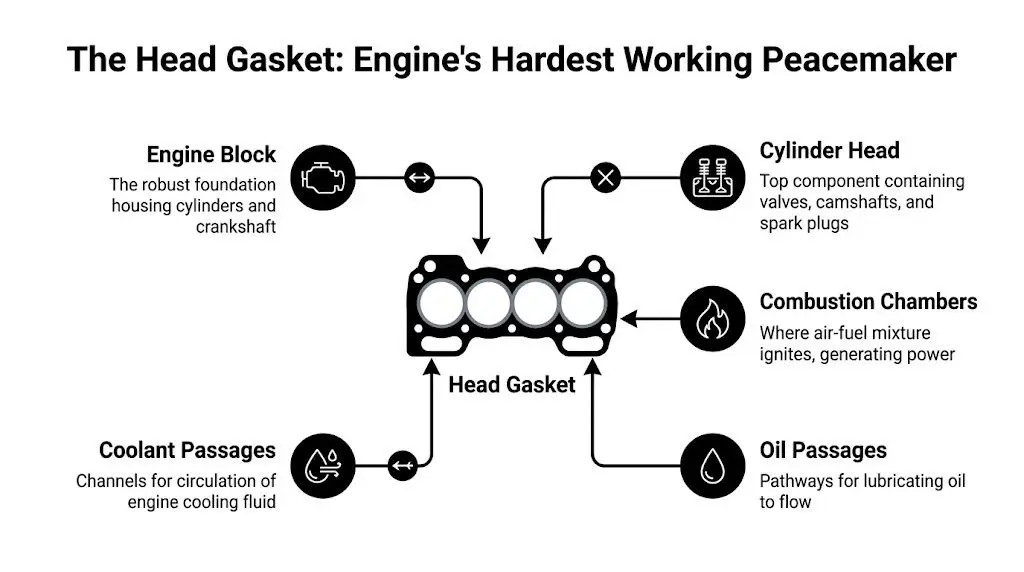
A simple way to picture it is this. Your engine has three separate traffic flows moving through a very tight space. The head gasket is the part that keeps those flows from crashing into each other. When it seals properly, the engine can build power, circulate oil, and control heat. When it fails, the clues can seem unrelated because the leak changes where those systems cross paths.
What the head gasket is protecting
Inside the engine, three things have to stay separated:
- Combustion pressure that fires the cylinders
- Engine oil that lubricates moving parts
- Coolant that controls temperature
If the gasket develops even a small breach, one of those can slip into a space where it does not belong. Coolant may enter a cylinder. Combustion gases may push into the cooling system. Oil and coolant may mix. For a Plano driver trying to decide whether a symptom is serious, that explains why one car smokes, another overheats, and another just starts running rough on the way to work.
What “blown” really means
“Blown head gasket” sounds sudden, like a tire bursting. In the shop, it often looks more gradual than that.
Some failures start with a tiny weak spot that only leaks under load, such as climbing a highway on-ramp or sitting in summer traffic with the A/C on. Others open up enough to cause fast overheating or a hard misfire right away. The location of the breach shapes the symptom, which is why two vehicles with the same basic problem can act very differently.
That difference matters for diagnosis and cost. A small early leak may still allow the engine to run well enough to fool you, but it can often be caught before overheating warps the cylinder head and raises the repair bill.
Why modern engines can be trickier
Drivers often associate head gasket trouble with older, neglected vehicles. Newer engines are not immune. Many modern designs run higher cylinder pressures, tighter tolerances, and more heat, especially in smaller turbocharged engines. As noted in Haynes' discussion of head gasket failure patterns, modern failures do not always follow the old textbook version where oil and coolant obviously mix.
The implication is that newer failures can show up first as a compression leak between cylinders, a cold-start misfire, or repeated coolant loss with no puddle in the driveway. Those subtler patterns are easy to mistake for an ignition problem, a thermostat issue, or a minor coolant leak. That is one reason local diagnosis matters. Catching an early-stage failure before one hot day on Central Expressway turns it into major engine damage can save a lot of money.
Why this one seal creates so many symptoms
The head gasket does not move, click, or squeal. It just keeps order under extreme pressure and heat.
Every drive cycle forces the engine to heat up, cool down, expand, and contract. The gasket has to keep sealing through all of it. If it loses that fight, the engine stops controlling pressure and fluid flow the way it was designed to. To the driver, that can feel like several unrelated problems at once. In reality, one failed seal may be behind all of them.
The Four Telltale Signs of Head Gasket Failure
Most drivers don’t need a lab test to know something’s wrong. The engine usually leaves clues. The trick is knowing which clues point toward a bad head gasket and what each one means.
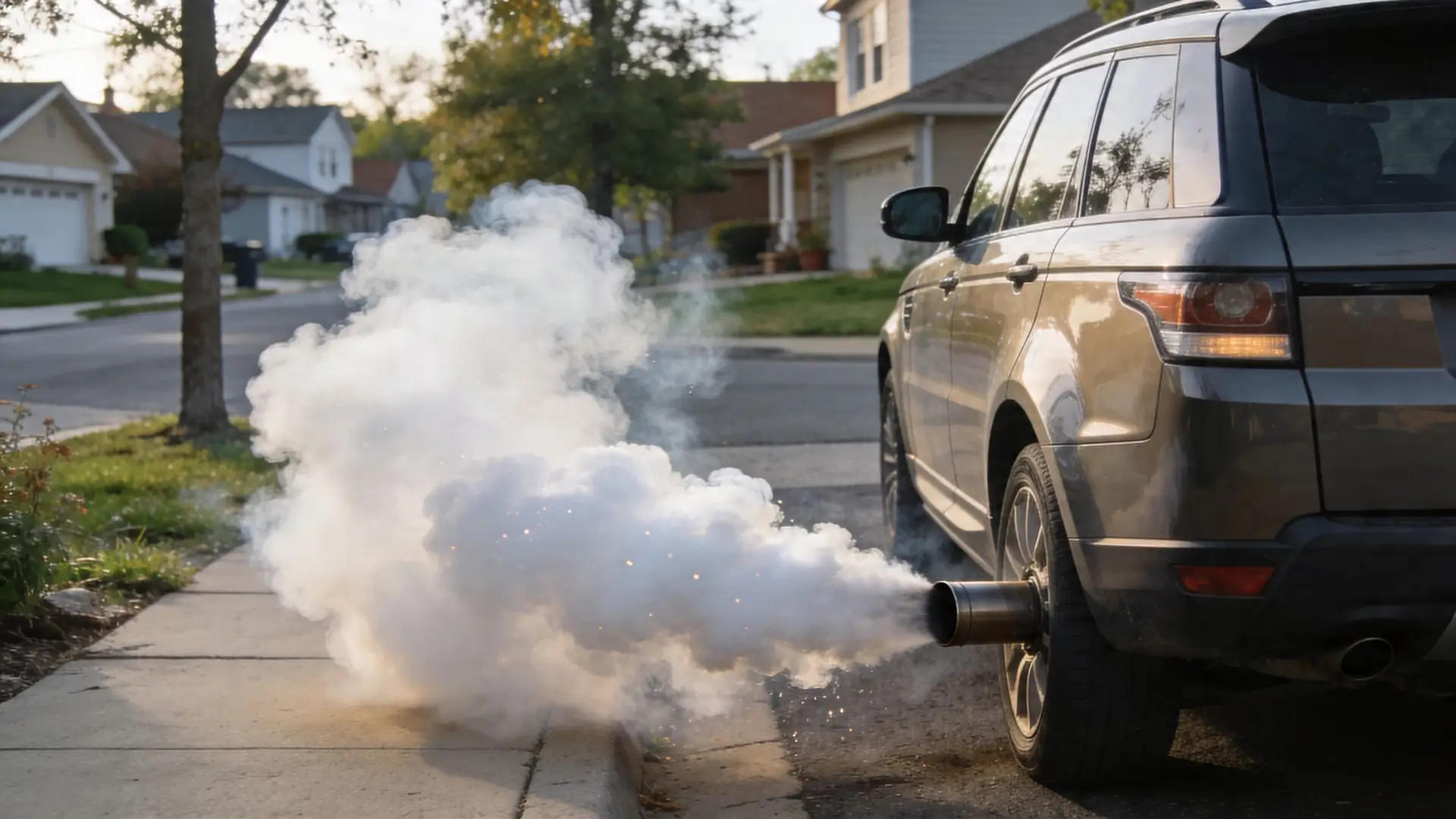
White exhaust smoke
This is the classic sign people talk about first. When coolant leaks into a combustion chamber, it burns and exits through the exhaust as thick white vapor.
A little vapor on a cold morning can be normal. Persistent white smoke that hangs around after warm-up is different. That’s a clue the engine is burning something it shouldn’t.
If you also notice a sweet smell, that raises the suspicion further.
Milky oil or sludge under the cap
Oil and coolant should never turn into a milkshake together. If they do, lubrication suffers fast.
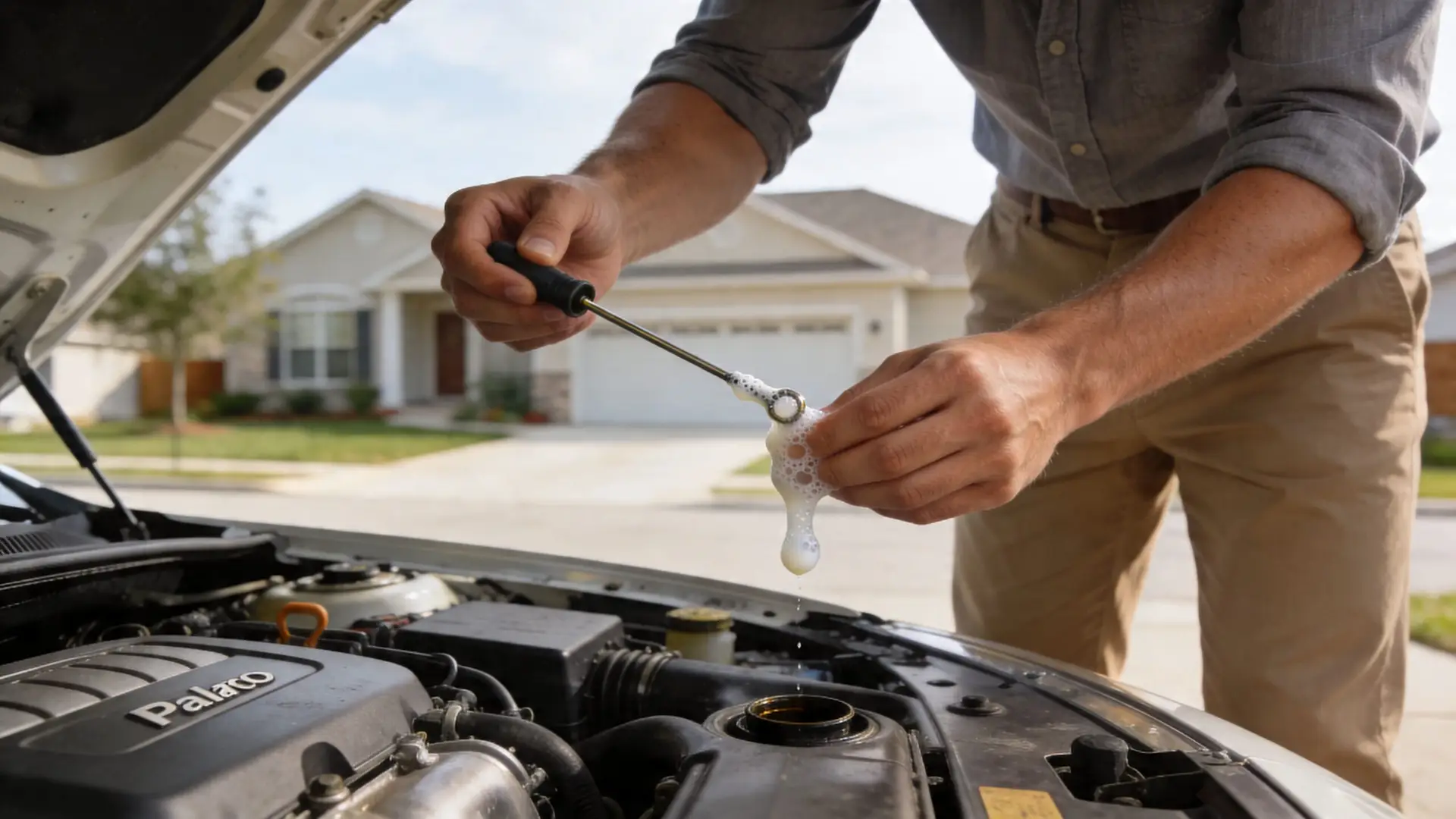
You might see this on the dipstick or under the oil filler cap as a creamy, frothy residue. That’s contamination, and it’s bad news for bearings and internal engine surfaces because the oil can no longer protect parts the way it should.
Coolant loss with no visible leak
A driver tops off coolant. A few days later, the level is down again. There’s no wet hose, no puddle in the driveway, and no obvious drip under the radiator.
That can happen when coolant is leaking internally instead of externally. A bad head gasket can let coolant enter the cylinders or push it out through the exhaust. From the driver’s seat, it looks like coolant is vanishing.
Overheating that keeps returning
This is the sign I tell drivers to treat with the most respect. Overheating doesn’t just result from head gasket failure. It also causes it and makes it worse.
AMSOIL explains that overheating is the predominant cause of head gasket failure. It notes that excessive temperatures, often exceeding 250°F, can warp the aluminum cylinder head and crush the gasket, creating leak paths for coolant and combustion gases. It also states that even a brief overheating episode can reduce a gasket’s sealing efficiency by 30-50%.
That’s why a driver can overheat once, top off coolant, and think the problem is over, only to find the engine overheating again soon after. The original heat event may have already damaged the seal.
A quick way to think about the signs
Each symptom usually points to a specific kind of internal leak:
| Symptom | What may be happening inside |
|---|---|
| White smoke | Coolant is entering a cylinder and burning |
| Milky oil | Coolant and oil are mixing |
| Coolant disappears | Coolant is leaking internally |
| Repeat overheating | Gases or coolant leaks are disrupting temperature control |
When one sign is enough
You don’t need all four symptoms to take this seriously. One strong sign can be enough, especially if it’s paired with a check engine light, rough running, or a recent overheating event.
- Smoke after warm-up deserves attention
- Milky oil needs immediate inspection
- Unexplained coolant loss shouldn’t be brushed off
- A rising temperature gauge means stop and reassess before driving farther
If the gauge is climbing, your best move is to pull over safely and shut the engine off. A few more minutes of driving can turn a repairable issue into major engine damage.
Confirming Your Suspicions Without a Wrench
You can learn a lot in your driveway without taking anything apart. The goal isn’t to prove the diagnosis with certainty. The goal is to gather clean observations before the problem gets worse.
Start with safe visual checks
Only inspect the engine when it’s cool. Don’t remove a radiator cap on a hot engine.
Here are the easiest checks a driver can do:
- Look at the dipstick. If the oil looks creamy or frothy, coolant contamination is possible.
- Check under the oil cap. A milky residue can be a warning sign.
- Inspect the coolant reservoir. Watch for oily film, unusual discoloration, or steady bubbling after startup.
- Observe the exhaust on a cold start. Normal condensation usually clears. Persistent white smoke after the engine warms up is more concerning.
These checks don’t require tools. They require patience and a clear eye.
Pay attention to patterns
A head gasket issue often shows itself under certain conditions. You may only notice rough running on the highway, smoke after a long idle, or overheating in stop-and-go traffic.
Write down what you see:
- When it happens
- Whether the engine is hot or cold
- Whether coolant level keeps dropping
- Whether the check engine light comes and goes
If the check engine light is on, a basic scan can add useful context. This guide on how to read check engine codes helps you understand what a code can and can’t tell you.
Why driveway checks can miss early failures
People get frustrated. The car acts strange, but the obvious signs don’t always show up.
This diagnostic discussion on early head gasket issues notes that early-stage blown head gaskets are notoriously difficult to diagnose, with up to 20-30% of suspected head gasket issues in high-mileage vehicles starting asymptomatically, and that shops report 40% repair savings via early intervention before full failure.
That fits what many drivers experience. The engine may run fine most of the time. The leak may only open under load or after the engine reaches a certain temperature. A quick look under the hood may not reveal much.
Some of the trickiest head gasket problems don’t look dramatic. They look inconsistent.
A useful visual walkthrough can help you know what to look for before you schedule a test:
What professional tests do differently
When symptoms are subtle, a shop steps beyond visual checks.
A technician may use:
- A cooling system pressure test to see if the system holds pressure
- A block test to check for combustion gases in the coolant
- A leak-down test to identify where a cylinder is losing pressure
- Compression testing to compare cylinder sealing
Those tests matter because a bad head gasket is often about where the leak is happening, not just whether the engine feels rough. A clear diagnosis saves you from guessing and helps you decide whether the car is still safe to drive.
Understanding the Root Causes and High-Risk Vehicles
A bad head gasket usually has a backstory. In the shop, we rarely see one fail for no reason. Something has been stressing the seal between the engine block and cylinder head, often for a while before the driver notices a clear symptom.
Overheating is still the main trigger
Heat is the cause we see most often.
The head gasket works like the engine’s peacekeeper. It has to keep combustion pressure, coolant, and oil in their own lanes while the engine heats up and cools down thousands of times. If the cooling system falls behind, metal parts expand at different rates, sealing surfaces can shift, and the gasket can lose its grip.
Sometimes the original problem is small. Low coolant, a sticking thermostat, a weak radiator, a failing water pump, or cooling fan trouble can all start the chain reaction. If you want the bigger picture, our guide on what causes overheating in cars explains how those problems build into engine damage.
One overheating event can be enough. Repeated borderline overheating is just as hard on the gasket.
Cylinder pressure can damage a gasket too
Heat is common, but it is not the only path.
Detonation, often called spark knock, creates sharp pressure spikes inside the cylinders. Over time, those repeated pressure hits can weaken the fire ring area of the gasket, which is the part that seals combustion. In plain terms, the gasket is getting hammered from the inside.
This is one reason the correct fuel grade and proper ignition performance matter. If an engine is pinging, misfiring, or running poorly under load, that is not something to brush off.
Age and maintenance history matter
Some head gaskets fail because of one big event. Others fail because of years of smaller stresses.
Every Plano commute brings another heat cycle. The engine warms up, expands, cools down, and contracts. Over many miles, gasket material, bolts, and sealing surfaces all age together. If coolant changes were skipped, if the engine has run low on coolant before, or if the car has a history of overheating, the odds of trouble go up.
That is why two vehicles with the same mileage can be in very different shape. The better-maintained one often gives you more margin.
Some vehicles deserve closer attention
Certain models have earned a reputation for head gasket trouble based on Consumer Reports data and long-running repair patterns in the industry. Older Subaru flat-four engines come up often in that conversation, along with a handful of BMW, Mini, Chevrolet, Infiniti, and Mazda models from specific years.
That does not mean every one of those vehicles will fail. It means a Plano driver shopping for a used car, or deciding whether to keep an older one, should treat mild overheating, coolant loss, or unexplained rough running more seriously on those models.
Here is the practical takeaway. Risk comes from the combination of design history, maintenance history, and current symptoms. A known-problem vehicle with fresh coolant, stable temperatures, and no fluid loss may be fine. A high-mileage vehicle with a known pattern plus subtle coolant loss is the one that deserves a careful diagnostic visit before the problem gets expensive.
That is also where local experience helps. Early-stage head gasket leaks can look like ordinary cooling system issues at first, especially in stop-and-go Plano traffic and summer heat. A shop that sees these patterns regularly can separate a bad thermostat or radiator problem from the first signs of a gasket starting to give up.
Repair Costs and The Dangers of Driving On
A lot of Plano drivers reach this point with the same question in mind. Is this something I can watch for a week or two, or is every mile making the bill worse?
That decision usually comes down to three things. How bad the leak appears to be, whether the engine has already overheated, and whether the vehicle still makes sense to repair. A small external seep and a badly compromised gasket do not carry the same risk, even though both fall under the label of “bad head gasket.”
The two repair paths
There are only two realistic options.
One is a chemical sealant. The other is a mechanical repair that involves removing the cylinder head and replacing the gasket correctly.
Sealants have a limited role. On an older vehicle with a minor leak, they may buy a little time. They are closer to a temporary patch on a leaking pipe than a real rebuild. Sometimes they help. Sometimes they do very little. In some cases, they can also complicate later cooling-system service.
A proper repair is more involved because the head gasket sits in one of the busiest, hottest parts of the engine. The technician has to take the engine apart far enough to inspect the sealing surfaces, check for warpage or cracks, replace the gasket, and reassemble everything to specification. If heat has already distorted the cylinder head, machine work may be part of the job.
Head gasket repair options compared
| Repair Option | Best For | Estimated Cost | Success & Longevity |
|---|---|---|---|
| Chemical sealant | A minor early leak on an older vehicle, usually as a temporary measure | Lower upfront cost than major engine disassembly | Can be temporary and unpredictable |
| Full head gasket replacement | Vehicles worth keeping, repeat overheating cases, contamination, or confirmed internal leakage | Often in the thousands, depending on engine design, labor time, and any related damage found | Most durable path when done correctly |
Why full replacement costs what it costs
The gasket itself is not usually the expensive part. Getting to it is.
On many engines, a large share of the upper engine has to come apart first. Then the shop has to inspect the cylinder head, check the engine block sealing surface, replace related gaskets and bolts, refill fluids, and verify that the original cause of failure has been addressed. If the car overheated, the final number can climb because the gasket may not be the only damaged part.
If you are trying to decide whether the repair fits the value of the vehicle, this guide on how much engine repair costs gives useful context for the bigger picture.
Why delaying gets expensive fast
A failing head gasket rarely stays in one lane. It starts as a sealing problem, then spreads into other systems.
Coolant can get into the oil and weaken lubrication. Combustion gases can pressurize the cooling system and push coolant out. Repeated overheating can warp the cylinder head. If enough coolant enters a cylinder, the engine may stop suddenly or suffer severe internal damage.
That is why early diagnosis matters so much for Plano drivers. A car that still runs and drives can still be on its way from “repairable gasket job” to “engine replacement conversation.”
The least expensive head gasket repair is usually the one found before overheating and contamination spread the problem.
Repair quality matters just as much as the diagnosis
A lasting repair looks at the whole failure story.
If the engine overheated, the cooling-system cause needs attention too. If detonation or poor clamping contributed, the repair plan should reflect that. Bar’s Leaks explains common bad head gasket symptoms and failure causes, including combustion-related stress that can damage the gasket’s sealing layers.
That does not mean every vehicle needs upgraded parts or the same repair strategy. It means the right fix matches the evidence. For a driver making a practical decision, that distinction matters. Spending less on an incomplete repair can cost more if the engine comes back with the same problem.
The decision most drivers are really making
A good next step is to answer four plain questions:
- Does the car have a mild symptom, or is it already overheating or contaminating fluids?
- Is the vehicle worth keeping for several more years?
- Has any secondary damage likely happened already?
- Do you need a short-term stopgap, or are you trying to solve the problem for good?
If your checks point to coolant loss, repeated overheating, white exhaust, milky oil, or pressure building in the cooling system, continued driving is a gamble. At that stage, the smart move is usually to stop guessing, get it tested, and compare the repair cost against the value and condition of the vehicle.
Your Plano Partner for Honest Diagnosis and Repair
When a driver suspects a bad head gasket, guessing is expensive. So is replacing parts based on symptoms alone. The smarter move is a clear diagnosis from people who test before they talk.
That’s where Express Lube & Car Care in Plano stands out. The shop handles quick maintenance and deeper repair work under one roof, which matters when a simple oil check turns into an engine concern. You can stop by without an appointment, and the team’s ASE-certified technicians can use modern diagnostics to sort out whether you’re dealing with a head gasket issue, an overheating problem, or something less severe.
The biggest value for most drivers is honest direction. If the engine shows early signs, you want to know that. If the symptoms point somewhere else, you want to avoid paying for the wrong repair. Clear answers save money.
Express Lube & Car Care also keeps service practical for everyday Plano drivers. The shop offers $20 off oil changes, discounts for military, first responders, and healthcare workers, $25 off oil changes on Ladies Day every Wednesday, and $20 off batteries with the Express Lube Signature battery service.
If your car is smoking, overheating, losing coolant, or just acting different, local testing beats online guessing every time.
Frequently Asked Questions About Head Gaskets
Can a bad head gasket fix itself
No. A bad head gasket doesn’t heal with more driving. Heat and pressure usually make the leak larger, not smaller.
Is a chemical sealant a permanent fix
Usually no. It’s best viewed as a temporary measure for a limited situation. If the leak is significant, or if oil and coolant are already mixing, a sealant is not the same as a proper repair.
How long does head gasket repair take
It’s usually not a same-day job. The engine has to be disassembled far enough to remove the cylinder head, inspect the surfaces, and reassemble correctly. Exact timing depends on the engine design and whether the head needs machine work.
What if my car passes a pressure test but still has symptoms
That can happen. Some early leaks are intermittent and only show up when the engine is hot, under load, or after a certain amount of driving. That’s one reason experienced technicians may combine several tests instead of relying on one result.
Should I drive it if I only see one symptom
That depends on the symptom, but caution is smart. If the engine is overheating, losing coolant quickly, smoking heavily, or showing contamination in the oil, driving it can turn a repair into an engine replacement.
Is every overheating problem a bad head gasket
No. Many cooling system faults can cause overheating without a failed gasket. But one overheating event can damage the gasket, so the problem deserves attention either way.
If your vehicle in Plano is showing signs of a bad head gasket, don’t guess and don’t keep driving until a small problem becomes a major engine repair. The team at Express Lube & Car Care can help you get a clear, honest diagnosis with ASE-certified expertise, no-appointment convenience, and practical repair guidance that fits your vehicle and budget.