
Before you drive, register, or store a privately owned vehicle, verify five things: lights, tires, fluids, brakes, and documentation. That single check protects you against a failed installation inspection under 32 CFR § 634.20, which sets NHTSA-aligned safety standards for POVs registered on base and keeps your car mission-ready whether you are heading to formation or across the country on PCS orders. A shop like Express Lube & Car Care can confirm all five in one visit, but you can run this triage yourself in ten minutes.
Run through this list right now:
- Check that headlights, brake lights, and turn signals all function.
- Confirm tire pressure matches the door-jamb sticker and tread depth is above legal minimum standards.
- Look under the car overnight for fluid spots on the pavement.
- Test the parking brake and listen for grinding when braking gently.
- Scan the dash for a lit check-engine, ABS, or tire-pressure warning.
- Verify your horn, wipers, and washer fluid all work.
- Confirm your registration and proof of insurance are current and in the vehicle.
- Locate your last inspection form, if your installation requires one.
Once you have handled these, pair this list with the sample 30-60-90 schedule below to build a recurring plan.
Key Takeaways
A documented, interval-based checklist covering lights, tires, fluids, brakes, and paperwork is what keeps a service member’s POV both safe and eligible for installation registration.
| Point | Details |
|---|---|
| Fix stop-and-drive items first | Brake faults, fluid leaks with warning lights, and nonfunctional lights must be resolved before driving or registering. |
| Run a monthly 15-30 minute check | Tire pressure, oil level, coolant, battery terminals, and lights catch small issues early. |
| Follow the 30-60-90 rhythm | Light checks at 30 days, deeper checks at 60, and a full review at 90 keeps maintenance predictable. |
| Know the registration standard | 32 CFR § 634.20 sets NHTSA-aligned inspection items that installations enforce directly. |
| Document everything digitally | Photos, receipts, and service summaries protect warranty coverage and speed up reinspection. |
| Use a same-day shop for urgent fixes | Express Lube & Car Care offers no-appointment service, digital inspection reports, and a military discount for inspection-ready repairs. |
Table of Contents
- What Immediate Auto Care Checks Should Service Members Never Skip?
- What Monthly Car Care Tasks Keep a POV Inspection-Ready?
- How Should You Handle Seasonal and Quarterly Vehicle Checks?
- Which Annual Services Protect Warranty Coverage and Resale Value?
- What Is the 30-60-90 Rule for Auto Maintenance?
- How Do POV Registration Rules Differ From Civilian Maintenance Standards?
- How Much Time and Money Should You Budget for Common Repairs?
- What Tools Should You Keep in the Vehicle for Field Checks?
- How Express Lube & Car Care Gets Your POV Inspection-Ready
- Sources
- FAQ
What Immediate Auto Care Checks Should Service Members Never Skip?
Some faults are not maintenance items. They are “do not drive” conditions, and treating them like routine wear is how a minor issue turns into a stranded vehicle or a denied registration.
Brake system faults. A soft pedal, grinding noise, or pulling to one side on braking means stop driving and get to a shop. Confirm by pressing the pedal with the engine off. If it sinks to the floor, you likely have a fluid or line problem, not a simple pad issue.
Tire-pressure or TPMS warnings. Check all four tires with a gauge, not by eye. A slow leak often shows up first as an intermittent dashboard light before a tire goes visibly flat.
Check-engine light paired with a fluid leak. This combination often signals an active problem, not a sensor glitch. Get it diagnosed before your next drive.
Visible smoke or a strong burning smell. Pull over immediately and shut off the engine. Do not attempt to keep driving to “make it home.”
Severe steering pull or vibration. This points to alignment, suspension, or tire damage that worsens with mileage. Have it inspected before highway driving.
Nonfunctional lights or turn signals. These are explicit inspection items under 32 CFR § 634.20 and an easy, cheap fix that avoids an automatic fail.
Pro Tip: Take time-stamped photos of any warning light, leak, or damage before your repair, and keep the receipt afterward. Installation inspectors and insurance adjusters both respond faster to documented evidence than to a verbal explanation.
A vehicle with an unresolved item from this list can be denied registration outright under 32 CFR § 634.20, so treat this section as your gatekeeping pass before anything else on this checklist.
What Monthly Car Care Tasks Keep a POV Inspection-Ready?
A 15 to 30 minute monthly pass catches small problems before they become inspection failures. Consumer Reports’ preventive maintenance guidance treats this cadence as the backbone of a low-breakdown-risk vehicle, and it maps cleanly onto a service member’s schedule.
- Check tire pressure cold, and record the number so you can spot a slow leak trend.
- Run a quick tread check with a penny or built-in wear bars; note uneven wear, which often points to alignment issues.
- Pull the oil dipstick and check both the level and color; dark, gritty oil means it is time to book a change.
- Check the coolant reservoir level against the “full cold” line, and top off washer fluid.
- Inspect battery terminals for corrosion and confirm the battery is mounted securely.
- Test every exterior and interior light, plus wiper function.
- Confirm your emergency kit (first aid supplies, flashlight, and warning triangle or reflective vest where required) is stocked and accessible according to installation or host nation requirements.
Keep a simple photo-plus-note log for each monthly pass. It takes thirty seconds and turns into your best evidence if you face a surprise reinspection or need documentation during a routine maintenance check.
How Should You Handle Seasonal and Quarterly Vehicle Checks?
Quarterly checks catch the slower-developing problems that a monthly glance misses, and seasonal shifts add another layer specific to where you are stationed.
Every quarter, run a battery load or voltage test, since batteries fail quietly until they fail completely. Rotate your tires to even out wear, visually inspect brake pad thickness through the wheel spokes, and note any pulling, vibration, or uneven tire wear that suggests an alignment problem.

Seasonal prep depends on climate. Cold-weather stations need a checked antifreeze mix, a battery test (cold weakens battery output fast), winter-rated wiper blades, and a working heater and defroster. Hot-weather stations need a functioning A/C system and coolant that is not overdue for a flush. Wet or coastal postings call for checking drain plugs and underbody areas for early corrosion.
Overseas assignments add another wrinkle. Host nations often set their own equipment rules. Germany, for example, requires a DIN 13164 first-aid kit and a warning triangle, and inspection intervals can differ from what you are used to stateside. Check host-nation and installation policy before you drive off base for the first time.
Pro Tip: If you are heading into a long station gap or storage period, move the vehicle every few weeks or use a jack stand to relieve constant weight on one tire section. Flat spots from sitting still are one of the most preventable forms of tire damage.
Which Annual Services Protect Warranty Coverage and Resale Value?
Annual and mileage-based services are where deferred maintenance catches up with you, and they are also what protects your warranty and your vehicle’s value at trade-in or PCS sale.
Budget for a full brake inspection, a brake fluid flush if your service interval calls for it, a coolant service, transmission service if due by mileage, and a visual inspection of belts and hoses for cracking. Add spark plug replacement and air or cabin filter swaps where applicable to your make and model. These items sit at the core of what Consumer Reports recommends as a preventive maintenance baseline.
Recordkeeping matters more here than anywhere else in this checklist. A documented service history protects your manufacturer warranty, supports installation registration renewals, and adds real value when you sell a vehicle ahead of a PCS move. A digital preventive maintenance record beats a shoebox of paper receipts every time.
Pro Tip: Keep one digital folder per vehicle with dated photos, itemized receipts, and a short summary of each service. It takes minutes to build and saves hours during a warranty claim or a buyer’s inspection.
What Is the 30-60-90 Rule for Auto Maintenance?
The 30-60-90 rule breaks recurring maintenance into three checkpoints: light checks monthly, deeper fluid and component checks quarterly, and a full inspection-style review seasonally, giving you a repeatable rhythm instead of trying to remember everything at once.
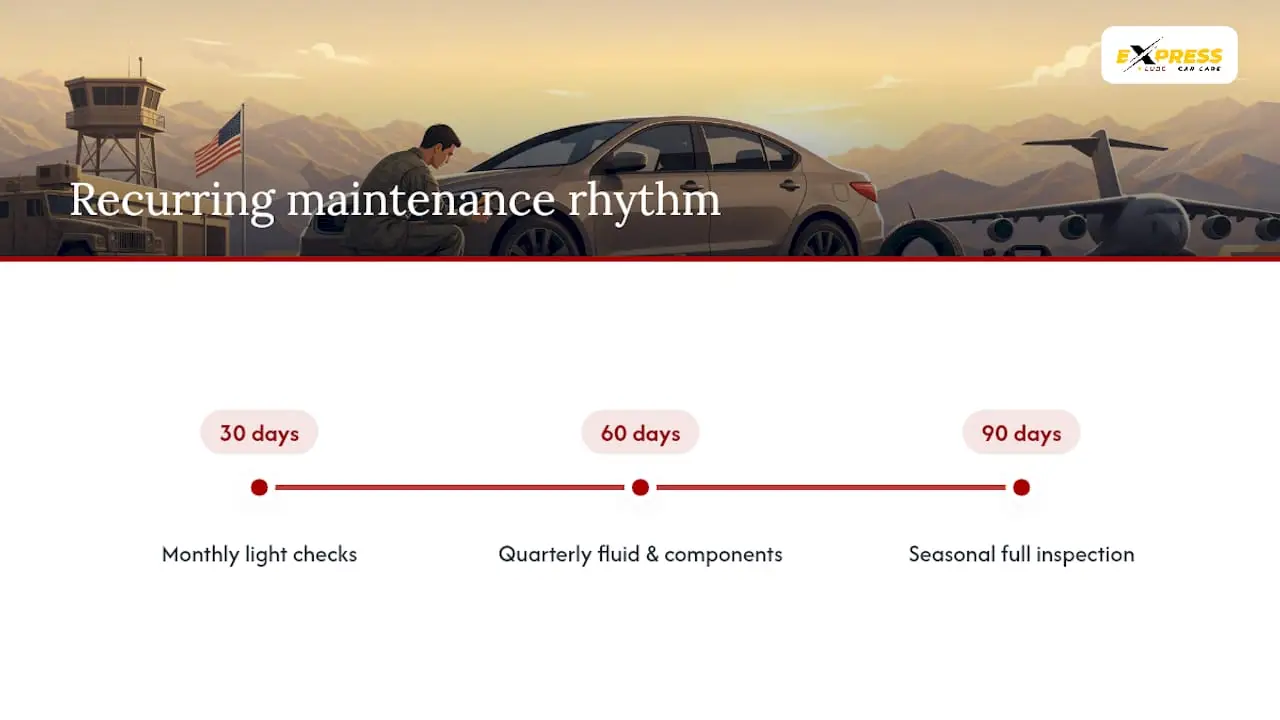
If you are heading into deployment or an extended absence, shift the 90-day checkpoint earlier and pair it with a pre-storage inspection through a base Auto Hobby Shop, which can also run periodic start-and-check routines while your vehicle sits. Use this same rhythm to plan around a mileage-based schedule if your annual mileage runs high or low compared to a typical commuter.
How Do POV Registration Rules Differ From Civilian Maintenance Standards?
Installation registration is not the same process as a state inspection sticker, and treating it that way is where most service members get caught off guard. 32 CFR § 634.20 requires that vehicles registered on a military installation meet safety and mechanical standards aligned with NHTSA minimums, and it specifically calls out lights, turn signals, brake lights, horn, wipers, and pollution control devices as inspection points. When local jurisdictions do not run their own periodic inspections, the installation commander can require and conduct an annual POV safety inspection instead.
The Army’s own POV inspection checklist goes further, specifying details like minimum tire tread depth, working seatbelts, and required emergency equipment, plus inspector sign-off fields. Some installations also require documents beyond registration and insurance, including specific inspection forms such as AE190-1O or AE190-1AA, along with non-expired safety gear like a first-aid kit, warning triangle, or reflective vest depending on location.
Vehicles modified from factory specifications, such as suspension lifted beyond the manufacturer’s design height, can be flagged as unsafe and denied registration outright. A minor cosmetic upgrade can turn into an inspection failure if it changes the vehicle’s ride height or stance.
This is also where PMCS habits can mislead you. PMCS trains you to think in terms of operational readiness for military equipment in harsh field conditions. Civilian vehicle maintenance runs on a different logic: documented service intervals, warranty-compliant parts, and paperwork that a base inspector or a dealership can verify. A digital inspection report with photos and technician notes, the kind Express Lube & Car Care provides, closes that gap better than a handwritten checklist.
Pro Tip: Bring your registration, proof of insurance, last inspection form, and any outstanding repair receipts to every on-base inspection. Missing paperwork alone can get an otherwise sound vehicle turned away.
How Much Time and Money Should You Budget for Common Repairs?
Planning around duty schedules means knowing roughly how long a job takes and what it costs before you show up.
- Oil change: 20-30 minutes, typically $40-$90 depending on conventional versus synthetic oil.
- Tire rotation: 20-30 minutes, usually $20-$50, often bundled free with an oil change package.
- Battery replacement: 15-30 minutes, generally $120-$250 including the part.
- Brake pad replacement: 1-2 hours per axle, roughly $150-$300 per axle depending on rotor condition.
- Diagnostic or inspection check: 30-60 minutes, often $50-$120 depending on the depth of the diagnostic.
Costs run higher for import or luxury vehicles that require OEM parts or specialty labor, so European vehicle owners should expect the upper end of these bands. A same-day, no-appointment model works well for time-sensitive fixes like a dead battery or a brake warning, while cosmetic or deferred items can wait for a scheduled visit during leave.
Prioritize by risk, not convenience. A brake or steering fault is a time problem first and a cost problem second. A worn cabin filter or a minor cosmetic scuff is the reverse.
What Tools Should You Keep in the Vehicle for Field Checks?
A compact toolkit turns a roadside surprise into a five-minute fix instead of a tow call. Keep a tire pressure gauge, a basic socket set, a flashlight, a jumper pack or jumper cables, a tow strap, and a first-aid kit in the trunk. Where your installation or host nation requires it, add a reflective vest and a warning triangle.
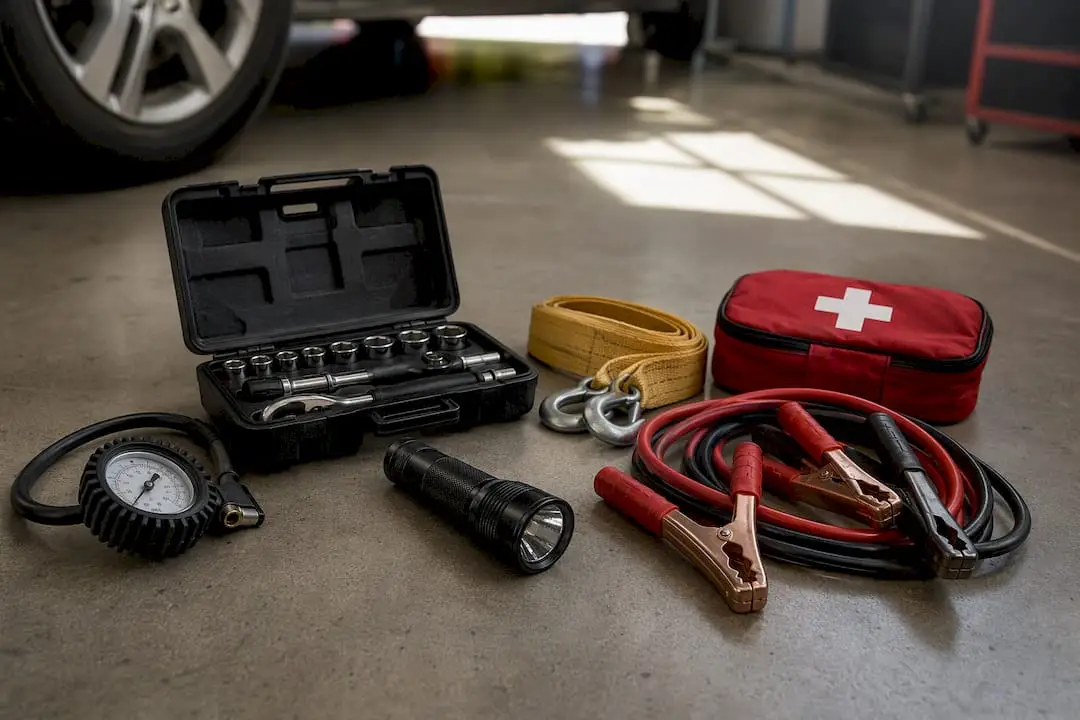
A few quick tests are worth memorizing: check battery terminals for white or greenish corrosion buildup, press the brake pedal with the engine off to confirm firm resistance, and visually scan belts and hoses for cracking or fraying. Never work underneath a vehicle without it secured on a jack stand, and never assume a parking brake alone will hold a car on an incline.
Pro Tip: If you need to check anything roadside, pull fully off the travel lane, turn on hazard lights, and set the parking brake before you get out. In base housing or a deployed environment, visibility to other drivers matters as much as the repair itself.
Snap a photo of anything you find and log it with a date. That habit turns a random roadside check into documentation you can hand an installation inspector later.
Why This Checklist Reflects What We See on Real Inspections
Working on military customers’ vehicles day after day surfaces the same failure points again and again: a burned-out brake light nobody noticed, a tire pressure warning ignored for weeks, an oil change pushed past due right before a PCS move. This checklist is built around those patterns, not theoretical ones. Express Lube & Car Care’s ASE-certified technicians run digital inspections with photos and notes specifically because paperwork gaps, not mechanical failures, cause most avoidable inspection delays. Add a standing military discount, and the goal is simple: fewer surprises at the gate, fewer surprises at the register.
How Express Lube & Car Care Gets Your POV Inspection-Ready
Express Lube & Car Care handles the exact items this checklist covers, oil changes, brake inspections and repairs, battery testing, and full digital inspection reports with photos and technician notes, all on a no-appointment, same-day basis that fits around duty schedules instead of around a shop’s calendar.
If a brake warning or a check-engine light has you second-guessing your next inspection, walk in for a diagnostic check or roll through for a fast oil change and service special before your next duty day. Military customers get a dedicated discount, and if brake wear is the issue, this $30 off brake service coupon covers pad and rotor work without waiting for a scheduled slot. For readers planning a long haul before deployment or PCS, this vehicle safety guide for long-distance travel pairs well with a pre-trip inspection. Stop by for a walk-in check, or book online through the appointment page if you would rather lock in a time first.
Sources
- 32 CFR § 634.20 – Privately owned vehicle operation requirements. | LII / Legal Information Institute
- Motors
- Consumer Reports’ Guide to Car Maintenance
- Car Care for Deployed Military | Eglin AFB
FAQ
What Is Included in a Basic Vehicle Maintenance Checklist?
A basic checklist covers tire pressure and tread, oil level, coolant, battery condition, lights, wipers, and brake function, checked monthly with deeper reviews quarterly and annually.
What Is the 30-60-90 Rule for Car Maintenance?
It is a schedule that assigns light checks at 30 days, moderate fluid and component checks at 60 days, and a full inspection-level review at 90 days, repeating on a rolling basis.
What Does a Full Car Servicing Checklist Typically Include?
A full service typically covers brake inspection, fluid flushes, belts and hoses, filters, spark plugs where applicable, and a diagnostic scan, matching the annual items covered in this checklist.
Does Express Lube & Car Care Offer Inspection-Ready Service for Military Customers?
Yes. Express Lube & Car Care provides digital inspections with photos and technician notes, same-day no-appointment service, and a military discount aimed at keeping POVs ready for installation registration.
How Do PMCS and Civilian Maintenance Differ?
PMCS focuses on operational readiness for military equipment in field conditions, while civilian maintenance emphasizes documented service intervals and warranty-compliant records that installations and dealerships can verify.