

A ball joint is a critical suspension pivot point, similar to a human hip joint, that connects your vehicle’s control arms to the steering knuckles so the wheels can move up and down and steer smoothly. Most ball joints are built to last 70,000 to 150,000 miles, but when they wear out, you can feel it in the form of clunks, vibrations, wandering steering, and uneven tire wear.
If you're reading this because your car started making a strange noise in a Plano parking lot, or the front end feels loose on the way down Central, you're asking the right question. Ball joints are small parts, but they do a big job every time you turn the wheel, hit a dip, or roll over rough pavement.
A lot of drivers have heard the name without really knowing what the part does. That's normal. Ball joints sit low in the suspension, out of sight, and drivers often don't think about them until something feels off.
What matters is this. A worn ball joint isn't just a noise issue. It's a safety issue, and it's one of those problems that's easier and cheaper to deal with when you catch it early.
Your Guide to a Critical Suspension Part
That front-end clunk you hear when turning into a parking space often points drivers toward the same question: what is a ball joint, and why does it matter so much? The short answer is that it's one of the main pivot points in your suspension and steering system, and when it gets loose, the whole vehicle can start feeling unsettled.
Think of it as one of the unsung heroes under your car. You don't see it working, but it helps the wheel move in more than one direction at once. Your suspension needs that motion so the tire can follow the road while your steering still points the vehicle where you want it to go.
Ball joints matter even more today because people are holding onto vehicles longer. The automotive ball joint market was valued at USD 5.40 billion in 2024 and is projected to reach USD 8.09 billion by 2033, while the average age of vehicles in the U.S. reached 12.5 years in 2023, which means more drivers are dealing with age-related suspension wear and replacement needs, according to Grand View Research's automotive ball joint market report.
Why local drivers run into this problem
In Plano, a lot of vehicles see a mix of short errands, highway commuting, and rough patches that keep the suspension busy. Over time, any part that pivots under load starts to wear. Ball joints are right in the middle of that action.
If you manage multiple vehicles, this becomes even more important. A solid fleet maintenance checklist helps business owners keep suspension problems from turning into downtime, tire wear, or steering complaints across the whole lineup.
Practical rule: If the vehicle starts clunking, pulling, or vibrating from the front, don't treat it like a harmless annoyance. Get the front suspension checked before the symptom spreads into tires or alignment.
A good understanding of ball joints helps you make better decisions. You can spot early warning signs, understand why one mechanic recommends inspection while another talks about alignment, and avoid guessing when the issue is really in the suspension.
How a Ball Joint Works in Your Vehicle
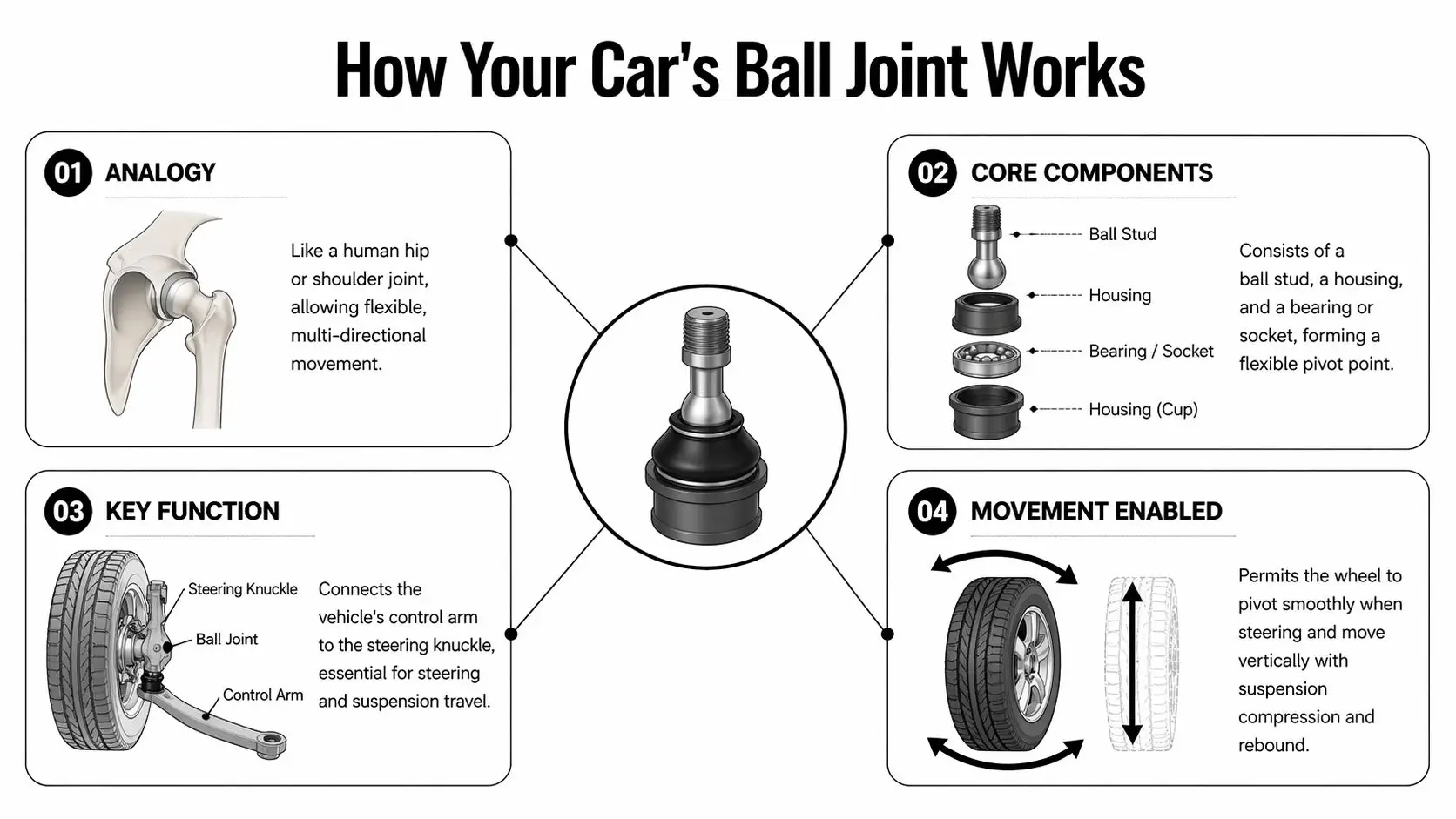
A ball joint works a lot like your hip or shoulder joint. It has to move in different directions while still staying tight and controlled. That's why it fits the job so well in a vehicle suspension.
Since the mid-20th century, ball joints became standard in vehicle suspension systems because they allow both steering precision and suspension travel. Modern versions are engineered to last 70,000 to 150,000 miles, making them a long-service but still wear-prone safety part, as explained in this ball joint engineering overview from eMag.
The simple version of what it does
Your front suspension has to do two jobs at the same time:
- Support movement from the road: The wheel has to travel up and down over bumps.
- Allow steering movement: The wheel also has to pivot left and right when you turn.
- Stay tight under load: The connection can't flop around while the vehicle is moving.
The ball joint is the part that makes those motions possible in one compact connection.
The three pieces most drivers should know
When I explain what is a ball joint to customers, I usually break it into three parts.
- Ball stud: This is the rounded metal piece that pivots. It acts like the "ball" in the joint.
- Housing or socket: This holds the ball stud in place and lets it move in a controlled way.
- Rubber boot: This flexible cover keeps grease in and dirt and water out.
That boot matters more than people think. Once it tears, contamination can get inside, grease protection drops, and wear speeds up. A ball joint doesn't have to snap to become a problem. It just has to loosen enough to affect steering feel and tire position.
Where the ball joint sits
The ball joint connects the control arm to the steering knuckle. If those names sound abstract, here's the plain-English version:
- The control arm helps the wheel move with the suspension.
- The steering knuckle is the part the wheel assembly attaches to and pivots on.
- The ball joint links them while allowing motion.
A ball joint has one job that sounds simple but isn't. It must move freely enough for suspension travel and steering, while staying tight enough to keep the wheel pointed correctly.
That balance is why a worn joint changes how the whole front end feels. Too tight would bind. Too loose creates play, noise, and unstable handling.
Recognizing the Signs of a Failing Ball Joint
Most drivers don't notice a bad ball joint by looking at it. They notice it by how the vehicle sounds and feels.
The classic complaint is a clunk when pulling into a driveway, backing out of a parking spot, or going over a bump at low speed. That sound often comes from looseness in the joint as the suspension shifts load.

What you might hear and feel on the road
A failing ball joint can show up in a few different ways:
- Clunking or popping over bumps: The joint has developed play, so parts move more than they should.
- Steering that wanders: The front end may not track cleanly in a straight line.
- Vibration through the wheel: Loose suspension parts can send movement back into the steering wheel, especially as speed increases.
- Pulling to one side: The wheel angle can shift enough to change how the vehicle drives.
- Uneven tire wear: If the wheel doesn't stay at the proper angle, the tread wears irregularly.
One of the easiest mistakes is assuming vibration always comes from tires. Sometimes it does. Sometimes the tire is fine and the suspension point holding the wheel steady is the underlying problem. If that sounds familiar, take a look at this guide on what causes steering wheel vibration.
Why the symptoms seem inconsistent
Drivers get confused because the symptom may come and go. You might hear nothing on a smooth road, then hear a knock in a parking lot. You might feel a slight shimmy at higher speed, then nothing during a short neighborhood drive.
That's because a worn ball joint reacts to load changes. Turning, braking, potholes, driveway entrances, and uneven pavement all shift force through the suspension differently.
If the front end only acts up during turns or bumps, that doesn't mean the problem is minor. It usually means the suspension only gets pushed hard enough to reveal it in those moments.
A quick visual can help you understand what those symptoms feel like from the driver's seat:
Understanding Upper Versus Lower Ball Joints
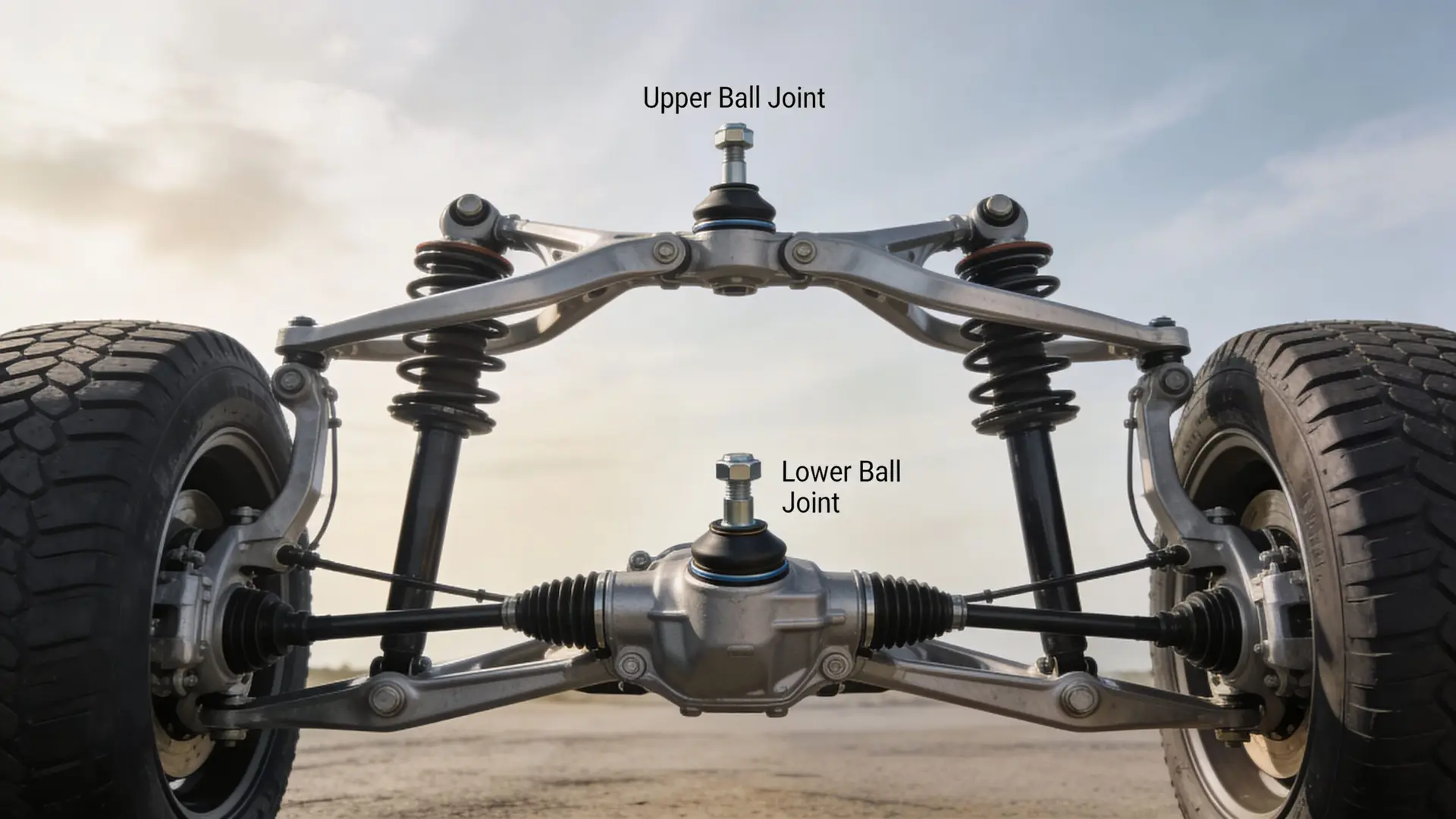
Not every ball joint does the same job. That's where a lot of online advice gets fuzzy. On many suspension designs, especially setups common on trucks and SUVs, the upper and lower ball joints have different roles.
The easiest way to think about it is this. One mainly guides motion, and the other often carries weight.
What the upper ball joint does
The upper ball joint is often a follower joint. In plain language, that means it helps guide the steering knuckle and lets the suspension move, but it usually doesn't carry the same constant load as the lower joint.
That doesn't make it unimportant. If the upper joint gets loose, steering precision still suffers. But in many vehicles, it lives a little easier life than the lower one.
Why the lower joint usually wears faster
The lower ball joint is commonly the load-carrying joint. It supports the vehicle's weight and takes repeated force from braking, cornering, bumps, and road shock. Because of that heavier job, lower ball joints can fail up to 2-3 times faster than upper follower joints, and once looseness exceeds 0.050 inches, alignment can shift enough to accelerate tire wear by 20-30%, according to MOOG's ball joint technical guide.
That load difference matters a lot in Texas, where trucks and SUVs are common. Heavier vehicles place more demand on the lower joint during everyday driving.
A side-by-side way to remember it
| Joint | Main role | Typical wear pattern |
|---|---|---|
| Upper ball joint | Follows and guides movement | Often wears more slowly |
| Lower ball joint | Supports weight and handles higher loads | Commonly wears sooner |
If a lower joint gets loose, the tire may not stay pointed where the alignment says it should. That's when you start seeing edge wear, unstable steering feel, or a front end that doesn't feel planted.
Shop-floor advice: On trucks and SUVs, never ignore lower ball joint inspection. That's the joint doing the hardest work every mile.
How Mechanics Diagnose a Worn Ball Joint
A lot of DIY videos make ball joint inspection look simple. Jack the vehicle up, grab the tire, shake it, and call it good. That can catch obvious failure, but it often misses the smaller movement that causes early symptoms.
That's where a professional inspection earns its keep.
Why the driveway test falls short
DIY checks often miss micro-play below 1/16 inch, which technicians can detect with a dial indicator. That matters because around 40% of DIY ball joint claims lead to unnecessary part replacement, while proper inspection can prevent catastrophic failure, which is described as 100% preventable with proper inspection in Summit Racing's guidance on ball joint checking.
The challenge isn't just seeing looseness. It's knowing where the looseness is coming from. A worn tie rod end, wheel bearing, control arm bushing, or alignment problem can mimic some of the same complaints.
What a technician actually does
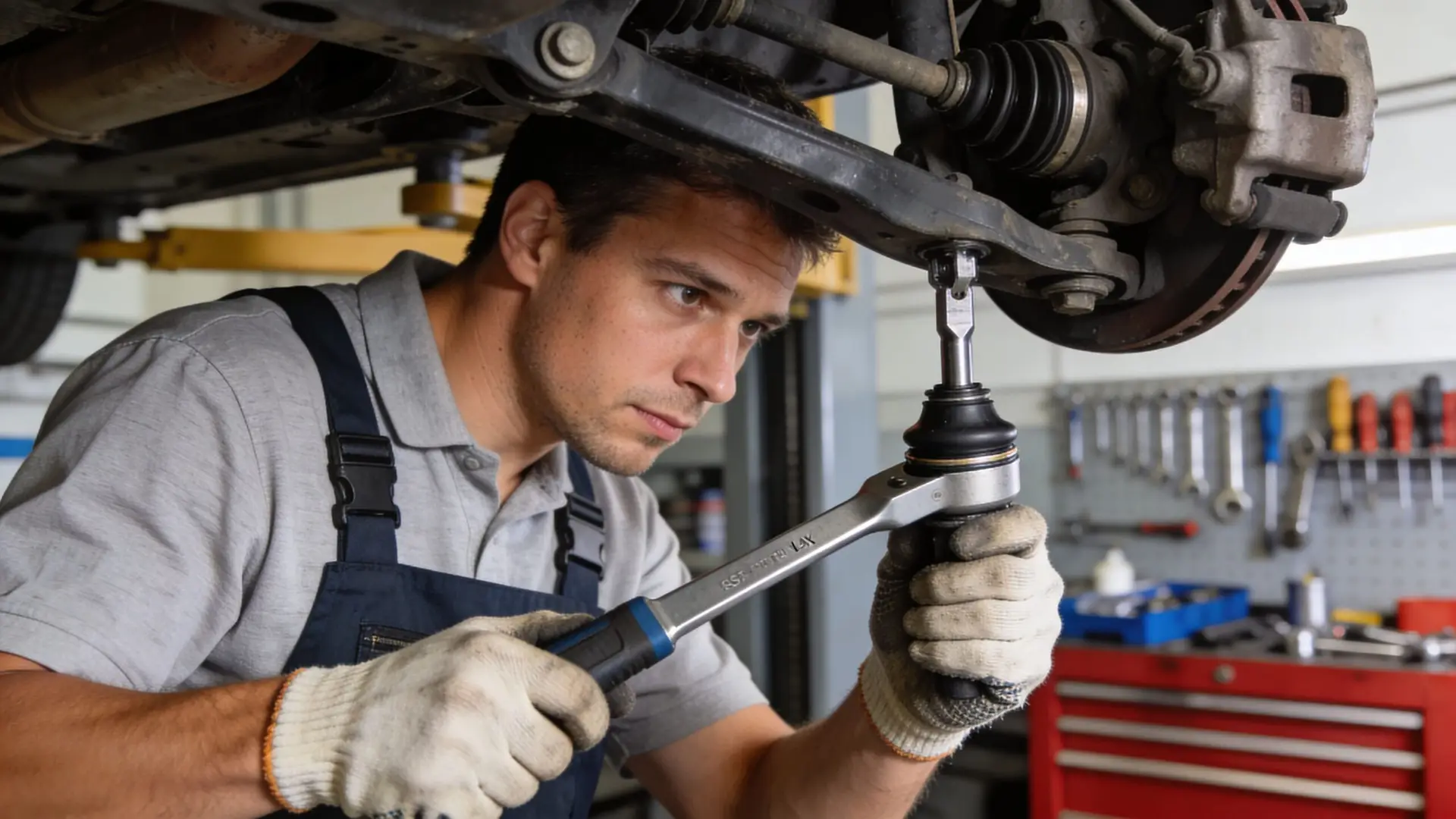
A proper inspection usually includes several steps, not just one:
- Load the suspension correctly or unload it correctly depending on the joint design.
- Use a pry bar to check for vertical or lateral movement.
- Watch the joint while the wheel moves so the tech can see whether the play is in the socket.
- Measure movement with a dial indicator when needed.
- Inspect the boot for tears, grease loss, or contamination.
Some vehicles require supporting the lower control arm before checking. Others need the suspension to hang a certain way. That's why two vehicles can have different inspection procedures even though both have ball joints.
Why accurate diagnosis saves money
If a driver guesses wrong, they may replace a part and still have the same problem. I've seen people chase vibration with tires, then brakes, then wheel bearings, when the front suspension looseness was the root cause all along.
If you're also seeing tire wear or a vehicle that doesn't track straight, this guide on signs your car needs alignment helps explain why alignment complaints and ball joint wear often show up together.
A ball joint diagnosis isn't just about confirming a bad part. It's about ruling out the other front-end parts that can fool you.
Ball Joint Replacement DIY vs Professional Service
Some repairs are reasonable for a skilled DIYer with the right tools. Ball joint replacement sits in a gray area. It isn't impossible at home, but it isn't beginner work either, especially on press-in designs.
This is one of those repairs where the part itself isn't the only challenge. The job depends on proper support, correct disassembly, the right press tools, and safe reassembly.
When DIY makes sense and when it doesn't
A confident DIYer may consider the job if they already have solid suspension experience, access to a ball joint press, and a safe place to work. Even then, the repair can get stubborn fast. Rust, seized hardware, or an integrated design can change the whole plan.
Professional service makes more sense for most drivers because suspension work affects steering, alignment, and safety all at once. That matters even more because lower ball joints on many vehicles fail 20-30% sooner, especially on trucks and SUVs, and ignoring early signs can turn a minor issue into a $500-$1200 repair, according to UTI's explanation of ball joint wear and repair implications.
DIY vs Professional Ball Joint Replacement
| Factor | DIY Replacement | Professional Service (e.g., Express Lube Plano) |
|---|---|---|
| Tools needed | May require specialty tools such as a ball joint press, pry bars, and torque tools | Shop already has the correct tools and service information |
| Time commitment | Can stretch if parts are seized or the joint is difficult to remove | Usually more predictable because techs do this work regularly |
| Diagnosis confidence | Easy to confuse ball joint play with other front-end wear | Inspection can separate ball joints from alignment, tie rod, or bearing issues |
| Safety risk | Higher if the vehicle isn't supported properly or hardware isn't torqued correctly | Lower because the repair follows established procedures |
| Follow-up needs | You still may need alignment service afterward | Repair and related suspension checks can be coordinated together |
A related repair many drivers compare it to is strut work. If you want to see how fast suspension jobs can get more involved than they look, this article on how to change a strut gives a good sense of the labor and tooling side.
If you have to ask whether ball joint replacement is within your skill level, that's often your answer.
Typical Repair Costs and Timelines
Ball joint repair cost depends on the vehicle and how the joint is built into the suspension. Some are easier to replace because they bolt in. Others are pressed into the control arm or knuckle and take more labor.
The practical cost range most drivers care about is already reflected in the earlier repair guidance. If symptoms are caught early, the expense stays more manageable. If wear is ignored and it leads to added suspension or tire problems, the bill can climb into that $500-$1200 range noted earlier.
What changes the final price
A few things usually move the estimate up or down:
- Vehicle design: Truck and SUV suspensions can be more labor-intensive.
- Upper or lower joint location: Lower joints often take more abuse and can be tougher to service.
- Press-in versus bolt-on design: Pressed components usually require more labor.
- Alignment needs afterward: Suspension geometry should be checked any time steering or suspension parts are replaced.
Timeline-wise, a professional shop can often complete the work in a few hours, depending on parts access and whether related suspension wear is found during inspection. If rusted hardware or additional front-end wear shows up, the vehicle may need more time.
Drive with Confidence When to Visit Express Lube Plano
A ball joint may be small, but the warning signs are hard to ignore once you know what they mean. Clunking, steering looseness, vibration, pulling, and uneven tire wear all deserve attention because they point to a suspension part that helps hold your steering and wheel motion in control.
If your vehicle has any of those symptoms, don't wait for the sound to get louder. Ball joints don't repair themselves, and front-end looseness has a way of turning one problem into several. The sooner a technician checks it, the better your chances of keeping the repair simple.
For Plano drivers, convenience matters too. You need a shop that can inspect the issue correctly, explain it in plain English, and get you back on the road without making the process a hassle. That's where no-appointment service, ASE-certified technicians, and straightforward recommendations make a real difference. If you're already planning maintenance, it's also worth asking about current savings like $20 off services.
If your car is clunking over bumps, pulling in traffic, or just doesn't feel right, let the team at Express Lube & Car Care take a look. Their ASE-certified technicians in Plano can inspect your suspension, confirm whether a ball joint is the problem, and help you fix it before it turns into a bigger safety issue.