

Determining the precise interval for changing your transmission fluid can be challenging. As a general guideline, most vehicle manufacturers recommend this service every 30,000 to 60,000 miles. However, this wide range underscores a critical point: the optimal schedule is contingent upon your specific vehicle, its transmission type, and your driving habits.
Understanding Transmission Service Schedules
Your vehicle's transmission is a highly complex mechanical system composed of gears, clutches, and sensitive hydraulic components. The transmission fluid serves as its essential lifeblood, responsible for cooling, lubricating, and enabling smooth gear shifts.
Similar to engine oil, transmission fluid degrades over time. Continuous exposure to heat and the accumulation of contaminants break down its chemical properties, reducing its effectiveness. Adhering to a consistent service schedule is one of the most effective preventative measures you can take to avoid costly transmission repairs.
This chart illustrates how driving conditions directly influence the required frequency of a fluid change.
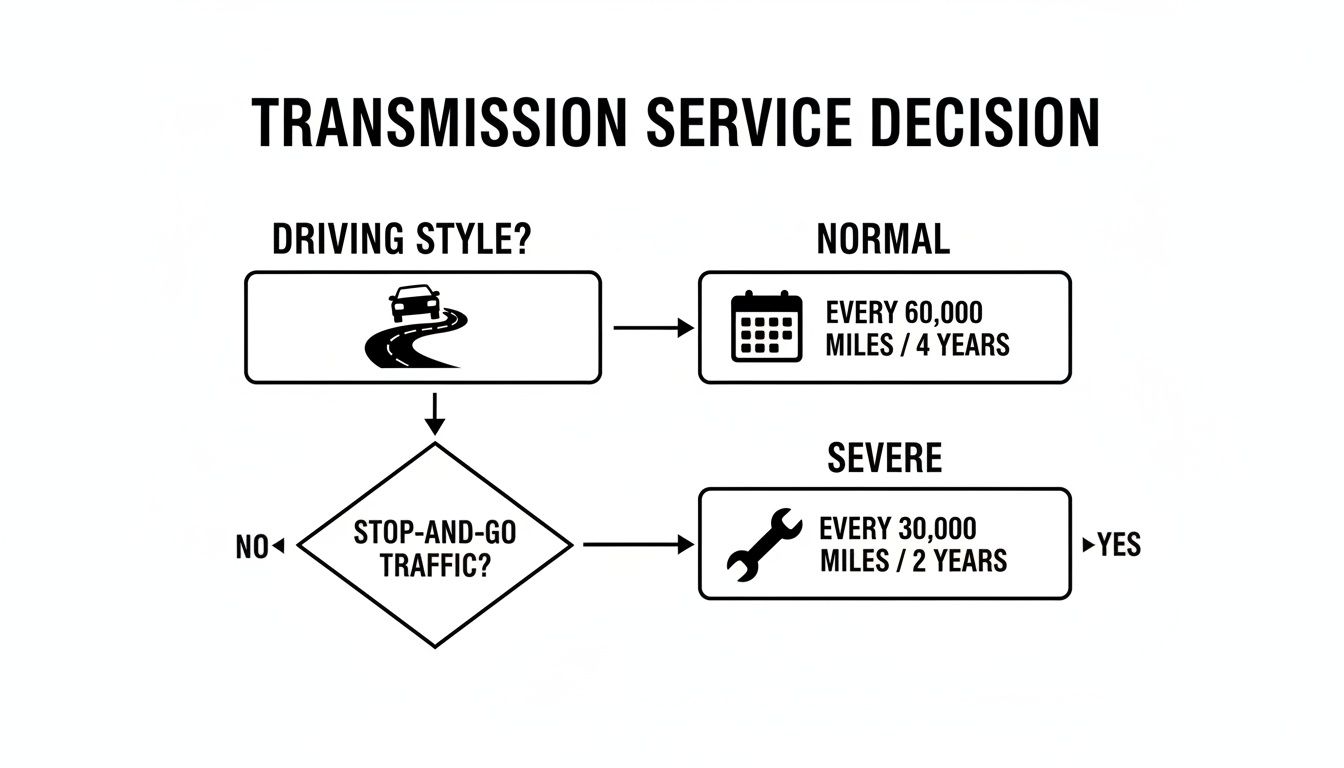
A key insight from this is that what many drivers consider "normal"—such as daily stop-and-go commutes or frequent short trips—is classified by manufacturers as "severe" use. This classification implies that your vehicle likely requires service more frequently than the standard interval suggests.
Normal vs. Severe Driving Conditions
Automotive experts estimate that up to 90% of vehicles operate under conditions classified as "severe." These conditions place significantly more thermal and mechanical stress on the transmission fluid compared to sustained highway driving.
Consequently, the 100,000-mile service interval that might be listed in an owner's manual is often an ideal-case scenario. For the majority of drivers, a more realistic interval is closer to 50,000 miles.
A common misconception involves "lifetime" transmission fluid. Within the automotive industry, the term "lifetime" typically refers to the duration of the vehicle's warranty period under ideal operating conditions—not the entire operational life of the vehicle on real-world roads.
To provide a clearer overview, the following table offers general guidelines for service intervals.
Recommended Transmission Fluid Change Intervals at a Glance
This table provides estimated service intervals for different transmission types. Always consult your owner's manual for the most accurate information specific to your vehicle.
| Transmission Type | Normal Driving Interval (Miles) | Severe Driving Interval (Miles) |
|---|---|---|
| Automatic (Traditional) | 60,000 – 100,000 | 30,000 – 50,000 |
| Manual | 30,000 – 60,000 | 15,000 – 30,000 |
| CVT (Continuously Variable) | 30,000 – 60,000 | 25,000 – 45,000 |
Of course, the most direct method to assess the need for a change is to inspect the fluid itself. You can find detailed instructions in our guide on how to check your transmission fluid.
The Critical Functions of Transmission Fluid
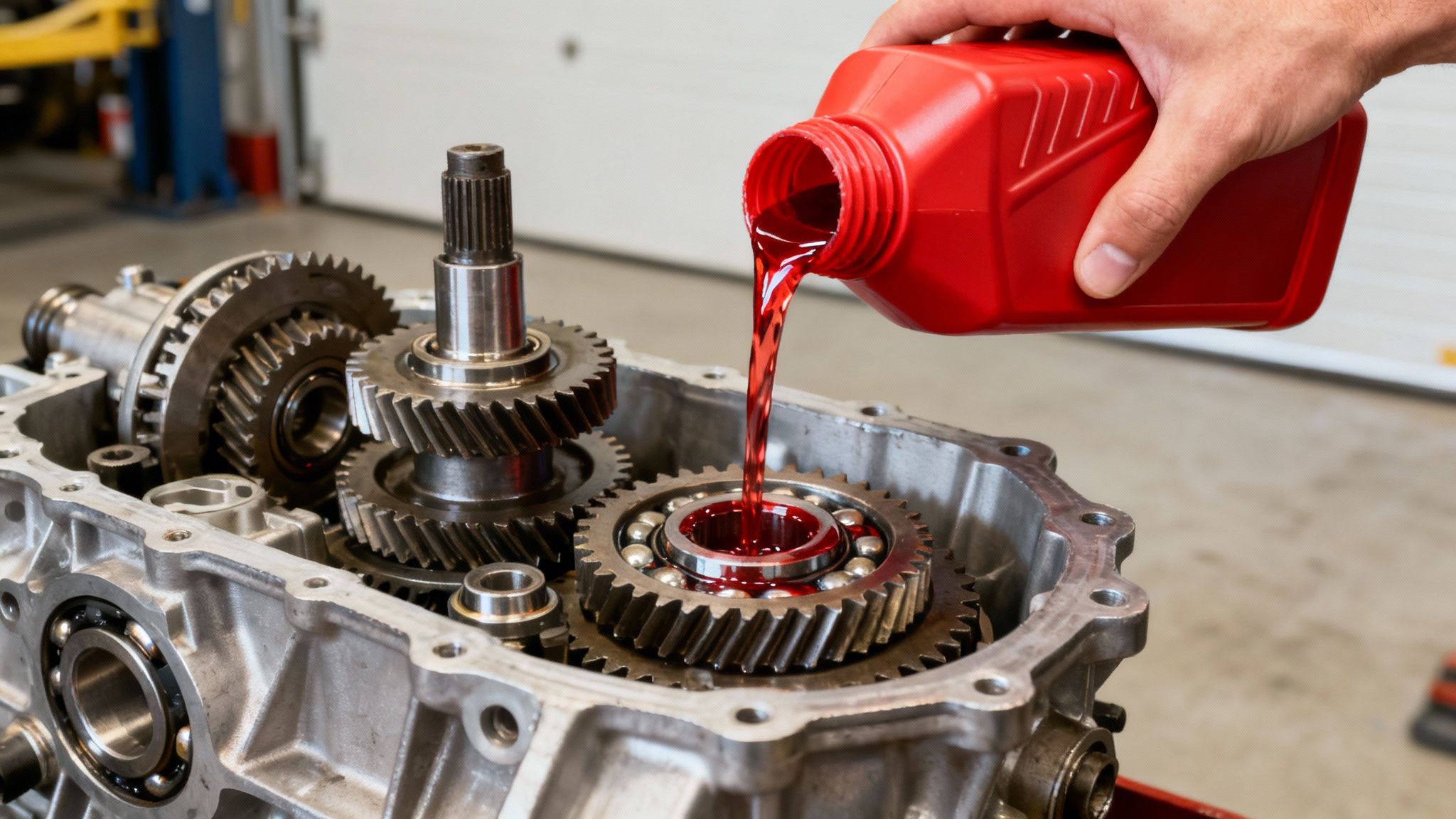
To understand when to change the fluid, it's essential to understand why it's so important. Transmission fluid performs several critical functions simultaneously, making it one of the hardest-working fluids in your vehicle. Neglecting its maintenance is a leading cause of premature transmission failure.
Fundamentally, transmission fluid is an advanced lubricant. It forms a protective film over hundreds of moving components—including gears, clutches, and bearings. This film prevents direct metal-on-metal contact, significantly reducing friction and wear that can lead to catastrophic damage.
More Than Just Lubrication
The role of transmission fluid extends beyond lubrication. It also functions as a hydraulic fluid. In an automatic transmission, fluid pressure is what actuates clutches and bands to engage the correct gear. Every time your vehicle shifts, this fluid is transferring hydraulic force to make the gear change possible, effectively transmitting power from the engine to the wheels.
Furthermore, it acts as a coolant. Transmissions generate immense heat during operation, with temperatures often exceeding 200°F, especially in demanding conditions like stop-and-go traffic. The fluid circulates continuously, absorbing this heat from critical internal components and transferring it to a cooler to be dissipated. Without this cooling effect, the transmission would rapidly overheat.
Modern transmission fluids are also formulated with a sophisticated package of detergents and anti-corrosion additives. These agents are designed to keep the transmission's intricate network of passages clean by suspending microscopic metal particles and other contaminants until they can be trapped by the filter.
The Process of Fluid Degradation
Over time, constant exposure to high temperatures and mechanical stress degrades the fluid. Its additives deplete, and its lubricating properties diminish. It becomes saturated with the contaminants it has collected, causing its color to change from a healthy, translucent red to a dark, opaque brown.
Once the fluid reaches this state, it can no longer adequately protect the transmission. Friction increases, heat builds up, and sludge can form, obstructing vital fluid passages. This is when performance issues arise, such as slipping gears, harsh shifts, or unusual noises.
Understanding when to change transmission fluid is about replacing it before this degradation leads to damage. Proactive maintenance ensures the transmission remains cool, clean, and properly lubricated, preventing the catastrophic and costly failure that often results from neglect.
Decoding Your Transmission's Specific Fluid Requirements
Different transmission technologies have distinct maintenance needs, rendering a one-size-fits-all approach to fluid changes ineffective. The design of your transmission—whether it's a traditional automatic, a Continuously Variable Transmission (CVT), or a Dual-Clutch Transmission (DCT)—dictates a unique service protocol.
One of the most pervasive myths is the concept of "lifetime fluid." When a manufacturer uses this term, "lifetime" typically corresponds to the vehicle's warranty period and is predicated on ideal, laboratory-tested driving conditions. This does not account for the rigors of daily commuting, high ambient temperatures, or towing.
In reality, all fluids degrade under real-world operating stress. Deferring service based on a "lifetime" designation is a significant risk that can lead to expensive repairs.
How Transmission Type Dictates Service Intervals
The internal architecture of a transmission directly impacts the demands placed on its fluid. This is the primary reason for the wide variation in service schedules across different vehicle models.
For example, common planetary automatic transmissions—found in numerous Toyota, Volvo, and Subaru models—can be particularly demanding on their fluid. Some major transmission manufacturers, such as Aisin, recommend a fluid exchange as frequently as every 20,000 km (approximately 12,500 miles) or every two years, especially for vehicles operated in hot climates.
Modern transmission designs follow different guidelines:
-
Dual-Clutch Transmissions (DCTs): These function like two automated manual transmissions working in tandem. They generate significant heat and mechanical stress, often requiring fluid service every 40,000–60,000 km (25,000–37,000 miles).
-
Continuously Variable Transmissions (CVTs): CVTs utilize a belt and pulley system instead of traditional gears. The fluid's primary role is to prevent metal-on-metal wear, a demanding task that typically results in a shorter service life, also often within the 40,000–60,000 km range.
The key takeaway is that your vehicle's specific technology is the single most important factor in determining its maintenance schedule. Relying on a generic rule of thumb could result in servicing your transmission far beyond its optimal point.
Because each system is unique, using the correct fluid is as important as the service interval itself. Every transmission requires a fluid with a specific formulation. A professional technician can ensure your vehicle receives the correct automotive fluid exchanges according to the manufacturer's exact specifications, which is the best way to protect its complex internal components from premature wear.
Recognizing the Warning Signs of Degraded Transmission Fluid
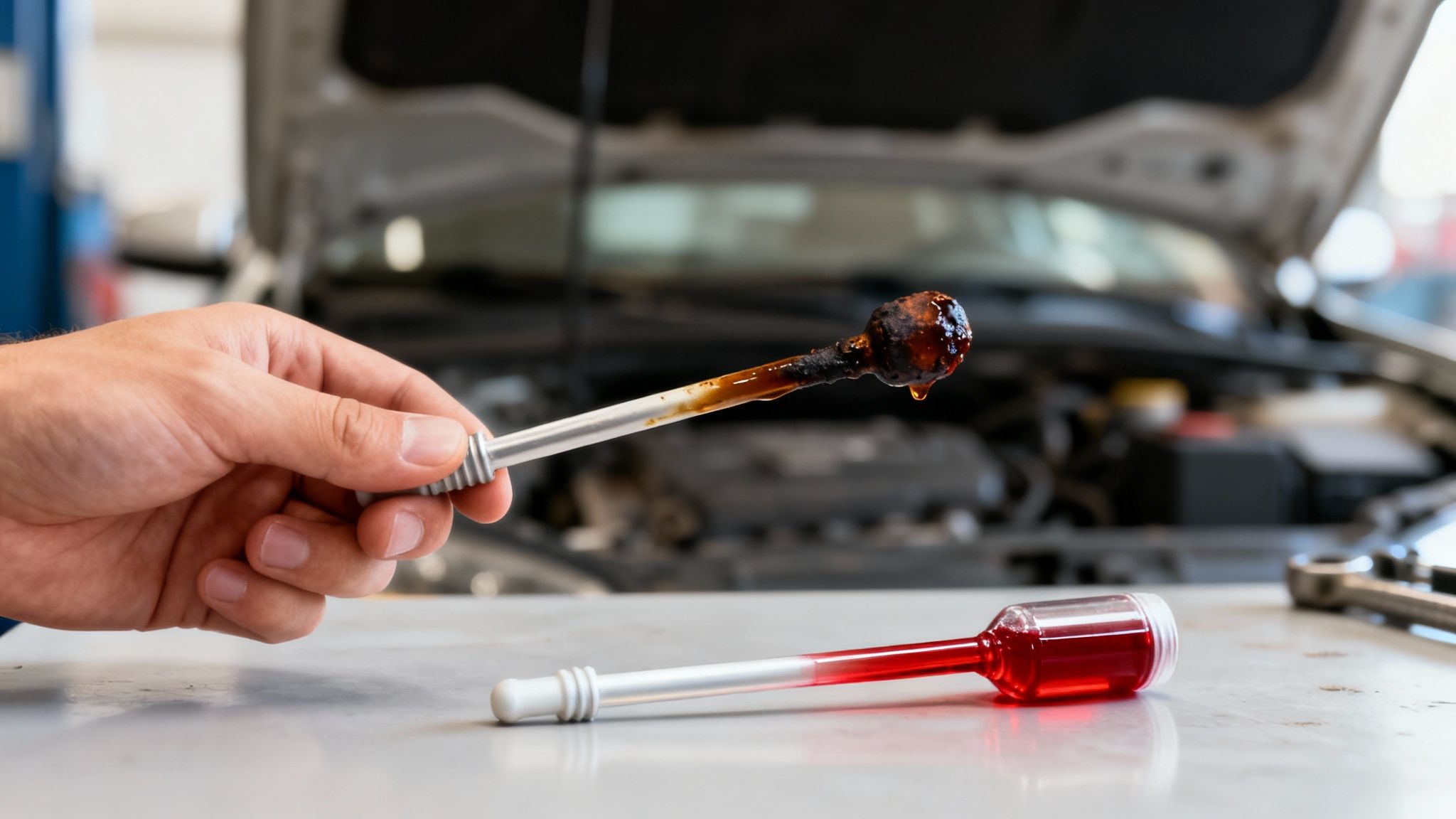
While mileage is a useful guideline, it is not the only indicator. Your vehicle will often provide sensory clues that its transmission fluid is compromised. Learning to recognize these signals is crucial for addressing a minor maintenance need before it escalates into a major mechanical failure.
By paying attention to what you hear, feel, and smell, you can often detect the early signs of fluid degradation. Ignoring these warnings is akin to disregarding a smoke alarm—the underlying issue will only worsen.
Auditory and Olfactory Indicators
The first signs of trouble are often unusual sounds and smells. A healthy transmission operates nearly silently. Any new noise should be considered a potential red flag. Similarly, fresh fluid has a mildly sweet scent; a change in odor can indicate a problem.
Be alert for these tell-tale sounds:
- A persistent whine or hum: A whining noise that changes pitch with vehicle speed can indicate that the fluid is low or degraded, causing the internal pump to cavitate or strain.
- Clunking, thudding, or grinding: Any harsh mechanical noise during gear shifts strongly suggests that the fluid is no longer providing adequate lubrication for the gear sets.
A burning smell is another classic symptom. A sharp, acrid odor, similar to burnt toast, is a sign of overheating. This means the fluid is breaking down chemically due to excessive heat and has lost its ability to protect internal components.
Performance and Visual Clues
In addition to sounds and smells, you will feel the effects of failing transmission fluid. A properly functioning transmission provides smooth, nearly imperceptible gear changes. As the fluid degrades, this seamless operation is compromised.
Pay close attention to the quality of your gear shifts. Any hesitation, jerking, or sensation of the engine revving without a corresponding increase in speed (slipping) points directly to fluid that has lost its critical properties. This is a clear indicator that it's time to investigate when to change transmission fluid.
A visual inspection is also a critical diagnostic tool. If your vehicle is equipped with a dipstick, you can check the fluid's condition. Healthy automatic transmission fluid is bright, translucent red. Degraded fluid will appear dark brown or black and may have a thick, sludgy consistency. This discoloration is a result of oxidation and contamination.
If your fluid resembles used motor oil more than its original cherry-red color, a change is long overdue. If you notice any of these symptoms, a professional inspection is recommended.
Troubleshooting Common Transmission Fluid Warning Signs
| Symptom | Potential Meaning | Recommended Action |
|---|---|---|
| Whining or Humming Noise | The fluid level may be low, or the internal pump is straining due to old fluid. | Check fluid level immediately. If it's low, top it off and inspect for leaks. If the level is correct, the fluid is likely degraded. |
| Slipping Gears | The fluid has lost its frictional properties, preventing clutches and bands from engaging properly. | This is a serious symptom. Cease driving if possible and schedule a professional inspection and fluid service. |
| Jerking or Clunking Shifts | The fluid can no longer provide smooth hydraulic pressure or adequate lubrication for gear changes. | Have a trusted mechanic inspect the fluid condition. A fluid and filter change is often the first diagnostic step. |
| Burnt Smell | The transmission is overheating, causing the fluid to break down and burn. | Pull over safely and allow the vehicle to cool. Check the fluid level and have the transmission cooling system inspected. |
| Dark, Muddy Fluid | The fluid is old, oxidized, and contaminated with debris. It is no longer effective. | A complete fluid exchange is necessary to remove all old, contaminated fluid from the system. |
Remember, these symptoms are your vehicle's early warning system. Addressing them promptly with a fluid service can prevent the need for a complete transmission rebuild.
Maintenance for High-Mileage Transmissions
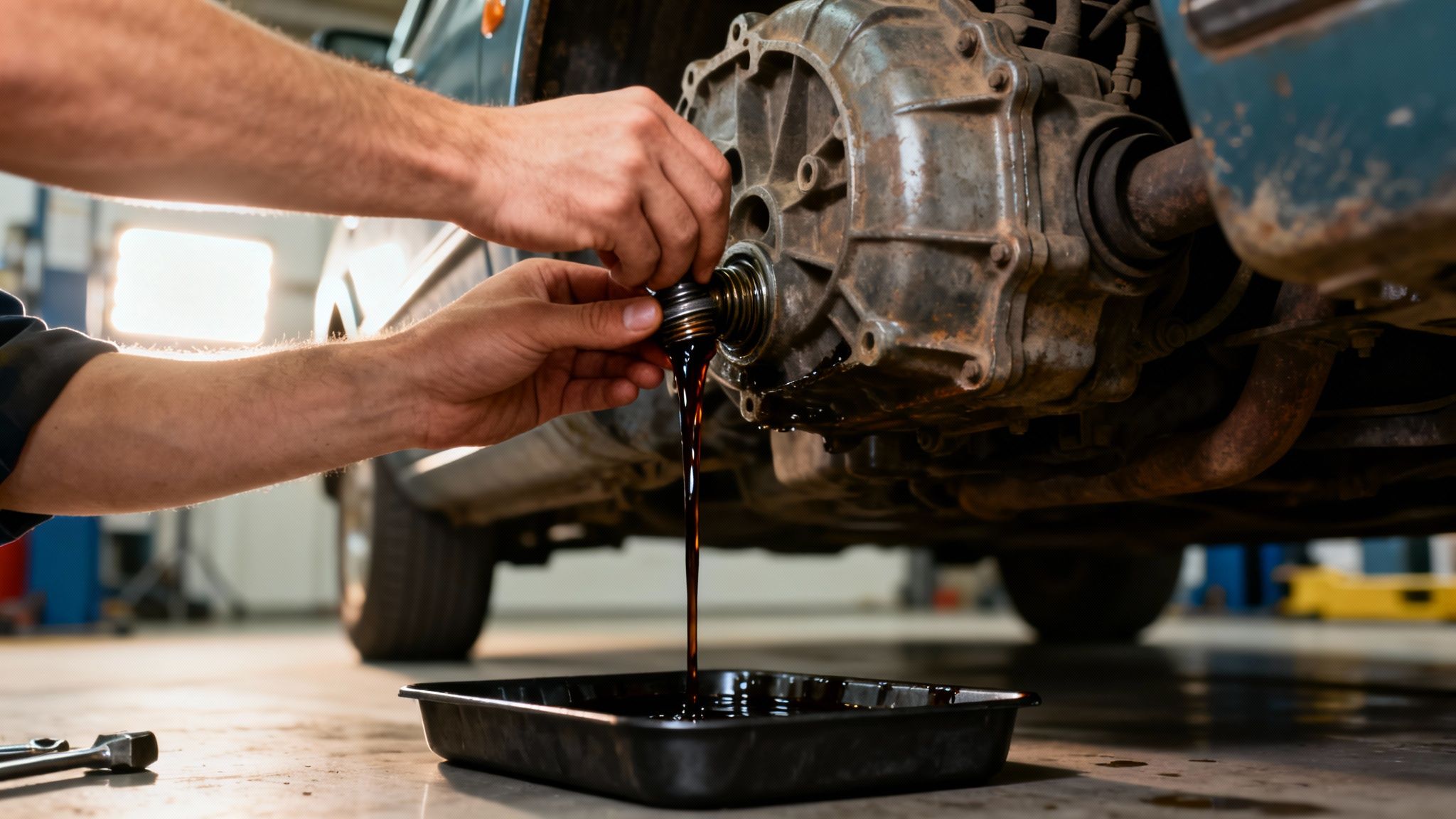
Once a vehicle surpasses 75,000 miles, its transmission maintenance requires a more cautious approach. Over years of operation, a thin layer of varnish and sediment can accumulate on internal surfaces. While not ideal, these deposits are often stable and may not be causing immediate issues.
This situation leads to a critical debate: should you perform a "transmission flush" or a "drain and fill"? Understanding the distinction is vital for protecting an older transmission from iatrogenic damage—harm caused by the service itself.
The Flush vs. Drain and Fill Debate
A transmission flush is an aggressive procedure that uses an external machine to circulate fluid and cleaning agents through the transmission under pressure. This process removes nearly all of the old fluid, including what resides in the torque converter and cooler lines. While thorough, this method poses a significant risk for an older transmission, particularly one with an unknown or inconsistent service history.
The high pressure of a flush can dislodge accumulated sediment. These freed particles can then circulate through the transmission and clog narrow, critical passages within the valve body, leading to severe shifting problems that were not present before the service.
For this reason, a simple drain and fill is almost always the safer and more prudent option for high-mileage vehicles. This less aggressive method uses gravity to drain the fluid from the transmission pan, similar to a standard engine oil change. While it only replaces a portion of the total fluid volume, it introduces fresh fluid and additives without the risk of disturbing settled deposits.
The Recommended Strategy for Older Vehicles
For vehicles in the 70,000 to 100,000-mile range or higher, careful consideration is paramount. A powerful flush can easily mobilize varnish and debris, which can then lodge in sensitive electronic solenoids and cause them to fail.
A drain-and-fill or a pan-drop service (which includes a filter change) is the recommended strategy. The preventative cost is minimal compared to a full transmission rebuild, which can cost between $4,500 and $6,000. You can find additional expert advice on transmission care for older vehicles on AdvancedTransmission.com.
By opting for the gentler drain-and-fill method, you can safely refresh the fluid and extend the transmission's service life without taking unnecessary risks. It is a conservative, intelligent approach that keeps your reliable, high-mileage vehicle operating properly.
Finding a Trusted Partner for Transmission Service
Knowing when to change your transmission fluid is only part of the equation. The other is selecting a reputable service center to perform the work correctly. This is not a simple DIY task like topping off washer fluid; it is a precise service that protects one of your vehicle's most complex and expensive systems.
Leaving this job to professionals is highly advisable. An experienced technician understands that using an incorrect fluid type can cause irreversible damage to a modern transmission. They have access to the manufacturer-specific fluids your vehicle requires, as well as the specialized equipment needed to perform the service cleanly and effectively.
Why Choose a Local Plano Expert
For drivers in Plano, Texas, local conditions present unique challenges. At Express Lube & Car Care, we have extensive experience with how our region's high summer heat and frequent stop-and-go traffic impact transmission health. Our ASE-certified technicians are local experts who provide honest, data-driven advice to help you avoid major repair costs.
Our philosophy is centered on preventative maintenance. A timely fluid exchange is a small, strategic investment that helps prevent the kind of catastrophic failure that results in a multi-thousand-dollar transmission replacement. We are dedicated to helping our community make informed decisions for their vehicles.
We aim to build long-term relationships with our clients based on trust and high-quality work. Whether your vehicle requires a simple drain-and-fill or a more comprehensive service, our team is equipped to handle the job. You can learn more about our expert transmission services in Plano and see how we help keep our community's vehicles performing reliably.
Don't wait for a warning sign to appear. Protect your automotive investment and gain the peace of mind that comes from proper maintenance. Schedule an inspection with Express Lube & Car Care today, and let our team ensure your vehicle is ready for the road ahead.
Transmission Fluid FAQs
Even with a detailed guide, specific questions often arise. Here are answers to some of the most common inquiries we receive from vehicle owners.
Can I Simply Top Off My Transmission Fluid?
While adding fluid may seem like a quick fix for a low level, it does not address the underlying cause. A low fluid level almost always indicates a leak. Topping off the fluid is a temporary measure that fails to resolve the root problem.
Furthermore, adding new fluid to a system containing old, degraded fluid is ineffective. The new fluid is immediately contaminated by the old, which has already lost its protective properties. This is analogous to adding a small amount of clean water to a gallon of mud; the overall mixture remains contaminated and unable to properly lubricate and cool the transmission.
What Are the Consequences of Using the Wrong Type of Fluid?
Using the incorrect transmission fluid is a critical and potentially catastrophic error. Each transmission is engineered to operate with a fluid possessing a specific viscosity, friction coefficient, and additive package.
Introducing the wrong fluid can lead to a cascade of problems:
- Poor Shifting Performance: You will likely experience harsh gear engagement, slipping, or delayed shifts.
- Overheating: An incorrect fluid may not have the proper thermal stability, leading to overheating that can damage seals, clutches, and other internal components.
- Complete Transmission Failure: In severe cases, the wrong fluid can lead to the complete destruction of the transmission, requiring a full replacement.
Always verify the correct fluid type in your owner’s manual or consult with a professional technician. This simple step is crucial for protecting a component that costs thousands of dollars to replace.
Does My Driving Style Truly Affect Fluid Life?
Yes, absolutely. Your daily driving habits have a profound impact on when to change transmission fluid. Consider the transmission fluid's workload. Sustained highway driving at a constant speed is a low-stress condition.
In contrast, heavy towing, frequent hard acceleration, or navigating constant stop-and-go traffic are "severe" conditions. These activities generate significantly more heat and mechanical stress, which accelerates the breakdown of the fluid. The protective additives are consumed more quickly, necessitating more frequent fluid changes to maintain proper transmission protection.
Proactive transmission maintenance is one of the most effective ways to ensure your vehicle's long-term reliability. For honest advice and expert service in the Plano area, trust the team at Express Lube & Car Care. We will ensure your vehicle receives the correct care to operate smoothly for years to come. Schedule your visit today at https://www.expresslubeplano.com.