

A power steering leak can be dangerous. It drains the hydraulic assist that makes steering manageable, and leaking fluid near a hot exhaust manifold carries real fire risk. Park somewhere safe, check the reservoir for the fluid level, and skip long drives until you know what is wrong. If steering suddenly feels heavy, fluid is spraying, or you smell burning, call for a tow instead of driving. Most leaks are repairable at a reasonable cost, but a leak left alone can wreck a pump or the steering rack.
TL;DR:
- Most power steering leaks originate from the pump shaft seal, high-pressure hoses, or rack-and-pinion seals, with puddle location offering crucial diagnostic clues.
- Whining noises during steering often signal low fluid levels or air in the system, typically preceding visible leaks and system failure.
- Driving with active spray, burning smells, or heavy steering issues risks pump damage and sudden loss of steering assist, requiring immediate professional attention.
- Repair costs range from under $100 for simple hose or clamp fixes to over $1,200 for complete rack replacements, emphasizing early detection for cost savings.
- Routine inspections, fluid checks, and timely hose or seal replacements can prevent leaks from worsening, along with avoiding stop-leak additives that may cause system damage.
Table of Contents
- What Are the Symptoms of a Power Steering Leak?
- Where Do Power Steering Leaks Usually Come From?
- How Do You Check and Diagnose a Power Steering Leak?
- Can You Drive With a Power Steering Leak?
- What Does It Cost to Fix a Power Steering Leak?
- How Can You Prevent Future Power Steering Leaks?
- Our Take on Power Steering Leaks
- Get Your Power Steering Leak Diagnosed Today
- Sources
- FAQ
What Are the Symptoms of a Power Steering Leak?
Your ears usually catch a power steering problem before your eyes do. A whining or groaning noise when you turn the wheel, especially at idle or low speed, often means the pump is starving for fluid or drawing in air, and it’s one of the most common signs of low power steering fluid drivers report before a full diagnosis.
Steering feel changes matter just as much as noise. Watch for these signals:
- Stiff or heavy steering, especially when parking or making tight turns at low speed
- Jerky or inconsistent steering response instead of the usual smooth pull
- Pink, amber, or reddish fluid puddles under the front of the vehicle
- Wet or oily residue on the rack boots, hoses, or around the pump housing
- Foamy or bubbly fluid in the reservoir, which points to air in the system
- Dark, burnt-smelling fluid or fluid with tiny metallic flecks, which signals advanced wear
Pro Tip: If the whining noise only happens when the wheel is turned fully to one side, check the fluid level first. That’s a classic sign the pump is cavitating from low fluid, not a failing part.
A grinding sound is a different animal entirely and usually points to a mechanical issue rather than fluid loss. Our guide on grinding noise when turning the steering wheel breaks down that distinction if you’re not sure which sound you’re actually hearing.
Where Do Power Steering Leaks Usually Come From?
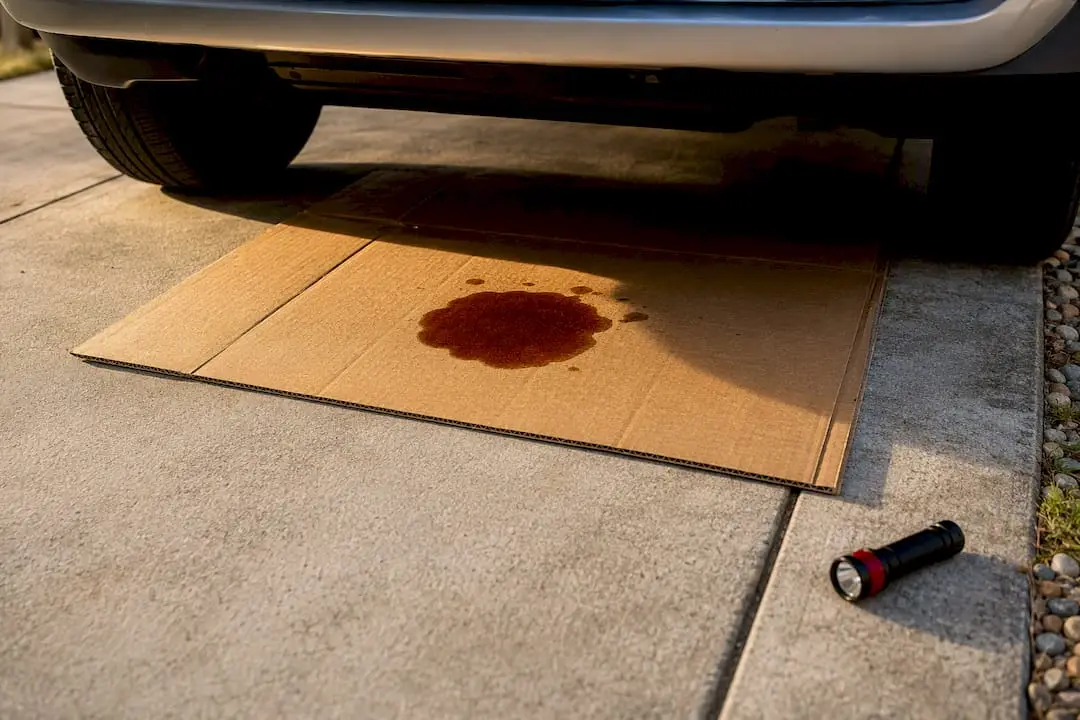
Where the puddle forms tells you almost everything about what failed. A drip near the front of the engine, close to the belt system, usually traces back to the pump. Fluid pooling closer to the wheels or along the centerline of the car more often points toward the rack.
The most frequent failure points, from simple to serious, include:
- Pump shaft seal and O-rings — drips at the front of the engine, often paired with whining that changes with RPM.
- High-pressure hose or crimp fittings — spray or heavier leaking under load, especially noticeable when turning the wheel lock to lock.
- Return or low-pressure hoses — slow, steady drips from cracked rubber or a loosened clamp, often lower on either side of the engine bay.
- Rack-and-pinion seals — fluid near the bellows or boots, typically requiring rack service rather than a quick patch.
- Reservoir cracks or a bad cap O-ring — fluid tracking down the inner fender or pooling near the firewall.
Common failure points span everything from pump seals to cracked plastic reservoirs, and the fix ranges from a $10 hose clamp to a full rack swap. That’s exactly why puddle location is worth studying before you assume the worst.
Pro Tip: Slide a piece of clean cardboard under the car overnight. The puddle’s shape and position the next morning will narrow down the source faster than staring under the hood in bad lighting.
How Do You Check and Diagnose a Power Steering Leak?
Before touching anything, run through a short safety routine: park on level ground, set the parking brake, let the engine cool, and put on gloves and eye protection. Power steering fluid is under pressure and can be hot right after driving.
Once you’re set up, work through these steps:
- Check the reservoir. Compare the fluid level to the MIN/MAX lines, and note the color and smell. Clean, translucent fluid is normal; dark or burnt-smelling fluid signals a bigger problem.
- Trace the lines visually. Follow the hoses from the reservoir to the pump and rack, checking clamps, fittings, and boots for wetness.
- Top off and run the engine. Add fluid to the correct level, then start the car and turn the wheel lock to lock to circulate it.
- Clean and recheck. Wipe down suspect areas, then run the engine again and watch where fresh fluid reappears.
- Use UV dye if the leak stays hidden. A shop can add dye to the system and use a UV light to spot even slow seeps.
This top off, clean, run, and dye sequence is the same one professionals rely on, and it’s effective at locating leaks in the vast majority of cases without tearing anything apart. Our step-by-step guide to checking power steering fluid walks through the same process in more detail.
Pro Tip: Don’t confuse power steering fluid with engine oil or transmission fluid when you’re checking a puddle. Our guide to diagnosing engine oil leaks can help you rule those out first.
Stop the DIY approach and call a shop if fluid sprays out under pressure, steering suddenly feels heavy or unpredictable, you notice smoke or a burning smell, or the leak seems to originate from underneath the rack. Rack repairs generally require a lift and specialized tools that aren’t practical in a driveway.
Can You Drive With a Power Steering Leak?
Short, cautious drives to a nearby shop are usually fine if the leak is minor and steering still feels predictable. That’s not a green light to keep driving indefinitely, though.
Tow the vehicle instead of driving it if you notice any of these red flags:
- Fluid actively spraying or streaming, not just dripping
- A strong burning smell or visible smoke from the engine bay
- Steering that suddenly turns heavy, sticks, or jerks unexpectedly
- A puddle under the car larger than a quarter after only a short parking stretch
Continuing to drive on a significant leak risks pump cavitation and internal scoring, which can lead to sudden loss of steering assist during an emergency maneuver, exactly when you need full control the most. Metal particles from a worn pump can also circulate through the rest of the system, turning a moderate repair into a much bigger one.
What Does It Cost to Fix a Power Steering Leak?
Repair costs track closely with how far the damage has spread. A leak caught early, at a loose clamp or a cracked reservoir, is a quick fix. Wait too long, and you’re looking at pump or rack replacement.
Realistic ranges break down roughly like this:
- Minor fixes (clamps, return hose, reservoir replacement): typically under $100 to $250.
- Moderate repairs (high-pressure hose replacement, pump seal or remanufactured pump): commonly $200 to $600.
- Major repairs (steering rack or gearbox replacement): often $600 to $1,200 or more, depending on the vehicle and whether an alignment or fluid flush is also needed.
Frequent failure points range from simple hose swaps to expensive rack replacements, which is why catching a leak early genuinely saves money, not just hassle.
One thing worth skipping entirely: stop-leak additives poured into the reservoir. They can temporarily swell rubber seals to slow a weep, but they don’t repair cracked hoses or failed metal fittings, and the residue can clog the pump or rack, turning a moderate repair into a major one.
How Can You Prevent Future Power Steering Leaks?
Most leaks don’t appear overnight. They build slowly through worn rubber, contaminated fluid, or a hose that finally gives out after years of heat cycling.
A short maintenance routine catches most of this before it becomes a roadside problem:
- Check the fluid level and condition at scheduled service intervals, not just when something feels off.
- Flush and replace the fluid per your manufacturer’s recommendation, or sooner if it looks dark or gritty.
- Have hoses, clamps, and rack boots inspected during routine oil changes rather than waiting for a visible leak.
- Avoid curb strikes when parking, and check the boots for damage after any impact.
- Schedule a professional inspection if you’re topping off fluid often or hearing persistent whining.
Some manufacturers specify automatic transmission fluid for power steering systems while others require dedicated power steering fluid, so it pays to check the reservoir cap or owner’s manual before topping off with whatever’s on the shelf. Using the wrong fluid type can degrade seals faster than the leak itself.
Pro Tip: Ask your technician to inspect power steering hoses the next time you’re in for an oil change. It costs nothing to look, and catching a hardening hose before it cracks is far cheaper than a tow later. For a deeper look at fluid service intervals, see our guide to flushing a power steering system.
Our Take on Power Steering Leaks
Most drivers treat a little whining noise as background static, something to live with until it gets annoying enough to deal with. That’s backward. The noise is the cheapest, earliest warning your steering system gives you, and it usually shows up well before a visible puddle does. By the time you’re wiping fluid off the driveway, the leak has often had weeks or months to work on the pump or rack internals.
We’d also push back on the instinct to “wait and see” with a slow drip. A slow leak today is rarely a slow leak in six months. Rubber hoses harden and crack progressively, pump seals wear a little more with every mile, and once metal particles start showing up in the fluid, you’re no longer looking at a simple seal swap. The gap between a $150 hose repair and a $1,000 rack replacement is almost always time, not luck.
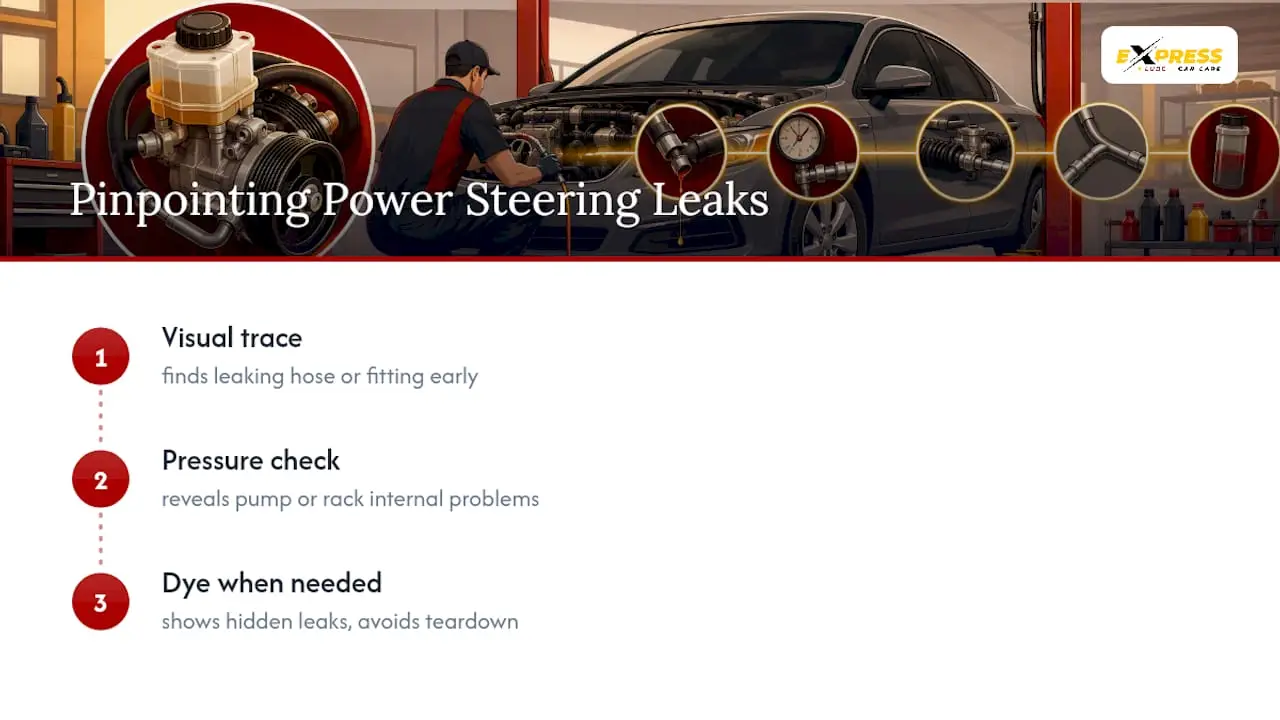
What we’d genuinely like more drivers to understand is that a proper diagnostic doesn’t require guesswork or a parts cannon approach. A visual trace, a pressure check, and dye when needed will find the source of nearly any leak without unnecessary teardown. There’s no reason to replace a pump when the actual problem is a $20 hose clamp.
Get Your Power Steering Leak Diagnosed Today
You don’t need an appointment to get a straight answer about that whining noise or the puddle under your car. Express Lube & Car Care offers same-day diagnostics with no appointment required, and our ASE-certified technicians handle everything from a simple hose swap to a full steering rack replacement.
Here’s what to expect when you pull in: a quick visual check of the reservoir and visible components, a safe top-off if fluid levels allow it, and pressure or UV dye testing when the leak isn’t obvious. Every inspection includes a photo-based digital report and a clear written estimate before any work begins, so you know exactly what you’re paying for and why. If your visit uncovers other maintenance needs while you’re there, check our current oil change and service specials to see what else might apply. Stop by or schedule your visit and get that steering system checked before a small drip turns into a bigger repair.
Sources
Symptoms and diagnostic steps draw from Cartreatments’ guide to low power steering fluid signs and The Motor Guy’s breakdown of common leak points. Fluid-check guidance comes from CarBasicsHub’s beginner’s guide, and safety recommendations reference AAA’s warning signs advisory.
- Steering Doesn’t Feel Right? 4 Signs of Low Power Steering Fluid
- Where Is Power Steering Fluid Leaking From In My Car? (7 Common Places & Fixes)
- Common Causes of Power Steering Fluid Leaks
FAQ
Can I Still Drive With a Power Steering Leak?
A short, cautious drive to a nearby shop may be fine for a minor drip if steering still feels normal. Tow the vehicle instead if fluid is spraying, steering suddenly feels heavy, or you notice smoke or a burning smell.
How Much Does It Usually Cost to Fix a Power Steering Leak?
Minor fixes like a clamp or hose replacement typically run under $100 to $250. Pump repairs commonly fall between $200 and $600, while a full rack replacement can run $600 to $1,200 or more depending on the vehicle.
Where Is the Most Common Place for a Power Steering Leak?
Leaks most often start at the pump shaft seal, high-pressure hose fittings, or the rack-and-pinion seals. Puddle location is a strong clue: front-of-engine drips usually mean the pump or hoses, while fluid near the wheels or centerline often points to the rack.
How Do I Fix My Power Steering Leak?
Small issues like a loose clamp or worn hose can often be replaced directly once you’ve confirmed the source with a visual trace and top-off test. Larger problems, like a failing pump seal or rack seal, need a professional inspection with pressure testing or UV dye, which is a service Express Lube & Car Care provides with no appointment needed.