

If your owner’s manual specifies 5W-20, you can generally use 5W-30 as a substitute in many gasoline engines, though you may notice a small dip in fuel economy. Going the other direction, using 5W-20 when the manual calls for 5W-30, is riskier because it can reduce the oil film’s strength at operating temperature. The manufacturer’s recommendation should always come first.
TL;DR:
- Both grades share the same 5W cold rating, but 5W-30 stays thicker when warm; check the manual’s required API or ILSAC category too.
- A technical paper found friction modified 5W-20 improved fuel efficiency by about 1.5% to 2% versus conventional 5W-30 in engine test cycles.
- If your manual specifies 5W-20, 5W-30 is commonly acceptable in many gasoline engines, especially under heat or load, but may slightly reduce fuel economy.
- Using 5W-20 where the manual specifies 5W-30 is riskier under sustained heat or heavy use; treat any substitution as temporary and arrange service soon.
- A different grade added when topping up usually will not cause immediate damage, but check the oil level and schedule a full oil change soon.
Table of Contents
- How to Read “5W-20” and “5W-30”: the SAE Viscosity Basics
- Cold Start vs Operating Temperature: How Each Grade Performs
- Fuel Economy vs Engine Protection: What Research Shows
- Practical Substitution Rules: When Swapping Grades Is Acceptable
- Mixing and Topping Off: What to Do Right Now
- Decision Checklist: Choosing the Right Grade for Your Vehicle
- Environmental Considerations Related to Oil Viscosity Choices
- How We Handle Oil-Grade Questions During Service
- Book an Oil Change or Inspection in Plano
- FAQ
- Sources
How to Read “5W-20” and “5W-30”: the SAE Viscosity Basics
Every motor oil grade follows a format set by the SAE J300 standard, which classifies oils by how they flow at different temperatures. The “W” stands for winter, not weight, and the number before it describes how the oil behaves in cold conditions. A lower number means the oil flows more easily when the engine is cold, which matters most during startup when the pump first has to move oil through the engine.
The number after the “W” measures viscosity at normal operating temperature. This is where 5W-20 and 5W-30 actually differ. Both grades flow similarly when cold, since both carry a “5W” rating, but once the engine reaches full operating temperature, 5W-30 holds a thicker consistency than 5W-20.
That thickness difference is intentional. Engineers select a target viscosity range for each engine based on bearing clearances, oil pump capacity, and how much heat the internal components generate under load. A tighter-tolerance engine designed for lighter oil will circulate 5W-20 efficiently and maintain adequate film thickness for its specific clearances. An engine designed with larger clearances or higher heat loads may need the extra body that 5W-30 provides to keep metal surfaces properly separated.
A few practical points help clarify what the numbers mean in daily use:
- The first number (5W) governs cold-start flow and pumpability in low temperatures.
- The second number (20 or 30) governs resistance to flow at normal operating temperature, with higher numbers indicating thicker oil.
- Both grades share the same cold-weather rating, so the real-world difference shows up once the engine is warm.
- Viscosity grade alone does not guarantee performance; the oil also has to meet the API and ILSAC service category your engine requires.
Manufacturers choose a specific grade based on engine testing, not guesswork, which is why matching the owner’s manual remains the safest starting point for any oil decision.
Cold Start vs Operating Temperature: How Each Grade Performs
Startup is one of the most demanding moments for an engine’s lubrication system. Oil pools at the bottom of the pan overnight, and when you turn the key, the pump has to move that oil through narrow passages and up to the valvetrain before parts begin spinning against each other without full lubrication. Because both 5W-20 and 5W-30 carry the same “5W” cold-flow rating, they have similar cold-temperature flow characteristics.
The difference emerges once the engine warms up. At operating temperature, 5W-30 maintains a thicker film between moving metal surfaces than 5W-20. That extra film thickness provides a wider margin of protection under heat and load, which is why many trucks, SUVs, and engines that tow or carry heavy loads are specified for 5W-30 rather than 5W-20.
Certain driving conditions shift the balance toward one grade or the other:
- Frequent short trips in cold climates benefit from either grade’s shared cold-start advantage, so manufacturer specification should guide the choice.
- Towing, hauling, or sustained high-RPM driving favors the thicker film strength that 5W-30 provides at operating temperature.
- Extended idling or stop-and-go traffic in high ambient heat raises oil temperature and can make the extra body of 5W-30 appealing in engines that allow it.
- Daily commuting in moderate conditions, within a manufacturer’s specified range, rarely creates a meaningful difference between the two grades.
An engine built and tested for 5W-20 is engineered around that oil’s specific flow characteristics, including oil pump output and bearing clearances, so the manufacturer’s rating still matters more than the driving scenario alone.
Fuel Economy vs Engine Protection: What Research Shows
The 5W-20 versus 5W-30 debate often comes down to a trade-off between fuel economy and film strength. A technical paper presented through SAE found that lighter, friction-modified 5W-20 oil improved fuel efficiency by approximately 1.5% to 2% compared with conventional 5W-30 in engine test cycles, a modest but measurable gain tied to reduced internal friction from the thinner oil.
That efficiency gain exists because thinner oil requires less energy for the engine to pump and circulate, and it flows more easily past piston rings and bearings. The trade-off is high-temperature, high-shear (HTHS) viscosity, a measurement of how well oil resists thinning under heat and mechanical stress. Lower HTHS values generally correspond to thinner oil films at operating temperature, which can mean less cushioning for highly loaded components like rod bearings and cam lobes.
Viscosity grade is only one part of the protection equation, though. The additive package, base oil quality, and the oil’s API or ILSAC service category all influence how well it resists wear, oxidation, and deposit formation. Two oils with the same viscosity number can perform differently depending on their formulation, which is why the American Petroleum Institute advises checking the service category alongside the grade printed on the bottle.
A few points help put the trade-off in perspective:
- Fuel economy gains from lighter oils are real but modest, generally in the low single digits.
- HTHS viscosity, not just the SAE number, determines how much protective film remains at operating temperature.
- Additive chemistry and base oil quality affect wear protection as much as viscosity grade does.
- An engine specified for 5W-20 was tested and calibrated with that oil’s friction characteristics in mind, so the fuel economy benefit is already built into the manufacturer’s recommendation.
Because formulation varies between brands and products, the safest approach is matching both the viscosity grade and the service category listed in your owner’s manual rather than assuming any 5W-20 or 5W-30 product performs identically to another with the same number.
Practical Substitution Rules: When Swapping Grades Is Acceptable
Owners frequently ask whether a quart of the “wrong” grade on the shelf is safe to use in a pinch. The answer depends on which direction you’re substituting and how long the substitution will last.
- Always check the owner’s manual first. Some manufacturers list an acceptable range or an approved alternative grade for certain climates or model years, and that guidance overrides general rules of thumb, according to the API Motor Oil Guide.
- Using 5W-30 where 5W-20 is specified is commonly acceptable for many gasoline engines, particularly under high-load or high-temperature driving, though you may notice a slightly smaller fuel economy benefit and should watch for any unusual oil pressure readings.
- Using 5W-20 where 5W-30 is specified carries more risk, since the thinner oil may not maintain adequate film strength under the heat and load the engine was designed around, making this direction less advisable for sustained or heavy-duty use.
If you find yourself needing a substitution, whether from an emergency top-off or a parts-counter mix-up, the safest move is scheduling a full oil and filter service as soon as it’s convenient rather than continuing to drive indefinitely on the substituted grade. Watch for oil consumption changes, dashboard warning lights, or unusual engine noise in the meantime.
Pro Tip: Keep a photo of your oil cap or owner’s manual page on your phone so you always have the correct grade on hand when buying oil away from home.
Mixing and Topping Off: What to Do Right Now
Running low on oil between services happens, and topping off with a different grade than what’s already in the engine will not cause immediate damage in most cases. The American Petroleum Institute’s guidance prioritizes matching both the viscosity grade and service category whenever possible, since mixing different formulations can slightly alter the blended oil’s overall performance characteristics even though it will still lubricate the engine.
If matching oil isn’t available and you need to top off with whatever grade you have, treat it as a temporary stop-gap rather than a long-term solution. Plan a full oil and filter change soon afterward so the system runs on a single, correctly specified product again.
To top off safely:
- Check the level with the dipstick or digital readout while the engine is off and on level ground.
- Add oil in small amounts and recheck the level between additions.
- Avoid overfilling, since too much oil can aerate and reduce lubrication effectiveness.
- Watch for dashboard warning lights, leaks, or unusual smells that suggest a problem beyond a normal low-level situation.
A quick top-off buys you time, but it’s not a substitute for regular oil and filter service on the manufacturer’s recommended interval.
Decision Checklist: Choosing the Right Grade for Your Vehicle
Cutting through the technical detail, here’s how to settle on the right oil grade and know when to get help.
- Start with the owner’s manual or the onboard maintenance reminder. This remains the single most authoritative source for your specific engine, since manufacturers test fuel economy, emissions, and wear protection using the exact grade they recommend.
- Factor in how you actually drive the vehicle. Towing, carrying heavy loads, or driving in consistently high ambient temperatures favors the thicker grade your manufacturer allows, if one is listed as an acceptable alternative.
- Watch for warning signs that need professional attention. High oil consumption between changes, low oil pressure readings, knocking or ticking noises, or an illuminated oil warning light all call for a technician’s inspection rather than guesswork at home.
Matching the grade to your specific engine, rather than assuming all small passenger vehicles use the same oil, protects both your fuel economy and your engine’s long-term wear pattern. For more on selecting the right oil for daily driving, a technician can walk through your specific mileage and driving habits.
Environmental Considerations Related to Oil Viscosity Choices
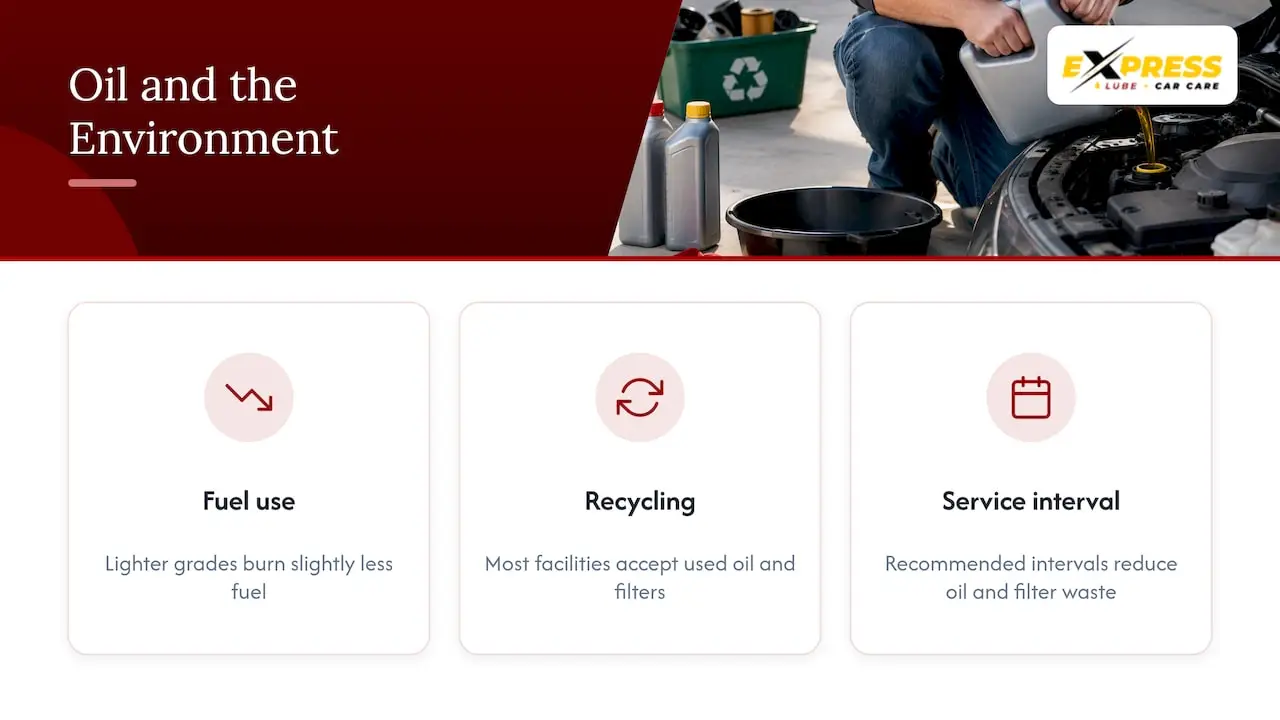
Oil viscosity choice has a secondary effect worth considering: fuel consumption. Since lighter grades like 5W-20 reduce internal engine friction, vehicles specified for lighter oil typically burn slightly less fuel over time than they would with a heavier grade, which translates to modestly lower emissions per mile driven. This is part of why automakers increasingly specify thinner oils, including 0W-20 and even 0W-16, in newer engine designs built with tighter tolerances specifically to take advantage of that efficiency.
Beyond fuel consumption, used oil disposal matters regardless of which grade you run. Motor oil, synthetic or conventional, should never be poured down a drain or into the ground, since it can contaminate soil and water supplies. Most oil change facilities and auto parts stores accept used oil and filters for recycling, where the oil is reprocessed into new lubricants, fuel oil, or other industrial products rather than discarded as waste.
Choosing the correct grade for your engine also extends oil life and reduces how often you need a full service, which modestly reduces the overall volume of oil and filters consumed over your vehicle’s lifetime. For owners seeking broader vehicle maintenance context, resources like the dealer’s checklist for buying high mileage luxury cars provide valuable insights. Sticking to the manufacturer’s recommended interval, rather than changing oil more frequently than necessary, strikes a reasonable balance between engine protection and minimizing waste.
How We Handle Oil-Grade Questions During Service
When a customer isn’t sure whether their vehicle takes 5W-20 or 5W-30, we start by confirming the manufacturer’s specified viscosity and service category rather than guessing from the vehicle’s size or age. That verification step prevents the kind of mismatch that can quietly affect fuel economy or wear protection over time.
If a customer asks about swapping grades, whether because of a prior top-off or a question about towing, our technicians walk through the trade-offs in plain terms and inspect the oil’s current condition before making a recommendation. When we find a mismatch between what’s in the pan and what the manufacturer specifies, we recommend a full oil and filter service to correct it rather than leaving a partial fix in place.
A few things shape how we approach these conversations:
- Our technicians check viscosity and service category against the manufacturer’s specification before performing any oil change.
- Our service model means you can come in for a grade correction when you notice a concern.
- Every oil change includes a check of related fluid levels and a visual inspection, so a grade mismatch rarely goes unnoticed for long.
— Express Lube & Car Care
Book an Oil Change or Inspection in Plano
If you’re not sure which grade your vehicle needs, or you suspect a previous top-off left a mismatch in the pan, we can verify the manufacturer’s recommended viscosity, inspect your current oil’s condition, and perform a full oil and filter change in one visit. Our technicians also check your maintenance minder or service interval so you leave with a clear picture of when your next service is due.
Here’s what a visit typically includes:
- Confirmation of your manufacturer’s recommended viscosity and service category before any oil goes in.
- A full oil and filter change using the correct grade for your specific engine.
- A review of your dashboard maintenance reminder or mileage-based interval.
- A quick visual check of related systems so small issues get flagged early.
If you’re unsure which grade is right or you need a quick oil-and-filter change, visit or book online with no appointment required. You can also browse our full service menu or check current oil change specials before you come in.
FAQ
How often should I change my oil?
Oil change intervals depend on your vehicle, driving habits, and the oil type used, so the most reliable guide is your owner’s manual or onboard maintenance minder rather than a flat mileage rule. Many modern vehicles calculate a custom interval based on actual driving conditions, which can extend or shorten the traditional schedule. For more detail on how different interval systems work, see our breakdown of oil change interval types.
What is synthetic motor oil?
Synthetic motor oil is a lubricant engineered from chemically modified base molecules rather than refined directly from crude oil, giving it more consistent molecular structure and performance across temperature extremes. It generally resists breakdown and maintains viscosity better than conventional oil over a full service interval. Many manufacturers now specify synthetic oil as standard, particularly in engines built around lighter viscosity grades like 5W-20 or 0W-20.
Can I use 5W-30 instead of 5W-20 in my Honda Pilot?
Using 5W-30 instead of a manufacturer-specified 5W-20 is commonly acceptable in many gasoline engines, but you should check your specific owner’s manual for any approved alternative grades before making the switch a regular practice. Honda’s own maintenance documentation and maintenance minder system are the authoritative source for your model year. If you’re uncertain, a technician can confirm the correct grade during your next service.
What cars use 5W-30 oil?
Many trucks, SUVs, and engines built for higher towing or load capacity specify 5W-30 because its thicker film at operating temperature better protects components under sustained heat and stress. Some passenger cars also call for 5W-30 depending on engine design and model year. Always confirm the exact grade listed in your specific vehicle’s owner’s manual rather than assuming by vehicle type alone.
Sources
- 982506: Fuel Efficiency of SAE 5W-20 Friction Modified Gasoline Engine Oil – Technical Paper
- WHICHOIL ISRIGHT FORYOU?