

For most daily commuters, the correct engine oil is the viscosity grade and performance specification printed in your owner’s manual — full stop. If your manual calls for 5W-30 API SP, that is what goes in the engine. If it requires full synthetic, conventional oil is not an acceptable substitute, even at the right viscosity. The manufacturer’s recommendation accounts for your engine’s tolerances, operating temperatures, and emissions hardware in ways that no general advice can replicate.
The three trust signals that matter most for any oil type selection for a daily driver are the API performance category, the ILSAC standard printed on the bottle, and the judgment of an ASE-certified technician who can cross-check your VIN against the exact spec your engine requires. Express Lube & Car Care’s certified technicians do exactly that check at every oil service.
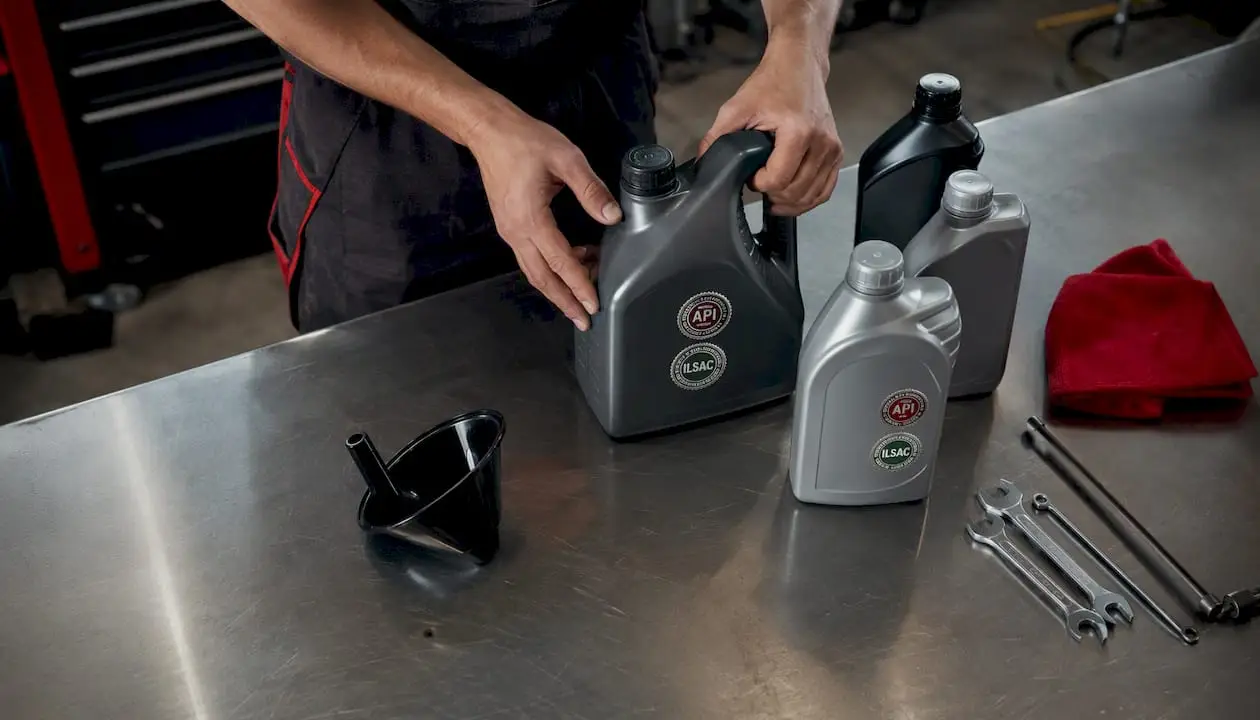
Table of Contents
- Five steps to pick the right oil right now
- What SAE viscosity numbers actually mean for your commute
- Synthetic vs. conventional oil: what daily commuters need to know
- Oil recommendations for five common daily-driver situations
- Why racing oil is usually the wrong choice for a daily driver
- How to find the exact oil spec for your specific car
- How often to change oil and what it costs in the U.S.
- What our ASE-certified technicians check at every oil service
- Key Takeaways
- The oil advice most drivers never hear
- Get your oil change done right, today
- Useful sources and further reading
- FAQ
Five steps to pick the right oil right now
Before you buy a quart or walk into a shop, run through this checklist:
- Check the owner’s manual first. Find the viscosity table and any listed OEM approvals (e.g., dexos1 Gen 3, BMW LL-04). The manual is the primary source; everything else is a cross-check.
- Glance at the oil filler cap. Most caps print the viscosity grade (e.g., 5W-20) as a fast visual confirmation, but the cap alone does not list performance specs.
- Match the API/ILSAC mark on the bottle. API guidance confirms that newer categories are backward compatible, so an API SP oil covers engines that called for SP, SN, or earlier. Still confirm any OEM-specific approval separately.
- Choose full synthetic when the manual requires it or your driving qualifies as severe use (short trips under 15 minutes, frequent towing, extreme temperatures). Otherwise, a quality synthetic blend or conventional meeting the spec is acceptable.
- When in doubt, bring your VIN. A VIN lookup through the manufacturer’s portal or an ASE-certified shop confirms the engine code and the exact oil spec, especially when the manual is missing.
Pro Tip: Brand choice matters far less than meeting the viscosity and certification listed in the manual. A store-brand oil displaying the correct API Starburst and viscosity grade protects your engine just as well as a premium-labeled product at twice the price — as long as the specs match.

What SAE viscosity numbers actually mean for your commute
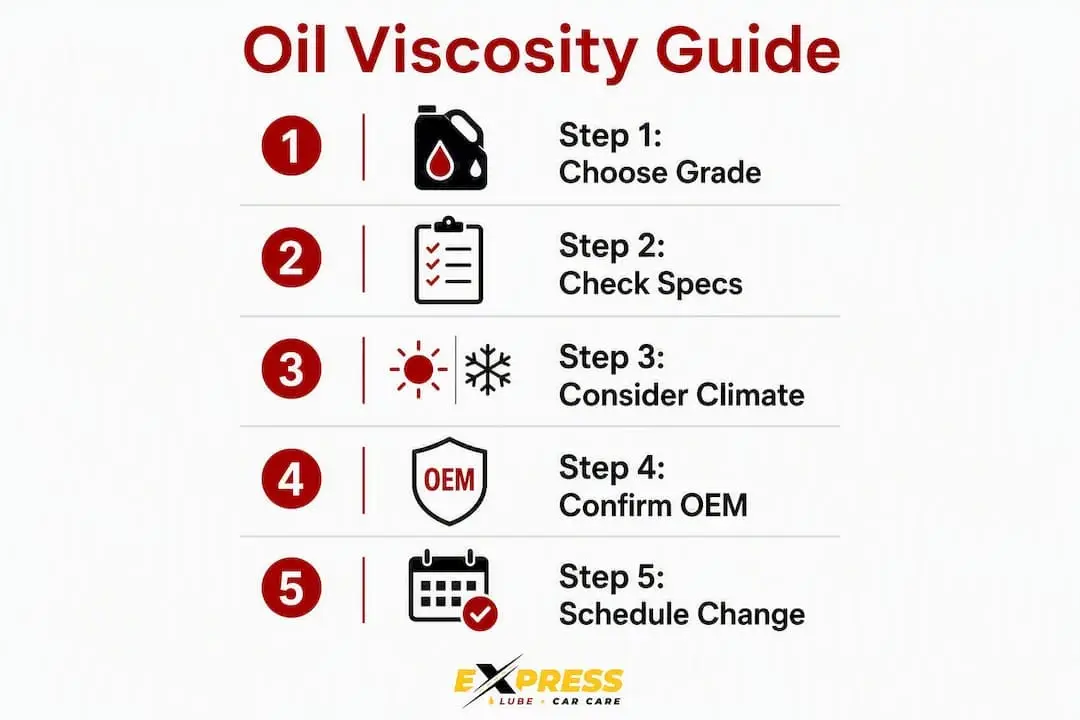
The two-number SAE grade on every oil bottle (0W-20, 5W-30, 10W-30) describes how the oil flows at two different temperatures. The number before the “W” (which stands for Winter) measures cold-start viscosity — lower is thinner and flows faster when the engine is cold. The number after the “W” measures viscosity at operating temperature — higher means thicker protection under heat and load.
Why this matters for daily drivers:
- A 0W-20 flows almost immediately at startup in sub-zero temperatures, making it the spec of choice for many modern fuel-efficient engines in northern climates.
- A 5W-30 is the most common grade for a broad range of passenger cars and light trucks across most of the continental U.S.
- A 10W-30 starts slightly thicker in cold weather; it was standard for decades but is less common in newer engines with tighter tolerances.
Modern OEMs increasingly specify ultra-low viscosities like 0W-16 for engines engineered to very tight clearances. Swapping to a thicker grade on those engines is not a minor adjustment — it can affect fuel economy, cold-start protection, and in some cases, warranty coverage. Understanding what oil viscosity means for your engine helps clarify why the manual’s grade is not a suggestion.
Pro Tip: The difference between 5W-30 and 10W-30 shows up mainly at cold startup, not at highway cruising speed. If your manual lists both as acceptable, choose 5W-30 for northern winters and 10W-30 only if you’re in a consistently warm climate and the manual explicitly permits it.
Synthetic vs. conventional oil: what daily commuters need to know
There are four practical categories of motor oil a daily driver might encounter:
- Conventional oil: — Refined from crude oil; meets baseline API/ILSAC specs; suitable for older engines with wider tolerances and normal driving patterns.
- Full synthetic: Engineered base stocks with a precisely formulated additive package; superior thermal stability, deposit control, and cold-flow performance. Consumer Reports notes that synthetic tends to last longer between changes and performs better under extreme temperatures.
For daily commuters, the case for full synthetic is strongest when the OEM requires it, when your commute involves frequent short trips, or when you drive in extreme heat or cold; learn more about how car engine tuning impacts your engine’s oil needs in this car engine remapping guide. Downgrading from full synthetic to conventional — even at the correct viscosity — can void warranty language in some OEM agreements and reduces protection against high-temperature deposits. The deeper comparison between synthetic and conventional oil is worth reading if you’re weighing the cost difference.
Statistic callout: Consumer Reports’ guidance on synthetic oil confirms it offers longer drain intervals and better extreme-temperature performance — but the primary benefit for daily drivers is sludge resistance in short-trip, stop-and-go commutes where the engine rarely reaches full operating temperature.
Oil recommendations for five common daily-driver situations
Scenario-based guidance cuts through the noise faster than general rules. Here is what the spec and the conditions actually call for:
- Cold northern winters (Minnesota, Michigan, upstate New York): Choose the lowest winter number your manual permits — 0W-20 or 0W-30 over 5W-30 when both are listed. Cold-start protection is the priority; thinner cold-flow means oil reaches bearings faster at -20°F.
- Hot southern climates (Texas, Arizona, Florida): Stick to the listed hot viscosity. A thicker oil does not automatically mean better protection in heat — it can actually increase drag and reduce fuel economy. Texas heat accelerates oxidation, which is a stronger argument for synthetic than for a thicker grade.
- High-mileage vehicles (typically 75,000+ miles): Consider a high-mileage formula if you notice minor seepage around gaskets or elevated oil consumption between changes. These formulas add seal conditioners that can reduce minor leaks without requiring immediate repairs. More detail on oil changes for high-mileage cars covers the tradeoffs.
- Turbocharged or small-displacement high-boost engines: Prioritize OEM approvals and current API/ILSAC categories. API’s updated GF-7A/GF-7B and API SQ standards (introduced March 2025) specifically address LSPI protection and timing-chain wear — both real failure modes in turbo engines running the wrong oil.
- Short-trip commuters (under 15 minutes each way): Consumer Reports advises synthetic for this pattern because the engine rarely reaches full operating temperature, leaving moisture and combustion byproducts in the oil. Synthetic resists sludge formation far better than conventional under these conditions.
Why racing oil is usually the wrong choice for a daily driver
Racing oils like Driven 5W-30 appear frequently in enthusiast forums, and the appeal is understandable — high-performance formulations sound like an upgrade. The reality for a daily commuter is more complicated.
Racing oils are formulated for short, high-load events where the engine runs at peak temperature for a defined period and the oil is changed immediately afterward. They typically carry elevated levels of zinc dialkyldithiophosphate (ZDDP) for flat-tappet protection but sacrifice the detergency and additive balance needed for long drain intervals and emissions-system compatibility.
The specific risks for daily driving include:
- Faster additive depletion over normal commute cycles, leaving the engine under-protected well before the next scheduled change.
- Reduced deposit control, which accelerates sludge buildup in stop-and-go driving.
- Possible incompatibility with catalytic converters and oxygen sensors due to elevated phosphorus levels.
Driven 5W-30 is cited in forums as acceptable for occasional use in some engines, but it is not a recommended default for commuters. The API Starburst and ILSAC certification marks are absent from most racing oils for a reason — they do not meet the full performance requirements for street use.
Pro Tip: If you’ve run a racing-grade oil temporarily, don’t wait for the normal interval. Change back to a properly certified daily-use oil at the next service and inspect the filter for unusual debris.
How to find the exact oil spec for your specific car
The process takes about three minutes and removes all guesswork:
- Owner’s manual: Open to the maintenance or specifications section. Look for a viscosity table that may list multiple acceptable grades by temperature range, plus any required API, ILSAC, or OEM approvals (dexos, BMW LL, VW 502.00, etc.).
- Oil filler cap: A fast visual check for the viscosity grade. Useful as a cross-check, but not a substitute for the manual because it does not list performance certifications.
- VIN lookup: If the manual is missing, use the manufacturer’s owner portal or a dealer’s online lookup. Enter your VIN to confirm the engine code — critical when a model year offered multiple engine options with different oil specs.
- Bottle verification: Matching viscosity alone is not enough. Confirm the bottle displays the required API, ILSAC, or OEM approval mark. A label that says “meets” a spec without the actual certification mark can be misleading.
- ASE-certified technician: Bring your VIN to a shop. An ASE tech can cross-reference the engine code against the manufacturer’s spec sheet and confirm the correct oil and filter in under a minute. Understanding why the correct oil grade protects your engine reinforces why this verification step matters.
How often to change oil and what it costs in the U.S.
Modern vehicles generally call for oil changes every 5,000–10,000 miles, depending on oil type and driving conditions, or whenever the oil-life monitor signals a change. Popular Mechanics confirms that the old 3,000-mile rule is outdated for most current vehicles running quality oil. The interval types explained in detail show how driving patterns shift those windows.
Severe-use conditions that shorten the interval:
- Trips consistently under 5 miles in cold weather
- Frequent towing or hauling near the vehicle’s rated capacity
- Sustained high-speed driving or track use
- Dusty or off-road environments
Typical U.S. cost ranges for a quick-lube or independent shop:
- Conventional oil change: roughly $35–$55 including filter and labor
- Synthetic blend: roughly $45–$70
- Full synthetic: roughly $65–$100, higher for European vehicles or specialty filters
- Dealer service: typically $20–$40 more than independent shops for the same spec
Cost callout: The price gap between conventional and full synthetic narrows considerably when synthetic’s longer drain interval is factored in. A synthetic change at 7,500 miles costs less per mile of protection than a conventional change at 3,500 miles — and it provides better sludge resistance for short-trip commuters in the process.
What our ASE-certified technicians check at every oil service
An oil change at Express Lube & Car Care is not just a drain-and-fill. The technician’s inspection covers the items that most affect oil performance and engine longevity:
- VIN and manual cross-check: Confirms the exact viscosity and performance spec before the drain plug is touched.
- Leak inspection: Checks valve cover gaskets, drain plug seating, and oil pan for seepage that could cause consumption between services.
- PCV system and turbo drain line: A clogged PCV valve pressurizes the crankcase and accelerates oil contamination; turbo drain lines that restrict flow cause oil to cook inside the turbo housing.
- Oil color and contamination check: Dark brown oil is normal; gray or milky oil signals coolant intrusion and requires immediate attention before a standard oil change proceeds.
- Filter replacement with an OEM-compatible part: The filter replacement interval matters as much as the oil itself; a clogged filter bypasses filtration entirely.
From the service bay: The most common mistake we see from short-trip commuters is running conventional oil past 5,000 miles and wondering why the engine sounds rough at startup. Synthetic oil and a tighter interval solve that problem before it becomes an engine repair.
Pro Tip: If your commute averages under 15 minutes each way, tell the technician. That single detail changes the interval recommendation and the oil-type recommendation — and it takes 10 seconds to say.
Express Lube & Car Care provides same-day, no-appointment-required oil changes with digital inspection photos, technician notes, and a 24-month/24,000-mile warranty on every service.
Key Takeaways
Matching your manufacturer’s viscosity and performance specification is the single most protective decision you can make for a daily-driven engine — everything else is secondary.
| Point | Details |
|---|---|
| Owner’s manual is the authority | Always confirm viscosity grade and API/ILSAC/OEM approval from the manual before buying oil. |
| Full synthetic when required or severe-use | Use full synthetic if the OEM mandates it or your commute involves short trips, extreme temps, or towing. |
| Modern intervals: 5,000–10,000 miles | Follow the manufacturer schedule or oil-life monitor; the 3,000-mile rule is outdated for most current vehicles. |
| Racing oil is not a daily-driver upgrade | Products like Driven 5W-30 lack the detergency and emissions compatibility needed for regular commuting. |
| Express Lube & Car Care | ASE-certified technicians confirm your exact oil spec by VIN, same day, no appointment needed. |
The oil advice most drivers never hear
Most oil-related content focuses on the synthetic-vs.-conventional debate as if it were the central question. It is not. The central question is whether the oil in your engine carries the right API/ILSAC certification for your specific engine’s design. A premium full-synthetic product in the wrong performance category — say, an API SN oil in an engine that requires SP for LSPI protection — provides less protection than a mid-grade synthetic with the correct certification.
The second thing drivers consistently underestimate is the severity of short-trip commuting. Driving 8 miles to work and 8 miles home sounds easy on an engine. In practice, the oil never fully reaches operating temperature, moisture accumulates in the crankcase, and combustion acids don’t burn off. That pattern is harder on oil chemistry than a 45-minute highway run. Synthetic oil and a shorter change interval are not upsells for short-trip drivers — they are the correct specification for that use case.
The third overlooked point: interval discipline matters more than brand loyalty. An engine running the correct spec oil changed on schedule will outlast one running a premium brand at twice the recommended interval, every time.
Get your oil change done right, today
Knowing the right oil is half the job. Having it installed correctly, with the right filter, a verified torque on the drain plug, and a full inspection of what the oil is actually doing inside your engine — that is the other half.
Express Lube & Car Care in Plano handles oil changes for daily drivers the same day, no appointment required. Bring your VIN or your owner’s manual page, and the ASE-certified technicians will confirm the exact viscosity, performance spec, and filter your engine needs before anything is touched. Military personnel and healthcare providers receive special discounts, and every service carries a 24-month/24,000-mile warranty.
Check the current oil change specials and stop in when it fits your schedule — most oil services are completed while you wait.
Useful sources and further reading
The following sources were used to build and verify the guidance in this article:
- API Oil Categories — American Petroleum Institute: The authoritative reference for current and historical API Service Categories for gasoline and diesel engines.
- API Motor Oil Guide (PDF): Plain-language explanation of performance levels, viscosity grades, and how to read the API Service Symbol
- Consumer Reports — Should You Use Synthetic Oil?: Evidence-based guidance on when synthetic is worth the cost for everyday drivers.
- Popular Mechanics — How to Pick the Right Engine Oil: Practical overview of interval guidance and viscosity selection for modern vehicles.
For final confirmation, always check your owner’s manual, use your manufacturer’s VIN lookup tool, and verify the API/ILSAC marks on the oil bottle before purchase.
FAQ
What is the best oil for daily driving?
The best oil for a daily driver is the viscosity grade and API/ILSAC performance category specified in your owner’s manual. Full synthetic is the right choice when the OEM requires it or when your commute involves short trips, extreme temperatures, or towing.
Is 5W-30 or 10W-30 better for a daily driver?
5W-30 flows better at cold startup and suits a wider range of U.S. climates, making it the more practical choice for most daily drivers. Use 10W-30 only if your manual explicitly permits it and you drive in consistently warm conditions.
How do I find out what oil my car needs?
Check the viscosity table in your owner’s manual and look for any listed API, ILSAC, or OEM approval requirements. If the manual is missing, use your manufacturer’s VIN lookup portal or ask an ASE-certified technician to cross-reference your engine code.
Can you use racing oil in a daily driver?
Racing oils like Driven 5W-30 are formulated for short, high-load events and typically lack the detergency, long-drain additive balance, and emissions compatibility that daily commuting requires. Using one temporarily is not catastrophic, but it should be replaced with a properly certified street oil at the next service.