

The most common sign of a worn ball joint is a faint, intermittent clunk from one corner of the car, usually over bumps or while turning. Other symptoms include loose or wandering steering, vibration in the wheel and uneven wear on the front tires. Because a failed ball joint can leave a wheel unsupported, any of these signs deserves a prompt look from a technician. Below we cover what each symptom feels like, what else can cause it, and how a proper inspection confirms the diagnosis.
TL;DR
- A clunk or knock from the front suspension over bumps, dips or turns is the classic ball joint sign. It starts faint and grows more frequent as wear increases.
- Loose steering, wandering, vibration and wear on the inner or outer edge of a front tire are the other common signals.
- Tie rods, bushings, tires, wheel bearings and shocks can mimic a bad ball joint, so the noise alone does not settle it.
- A ball joint that separates can make the car undrivable. Do not wait on a clunk that is getting worse.
- We inspect steering and suspension in Plano without an appointment, and qualifying repairs carry our limited warranty (eligibility and exclusions apply).
Table of Contents
- What a ball joint does
- The main ball joint symptoms
- Quick reference: symptom, feel and what it may mean
- What can be mistaken for a bad ball joint
- What causes ball joints to wear out
- How a ball joint is checked
- Can you keep driving on a bad ball joint?
- What repair looks like
- Our perspective: what we see in the bay
- Get your front end inspected in Plano
- Protecting your ball joints
- FAQ
- Sources
What a ball joint does
A ball joint is a pivot that connects the steering knuckle (which holds your wheel) to the control arm. It works like the hip joint in your body: it lets the wheel move up and down with the road and swing left and right when you steer, while keeping the wheel in the right position. Many vehicles have an upper and a lower ball joint at each front wheel, while some designs use only one load-carrying joint per side.
Inside the joint is a steel ball and socket, sealed by a rubber boot that holds in grease. Over time the boot can tear, grease escapes, dirt gets in and the surfaces wear. Once there is slack in the joint, the wheel can shift in ways it was never designed to. For a deeper look at the part itself, see our guide on what a ball joint is, how it fails and how it is repaired.
The main ball joint symptoms
Wear is gradual, so early symptoms are easy to dismiss. Here is what drivers typically notice, roughly in the order it tends to show up.
A clunking or knocking noise
According to MOOG, a suspension parts maker, the first sign is usually a faint, intermittent clunk from one corner of the vehicle that becomes louder and more frequent as wear worsens. It is most noticeable over bumps and dips and while turning.
AutoZone describes the same pattern: clunking over uneven surfaces or in turns, and with progressively more play, a more frequent hammering sound.
A few practical details help you describe it to a technician:
- When it happens: over a speed bump, a driveway apron, a pothole or a rough railroad crossing, or when turning into a parking space.
- Where it seems to come from: one front corner, usually. Note whether it is the driver or passenger side.
- How it changes: a single dull knock that repeats more often over several weeks is a stronger lead than a rattle that comes and goes with temperature.
Squeaking or creaking
Not every ball joint noise is a clunk. MOOG notes that damaged ball joint boots can produce squeaking as the suspension moves, while worn joints can clunk as they rattle through suspension travel. A squeak that follows the up-and-down motion of the car, rather than the speed of the wheels, is worth having checked. A dry or torn boot is often the early warning before the joint itself is loose.
Loose, wandering or stiff steering
AutoZone lists steering wander, reduced precision, vibration at speed and increased steering effort as possible effects of a loose ball joint. In daily driving this feels like making small corrections to stay in your lane, or a sense that the front end is vague and slow to respond. MOOG also lists sloppy or stiff steering and drifting over bumps among the signs.
Vibration or shimmy
A worn joint lets the wheel move slightly out of position, which can show up as a shake in the steering wheel or a front-end shimmy at certain speeds. This symptom has many other causes, which we cover below, so treat it as a clue rather than a verdict.
Uneven tire wear
When a joint is loose, the wheel’s angle shifts under load and the tire can wear unevenly. MOOG says uneven wear on the inner or outer edges of the front tires may indicate worn ball joints. If you see one edge of a front tire wearing faster than the rest, look at the tread when you check air pressure and mention it at your next visit.
Quick reference: symptom, feel and what it may mean
| Symptom | What you notice | Other possible causes |
|---|---|---|
| Clunk over bumps | Dull knock from one front corner | Sway bar links, strut mounts, control arm bushings, tie rods |
| Squeak or creak | Noise as the suspension moves | Dry bushings, damaged boots, worn shocks |
| Wandering steering | Constant small corrections | Tie rods, tire pressure, alignment |
| Steering wheel shake | Vibration at certain speeds | Unbalanced tires, warped rotors, stuck calipers |
| Edge wear on tires | Inner or outer tread worn faster | Alignment, inflation, balance, worn shocks |
What can be mistaken for a bad ball joint
This is where many diagnoses go wrong. Several parts share the same symptoms, and replacing the wrong one costs you money and leaves the original problem in place.
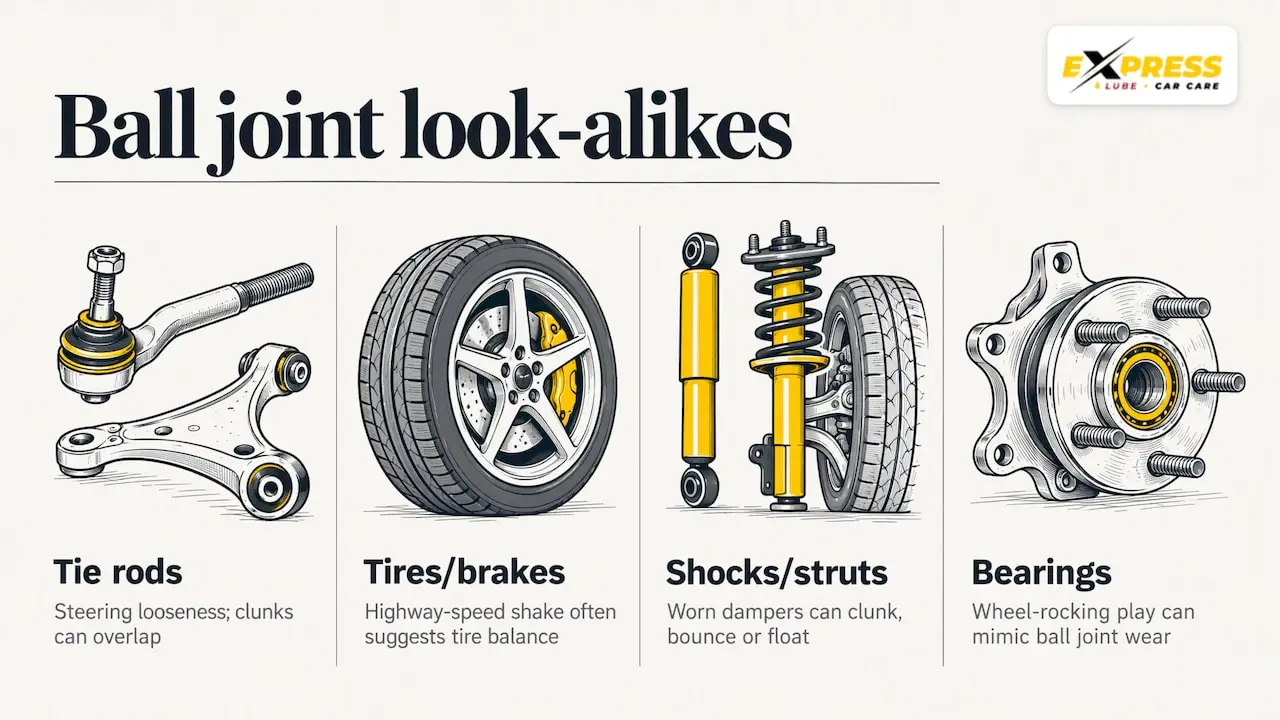
Tie rods and bushings. AAA notes that tie rods and bushings, like ball joints, can cause odd sounds, creaks, changed bump response and steering wheel shake. A worn tie rod end often shows up as looseness in steering response, while a ball joint more often announces itself with a clunk over bumps, but there is overlap. Our article on control arm bushings explains another common look-alike.
Tires and brakes. The same AAA article lists warped rotors, stuck calipers, flat-spotted or unbalanced tires and alignment problems among the causes of a shaking steering wheel. If the shake appears mainly at highway speed, tire balance is a frequent suspect. See our guide to steering wheel vibration.
Shocks and struts. Worn dampers can clunk and let the car bounce or float. We list the signs in 7 common symptoms of bad shocks and struts.
Wheel bearings. Looseness in a bearing can feel like play in a ball joint when the wheel is rocked by hand. The U.S. Bureau of Land Management’s inspection guide specifically warns to make sure wheel bearing looseness is not mistaken for ball joint wear.
Pulling to one side is not proof
A car that drifts left or right is a common complaint, and drivers often assume the ball joint. AAA’s maintenance guidance says tire inflation, alignment, failed radial belts and worn or bent suspension parts can all cause pulling, so a pull alone does not identify a bad ball joint. The same guide says abnormal tire wear can reflect alignment, inflation, wheel balance, shocks or ball joints, and recommends a complete inspection before alignment work.
That is why it helps to separate the possibilities with a few simple checks. This breakdown of how to tell whether you need alignment or balancing is a good way to rule out the simpler causes first. We also cover the topic in why a car pulls to the right and signs your car needs alignment. If alignment checks out and the symptoms persist, the suspension itself needs to be looked at.
What causes ball joints to wear out
Ball joints are wear items, and their lifespan depends on the vehicle, the conditions and how well the boot has been protected. Common contributors include:
- A torn or cracked boot. Once grease leaks out and grit gets in, wear speeds up.
- Impacts. AAA says potholes can damage tires, wheels, shocks, struts, tie rods, ball joints and control arms. A hard hit followed by a new clunk is a reason to get the front end checked.
- Mileage and load. Heavier vehicles such as SUVs and trucks, and vehicles that carry or tow loads, put more stress on suspension parts.
- Neglected suspension. Worn bushings or shocks can push extra load onto the joints.
Service intervals and typical lifespans differ by make and model, so your owner’s manual and the manufacturer’s recommendations are the right reference for your vehicle.
How a ball joint is checked
A test drive tells a technician a lot, but confirming a bad ball joint takes a hands-on inspection with the vehicle raised. The method matters, and doing it wrong can produce a false result.
The BLM guide explains that looseness by itself is not enough to condemn a ball joint. Suspension design and spring location determine how the vehicle must be jacked, and wear is judged against the vehicle manufacturer’s tolerances. In outline:
- Inspect the boots. ZF Aftermarket recommends a visual check of the protective boots first, then a check for free play. A torn boot or grease leaking out is a red flag.
- Raise the vehicle correctly. The jacking point depends on whether the coil spring sits above or below the joint carrying the load. This unloads or loads the joint the way the manufacturer’s procedure requires.
- Check for movement. MOOG’s procedure is to rock the tire at the top and bottom, and says a healthy joint shows little to no play, while excessive movement or clicking points to looseness.
- Compare with specifications. Measured play is compared to the manufacturer’s tolerance for that vehicle, not a general rule of thumb.
- Rule out look-alikes. Wheel bearings, tie rods and bushings are checked so the right part gets replaced.
ZF also cautions that lever checks must account for whether the suspension is loaded or unloaded and for the direction of force, because incorrect loading can lead to misdiagnosis. This is one reason we do not recommend relying on a quick wiggle in the driveway to decide. AAA Club Alliance advises examining suspension parts on a lift for wear or damage, including loose ball joints, because suspension failure can cause a crash.
If you are chasing a noise and are not sure where it comes from, our article on diagnosing a suspension clunk walks through the inspection steps. A grinding sound while steering is a different pattern, covered in grinding noise when turning the steering wheel.
Can you keep driving on a bad ball joint?
It depends on how worn the joint is, and you cannot judge that from the driver’s seat. A joint with slight play may get you to the shop. A joint that is badly worn can fail without much more warning.
AutoZone says complete ball joint separation can make a vehicle undrivable, because the wheel is no longer held in its proper position. AAA’s safety guidance is that steering shake caused by suspension wear should be inspected promptly because some causes can make driving unsafe.
In practical terms:
- Get it inspected soon if you notice a new clunk, loose steering or uneven front tire wear.
- Stop driving and arrange a tow or inspection if the clunk is loud and frequent, the steering feels very loose, or the wheel seems to lean or move differently than before. Do not take it on the highway.
- Do not wait for a failure to confirm the diagnosis. A ball joint that breaks at speed is a safety risk to you and to other drivers.
A worn ball joint is not something to keep driving on for months to see what happens. If you are unsure, a short inspection is a small cost compared with a roadside failure.
What repair looks like
If the inspection confirms a worn joint, the repair is replacement, not adjustment. Depending on the vehicle, the joint may be pressed into the control arm, bolted on, or sold as part of a complete control arm assembly. Some designs make the joint a separate part, while others call for replacing the whole arm. A technician should explain which applies to your vehicle and why.
Because a front-end repair changes suspension geometry, ask what else was inspected at the same time: boots, tie rods, bushings, shocks and tire wear. Fixing one worn part while leaving a neighboring worn part can bring the same symptoms back.
Prices vary with the vehicle and with whether one joint or a full arm is needed, so we give a quote after inspecting your car rather than a generic number.
Our perspective: what we see in the bay
We often meet drivers who describe the same story: a small clunk they have heard for a few weeks and put off. When we raise the car, the cause is sometimes a ball joint, and just as often a sway bar link, a bushing or a tie rod. That is why we start with an inspection, not a guess.
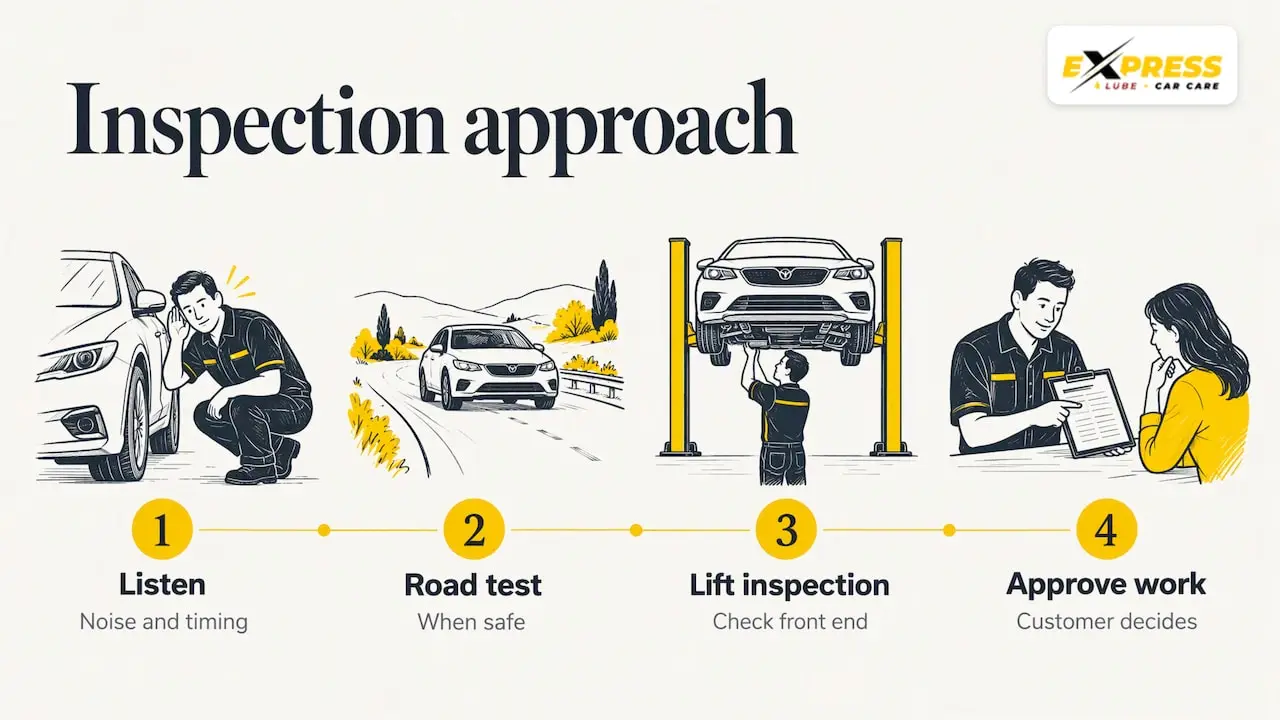
Our approach is simple. We listen to how you describe the noise and when it happens, we road test where it is safe to do so, and then we inspect the front end on a lift. Our ASE-certified technicians check boots, joints, tie rods, bushings and bearings, and we use digital vehicle inspections with photos and technician notes so you can see what we see before you decide. You approve the work, not us.
One practical rule: a new noise from the front end is worth checking the week you hear it. Parts that are caught early are often cheaper to deal with than parts that have damaged a tire or a neighboring component. And if the inspection finds the suspension is fine, you have ruled out a safety concern and can focus on the next suspect.
— Express Lube & Car Care
Get your front end inspected in Plano
If your car is clunking, wandering or wearing its front tires unevenly, bring it in. We take walk-ins with no appointment needed, and our steering and suspension repair service covers inspection and repair of ball joints and related parts. You can also browse all of our services. Qualifying repairs are backed by our 24-month/24,000-mile limited warranty, whichever comes first, and qualifying suspension repairs by our Lifetime Suspension Warranty. Eligibility, limitations and exclusions apply to both, so ask us for the details that fit your repair.
Protecting your ball joints
You cannot prevent all wear, but you can catch problems earlier:
- Listen for new noises. Drive occasionally with the radio off, and note any clunk over bumps.
- Look at your tires. Check the tread edges when you check pressure. Uneven wear is easier to correct early.
- Ask for a suspension look at routine visits. When your car is up for an oil change or tire service, a technician can glance at boots and joints. Our oil change and preventive maintenance visits are a convenient time for this.
- Check after impacts. After a hard pothole hit or curb strike, pay attention to steering feel and any new sounds.
- Follow your manufacturer’s schedule. Intervals and inspection recommendations vary by vehicle, so use the owner’s manual as your guide.
FAQ
What are the first signs of a bad ball joint?
Usually a faint, occasional clunk from one front corner over bumps or in turns. Over time it gets louder and more frequent, and you may notice loose steering or uneven wear on the edge of a front tire. Since other parts cause similar noises, an inspection is the only way to confirm.
Can you drive with a bad ball joint?
A mildly worn joint may still hold, but you cannot tell how close it is to failing. A joint that separates can leave the wheel unsupported and the car undrivable. If the clunk is worsening or the steering feels loose, stop driving and have it inspected right away.
How do I tell a bad ball joint from a bad tie rod?
They overlap. Tie rod wear tends to show up as looseness or wandering in the steering, while a ball joint more often clunks over bumps, but both can create noise and shake. A technician checks each part on a lift against the manufacturer’s tolerances, so you do not replace the wrong one.
Is a bad ball joint an urgent repair?
Yes, treat it as a safety item. Suspension failure can cause a crash, and a loose ball joint also wears tires faster. Get it checked promptly, and stop driving if symptoms are severe.
Does a bad ball joint cause the car to pull?
It can contribute, but pulling more often comes from tire pressure, alignment or tire condition. AAA lists several causes, so a pull alone does not point to the ball joint. An inspection sorts out which one applies.
Sources
- Symptoms of Bad Ball Joints | MOOG Parts
- Worn ball joints? Here’s how to check | MOOG
- Symptoms of a Bad Ball Joint | AutoZone
- How to inspect ball joint suspensions | U.S. Bureau of Land Management via GovInfo
- Why Your Steering Wheel Shakes: 6 Possible Causes | AAA Club Alliance
- AAA: Car Maintenance Guide
- Potholes and Vehicle Damage | AAA Exchange
- How to Get Your Older Car Road-Trip Ready | AAA Club Alliance
- Information on Multi-Link Suspension Systems | ZF Aftermarket