

A suspension clunk usually traces back to worn sway-bar end links or bushings, tired control-arm bushings, a failing ball joint, a loose strut mount, or sometimes just a loose exhaust hanger knocking against the underbody. If the noise shows up alongside pulling to one side, loose or vague steering, a wheel that looks out of position, or heavy vibration, stop driving and arrange an inspection right away. Otherwise, note when the clunk happens, record a short video if you can, and schedule a diagnostic visit.
TL;DR:
- Worn sway-bar end links and bushings typically cause a clunk when hitting bumps or potholes, especially on one-wheel impacts.
- Control-arm bushings and mounts produce a heavier, sharper clunk during both-wheel bumps, braking, or weight shifts, and may require replacing the entire arm or mount.
- Turning noises often originate from ball joints, tie-rod ends, or strut mounts, particularly during slow, tight turns, while speed-related noises suggest wheel bearing issues.
- Loose or missing fasteners, shifted mounts, or dangling exhaust hangers can mimic suspension problems and should be checked visually during inspection.
- Signs like severe steering pull, wheel displacement, or vibration paired with a clunk demand immediate professional attention and should never be ignored.
Table of Contents
- Common mechanical causes of a clunking noise
- How to narrow the source: safe DIY diagnostic steps
- Danger signs: when a clunk means stop driving and get immediate help
- Typical repairs, parts replaced, and cost drivers
- What a professional inspection should include
- Prevention and aftercare: reduce risk and protect repairs
- How Express Lube & Car Care approaches a suspension clunk
- Book a suspension inspection at Express Lube & Car Care
- Authoritative links readers can use
- Sources
- FAQ
Common mechanical causes of a clunking noise
Most clunks come from a small set of suspension components, and the pattern of the noise usually points a technician toward the right one before the car even goes on the lift. Sway-bar end links and their bushings are frequent offenders. When they wear out, you tend to hear a distinct clunk when one wheel hits a bump or dips into a pothole, since the link’s job is to control body roll between the two sides of the axle.
Control-arm bushings behave a little differently. These rubber or polyurethane mounts let the arm pivot while soaking up small shocks, and once they crack or separate, you’ll often hear a clunk when both wheels hit a bump together or when the vehicle’s weight shifts under braking or acceleration. Ball joints and tie-rod ends show their wear in a related but distinct way: the clunk tends to appear specifically during turns or under sideways load, because that’s when play in the joint becomes noticeable.
Strut mounts, complete strut assemblies, and broken coil springs produce some of the more alarming sounds. A cracked spring or a failed strut mount typically delivers one heavy, sharp clunk rather than a series of small noises, and the sound often changes depending on how much the strut is compressing or rebounding at that moment. According to the ASE Automobile Study Guide, technicians narrow these faults by matching the pattern of the noise to the part’s expected behavior: single-wheel impacts point toward end links or control-arm bushings, turning-related clunks point toward ball joints or mounts, and speed-linked rhythmic sounds point away from suspension entirely.
That last distinction matters, because loose fasteners, shifted subframe mounts, and dangling exhaust hangers can mimic suspension problems closely enough to fool an untrained ear. A wheel hub or bearing failure adds another wrinkle: it often produces a noise that changes with vehicle speed rather than with bumps, which is a helpful clue when you’re trying to describe the sound to a technician. For more on that distinction, see our guide on finding wheel bearing noise with a lane sway test.
Here’s a quick reference for what tends to point where:
- Clunk over single bumps or pothole edges: often a sway-bar end link or bushing.
- Clunk over both-wheel bumps or under braking: often a control-arm bushing or mount.
- Clunk while turning: often a ball joint, tie-rod end, or strut mount.
- One heavy clunk with a change in ride height: often a broken spring or failed strut.
- Clunk near the exhaust or underbody: often a loose hanger or bracket, not the suspension at all.
How to narrow the source: safe DIY diagnostic steps
Before you touch anything under the car, put safety first. Park on level ground, set the parking brake, and never rely on a jack alone if you need to look underneath. Use jack stands or wheel chocks, and if you’re not confident doing any of this yourself, skip straight to a professional inspection instead.
Once the vehicle is safely parked, a few simple observations can help a technician zero in on the problem faster.
- Identify which corner is making noise. Have a passenger sit in the back while you drive slowly over a bump, and note whether the sound seems to come from the front or rear, left or right.
- Try a one-wheel bump versus a two-wheel bump. Driving over a curb edge with just one tire isolates end links and ball joints, while driving straight over a speed bump with both wheels tests control-arm bushings and mounts.
- Turn slowly in an empty lot. A clunk that only appears during slow, tight turns often points to a ball joint, tie-rod end, or strut mount rather than a bushing.
- Brake and accelerate gently. Weight transfer under braking or acceleration can expose a loose or worn control-arm bushing that stays quiet on smooth, straight roads.
- Compare the noise to your speed. A clunk that gets louder or more frequent with speed, regardless of bumps, suggests a wheel bearing or tire issue rather than suspension. Our piece on steering wheel vibration covers that overlap in more detail.
While you’re under or around the car, do a quick visual scan for anything obvious: a dangling exhaust hanger, a visibly torn rubber bushing, a shock or strut that looks wet with fluid, a missing bolt or clip, or a rust fracture on a bracket. None of this requires special tools, just a flashlight and a few minutes.
Whatever you find, capture it. Record a short video or audio clip with your phone the next time the noise happens, and jot down the speed, road surface, steering angle, and temperature when it occurred. If you recently hit a large pothole, had a lift installed, or had suspension work done, write that down too. This kind of evidence, even a few seconds of shaky phone video, often saves diagnostic time once you’re in the shop.
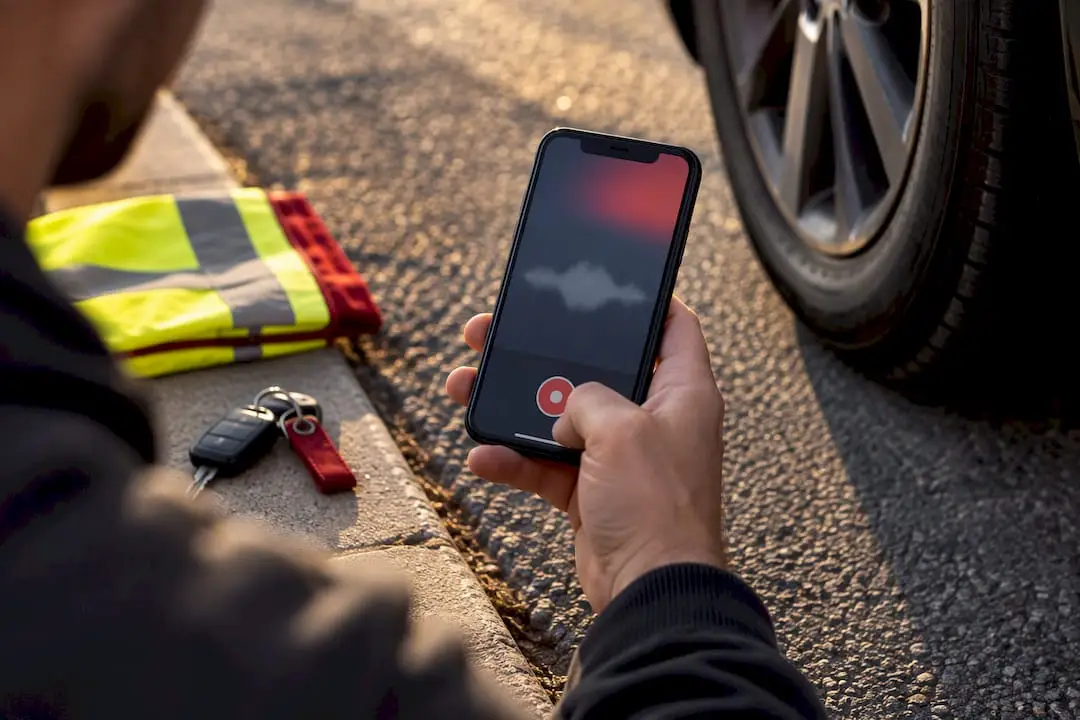
Pro Tip: Play your recorded clip for the service advisor before the car goes on the lift. A ten-second clip communicates more than a verbal description ever will.
If the noise appears alongside a pull to one side, looseness in the steering wheel, or a wheel that looks tilted or displaced, don’t attempt any of the above. Call for a tow or a mobile inspection instead.
Danger signs: when a clunk means stop driving and get immediate help
Most clunks are annoying rather than dangerous, but certain combinations of symptoms cross the line into an urgent safety issue. Watch for these together with the noise:
- Loose or vague steering, as if the wheel has extra play before the car responds.
- Severe pulling to one side that fights your steering input.
- Sudden, strong vibration through the wheel or floor, especially at speed.
- A wheel that looks displaced, tilted, or sits differently than the others.
- Any noticeable loss of braking control paired with the noise.
A displaced wheel, a sudden pull, or a loss of steering control alongside a clunk is a stop-driving situation. NHTSA recall records document cases where worn or loose suspension components produced clunking noises before a loss of vehicle control, which is why the pattern of symptoms matters more than the noise alone.
That same NHTSA recall database is also worth checking any time you hear a new clunk after a collision or recent repair work, since some model-specific issues are covered under manufacturer recalls tied to your vehicle’s VIN. If any of the red flags above show up, pull over safely as soon as you can, call for a tow or a mobile technician rather than driving to a distant shop, and avoid highway speeds until the vehicle has been inspected.
Typical repairs, parts replaced, and cost drivers
Once a technician confirms the source of the clunk, the fix is usually a straightforward parts replacement, though the specific part and the labor involved can vary quite a bit. Common repairs include:
- Sway-bar end links or bushings, typically a lower-labor job on most vehicles.
- Control-arm bushings, which sometimes require pressing out the old bushing or replacing the entire arm.
- Ball joints, either serviced individually or as part of a control-arm assembly.
- Struts, strut mounts, or complete strut assemblies, often replaced in pairs for even handling.
- Springs or spring isolators, usually addressed alongside strut work.
- Wheel hub or bearing assemblies, when the noise turns out to be speed-related rather than bump-related.
- Loose fasteners or exhaust hangers, which can sometimes resolve the noise without any parts replacement at all.
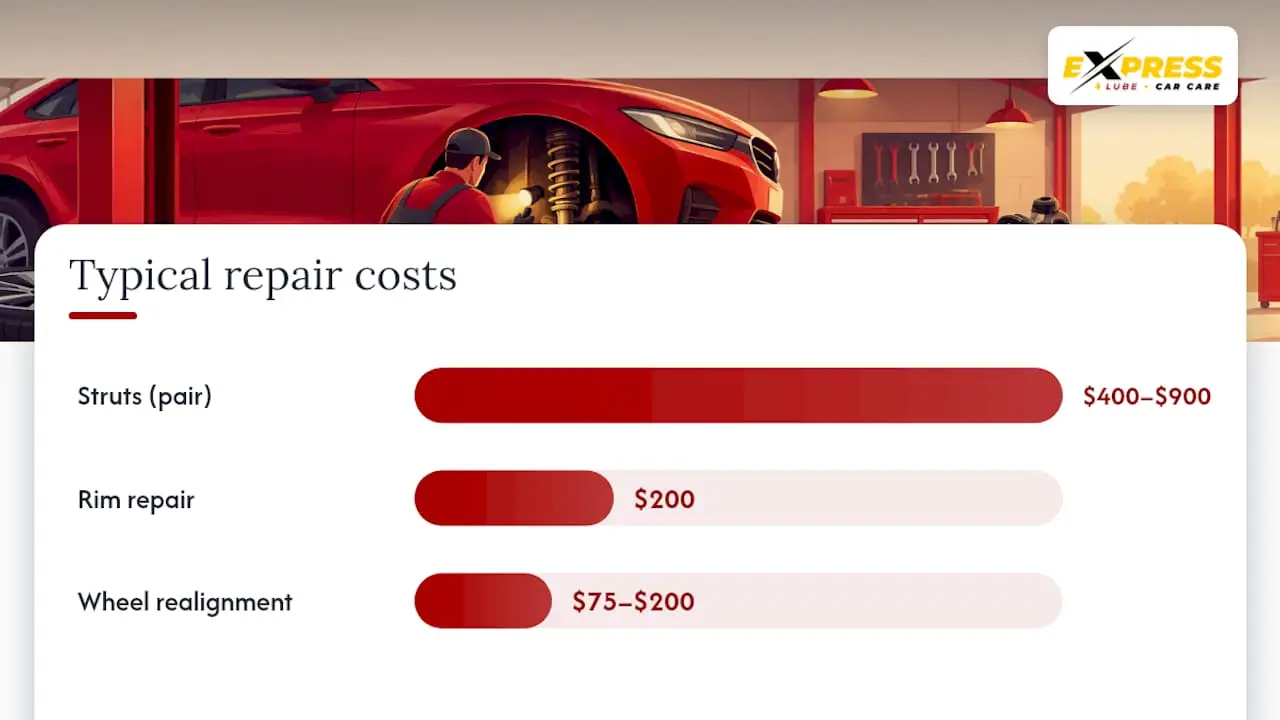
Cost depends on a few real variables: whether the shop uses OEM or aftermarket parts, how much labor time the repair takes based on how accessible the component is, and whether the repair triggers a need for tire or wheel repairs afterward. According to AAA, pothole-related suspension repairs commonly run into the hundreds of dollars, with shocks or struts replaced as a pair typically costing $400 to $900, rim repairs running around $200 per rim, and a wheel realignment adding roughly $75 to $200 on top. Those figures are national averages and will vary by make, model, and local labor rates, but they give a useful sense of scale before you request a quote.
Struts and control-arm work in particular tend toward the higher end of that range because of the labor involved in disassembly and reassembly. For a closer look at what strut replacement actually involves, see our guide on how to replace shock absorbers, and for help telling the two components apart in the first place, our piece on shock versus strut breaks down the difference.
What a professional inspection should include
A thorough suspension inspection follows a defined checklist rather than a quick look and a guess, and knowing what that checklist covers helps you judge whether an inspection was actually thorough. Based on ASE task lists for maintenance and light repair, a complete inspection typically works through these steps:
- Inspect control arms and bushings for cracking, separation, or excess play.
- Check ball joints for measured movement beyond the manufacturer’s tolerance.
- Examine the sway bar, end links, and bushings for wear or looseness.
- Inspect strut mounts and complete strut or shock assemblies for leaks, damage, or looseness.
- Check springs and spring isolators for cracks or settling.
- Test wheel bearings and hubs for play or roughness.
- Verify fastener torque on subframe and suspension mounting points.
- Inspect exhaust hangers and brackets for looseness that could mimic a suspension clunk.
Technicians confirm findings with a measured play check on suspicious joints rather than relying on sound alone, and a mechanic test drive helps recreate the noise under controlled conditions. Many shops, including ours, document each finding with digital photos and written notes so you can see exactly what was found rather than taking a verbal summary on faith. A VIN-based recall check, using the NHTSA lookup tool, is a reasonable step any time a new clunk follows a collision or recent repair.
Pro Tip: Ask to see the measured play readings on any ball joint or control-arm bushing flagged during inspection. A specific number, compared against the manufacturer’s tolerance, tells you more than “it’s worn.”
Suspension repairs commonly lead into an alignment check afterward, since replacing a control arm, strut, or tie-rod end changes the geometry the wheels sit at. Our guide on signs your car needs an alignment explains why that follow-up step matters and what uneven tire wear can tell you if it’s skipped.
Prevention and aftercare: reduce risk and protect repairs
A little defensive driving goes a long way toward avoiding suspension clunks in the first place, especially once potholes start showing up after winter freeze-thaw cycles or heavy rain. Slowing down before an obvious rough patch, rather than plowing through it at speed, spares end links, bushings, and strut mounts from the sharpest impacts.
Routine attention helps too:
- Keep tires at the correct pressure, since underinflated tires transmit more shock into the suspension.
- Have suspension components inspected on a regular schedule, in line with Car Care Council guidance on annual steering and suspension checks.
- Replace worn bushings or links proactively once they’re flagged, rather than waiting for a full failure.
- Avoid consistently overloading the vehicle, since extra weight strains bushings, springs, and mounts over time.
After any suspension repair, a short break-in test drive helps confirm the clunk is actually gone and that no new noise has appeared. Watch for the same symptoms over the following week or two, and if anything recurs, don’t assume it will work itself out. For a broader look at what a full seasonal check should cover, see our vehicle safety inspection checklist.
How Express Lube & Car Care approaches a suspension clunk
When a customer brings in a suspension clunk, our ASE-certified technicians start with the same safety triage described above: any red flags mean the car gets looked at before it goes back on the road. From there, we work through a structured inspection covering control arms, bushings, ball joints, sway-bar links, strut mounts, and related components, documenting each finding with a digital inspection report that includes photos and technician notes.
Bringing your VIN, any recorded video or audio of the noise, and a short note on when it happens (bumps, turns, braking) speeds up that process considerably. Because we operate on a no-appointment basis, you can bring the vehicle in as soon as the symptom appears rather than waiting on a scheduled slot, and any suspension repair we perform is backed by our 24-month/24,000-mile warranty.
— Express Lube & Car Care
Book a suspension inspection at Express Lube & Car Care
A suspension clunk rarely gets quieter on its own, and driving on a worn ball joint or a cracked bushing longer than necessary only raises the odds of a bigger repair later. Express Lube & Car Care offers no-appointment suspension inspections handled by ASE-certified technicians, with shocks and struts service available the same day for most vehicles. Bring your VIN, any video or notes on when the noise happens, and details of recent impacts or repairs, and we’ll walk you through exactly what we find.
| What to bring | Why it helps |
|---|---|
| Vehicle VIN | Allows a recall check tied to your specific vehicle |
| Recorded video or audio of the noise | Helps technicians match the sound to a likely cause before inspection |
| Notes on when it happens | Speeds up localization (bumps, turns, braking, speed) |
| Details of recent impacts or repairs | Flags parts that may already be under stress |
Visit our full services page to see shocks, struts, and suspension work alongside our other offerings, or head to Expresslubeplano to get started on your inspection today.
Authoritative links readers can use
A few outside resources are worth bookmarking alongside any shop visit. Check the NHTSA recall lookup using your VIN any time a new clunk follows a collision or recent repair. ASE’s study guides outline the inspection scope technicians are trained to follow. AAA’s guide to noises you shouldn’t ignore and the Car Care Council’s seasonal guidance both reinforce the same principle: treat handling changes as urgent, not just noisy.
Sources
- Vehicle noises you should never ignore | AAA Club Alliance
- Check for Recalls: Vehicle, Car Seat, Tire, Equipment | NHTSA
- Cone-zone season can be tough on vehicles | Car Care Council
- ASE Automobile Study Guide
- How to protect your car and tires from pothole damage | AAA
FAQ
Is it safe to drive with clunking suspension?
It depends on what else is happening. A clunk alone, without pulling, loose steering, or vibration, is usually safe to drive short distances to a shop, but AAA warns that broken or worn suspension parts can reduce vehicle control, so any combination of symptoms should be treated as urgent.
How much does it cost to fix clunking?
Cost depends entirely on which part has failed. According to AAA, shocks or struts replaced as a pair typically run $400 to $900, with alignment adding $75 to $200 if needed afterward.
Is it expensive to fix a suspension on a car?
It varies widely based on the component and labor involved, from a relatively simple sway-bar link replacement to a more involved control-arm or strut job. AAA’s pothole damage guide puts shock and strut pairs at $400 to $900, which gives a useful benchmark for one of the more common repairs.
What does a failing suspension sound like?
A failing suspension often produces a heavy clunk, knock, or rattle over bumps, though the exact sound depends on which part is wearing out. The pattern matters: noise over bumps tends to point toward suspension or exhaust movement, while noise during turns often involves ball joints or mounts instead.