

A grinding noise when turning the steering wheel is a distinct and concerning auditory signal from your vehicle. It indicates that something is mechanically wrong. Most often, this sound points to a problem within the power steering system or with worn-out suspension components. Addressing it promptly is crucial for both safety and preventing more costly repairs.
Understanding the Grinding Noise When Turning Steering Wheel Car
Imagine you are maneuvering into a parking space, and a harsh, metallic scraping sound accompanies every turn of the steering wheel. This sound is not a minor anomaly; it is a clear distress signal originating from your car’s steering or suspension system.
Worn brake components, such as pads and rotors, can also cause grinding noises when turning, especially if the brake pads are worn down to the metal backing plate. In addition to steering and suspension issues, problems with brake components should be considered as a possible source of the noise.
Consider this sound a specific diagnostic alert, much like a “check engine” light for your steering. Just as you would not ignore a warning light on your dashboard, this auditory warning warrants immediate attention. Understanding the potential causes is the first step toward a proper diagnosis and solution.
Ignoring grinding noises can result in further damage and costly repairs, as well as potentially dangerous driving conditions due to compromised vehicle handling.
What Is My Car Trying to Tell Me?
A grinding noise when turning can be traced to several different mechanical issues, ranging from simple maintenance items to more complex and critical repairs. An informed driver can better communicate with a service professional.
The most common culprits include:
Power Steering System Issues: Often, the problem stems from low or contaminated power steering fluid. When fluid levels are insufficient, the power steering pump is starved of lubrication and may draw in air, causing a characteristic grinding or whining sound.
Worn Suspension Components: Parts like strut bearings, ball joints, and tie rod ends function as the articulating joints of your vehicle’s suspension. As they wear, the protective materials degrade, leading to metal-on-metal contact that generates a grinding noise during turns.
Failing Wheel-End Components: A faulty wheel bearing or a failing CV (Constant Velocity) joint can also produce a grinding sound that intensifies when turning.
Worn Brake Components: Worn brake pads or rotors can cause grinding noises, especially during turns or braking. Uneven wear or a soft brake pedal may indicate issues within the brake system.
It is important to differentiate a grinding noise from other sounds. While some steering issues cause vibration or a shuddering sensation, a true grind almost always indicates direct metal-on-metal friction—a condition requiring immediate mechanical inspection. Worn brake components, such as pads and rotors, can create grinding noises when turning or braking, and may require replacement. If you are experiencing vibrations rather than a grind, you can learn more by reading about what causes steering wheel vibration in our related article
To provide a clearer understanding, here is a brief overview of potential issues.
Diagnostic Guide to Steering Wheel Grinding Noises
Potential Cause | Urgency Level | Typical Repair Cost |
|---|---|---|
Low Power Steering Fluid | High – Risk of pump failure. | $15 – $50 (Fluid Top-Off) |
Failing Power Steering Pump | Critical – Loss of steering assist. | $400 – $800+ |
Worn Strut Bearings/Mounts | High – Affects alignment & safety. | $300 – $700 |
Bad CV Joints | High – Risk of axle failure. | $250 – $600 per axle |
Worn Ball Joints | Critical – Risk of wheel collapse. | $250 – $500+ per joint |
This table serves as an estimate and underscores the importance of an accurate professional diagnosis.
Regular maintenance, such as a brake inspection every 6 months or 6,000 miles, wheel alignment and suspension checks at least once a year, and tire rotation and balance every 5,000 to 7,500 miles, can help prevent grinding noises and expensive repairs. Many of these checks are performed during an oil change, making it a convenient time to address potential issues before they become costly.
Ultimately, the grinding noise is your vehicle communicating a mechanical failure. Addressing it swiftly not only prevents a minor issue from escalating into a major, expensive repair but, more critically, it ensures the safety of you and your passengers.
Primary Suspect: The Power Steering System
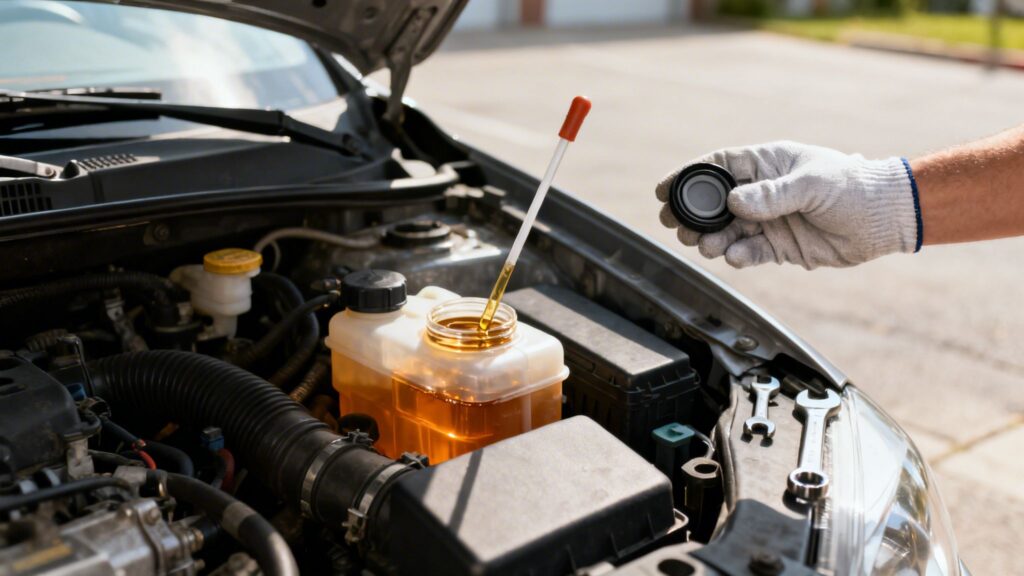
When you hear a grinding noise when turning the steering wheel, the power steering system is the most logical starting point for diagnosis. Hydraulic power steering systems rely on clean fluid under pressure to assist turning efforts, and low fluid levels can cause noise and difficulty steering. This hydraulic system multiplies the force you apply to the steering wheel, making it possible to steer a heavy vehicle with ease. It relies on pressurized fluid to function, and when healthy, it operates silently.
When problems arise, however, the system becomes audible. The most common fault is low or degraded power steering fluid. If the fluid level drops, the pump may begin to ingest air, a process known as cavitation. This starves the pump’s internal components of lubrication, causing metal parts to grind against each other and producing a distinct groaning or grinding sound that becomes more pronounced during turns. Issues with the power steering rack or a failing pump can also cause grinding noises, stiff steering, and reduced responsiveness, making timely repair important for safety and vehicle performance.
The Critical Role of Fluid Level
The classic symptom of low power steering fluid is a loud, protesting sound that accompanies every turn of the wheel. Checking and maintaining the correct power steering fluid level is crucial, as low fluid is a contributing factor in approximately 30% of steering noise-related issues.
The power steering system depends on this fluid for both hydraulic pressure and lubrication. Any decrease in volume—often due to a minor leak or degradation after 50,000 miles—forces the pump to operate without adequate lubrication, which is the direct cause of the noise.
The power steering is a sealed hydraulic system; therefore, a low fluid level is almost always indicative of a leak. Ignoring this symptom will not only lead to a more severe noise but will ultimately cause the catastrophic failure of the power steering pump.
This is why a fluid inspection, specifically checking the power steering fluid level, is the essential first step in diagnosis. It is a simple procedure that can be performed at home.
How to Inspect Your Power Steering Fluid
Checking the power steering fluid provides immediate insight into the system’s health. Both the fluid level and its condition are important diagnostic indicators.
Follow these steps for a quick inspection:
Locate the Reservoir: Open the hood and find the power steering fluid reservoir. It is typically a small tank with a cap labeled “Power Steering Fluid” or marked with a steering wheel icon.
Check the Level: Many modern reservoirs are made of translucent plastic with “MIN” and “MAX” fill lines. If the reservoir is opaque, the cap will have an attached dipstick. Wipe the dipstick clean, reinsert it fully, and remove it to check the level.
Assess the Fluid’s Condition: Healthy power steering fluid is clear with an amber or pinkish-red hue. If the fluid appears dark brown, black, or contains metallic particles, it is contaminated and has lost its lubricating properties. The system requires a professional flush.
If the fluid is low, topping it off may temporarily silence the grinding noise when turning the steering wheel, but this is not a permanent solution. Power steering fluid leaks are often the source of fluid loss, typically developing gradually due to worn seals or hoses. A leak is present and requires professional attention. For a more detailed walkthrough, see our guide on how to check power steering fluid properly. A certified technician can locate and repair the leak, ensuring the system’s long-term integrity.
Wheel-Related Noises: Worn Bearings and CV Joints
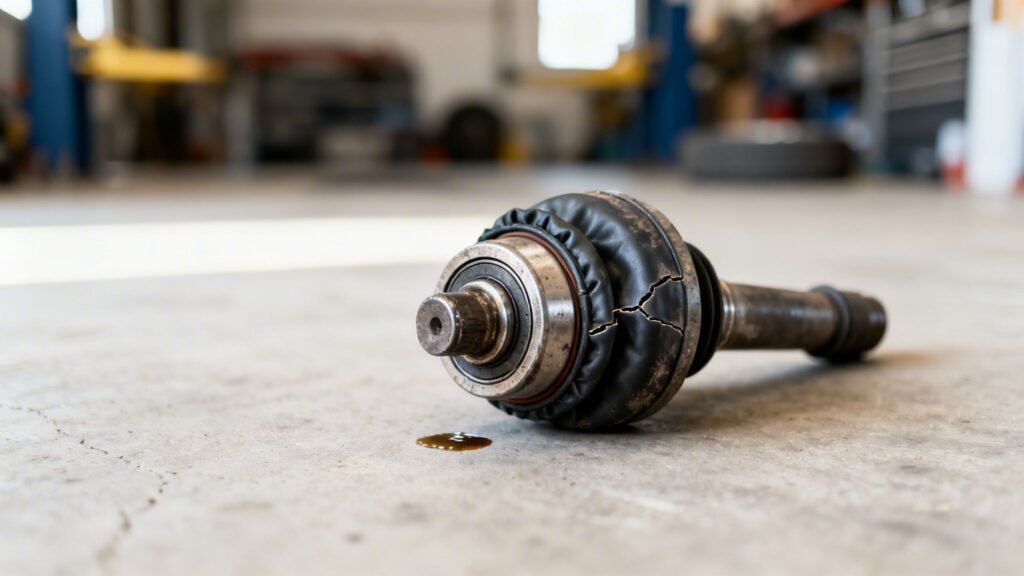
If the power steering system has been ruled out as the source of the noise, the investigation should move to the wheel assemblies. Sometimes, a bent dust shield can rub against a brake rotor, generating a grinding noise that varies with wheel motion. When you hear a grinding noise when turning the steering wheel, it is highly probable that the sound is coming from components that facilitate wheel rotation and articulation: the wheel bearings, the Constant Velocity (CV) joints, or even a bad CV axle. These issues can occur across all car makes.
These components operate in a high-stress environment at the ends of the vehicle’s axles, exposed to road debris, moisture, and extreme forces. When they begin to fail, they produce distinct noises—such as grinding, clicking, or humming—that are directly correlated with steering movements, providing valuable diagnostic clues. Bad wheel bearings or a bad CV joint can also cause these symptoms, and early repair is important to prevent further damage or safety risks.
The Grinding of a Bad Wheel Bearing
A worn wheel bearing produces a harsh, grinding sound that is most noticeable during turns. This is a serious mechanical warning sign originating from deep within your vehicle’s suspension.
Wheel bearings are engineered to allow your wheels to spin with minimal friction, but their operational lifespan is finite. After 100,000 to 150,000 miles of service, the internal roller elements and races can wear down. Automotive repair data indicates that failing wheel bearings are responsible for approximately 25% of all steering noise complaints.
The noise intensifies during a turn because the cornering force shifts the vehicle’s weight, placing a significant lateral load on the already failing bearing. You can find a more technical explanation of how these components fail on Stellar-autoworks.com
A failing wheel bearing often presents additional symptoms:
A humming or growling sound, especially at higher speeds, that increases in pitch and volume with vehicle speed.
A sensation of looseness or “play” transmitted through the steering wheel.
Uneven tire wear, as the compromised bearing allows for excessive movement of the wheel hub.
A failed wheel bearing is not merely a noise issue; it is a significant safety concern and a critical safety failure. In a worst-case scenario, the bearing can seize or collapse, which can cause the wheel assembly to separate from the vehicle while in motion.
Clicks and Grinds from a Failing CV Joint
Another primary source of turning-related noises, particularly in front-wheel-drive vehicles, is the CV joint. These joints are the flexible couplings that connect the transaxle to the wheels, allowing the driveshaft to transmit power while accommodating the vertical movement of the suspension and the horizontal movement of steering.
Each CV joint is sealed within a flexible rubber or thermoplastic cv boot filled with high-temperature grease. The cv boot plays a crucial role by protecting the joint from contaminants and keeping it properly lubricated to ensure smooth wheel movement. Failure almost always begins when this protective boot is breached.
Once the boot is compromised:
The vital lubricating grease is expelled due to centrifugal force.
Contaminants such as dirt, water, and road salt penetrate the joint.
This abrasive mixture rapidly wears down the precision-machined internal components.
The initial symptom is typically a distinct clicking noise or clicking sound during sharp turns—a classic sign of failing cv joints. If this warning is ignored, the wear will progress, and the sound will escalate into a louder, more constant grinding noise whenever the steering wheel is turned. Failing cv joints can eventually lead to joint separation and further damage to suspension components. A complete failure of a CV joint will result in a loss of power to that wheel, leaving the vehicle immobile.
Deeper Issues: Suspension and Steering Linkage
If the power steering system and wheel-end components are in good condition, the diagnostic process must move to the core network of the suspension and steering linkage. Suspension issues and suspension problems, such as loose components or worn joints, can cause strange noises—including grinding and popping noises—when turning or driving over bumps. These systems are an intricate assembly of pivots and connections designed for smooth, controlled vehicle dynamics. When these critical joints wear out, a grinding sound is often the first indication of failure.
Three of the most common culprits in this category are strut bearings, ball joints, and tie rod ends. Dry ball joints, tie rods, or failing upper strut mounts cause metal-on-metal friction, resulting in grinding sounds when the vehicle turns or drives over bumps. Each has a specific function, and the failure of any one of them can produce a grinding noise during steering maneuvers.
The Function of Strut Bearings and Mounts
A vehicle’s struts are integral suspension components responsible for damping road imperfections and maintaining ride quality. At the top of each front strut assembly is a strut bearing (or mount plate), which serves as the upper pivot point. This component allows the entire strut and wheel assembly to rotate smoothly with the steering input.
Over time and mileage, this bearing can wear, corrode, or lose its internal lubrication. When this occurs, the smooth pivot action is replaced by metal-on-metal friction. This results in a distinct binding or grinding sound, often most audible at low speeds, such as during parking maneuvers. You can learn more about related failures by reading about the symptoms of bad shocks and struts in our detailed guide.
Worn Ball Joints and Tie Rod Ends
Ball joints and tie rod ends are the critical linkage points of the steering and suspension system, analogous to the body’s joints. They permit the wheels to steer left and right while simultaneously articulating with the suspension’s vertical travel.
Ball Joints: These are the primary pivot points connecting the wheel hubs to the suspension control arms. They bear significant loads and allow for multi-axis movement. When a ball joint wears, the internal socket becomes loose, leading to a clunking, grinding, or even scraping sound as metal or plastic components impact or rub against each other, especially during turns when lateral forces are high. Scraping sounds may also occur if shields or wheel well parts are loose or misaligned.
Tie Rod Ends: These components connect the steering rack to the steering knuckles on the wheels. They are responsible for transmitting the driver’s steering inputs. As they wear, the steering can feel imprecise or “loose,” and you may hear a grinding, popping, or scraping sound when turning the wheel.
A grinding noise originating from any of these components is a serious safety warning. Unlike a fluid leak, the failure of a ball joint or tie rod end can lead to a complete and sudden loss of steering control. This represents an immediate and severe safety hazard.
Worn suspension parts are a highly probable cause of a persistent grinding noise during a turn. These components account for 20-25% of steering noise complaints in vehicles. The constant stress they endure means ball joints can fail after just 70,000-100,000 miles. Further details on these failure rates are available from the experts at MasterMechanic.ca
Your Action Plan: Assessing Severity and Seeking Service
Now that you have identified the noise, the next step is to determine the appropriate course of action. A grinding noise when turning the steering wheel is a clear signal of a mechanical problem, but the urgency can vary.
Prompt brake repairs and addressing steering or suspension issues early can prevent costly damage and avoid expensive repairs down the line. Analyzing the specific characteristics of the noise and any accompanying symptoms can help you decide whether it is safe to drive the vehicle to a repair shop or if immediate roadside assistance is required.
When Is It Safe to Drive?
While no grinding sound should be ignored, not all indicate an imminent catastrophic failure. If the noise is very faint and consistent with low power steering fluid, a careful, short drive directly to a mechanic may be permissible.
However, if the grinding is accompanied by other symptoms, the risk increases substantially. Ignoring grinding noises is a significant safety concern, especially if related to brake components, as issues like uneven wear or a stuck caliper can pose serious risks. Continuing to drive could lead to further damage or precipitate a complete component failure, creating a hazardous situation for you and other road users.
The fundamental principle is this: never disregard a grinding sound. A noise that suggests metal-on-metal contact signifies that a component is actively degrading or failing. Early intervention will prevent a minor issue from becoming a larger, more expensive, and far more dangerous problem.
This diagnostic chart can help you correlate symptoms with potential failing components.
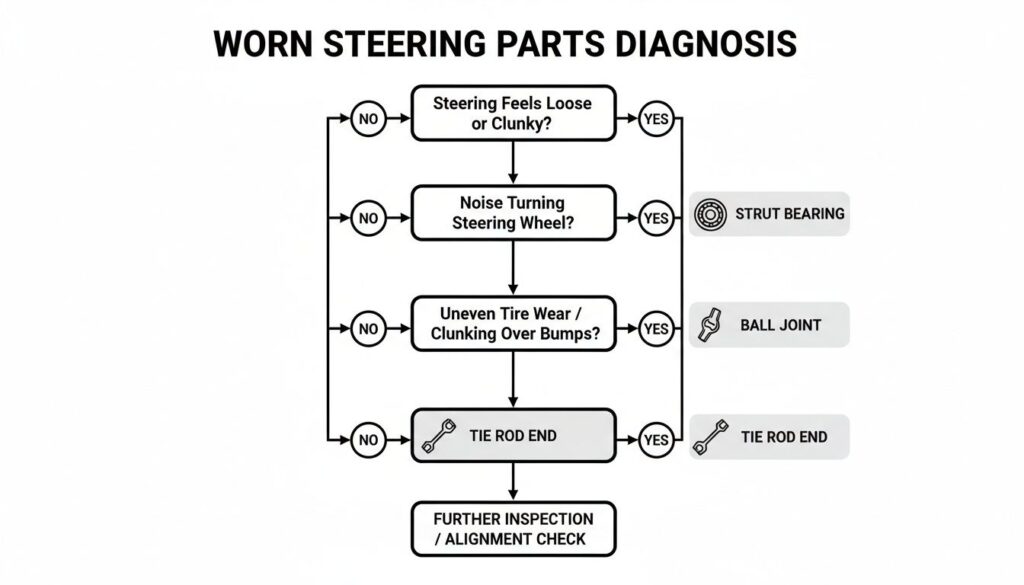
As illustrated, symptoms such as loose steering, specific noises, and uneven tire wear are strong indicators of worn strut bearings, failing ball joints, or bad tie rods.
When to Call a Mechanic Immediately
Certain symptoms are unequivocal red flags that demand you cease driving immediately. If your vehicle exhibits any of the following, pull over to a safe location and call for professional assistance. Do not attempt to continue driving.
The steering suddenly becomes very heavy or stiff: This is a classic sign of a failed power steering pump or a broken serpentine belt. You have lost the hydraulic assistance required for safe steering control.
Loud clunks or pops accompany the grinding: This is a critical warning. It often indicates a ball joint or tie rod end is about to separate, which would cause a complete loss of control over a wheel.
The entire vehicle begins to vibrate or shake violently: A severely damaged CV joint or wheel bearing can create intense vibrations that render the vehicle unsafe to operate at any speed.
Noise when I turn the steering wheel or during a tight turn: Hearing grinding, scraping, or clicking noises specifically when turning—especially during tight turns—is a strong indicator of critical component failure, such as worn CV joints, wheel bearings, or damaged steering components.
These are all signs of imminent critical component failure. Attempting to “limp” the vehicle to a repair shop is an unacceptable risk. A tow to a qualified mechanic for a professional diagnosis is the only safe option.
Your Go-To for Auto Care in Plano
That grinding noise when turning the steering wheel is more than just an inconvenience—it’s a direct message from your car that it requires professional attention. You need a trusted automotive team that can provide an accurate diagnosis and reliable repairs in the Plano area.
At Express Lube & Car Care, we prioritize diagnostic precision. Our ASE-certified technicians utilize advanced equipment to identify the exact source of the sound, whether it’s a worn strut bearing, a failing CV joint, a simple power steering fluid issue, or worn brake components. We specialize in diagnosing and repairing worn brake components that can cause grinding noises, ensuring your brakes perform safely and effectively. We determine the precise fault so you only invest in repairs your vehicle truly needs.
We operate on the principles of transparency and quality. Our role is to provide you with clear, understandable recommendations and execute repairs to the highest standard, ensuring your confidence and safety on the road.
Why Plano Drivers Choose Us
We understand that unexpected vehicle repairs can be disruptive, which is why we have streamlined our service process. We are committed to convenience and welcome customers without an appointment.
We also recognize and appreciate the contributions of those who serve our community and nation. We are proud to offer special discounts for:
Military Personnel
First Responders
Ladies Day every Wednesday
Do not allow a grinding noise to compromise your vehicle’s safety or your peace of mind. Allow our expert technicians to perform a thorough, professional inspection to get you back on the road safely and quietly. Visit Express Lube & Car Care in Plano today—we will restore your confidence behind the wheel.
Your Steering Noise Questions, Answered
We frequently address questions about unusual steering noises. Ignoring a grinding noise when turning the steering wheel can lead to costly repairs if not addressed promptly. To help you better understand the implications of a grinding sound, we have compiled clear answers to the most common inquiries we receive from drivers in Plano.
How Much Will It Cost to Fix the Grinding Noise?
The final repair cost is entirely dependent on the underlying cause. Therefore, a professional diagnosis is the most critical first step, as it provides a definitive answer and allows for an accurate repair estimate.
Here are a few common repair scenarios and their typical cost ranges:
Power Steering Fluid Flush: This is a maintenance procedure and one of the most affordable solutions, generally costing between $100 and $200.
Brake Repairs: Specialized brake repairs, such as replacing brake pads and rotors, typically cost between $250 and $600 per axle, depending on the vehicle and parts used.
Wheel Bearing or Ball Joint Replacement: These are more labor-intensive repairs and can range from $400 to $800 per wheel, depending on the vehicle.
Steering Rack Replacement: As a core component of the steering system, a full replacement is a significant repair that can exceed $1,000.
Can I Simply Add More Power Steering Fluid Myself?
While adding power steering fluid may seem like an easy solution, it is only a temporary measure. A low fluid level is a symptom of a leak, and merely topping it off does not resolve the root problem. The grinding noise will invariably return.
It is always recommended to have a professional technician locate and repair the leak. Furthermore, using an incorrect type of fluid for your vehicle's specific system can cause severe damage to the pump and other components. Expert service is essential.
Does the Noise Occur When Stationary or Only When Moving?
This is an excellent diagnostic question. Observing when the noise occurs provides a crucial clue that helps narrow down the potential causes before a technician even begins an inspection.
Here is a guide to what the timing of the noise might indicate:
Noise When Stationary: A grinding or whining sound that is present while the vehicle is parked and the steering wheel is turned is a classic symptom of an issue with the power steering system, such as low or contaminated fluid, or a faulty strut bearing. A whining noise may also point to power steering issues or problems within the steering column, including worn bearings or electrical connections. These components are under load from steering input, even without wheel rotation.
Noise Only When Moving: If the grinding sound only begins—or significantly worsens—when the vehicle is in motion and turning, the problem is more likely a failing wheel bearing or a worn-out CV joint. The load and rotation of the wheels are the key factors in producing the noise.
If a grinding noise is causing you concern, do not wait for the issue to escalate. The ASE-certified technicians at Express Lube & Car Care in Plano use state-of-the-art diagnostic tools to pinpoint the problem accurately and provide honest, reliable repairs. Drive in today for professional service and peace of mind—no appointment necessary. Learn more about our full range of services at https://www.expresslubeplano.com