

When your brake pedal is hard to press, it's a critical signal from your vehicle that requires immediate attention. This condition often indicates a problem with the brake booster, a key component of your car's power braking system. Without its assistance, you're left attempting to stop a heavy vehicle using only the force of your own leg—a significant safety risk.
What a Hard Brake Pedal Indicates About Your Vehicle's Safety
A rock-solid brake pedal is a clear sign that the power-assist function of your braking system has failed. Modern vehicles are equipped with a brake booster, which functions similarly to power steering but for your brakes. It utilizes engine vacuum to multiply the force applied by your foot, making the process of stopping the car feel smooth and effortless.
When this system fails, that assistance vanishes. Suddenly, stopping the vehicle demands a substantial amount of physical effort. While the brakes may still be functional in a mechanical sense, the force required to engage them is dangerously high, particularly in an emergency situation.
The Role of the Brake Booster
Located on the driver's side firewall behind the brake pedal, the brake booster is a round, black canister. Its function is straightforward yet crucial: it harnesses engine vacuum to amplify the pressure you apply to the pedal, which then moves brake fluid to stop the car. This system is what provides the smooth, responsive pedal feel you rely on.
A hard brake pedal is almost always traced back to a failure within this system. Common reasons include:
- An internal failure within the brake booster itself.
- A leak from a cracked or disconnected vacuum hose.
- A malfunctioning one-way check valve that fails to maintain vacuum.
Because these components are integral to safe braking, any suspected issue warrants immediate professional inspection. If you've observed other unusual symptoms, our guide on the signs you need new brakes provides additional helpful information.
Safety First: A hard brake pedal significantly increases your stopping distance. A standard stop can become a potential collision because you may not be able to generate sufficient braking force quickly enough. This symptom should never be ignored.
Quick Guide to Hard Brake Pedal Causes
To help you understand the potential issues, this table summarizes the most likely causes, their implications, and the recommended course of action.
| Potential Cause | What It Means for Your Car | Recommended Action |
|---|---|---|
| Brake Booster Failure | The power assist is non-functional, leaving you with only manual braking, which is dangerously insufficient for normal driving. | Stop Driving Immediately. The vehicle should be towed to a professional for diagnosis and repair. |
| Vacuum Leak | The booster is not receiving the vacuum required to operate. Braking assistance will be inconsistent or completely absent. | Do Not Drive. A vacuum leak can also affect engine performance. Have it inspected without delay. |
| Bad Check Valve | The booster cannot maintain a vacuum charge. The first brake application may feel normal, but subsequent ones will become hard. | Immediate Inspection Needed. This is an unsafe condition that will progressively worsen. |
| Seized Brake Caliper | A caliper is stuck, preventing proper contact between the pads and rotor, resulting in a hard pedal feel. | Get Professional Service. This issue can also cause severe pulling and damage to brake rotors. |
These represent serious mechanical failures. Unlike a spongy pedal, which might offer some advance warning, a hard pedal often signifies a sudden and complete loss of your vehicle's primary safety feature.
Your First Safety Check Before You Drive
If you get into your car and discover the brake pedal feels unusually firm, like pressing on a solid object, your first priority is to perform a safety check. A stiff pedal almost always means the power assist has failed, which dramatically increases both the force and distance required to stop.
Before putting the car into gear, ensure you are parked on a level surface and the parking brake is engaged.
With the engine off, pump the brake pedal several times. You should feel it become progressively harder with each press. This is normal behavior, as you are depleting any residual vacuum stored in the brake booster.
The Engine-On Test
Now, perform the diagnostic test. With your foot pressing firmly on the hard pedal, start the engine.
Observe the pedal's response. As the engine starts and begins to generate vacuum, a properly functioning system will cause the pedal to give way or drop slightly under your foot. This indicates that your brake booster is engaging and operating as it should.
If the engine starts and the pedal remains high and hard, it's a major red flag. This simple test confirms a serious problem with the brake booster or the vacuum system that supports it.

This flowchart visualizes the diagnostic process. A hard pedal that fails to drop when the engine is started strongly suggests a booster-related failure, rendering the vehicle unsafe to operate.
The loss of power assist is a significant safety issue. The force required to stop could be five to ten times greater than normal, making an emergency stop nearly impossible.
When Not to Drive Your Vehicle
Your next action is critical and should be based entirely on the results of this test.
- If the pedal drops normally: Your booster is likely functioning. The initial stiffness may have been an anomaly, but you should monitor your brakes closely on your next drive.
- If the pedal stays hard: Do not drive the vehicle. You have lost your primary braking assistance, and operating the vehicle would pose a serious risk to yourself and others.
A vehicle that cannot stop reliably should not be on the road. The only safe course of action is to have it towed to a professional repair facility. At Express Lube & Car Care, our technicians can diagnose the root cause and ensure your vehicle is safe to drive.
Pinpointing the Problem with Your Brake Booster
When your brake pedal feels unusually firm, the problem is most often traced to the brake booster. This component is designed to amplify the force from your foot into effective stopping power by using engine vacuum.
Without this assistance, you are left to apply pressure against the entire hydraulic system with leg strength alone, a challenging and unsafe scenario, especially in traffic.
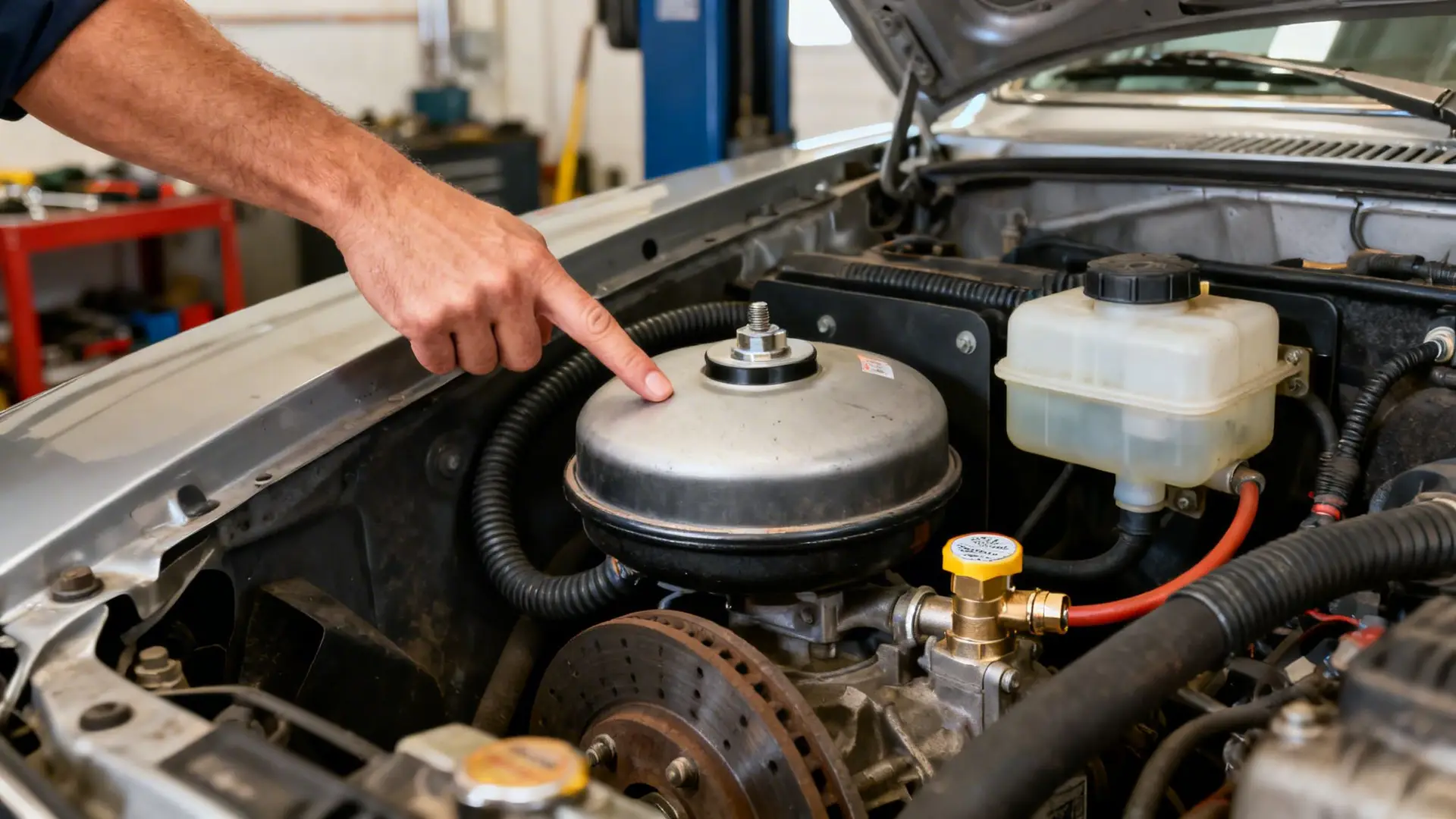
Interpreting the Signs of Booster Failure
While a rock-hard pedal is the most obvious indicator, a failing brake booster often presents other symptoms.
A Hissing Sound: A distinct "whoosh" or hissing noise when you press the brake pedal is a classic symptom of a failed diaphragm inside the booster. This sound is caused by air rushing in, which disrupts the vacuum needed for power assist.
Changes in Engine Behavior: Pay attention to your engine's idle. If the RPMs surge or the engine stumbles when you hold the brake pedal down, it's another sign of trouble. This occurs because the vacuum leak allows unmetered air into the engine, affecting its performance.
When these auditory cues are combined with a hard pedal, the diagnosis becomes clearer. It also explains why the pedal doesn't soften during the engine-on test—the booster is unable to build or hold the necessary vacuum.
Key Takeaway: A hissing noise paired with a brake pedal hard to press is direct evidence of brake booster failure. This is not a minor inconvenience but a critical failure in your vehicle's primary safety system.
Industry data suggests that approximately 60-70% of hard brake pedal complaints are due to a faulty booster or a leak in its vacuum supply lines.
Why This Knowledge Matters
Understanding these symptoms empowers you as a vehicle owner. It allows you to communicate more effectively with a technician, shifting the conversation from a vague "my brakes feel weird" to a more specific "I hear a hiss when I brake, and I suspect a booster issue."
This level of detail helps technicians diagnose the problem more efficiently and accurately, getting you back on the road safely. It also fosters confidence in the diagnostic process.
While a faulty booster is the most probable cause, a thorough mechanic will always inspect the entire braking system. You can also be proactive by learning how to check your brake fluid yourself.
Other Issues That Can Cause a Hard Brake Pedal
Although a failing brake booster is the most common culprit for a hard pedal, it isn't the only possible cause. A vehicle's power braking system is an interconnected chain of components, and a failure in any part can compromise your ability to stop safely.
Frequently, the issue lies not with the booster itself but with the vacuum supply that powers it. The system's integrity is only as strong as its weakest link, which can sometimes be a simple rubber hose.
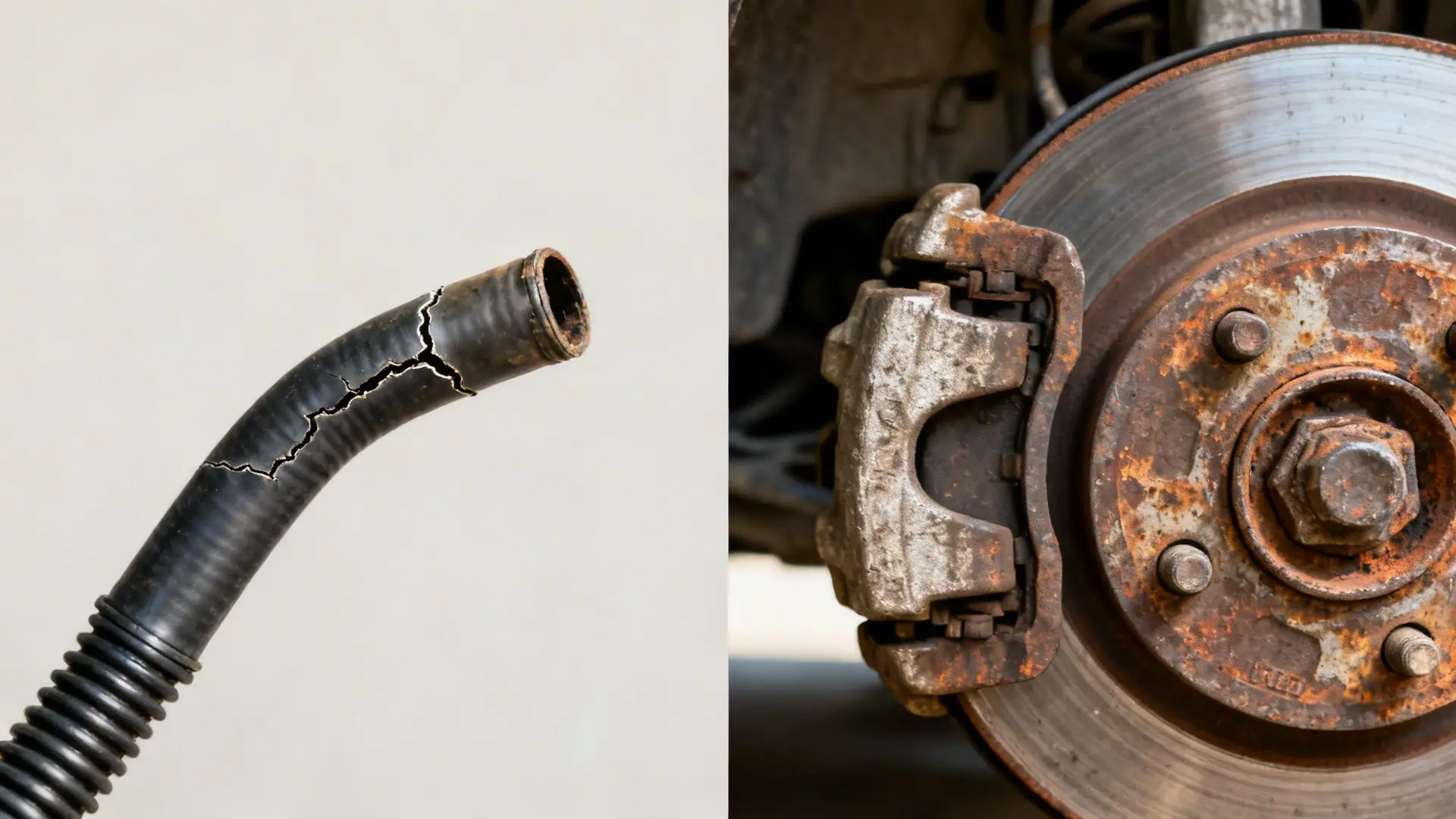
Vacuum Leaks from Hoses and Valves
Your brake booster requires a constant supply of engine vacuum for power assist, delivered through a rubber hose. Over time, exposure to engine heat and vibrations can cause this hose to become brittle, crack, or disconnect.
Even a small crack can create a vacuum leak, starving the booster of the suction it needs to function and resulting in a stiff pedal. You might also hear a hissing sound from under the hood or notice a rough engine idle—both classic signs of an air leak.
Another vital component in this system is the check valve. This small, one-way valve, typically plugged into the booster, is designed to allow vacuum in but prevent it from escaping.
If this valve fails, the booster cannot retain vacuum. Your brakes might feel normal on the first application, but the pedal will become hard on subsequent presses. This is particularly dangerous in stop-and-go traffic.
Seized Brake Calipers or Pistons
In some cases, the problem is purely mechanical and located at the wheel. A seized brake caliper can also make the brake pedal hard to press.
Each wheel's caliper houses a piston that squeezes the brake pads against the rotor. After years of exposure to moisture, road salt, and debris, the caliper's piston or the slide pins it moves on can seize due to rust.
A seized caliper is immobile. It might be frozen in the "on" position, causing the brake to drag, or frozen in the "off" position, preventing the pad from contacting the rotor at all.
When the caliper cannot move, pressing the brake pedal feels like pushing against a solid object. The force is not transmitted, and the vehicle fails to slow down properly. This issue is often accompanied by other signs:
- Pulling to One Side: The vehicle may pull sharply to the left or right during braking as one wheel brakes effectively while the other does not.
- A Burning Smell: A dragging seized caliper generates immense friction and a distinct burning odor from the affected wheel.
- Visible Rust or Damage: A visual inspection might reveal excessive rust or uneven wear on the brake rotor.
Given the variety of potential causes, professional diagnosis is essential. An experienced technician can quickly test the vacuum system and inspect the calipers to accurately identify the failure and perform the correct repair.
What to Expect for Your Brake Repair in Plano
Once the reason for your hard brake pedal is identified, the next step is the repair. A proper brake service is not just about replacing a part; it's about methodically restoring your car’s most critical safety system.
Understanding the repair process can provide clarity and confidence in the work being performed. The specific repair will target the component that failed the diagnostic tests.
Common Repair Procedures
After confirming the cause, technicians will explain the necessary repair. For a hard pedal, the solution typically involves one of the following procedures:
Brake Booster Replacement: This is a more involved repair. A technician must carefully disconnect the master cylinder and vacuum lines before accessing the vehicle's interior to unhook the pedal linkage. The new booster is then installed, all components are reconnected, and the system is bled of any air to restore a solid, responsive pedal feel.
Vacuum Line or Check Valve Repair: If a cracked hose is the issue, the repair is quicker but equally important. The faulty vacuum hose is replaced with a new, high-quality part to ensure a perfect seal. A failed check valve is a fast replacement that immediately allows the booster to hold vacuum again.
Seized Brake Caliper Service: This requires removing the wheel to access the caliper. The entire caliper assembly may be replaced, or it may be rebuilt by freeing the stuck piston and replacing the seals. The brake pads and rotors are also inspected for collateral damage, and the brake lines are bled to complete the service.
Peace of Mind is Priceless: For brake repairs, entrusting the job to an ASE-certified technician is crucial. It ensures the repair adheres to strict professional standards, using correct parts and procedures, which is fundamental to your safety.
Estimated Repair Costs for a Hard Brake Pedal
The cost to fix a hard brake pedal varies, depending on the vehicle's make and model and the specific part that has failed. For instance, a brake booster for a European luxury vehicle will typically cost more than one for a domestic sedan.
This breakdown provides a general idea of what to expect for parts and labor. A precise, detailed estimate is always provided after a thorough diagnosis.
| Repair Type | Parts Commonly Replaced | Estimated Cost Range (2026) |
|---|---|---|
| Brake Booster Replacement | Brake Booster, Gaskets, Brake Fluid | $400 – $900+ |
| Vacuum System Repair | Vacuum Hose, Check Valve | $100 – $250 |
| Seized Caliper Replacement | Caliper, Brake Pads, Brake Fluid | $300 – $650 per wheel |
At Express Lube & Car Care, we prioritize transparency. You will receive a detailed quote before any work begins, allowing you to make an informed decision. For more on service costs, see our guide on brake repair services in Plano, TX.
Choosing a professional ensures the repair is done correctly, restoring your vehicle's safety.
Why Trust Us with Your Brake Safety
Your brakes are the most important safety system on your vehicle. When the brake pedal suddenly feels hard to push, it signals a problem that cannot be postponed. At Express Lube & Car Care, we have established our reputation in Plano by providing trustworthy service for critical automotive issues.
We understand that brake problems are stressful and can render a vehicle unsafe to drive. Our process begins with a clear and straightforward diagnosis, ensuring you understand the issue and your available options.
The Expertise Your Brakes Demand
Modern braking systems are complex and require specialized knowledge and experience for proper repair. Our team consists of ASE-certified technicians who are experts in diagnosing challenging brake issues, from simple vacuum leaks to complete brake booster failures.
We do not rely on guesswork. Using advanced diagnostic tools, we pinpoint the exact source of your hard brake pedal. This methodical approach ensures we address the correct problem the first time, saving you money and providing confidence that your vehicle is safe.
We never compromise on safety. We take the time to explain our findings and your repair options clearly, because an informed customer is a confident one.
More Than Just Another Repair Shop
We know that car trouble disrupts your daily routine. Our conveniently located shop in Plano is committed to diagnosing and repairing your vehicle efficiently and safely.
Our commitment to honest, transparent service sets us apart. You can always expect:
- Honest Recommendations: We recommend only the repairs that are necessary for your safety and your vehicle’s long-term reliability.
- Quality Workmanship: Our ASE-certified technicians use high-quality parts and follow industry-best practices to ensure every repair is durable.
- Fair Pricing: You will receive a clear, itemized estimate before we start any work, with no hidden fees.
A hard brake pedal is a significant warning sign. Postponing a repair puts you and others at risk. Let our expert technicians provide the professional diagnosis and quality repair your vehicle needs.
Don't delay your safety. Bring your vehicle to Express Lube & Car Care for a professional brake inspection and gain the peace of mind you deserve. Schedule your visit today at https://www.expresslubeplano.com.