

If your car has crossed the 75,000-mile mark, the cost of keeping it running can feel relentless. One of the most frequent expenses you’ll face is the oil change, and for a high mileage engine, getting an affordable oil change on a high mileage car without cutting corners on quality takes real strategy. The right oil protects aging seals, reduces burn-off, and buys your engine more miles. The wrong approach costs far more in repairs than you ever saved at the service counter. This guide breaks down what high mileage oil actually does, where to find the best oil change rates for high mileage vehicles, and how to protect yourself from unnecessary charges.
Table of Contents
- Key takeaways
- What high mileage oil actually does for aging engines
- Finding affordable oil change services for high mileage cars
- How to prepare for a cost-effective high mileage oil change
- Common mistakes that cost high mileage car owners money
- Maintaining your vehicle’s health between oil changes
- My take on balancing cost and care in high mileage oil changes
- Get affordable high mileage oil change service in Plano
- FAQ
Key takeaways
| Point | Details |
|---|---|
| High mileage oil is worth it | Specialized oil with seal conditioners reduces leaks and burn-off in engines over 75,000 miles. |
| Skip the 3,000-mile myth | Most modern cars run safely 7,500 to 10,000 miles per interval, saving hundreds of dollars annually. |
| Avoid dealer upsells | Stick to your owner’s manual. Service advisors often recommend services your car does not need. |
| Compare providers carefully | High mileage oil change costs range from roughly $50 to $98 depending on provider and oil type. |
| Track every oil change | Maintenance records protect resale value, support warranty compliance, and help you spot problems early. |
What high mileage oil actually does for aging engines
Not all motor oil is built the same, and that distinction matters most once your odometer climbs past 75,000 miles. High mileage oil contains seal conditioners and antioxidants specifically designed to address problems that develop in older engines: shrunken and hardened seals, increased oil consumption, and accelerated oxidation of the lubricant itself. Standard conventional oil does not include these additives, which is why switching to a high mileage formula at the right time makes a measurable difference in engine behavior.
The seal conditioners in high mileage oil work by causing rubber seals and gaskets to swell slightly back toward their original dimensions. This reduces oil leaks around the valve covers and drain plug areas. The antioxidants slow the chemical breakdown of the oil under high heat, which means the oil holds its viscosity longer between changes. You may also notice a reduction in the blue smoke some older engines produce when oil burns in the combustion chamber.
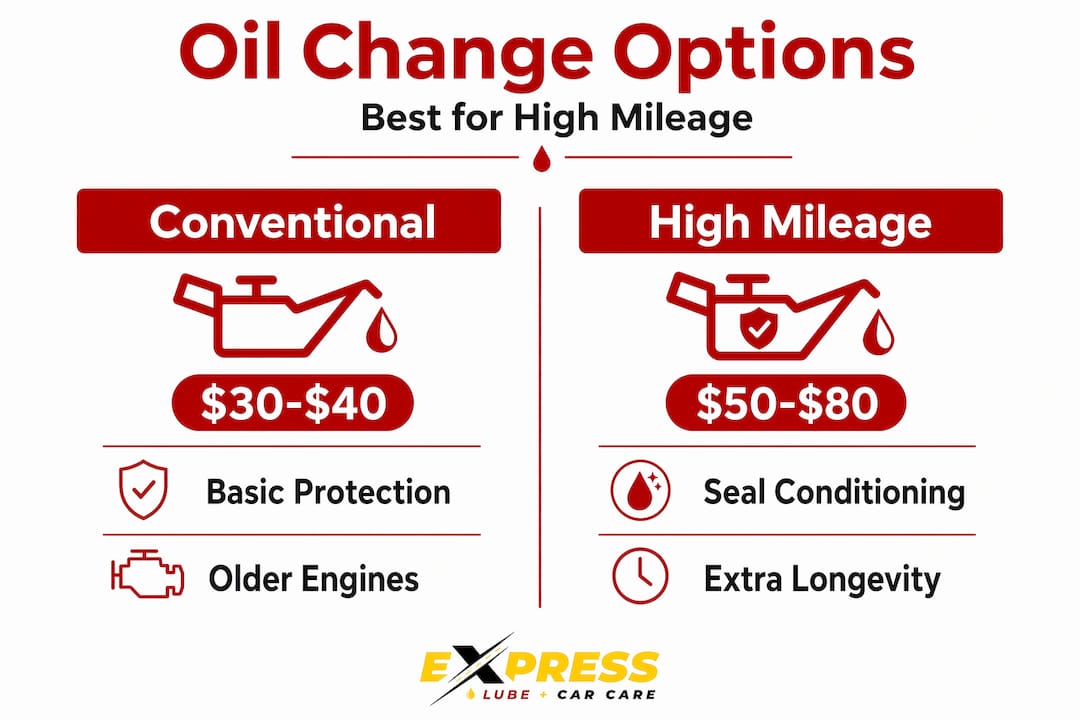
For context on pricing, high mileage oil typically runs $15 to $40 more than a conventional oil change, but the engine protection you gain at this stage of a vehicle’s life makes that cost reasonable. Think of it like replacing a worn gasket proactively versus paying for an engine rebuild later.
Here is how the four main oil types compare for high mileage vehicles:
| Oil Type | Typical Price Range | Best For | High Mileage Benefit |
|---|---|---|---|
| Conventional | $30 to $55 | Low mileage, newer engines | Minimal |
| Synthetic blend | $45 to $70 | Moderate mileage, mixed conditions | Moderate |
| Full synthetic | $65 to $100 | All engines, extended intervals | High, but lacks seal conditioners |
| High mileage | $50 to $98 | Engines over 75,000 miles | Highest for aging seals and leaks |
Pro Tip: Check our complete guide to high mileage oil to understand which additive package fits your specific engine type and driving conditions.
Finding affordable oil change services for high mileage cars
The price you pay for an affordable oil change on a high mileage car depends almost entirely on where you go and how prepared you walk in. High mileage oil change costs range from about $49.99 to $98 depending on the provider, the oil brand used, and whether a surcharge applies for high mileage formula. Quick lube centers typically add around $22 to their base price for high mileage oil upgrades.
Here is a breakdown of what to expect from each provider type, along with specific strategies to reduce your out-of-pocket cost:
- Quick lube centers: These offer the fastest turnaround and competitive base rates. Watch for published coupons and app-based discounts that can bring the total down by $10 to $20 per visit. Some locations run seasonal promotions specifically for high mileage oil changes.
- Retail auto centers: Buying oil and a quality filter in-store and paying labor only for installation can reduce your total compared to packaged service pricing. This works well if you know your oil specification and have a preferred filter brand.
- Dealerships: Expect to pay a premium for the same physical service. Dealerships are also the most aggressive about adding services your car does not need. More on that shortly.
- Independent shops: Often the best balance of price and personalized service. Many will match or beat advertised rates and are less likely to push unnecessary add-ons.
To keep costs manageable across all provider types, use these strategies:
- Download retailer apps for exclusive mobile coupons before you book.
- Sign up for loyalty programs at quick lube centers, which often offer a free oil change after a set number of visits.
- Ask specifically for a single service oil and filter change. Do not agree to package deals until you have confirmed each item is actually recommended by your manufacturer.
- Check for oil change discount offers for high mileage cars through your auto insurance provider or auto club membership.
Pro Tip: Oil change intervals vary by mileage and driving conditions. Knowing your actual recommended interval prevents overpaying for changes you do not yet need.
How to prepare for a cost-effective high mileage oil change
Going in prepared is the single most effective way to control costs and get the right service. Follow these steps before and during your next oil change appointment.
- Read your owner’s manual first. Your manual lists the exact oil viscosity, specification, and change interval your engine requires. The manufacturer’s maintenance schedule is the definitive guide, not the sticker the last shop put on your windshield.
- Decide on your oil type. For most vehicles over 75,000 miles, a high mileage formula is the right call. If your engine runs cleanly with no leaks or elevated oil consumption, a synthetic blend may suffice at a lower price point.
- Gather your questions. Before you hand over your keys, ask the technician to confirm the oil brand, viscosity, and filter brand they plan to use. Write it down if needed.
- Schedule during off-peak hours. Tuesday through Thursday mornings tend to have shorter waits and occasionally lower shop load, which means technicians are less rushed and more focused.
- State what you want upfront. Say clearly: “I want an oil and filter change only, please.” This sets the expectation before anyone has a chance to build a service package around your visit.
- Verify the work before you leave. Ask to see the old filter, confirm the drain plug was reinstalled and torqued correctly, and check the dipstick yourself to verify oil level and color. A fresh oil change should show clean, amber-colored oil on the dipstick.
This process takes less than five minutes of your time but protects you from both mechanical errors and unnecessary charges.
Common mistakes that cost high mileage car owners money
High mileage vehicles get the most out of their owners when those owners are informed. These are the mistakes that consistently lead to overspending or engine damage.
- Changing oil too frequently out of habit. The old 3,000-mile rule is outdated. Most vehicles run safely for 7,500 to 10,000 miles between changes, which translates to roughly $600 in unnecessary costs over 30,000 miles if you follow the old interval.
- Accepting dealer service package upsells. Dealer service advisors work on commission structured by parts and labor sold. A real-world example: one dealership recommended $2,038 in services at the 30,000-mile mark for a Toyota RAV4. The owner’s manual required a fraction of that work.
- Choosing the cheapest oil without checking specs. A discount brand that does not meet your engine’s API service classification can accelerate wear in high mileage engines. Always verify the spec code on the bottle matches your manual’s requirement.
- Skipping the oil filter. Reusing an old filter with fresh oil defeats much of the benefit of the change. A good quality filter costs $8 to $15 and should be replaced every time.
- Ignoring early warning signs. If your oil light flickers, you notice a burning smell, or your engine sounds louder than usual, those are indicators that your oil has degraded before the scheduled interval. Do not wait.
Experts recommend relying exclusively on manufacturer guidelines rather than service advisor recommendations driven by sales commissions. Your manual is the only document with no financial interest in your decision.
Maintaining your vehicle’s health between oil changes
Getting an affordable, quality oil change is only part of the equation. What you do between visits determines how long that protection lasts and whether you catch problems before they become expensive.

| Maintenance Task | How Often | What to Look For |
|---|---|---|
| Check oil level | Every 1,000 miles or monthly | Below minimum line, milky color, or burnt smell |
| Inspect for leaks | Monthly, after parking | Oil spots on the driveway or under the engine bay |
| Monitor oil condition | At each dipstick check | Dark black or gritty texture indicates degraded oil |
| Review maintenance log | Before each service | Gaps in record, inconsistent oil types used |
| Transmission fluid check | Per manufacturer schedule only | Avoid unnecessary flushes on high mileage vehicles |
One point worth understanding clearly: improper transmission fluid flushes on older vehicles can accelerate transmission failure rather than prevent it. On a high mileage car that has not had regular fluid maintenance, a full flush may dislodge debris and cause more harm than a partial change would. Follow your manufacturer’s guidance closely on this one.
Keeping a physical or digital maintenance log pays dividends on two fronts. It helps you spot patterns, like oil burning faster after a certain mileage point, and it adds credibility and resale value when you sell the vehicle. Buyers pay more for cars with documented care histories.
Pro Tip: The role of oil changes in engine longevity is well documented. Consistent intervals with the right oil type can add tens of thousands of miles to an engine’s functional life.
My take on balancing cost and care in high mileage oil changes
I have seen a consistent pattern in how high mileage car owners approach oil changes. The ones who try to save money by stretching intervals or using the cheapest oil available end up spending far more on repairs than those who spend a modest amount more on quality service from the start.
In my experience, the owner’s manual is the most underused tool in automotive maintenance. Drivers hand over their keys without any reference point, which makes them easy targets for service advisors suggesting chemical additives, engine flushes, and multi-point inspection packages that were not asked for and are not needed. I have watched the same $49 oil change turn into a $200 visit because the driver did not know what to decline.
The real value of quality oil is not dramatic. It does not fix a neglected engine overnight. But applied consistently, the right high mileage formula with the right filter, at the right interval, keeps internal components lubricated properly and prevents the kind of slow degradation that becomes a repair bill 20,000 miles later.
My honest advice: print out the oil change page from your owner’s manual, carry it with you to the shop, and ask technicians to confirm everything they plan to do matches what is on that page. That one habit saves most drivers between $100 and $400 per year. Keep every receipt and log every service date. Your future self, and any future buyer of your vehicle, will thank you.
— Express Lube & Car Care
Get affordable high mileage oil change service in Plano
If your car is over 75,000 miles and you want quality service at a price that makes sense, Express Lube & Car Care in Plano is built for exactly that. No appointment needed. Certified technicians handle your oil and filter change with precision, using the right high mileage formula for your specific engine without pressure to add services you did not ask for.
Express Lube & Car Care offers current oil change specials for a range of vehicle types and budgets, including options for high mileage vehicles that need specialized oil formulas. You can also browse oil change and service deals or grab a maintenance coupon before your next visit to maximize your savings. Military personnel and healthcare providers receive additional discounts as a genuine thank-you from the team. Fast, honest, and priced fairly. That is the standard at Express Lube & Car Care.
FAQ
What type of oil does a high mileage car need?
Vehicles over 75,000 miles benefit most from high mileage oil, which contains seal conditioners and antioxidants that reduce leaks and oil burn-off in aging engines. Check your owner’s manual for the correct viscosity before purchasing.
How often should I change oil in a high mileage car?
Most modern vehicles run safely between 7,500 and 10,000 miles per oil change interval, regardless of mileage. High mileage engines with known oil consumption issues may need checks closer to the 5,000-mile mark.
How much does a high mileage oil change cost?
Prices range from approximately $49.99 to $98 depending on the provider and oil type. Quick lube centers often add a surcharge of around $22 for high mileage oil upgrades over their base price.
Is it worth paying more for high mileage oil?
Yes. The price difference over conventional oil is typically $15 to $40, but the seal conditioning and oxidation protection it provides can prevent far more expensive engine repairs in older vehicles.
Should I avoid transmission flushes on my high mileage car?
Transmission fluid flushes on older vehicles that have not received regular fluid maintenance can cause more harm than good. Follow your manufacturer’s recommended service intervals and avoid flushes unless your manual specifically calls for them.