

You walk out to your car before work, coffee in hand, and spot a small red puddle under the middle of the vehicle. It wasn’t there yesterday. The car still drives, so you tell yourself it can wait. Then the questions start. Is it engine oil? Power steering fluid? Transmission fluid? Is it serious, or just one of those old-car drips you keep an eye on?
That’s where a lot of drivers get stuck.
A transmission front seal leak is one of those problems people hear about but rarely understand until it happens to them. The tricky part is that a leak from the front of the transmission can look like several other leaks, and guessing wrong can waste time and money. That’s why this repair deserves a calm, methodical look instead of internet roulette.
These seals are more common than often assumed. The transmission front seal market in China alone was valued at approximately 2.86 billion yuan, which shows how widespread and important these components are across modern vehicles, according to this transmission seal market overview.
If your vehicle is leaving a reddish spot behind, it helps to first understand the basics of what causes a car to start leaking transmission fluid. From there, you can narrow down whether the front seal is the likely source, or whether the leak is coming from somewhere else.
That Mysterious Red Puddle Under Your Car
A front seal leak usually doesn’t announce itself with drama. It starts small. A few drops on the driveway. A light fluid smell after parking. Maybe a little hesitation when shifting into Drive on a cold morning.
Then the pattern changes. The spot gets bigger. The transmission fluid level starts dropping. Shifts feel less crisp. At that point, the seal itself may still be a small part, but the risk to the transmission is getting bigger.
Why this leak gets misread
Drivers often describe the problem the same way: “It’s leaking from the front.” That sounds simple, but it isn’t. Fluid can travel. Wind can push it rearward while driving. Dirt on the underside can make an old leak look fresh.
That’s why the exact source matters.
A transmission front seal leak happens near the area where the transmission meets the engine. If that seal fails, automatic transmission fluid can escape from inside the bellhousing area. But that same general area can also make people suspect an oil leak, a pan leak, or another transmission seal entirely.
A red puddle tells you fluid is escaping. It does not tell you which seal failed.
Why it deserves quick attention
Automatic transmission fluid doesn’t just lubricate parts. It also helps cool the transmission and supports hydraulic operation. When the fluid level drops far enough, shift quality changes and internal damage becomes much more likely.
Here’s the practical takeaway:
- Small leaks grow: Heat, pressure, and time usually make a hardened seal worse, not better.
- Low fluid affects drivability: Harsh shifting, delayed engagement, or slipping can follow.
- The leak may not be the only problem: Sometimes a failed seal is the symptom, not the root cause.
That last point is where many guides fall short. Replacing the seal without checking why it failed can lead to the same leak returning.
The Unsung Hero Guarding Your Transmission Fluid
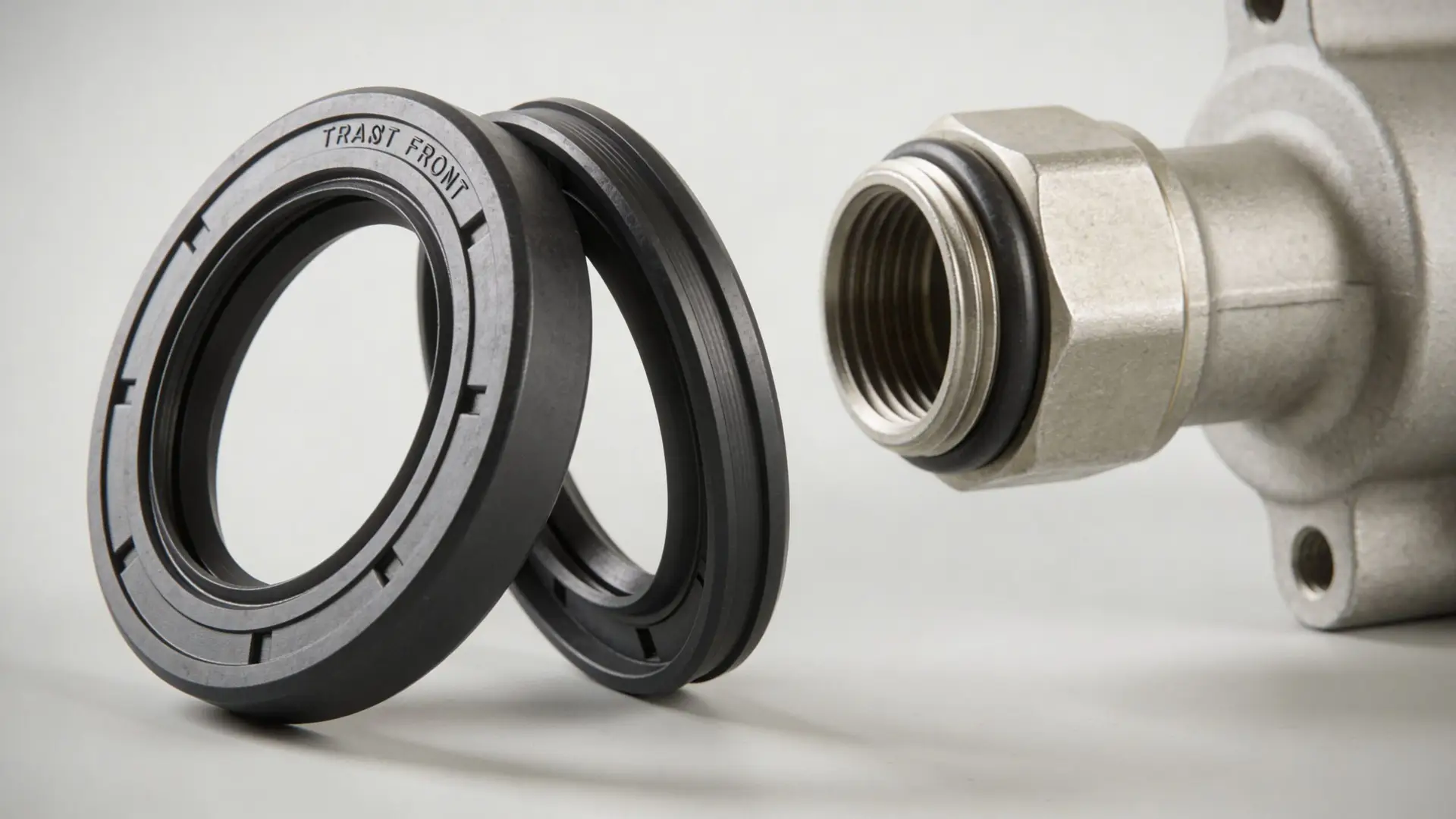
The transmission front seal has one job. It keeps transmission fluid from escaping where rotating components pass through the front of the transmission. If you want a simple analogy, think of the rubber seal inside a water bottle lid. The bottle can tip, shake, and move around, but that little seal keeps the liquid in place. Your transmission front seal does a similar job in a much harsher environment.
It sits behind the torque converter inside the transmission bellhousing. In automatic transmissions, the front seal is also called the front oil pump seal or input shaft seal. Its role is to seal the interface between the torque converter snout and the oil pump so automatic transmission fluid stays where it belongs under pressure. In Toyota applications from 1974 to 2008, one genuine seal listed as OE# 90311-38020 has dimensions of 55 mm OD, 38 mm ID, and 9 mm height, as shown in this Toyota front pump seal reference.
Where it lives and why that matters
Because the seal is buried behind the torque converter, you can’t lean over the engine bay and swap it out in a few minutes. The location is one reason this repair is labor-heavy even though the part itself is small.
You can think of the transmission as a hydraulic machine. Fluid has to stay contained for the system to work correctly. When the front seal starts leaking, the transmission can lose fluid from one of the worst possible places. Hidden, messy, and easy to confuse with other leaks.
If you want a better picture of how fluid maintenance supports this entire system, it helps to understand what a complete transmission service includes.
What the seal is made from today
Older sealing methods were much cruder. According to this seal engineering handbook, synthetic rubber materials like nitrile replaced older leather-based designs by the 1950s, and direct bonded rubber-to-metal seals became standard. That shift made seals far more durable and much better at resisting leaks.
Modern transmission seals are usually made from durable synthetic rubber compounds such as nitrile or neoprene-type materials, depending on application. They’re built to handle heat, fluid exposure, and constant contact with rotating surfaces.
Why such a small part can create a big problem
The front seal doesn’t carry the whole transmission. It doesn’t make shifts happen. But without it, the transmission can’t hold fluid where it needs to.
Here’s what that means in plain language:
- No proper sealing, no stable fluid level
- No stable fluid level, no reliable hydraulic pressure
- No reliable pressure, no confident shifting
Practical rule: A transmission front seal is cheap to ignore right up until the transmission starts reacting to the fluid loss.
That’s why mechanics pay close attention to even a minor leak in that area. The part is small. The consequences aren’t.
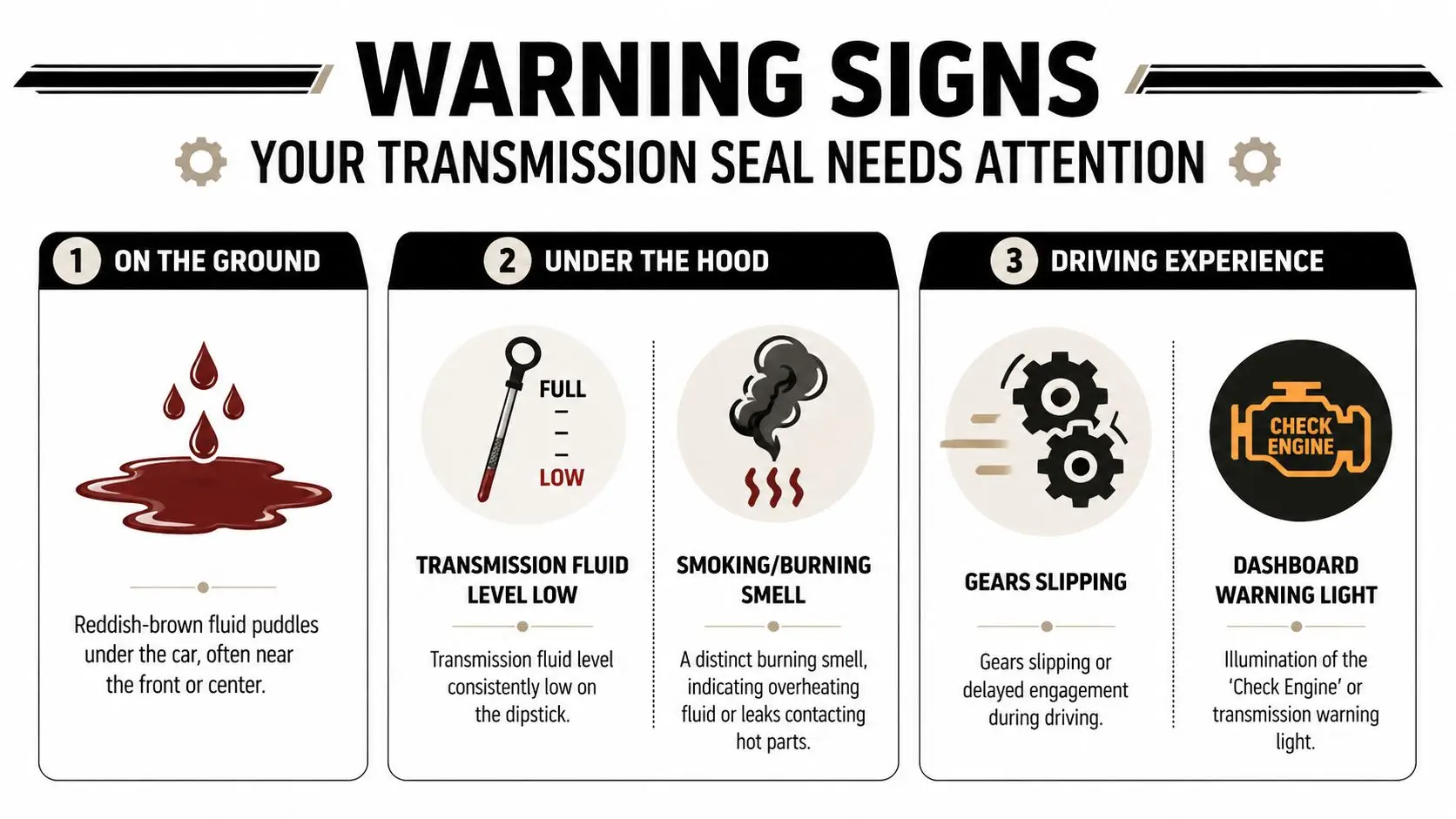
Warning Signs Your Transmission Seal Needs Attention
Most drivers don’t identify a transmission front seal by looking at the seal itself. They identify it by symptoms. The key is connecting those symptoms in the right order.
A front seal leak often starts with something you see, then turns into something you smell, then becomes something you feel while driving.
What you may notice on the ground
The first clue is usually fluid under the vehicle. Transmission fluid is often described as red or reddish-brown, especially when it’s still in decent condition. If you’re seeing that color under the front-center area of the vehicle, don’t ignore it.
The location matters, but it isn’t enough by itself. Airflow while driving can move fluid around, and splash can spread it across the underside.
A few signs that should get your attention:
- Fresh red or reddish-brown drips: These often suggest automatic transmission fluid rather than engine oil.
- A leak that appears after driving: Heat and internal pressure can make the leak show up more clearly once the transmission is warm.
- Spots near the bellhousing area: That can point toward a front transmission leak, though it still needs confirmation.
What changes under the hood and under the car
As fluid escapes, the transmission fluid level can drop. Once that happens, the transmission may start acting differently because it depends on fluid for pressure, lubrication, and cooling.
That’s when drivers may report:
- Delayed engagement: You shift into Drive or Reverse and the vehicle hesitates before moving.
- Slipping during acceleration: Engine speed rises, but the vehicle doesn’t respond the way it should.
- A burning smell: Leaking fluid can overheat, or it can contact hot surfaces.
- Warning lights: Some vehicles may trigger a check engine or transmission-related warning when operation is affected.
What you feel while driving
This is the part many people miss. They focus on the puddle, but they don’t connect it to the way the vehicle is behaving.
Low transmission fluid can reduce hydraulic pressure. That can show up as inconsistent shifting, rough engagement, or slipping. It can also make the vehicle feel fine one day and worse the next, depending on how much fluid has been lost.
If the leak is small but your shifts are already changing, the transmission is telling you the fluid loss is no longer minor.
The confusion between similar leaks
Diagnosis becomes tricky. Vehicle owners often confuse the torque converter seal and the front pump seal, and many online discussions blur the difference. Both can produce very similar symptoms, which is why this video discussion about front transmission leaks reinforces that professional diagnosis is essential before deciding what failed.
A front leak can also be mistaken for:
| Leak source | What owners often assume | Why it gets confused |
|---|---|---|
| Rear main seal | “The engine is leaking into the transmission area” | Both leaks can appear near the bellhousing |
| Transmission pan gasket | “It’s just a lower gasket” | Fluid can spread rearward and sideways |
| Cooler line leak | “It’s leaking from the front of the transmission” | Leaks can drip in misleading spots |
| Front seal or converter-related leak | “Any leak near the bellhousing must be the same repair” | Different seals can create similar evidence |
A quick reality check
If you’re seeing red fluid and the transmission is starting to shift poorly, you’re past the “watch and wait” stage. At that point, the smart move is to identify the source before replacing parts.
The Professional Diagnostic Process for Leaks
When a vehicle comes in with a suspected transmission front seal leak, a good technician doesn’t start by ordering parts. The first job is to prove where the fluid is coming from.
That matters because a leak at the bellhousing can fool even experienced DIYers. Fluid moves. Gravity spreads it. Dirt hides the trail.

Step one starts with the lift
A technician usually begins with a visual inspection from underneath. On a lift, you can inspect the pan, cooler lines, transmission case, vent area, and bellhousing much more clearly than you can on the ground.
The important question isn’t “Where is the fluid dripping now?” It’s “Where did the leak start?”
If the leak is indeed at the front seal area, an experienced tech looks for specific evidence. According to the earlier Toyota seal reference, a front seal leak often shows red ATF dripping from the bellhousing, sometimes after fluid bypasses the seal lip due to torque converter wobble. Another key clue is discoloration on the flexplate, while a rear main seal leak would show darker engine oil instead.
Step two rules out look-alike problems
The next part is elimination. A proper diagnosis checks nearby components that can mimic a front seal leak.
That includes:
- Cooler lines and fittings: A small leak higher up can run down and collect at the bellhousing.
- Transmission pan and gasket area: Road airflow can move fluid around enough to create a false trail.
- Rear main seal area: Engine oil can be mistaken for transmission fluid if the underside is dirty.
- Torque converter-related issues: A leak may involve more than the seal alone.
If you’ve already noticed shift issues, fluid loss, or warning lights, a broader check like this guide to diagnosing transmission problems helps explain why leak diagnosis and drivability diagnosis often overlap.
Step three uses dye when the leak is stubborn
Some leaks are obvious. Others only show up under heat and pressure. That’s when technicians often add UV dye to the transmission fluid, drive or idle the vehicle as needed, then inspect with a blacklight.
This is one of the best ways to trace the actual leak path. Instead of guessing where the fluid might have started, the dye shows where it escaped and where it traveled.
Here’s a useful visual on how technicians inspect transmission-related components during diagnosis:
Why guessing gets expensive
A front seal replacement is not a casual job. If someone guesses wrong and replaces the wrong seal, or misses the actual cause, the vehicle may still leak after major labor.
That’s why a professional process is worth it. Not because the leak is mysterious, but because the evidence has to be interpreted correctly.
Clean the area. Confirm the fluid type. Trace the leak path. Then decide on repair. That order saves money.
Fixing a Transmission Front Seal DIY vs Professional
People often find themselves surprised. The seal itself may be a small, affordable part. The labor is the main story.
On most automatic transmissions, replacing the transmission front seal means removing the transmission to access the seal behind the torque converter. That changes the repair from “parts replacement” to “major drivetrain work.”
What a DIY repair really involves
If you’re experienced, have the right equipment, and you’ve done transmission removal before, this repair is possible at home. But it isn’t a beginner project.
A proper DIY approach often involves:
- Supporting the vehicle safely: Not just with a floor jack. You need stable access and room to work.
- Using a transmission jack: The transmission has to be lowered and handled carefully.
- Removing connected components: Depending on the vehicle, that can include crossmembers, driveshafts, linkages, wiring, cooler lines, and the torque converter.
- Installing the new seal correctly: The lip must be protected, the seal must seat squarely, and the surrounding surfaces need inspection.
Premium replacement parts matter here. The Pro-Tek PTK-38151A front pump seal is designed for a temperature range of -20°F to 300°F and resists degradation from extreme pressure additives in ATF, according to the Pro-Tek PTK-38151A product specifications. The same source states that using a premium seal can extend service life by double compared with economy parts.
Why installation quality matters as much as the part
A new seal won’t fix a wobbling converter, a damaged hub surface, or poor installation. Even a good seal can fail quickly if the converter snout is worn, the seal lip gets nicked during installation, or the transmission goes back together with an underlying alignment problem.
That’s why this repair needs more than patience. It needs judgment.
A front seal job is one of those repairs where “I got it apart” and “I fixed the cause” are two very different things.
Transmission Front Seal Repair Comparison DIY vs Professional
| Factor | DIY Repair | Professional Service (e.g., Express Lube) |
|---|---|---|
| Skill needed | Advanced mechanical experience | Performed by trained technicians |
| Tools required | Transmission jack, lift or heavy-duty stands, hand tools, seal driver, fluid service tools | Professional shop equipment already in place |
| Time commitment | Often a full weekend or more, depending on vehicle and experience | Usually handled as scheduled repair labor |
| Diagnosis accuracy | Depends on experience and inspection quality | Better ability to confirm exact leak source first |
| Risk level | Higher risk of misdiagnosis, converter seating issues, or seal damage during installation | Lower risk when repair follows proven procedure |
| Part selection | Up to the owner | Access to premium replacement options |
| Best fit | Experienced DIYers with space and proper equipment | Most daily drivers who need reliability and less downtime |
When DIY makes sense and when it doesn’t
DIY makes sense if you already work on transmissions, have room to pull one safely, and can handle the possibility that the seal may not be the only issue.
Professional repair makes more sense if your vehicle is a daily commuter, you’re already dealing with drivability symptoms, or you don’t want to repeat the labor because of one missed detail.
That’s not fear-based advice. It’s just the reality of where this seal lives and what it takes to get to it.
Proactive Maintenance to Protect Your Transmission
The best transmission front seal repair is the one you never have to make.
Seals wear with age, heat, and mileage, but many seal failures get pushed along by underlying conditions that can be caught earlier. Preventive maintenance won’t make rubber last forever, but it can keep a good seal from being forced into failure by pressure, contamination, or extra movement.
Keep the fluid in good condition
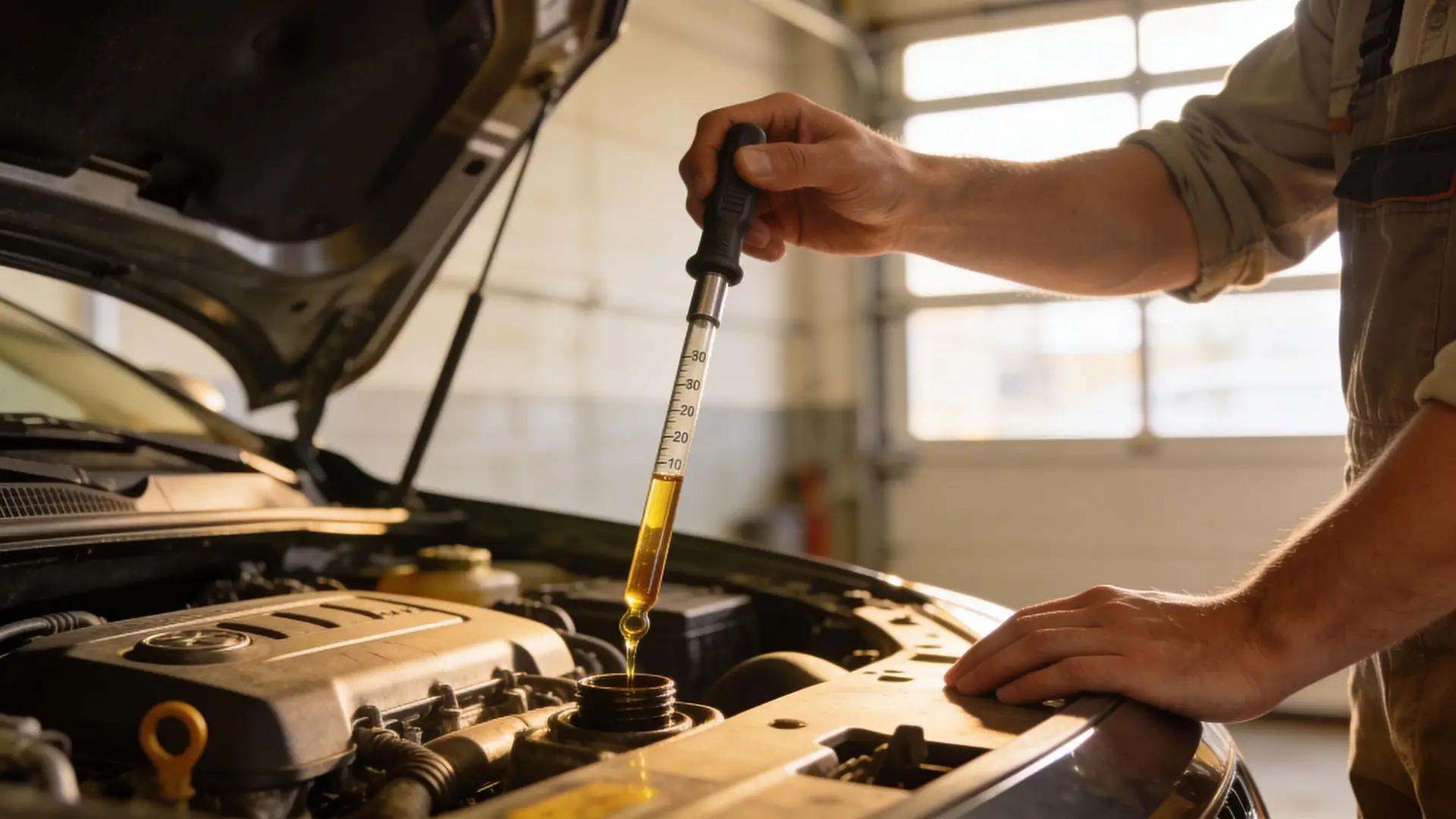
Transmission fluid has a hard life. It handles heat, friction, and hydraulic duties all at once. When fluid gets old or contaminated, the whole transmission works harder.
That’s why regular fluid service matters. Clean fluid helps with lubrication and cooling, and it gives seals a better environment to live in.
Simple habits help:
- Check for changes in shift feel: Delayed engagement and slipping often show up before a major leak.
- Watch for fresh spots where you park: New drips are easier to trace than old grime.
- Follow the manufacturer’s service schedule: The exact interval depends on the vehicle.
Pay attention to root causes most people miss
This is the part many owners never hear about. Sometimes the seal isn’t weak first. Sometimes another problem overstresses it.
According to this explanation of transmission seal leak causes, a worn extension housing bushing can allow excessive driveshaft movement that damages a seal, and a clogged transmission vent can build internal pressure that forces fluid out. Routine inspections can catch both before they create a leak.
That matters because replacing a failed seal without addressing the pressure problem or movement problem can set up the next failure.
Driving habits also affect seal life
How you drive changes how much heat and stress the transmission sees. Hard acceleration, heavy towing beyond the vehicle’s intended use, and ignoring vibrations all add strain.
You don’t have to baby the vehicle. But you should respond when it starts giving warnings.
Shop-floor advice: If you feel a new vibration, smell hot fluid, or notice a fresh leak, don’t wait for a louder symptom. Transmissions rarely get cheaper after that point.
What prevention looks like in real life
Good prevention is not complicated. It’s consistency.
- Inspect fluid condition during routine service
- Address driveline vibration early
- Make sure the transmission vent can breathe
- Have leaks identified before fluid loss affects shifting
That approach doesn’t just protect the seal. It protects the transmission the seal is trying to protect.
Why Choose Express Lube for Your Transmission Care
A transmission leak near the bell housing is one of those problems that can fool even careful car owners. From the ground, several leaks can collect in the same area and leave the same red drip on the driveway. The primary value in having it checked by an experienced shop is not just replacing a seal. It is identifying which seal is leaking, what ruled the others out, and what caused the failure in the first place.
That diagnostic approach matters because a front seal leak is often part of a bigger story. Fluid pattern, converter area residue, engine oil contamination, vent pressure, and driveline movement all help point to the right answer. If a shop skips that step and jumps straight to the seal, the leak can return and the owner ends up paying twice for one problem.
Express Lube & Car Care serves Plano drivers with ASE-certified technicians who handle both maintenance and repair work in the same shop. That helps when the symptoms do not stay neatly in one category. A vehicle may come in for a small drip, but the actual clue might be delayed engagement, overheated fluid, or a vibration that has been stressing the seal.
Built for busy Plano drivers
Transmission issues rarely start as a breakdown. They usually begin as something easy to put off. A spot under the car. A faint burnt-fluid smell. A shift that feels a little slower in the morning.
For drivers balancing work, school pickups, and daily errands, no-appointment service makes it easier to get a professional opinion before that small warning turns into a larger repair.
The shop also handles the supporting services that help catch related problems early, including fluid services, brakes, batteries, cooling system work, suspension service, oil changes, and broader engine and transmission repair. That matters because leak diagnosis often connects to the rest of the vehicle, not just one gasket or seal.
Clear explanations build trust
Good transmission service should feel like a mechanic turning the shop lights on for you. You should understand what was found, what was tested, and what was ruled out.
That is especially important with a transmission front seal concern. The most important question is not only whether fluid is leaking. It is why the leak started, whether another condition helped cause it, and what needs attention so the repair lasts.
Good transmission service starts with diagnosis, not assumptions.
Practical help for staying ahead of repairs
Express Lube Plano also offers savings that can make routine maintenance easier to keep up with:
- $20 off oil changes and additional services for military, first responders, and healthcare workers
- $25 off oil changes on Ladies Day every Wednesday
- $20 off batteries with Express Lube Signature battery service
Those offers are not a substitute for careful diagnosis. They do support the kind of regular service that helps catch fluid problems, heat issues, and wear before they grow into major transmission work.
If you have red fluid under the vehicle, shifting changes, or a leak that no one has clearly identified yet, a careful inspection is the smart next step.