

Dependable auto service is defined as consistent, quality vehicle maintenance and repair performed by certified technicians who follow industry standards and stand behind their work. Every car owner benefits from understanding what reliable service actually delivers, because the difference between a trustworthy shop and a mediocre one shows up in your safety, your wallet, and your vehicle’s lifespan. This guide covers the core advantages of dependable auto service, the qualities that separate great shops from average ones, and how to choose the right provider for your needs. ASE certification, written warranties, and transparent pricing are the benchmarks that matter most.
What are the key benefits of dependable auto service?
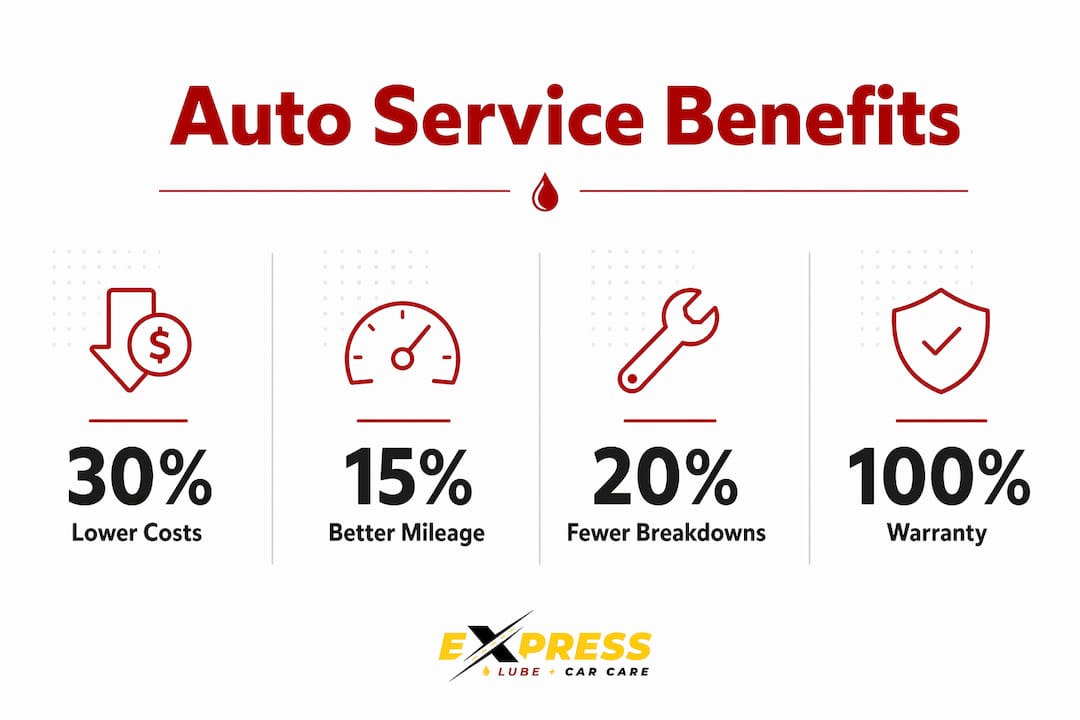
Dependable auto service delivers four measurable advantages: lower long-term repair costs, improved fuel economy, enhanced safety, and extended vehicle life. Each one connects directly to how consistently your car receives quality attention.
Early problem detection saves serious money. Consistent preventative maintenance preempts repair cascades by catching issues early in their development. A worn serpentine belt caught at a routine oil change costs roughly $100 to replace. Left undetected, it can snap and disable the alternator, power steering pump, and air conditioning compressor in one failure event, turning a $100 fix into a $1,500 repair bill.
Fuel economy improves with regular maintenance. A clean air filter, fresh engine oil, and properly inflated tires all reduce the load on your engine. The U.S. Department of Energy notes that fixing a faulty oxygen sensor alone can improve fuel economy by up to 40%. That kind of gain adds up over thousands of miles.

Safety depends on reliable brake, tire, and fluid checks. Brake fluid absorbs moisture over time, which lowers its boiling point and reduces stopping power. A dependable shop checks brake fluid condition, pad thickness, and rotor wear at every service visit. Skipping these checks is how minor brake fade becomes a dangerous stopping failure.
Here is a quick overview of the core advantages of auto service done right:
- Cost control: Early detection prevents expensive repair cascades
- Safety: Regular brake, tire, and fluid inspections reduce accident risk
- Fuel savings: Properly maintained engines run more efficiently
- Vehicle value: Complete service records support higher resale prices
- Peace of mind: Reputable shops provide warranties of at least 12 months or 12,000 miles on parts and labor, with many offering nationwide coverage
That last point matters more than most drivers realize. A warranty on parts and labor means the shop is confident enough in its work to back it financially. That confidence is a direct signal of dependability.
What qualities should you look for in a dependable auto service provider?
The right shop is not just the closest one or the cheapest one. Dependable auto service qualities to look for include certifications, transparent communication, fair pricing, and a shop environment that reflects professional standards.
Certifications establish a baseline. ASE (Automotive Service Excellence) certification confirms that a technician has passed standardized competency tests. However, ASE certification plus customer loyalty and honest pricing together define a truly reliable shop. Certification alone does not guarantee you will be treated fairly.
Transparent communication is non-negotiable. Trustworthy mechanics provide written estimates and avoid pressure tactics. If a shop calls you with a verbal estimate and then presents a higher bill at pickup, that is a red flag. A written estimate protects you and signals that the shop respects your time and budget.
The shop environment tells you a great deal. A clean, organized, and well-lit shop floor signals disciplined and detail-oriented vehicle care. Think of it like a commercial kitchen. A spotless prep area reflects the same discipline that goes into the food. A cluttered, disorganized bay suggests the same carelessness may extend to your vehicle.
Here are the key qualities to evaluate before you commit to a shop:
- ASE-certified technicians on staff
- Written estimates provided before any work begins
- Clear explanation of what was found and what was done
- Warranty on parts and labor (minimum 12 months or 12,000 miles)
- Positive reviews that mention honesty and follow-through
- No pressure to approve unplanned repairs on the spot
Pro Tip: Ask to see the shop floor before your first service. A shop that welcomes the request is one that has nothing to hide. A shop that hesitates should raise your suspicion.
You can also review a reliable auto shop qualities list that covers nine key traits to help you evaluate any provider before handing over your keys.
How does full-service maintenance at one trusted shop enhance dependability?
Bringing your vehicle to the same shop consistently creates something no single-visit repair can replicate: a documented service history and a technician who knows your car’s patterns.
Pattern recognition is the hidden advantage of consistent service. Experienced technicians look beyond warning lights to subtle mechanical cues like minor vibrations, delayed startups, and unusual fluid color. These signs can precede major repairs by weeks or months. A technician who has serviced your vehicle three times already knows what “normal” looks and sounds like for your specific car. That context makes early detection far more accurate.
Service records protect your vehicle’s resale value. A complete maintenance log shows prospective buyers that the vehicle was cared for properly. It also helps you avoid duplicate services, since a technician with your history on file will not recommend a transmission flush you had done six months ago.
The table below shows how full-service maintenance compares to isolated, as-needed repairs across key performance factors:
| Factor | Full-service maintenance | Isolated, as-needed repairs |
|---|---|---|
| Early problem detection | High: patterns identified over time | Low: no baseline for comparison |
| Repair cost over 3 years | Lower: cascades prevented | Higher: problems found late |
| Technician familiarity | High: knows your vehicle’s history | None: starts from scratch each visit |
| Service record completeness | Complete and documented | Fragmented across multiple shops |
| Resale value impact | Positive: documented care history | Neutral to negative: gaps in records |
Pro Tip: Keep a simple folder in your glove compartment with every service receipt. If you switch shops, hand that folder to the new technician before they inspect the vehicle. It cuts diagnostic time and prevents redundant services.
Drivers in the Plano area can use this local auto maintenance checklist to track service intervals and stay ahead of common wear items.
Independent shops vs dealerships vs quick lubes: which is most dependable?
Understanding the differences between service provider types helps you match the right shop to the right job. Each type has genuine strengths and real limitations.
Independent shops charge 20%–40% less for routine maintenance compared to dealerships while offering comparable quality and certified technicians. That cost gap is significant for drivers who follow a full maintenance schedule. Independent shops also tend to offer more personalized service and faster turnaround on common repairs.
Dealerships specialize in the brand they sell. Their technicians receive factory training and use OEM (original equipment manufacturer) parts. For complex warranty repairs or recalls on a newer vehicle, a dealership is often the right call. For routine oil changes, tire rotations, and brake inspections, the cost premium rarely reflects a quality advantage.
Quick lube facilities fill a specific need: fast, no-appointment service for high-frequency maintenance like oil changes and filter replacements. Professional independent shops often surpass dealerships in warranties, communication, and customer care. The best quick lube operations combine that speed with certified technicians and written service records, which is the combination that delivers real dependability without sacrificing your schedule.
Here is how the three provider types compare across the factors that matter most to everyday drivers:
| Factor | Independent shop | Dealership | Quick lube |
|---|---|---|---|
| Cost for routine service | Lowest | Highest | Low to moderate |
| Technician certification | ASE-certified | Factory-trained | Varies by location |
| Warranty coverage | Strong, often nationwide | Manufacturer warranty | Limited |
| Appointment required | Usually no | Usually yes | No |
| Best use case | Full maintenance, repairs | Warranty work, recalls | Oil changes, filters |
For a deeper look at how these options compare in your area, the guide on types of auto repair shops in the Plano area breaks down each provider type with local context.
Key Takeaways
Dependable auto service reduces long-term repair costs, improves safety, and extends vehicle life when delivered consistently by certified technicians who communicate transparently and back their work with written warranties.
| Point | Details |
|---|---|
| Early detection prevents cascades | Consistent service catches minor faults before they trigger expensive system failures. |
| Certifications plus honesty define dependability | ASE certification combined with transparent pricing and customer loyalty signals a truly reliable shop. |
| Full-service history adds value | A complete maintenance record improves resale value and enables faster, more accurate diagnostics. |
| Independent shops offer strong value | Independent providers charge 20%–40% less than dealerships for routine maintenance with comparable quality. |
| Written warranties signal confidence | Shops offering at least 12-month or 12,000-mile warranties demonstrate accountability for their work. |
What we have learned from years of servicing vehicles in Plano
The most common mistake we see at Express Lube & Car Care is drivers waiting for a warning light before they act. Warning lights are the last line of defense, not the first. By the time your check engine light activates, the underlying issue has often been developing for weeks. We have seen minor oil pressure irregularities turn into scored engine bearings simply because a driver skipped one service interval.
There is also a widespread belief that dealerships are automatically more trustworthy because of brand association. That is not accurate. What builds trust is consistent communication, written documentation, and technicians who explain what they found in plain language. Those qualities exist at independent shops and quality quick lube facilities just as readily as at any dealership.
The relationship you build with your service provider matters more than most drivers acknowledge. When a technician knows your vehicle, they notice when something is slightly off, even before it registers as a fault code. That familiarity is worth more than any coupon or promotional offer. We encourage every driver to find a shop they trust and stay with it. The long-term savings in avoided repairs and the confidence that comes from knowing your vehicle is genuinely cared for are worth far more than chasing the lowest price on every service visit.
— Express Lube & Car Care
Keep your vehicle dependable with Express Lube & Car Care
Express Lube & Car Care serves drivers in Plano with no-appointment-needed service, ASE-certified technicians, and a commitment to transparent, honest vehicle care. Whether you need a routine oil change or a full brake inspection, you get fast service without cutting corners on quality.
Right now, Express Lube & Car Care offers oil change and service specials designed to keep your vehicle running reliably without straining your budget. Military personnel and healthcare providers receive additional discounts as part of our commitment to the community. If your brakes need attention, our brake repair service in Plano covers pads, rotors, and ABS systems with the same certified care. Stop in when it works for you. No appointment needed.
FAQ
What does dependable auto service actually mean?
Dependable auto service means consistent, quality maintenance and repairs performed by certified technicians who provide written estimates, honor warranties, and communicate clearly about what your vehicle needs.
How often should I schedule routine vehicle maintenance?
Most manufacturers recommend an oil change every 5,000–7,500 miles for conventional oil and every 7,500–10,000 miles for full synthetic. Brake inspections, tire rotations, and fluid checks should occur at every oil change interval.
Is an independent shop as reliable as a dealership?
Independent shops charge 20%–40% less than dealerships for routine maintenance and frequently match or exceed dealership quality when staffed by ASE-certified technicians with strong customer reviews.
What is the best way to verify a shop’s trustworthiness?
Ask for a written estimate before any work begins, check for ASE certification on display, and read recent customer reviews that specifically mention honesty and follow-through. You can also review a driver’s guide to verifying estimates for a step-by-step approach.
Why do service records matter for my vehicle?
Complete service records document your vehicle’s care history, support higher resale value, and give technicians the baseline they need to detect early warning signs before they become costly repairs.