

A solid suburban commute car care routine takes less than ten minutes a week: do a 90-second visual check before every drive, run through five quick items each weekend, and follow your owner’s manual for scheduled services at the 30,000-, 60,000-, and 90,000-mile marks. That routine, backed by an ASE-certified technician for anything beyond the basics, keeps most commuter vehicles reliable for years. Americans now spend hundreds of hours each year commuting, which makes a breakdown more than an inconvenience — it’s a real disruption to your schedule and your budget.
Three things to check before you leave the driveway, every morning:
- Lights and mirrors: Confirm headlights, taillights, and turn signals are working; adjust mirrors if anyone else drove the car.
- Tire visual and fuel level: Walk around the car and look for any visibly flat or low tire; glance at the fuel gauge before you start the engine.
- Dashboard warning lights: If any warning light stays on after the engine starts, note it and address it before your next drive.
Your owner’s manual is the authoritative source for service intervals. This guide supplements it — it does not replace it. Bookmark this page or print the checklist table in the weekly/monthly section so you have it on hand.
Key Takeaways
A consistent suburban commute car care routine — daily visual checks, weekly pressure and fluid checks, and owner’s manual service intervals — prevents the majority of commuter breakdowns before they happen.
| Point | Details |
|---|---|
| Daily pre-drive check | Inspect lights, tires, fuel, and dashboard warning lights before every commute. |
| Weekly pressure and fluids | Check tire pressure cold and top off washer fluid every weekend. |
| Short-trip wear is real | Trips under 15 minutes accelerate oil contamination, battery wear, and brake pad wear. |
| 30-60-90 as a planning frame | Use milestone intervals for budgeting, but always follow your owner’s manual for exact schedules. |
| Express Lube & Car Care | ASE-certified, no-appointment service in Plano with a 24-month/24,000-mile warranty on qualifying work. |
Table of Contents
- What does a daily suburban commute car care routine look like?
- Weekly and monthly checks every commuter should do
- Why short suburban trips are harder on your car than highway miles
- How to use the 30-60-90 rule for your commuter service schedule
- Tire care and brake basics for stop-and-go suburban driving
- What to keep in your car for suburban commuter emergencies
- When should you take your car to a shop?
- What we’ve learned from working with suburban commuters
- Express Lube & Car Care keeps your commute on schedule
- Sources
- FAQ
What does a daily suburban commute car care routine look like?
Two minutes before you pull out of the driveway is enough time to catch the problems that cause most roadside breakdowns. The key is making the check automatic, not optional.
Walk around the vehicle and look at each tire. You’re not measuring pressure here — that’s a weekly task. You’re looking for any tire that is noticeably lower than the others or showing visible sidewall damage. While you’re at it, confirm all exterior lights are working: headlights, brake lights, reverse lights, and turn signals. A burned-out brake light is a rear-end collision waiting to happen, and you won’t know it’s gone unless you check.
Inside the car, give the windshield a quick scan for cracks that grew overnight (temperature swings do this), and confirm your mirrors are set correctly. Glance at the fuel gauge. Then start the engine and watch the instrument cluster for five seconds. Any warning light that stays on after the initial startup sequence needs attention.
- Exterior lights: Check all four corners, including brake lights (use a wall reflection or ask someone to stand behind the car).
- Tire visual: Look for any tire that sits lower than the others or shows bulging sidewall.
- Windshield and wipers: Note any new cracks; confirm wipers are seated on the glass.
- Fuel level: Never start a commute below a quarter tank.
- Dashboard lights: Oil pressure, battery, check engine, and tire pressure warning lights all require same-day attention.
- Doors and cargo: Confirm all doors are fully latched and nothing is loose in the trunk or cargo area.
Pro Tip: Attach a small laminated card with this checklist to your key fob or sun visor for the first two weeks. After 14 days, the sequence becomes automatic and you won’t need the card.
If you drive an EV or hybrid, add one item: check the remaining range or state of charge and confirm the charging cable was properly seated the night before.
Weekly and monthly checks every commuter should do
Consistency matters more than perfection here. A five-minute check on Sunday morning prevents the kind of slow-developing problems — a tire losing two PSI per week, a wiper blade starting to streak — that turn into expensive repairs or dangerous situations.
Weekly tasks (5 minutes)
- Tire pressure with a gauge: Cold pressure (before driving) should match the placard on your driver’s door jamb, not the number on the tire sidewall. Check all four tires and the spare.
- Windshield washer fluid: Top it off if it’s below the halfway mark. Running dry on a highway is a visibility hazard.
- Battery terminal visual: Look for white or blue-green corrosion buildup at the terminals. A small amount is normal; heavy buildup needs cleaning.
- Interior debris: Clear floor mats and vents of debris that can block airflow or interfere with pedal travel.
Monthly tasks (10–15 minutes)
- Oil level: Pull the dipstick, wipe it clean, reinsert, and read the level. If it’s below the minimum mark or the oil looks black and gritty rather than amber, schedule a change.
- Wiper blade condition: Run the blades and look for streaking, skipping, or squeaking. Blades typically last 6–12 months in most U.S. climates.
- Cabin air filter visual: Pull the filter (usually behind the glove box) and hold it up to light. If it’s gray and clogged, replace it. A blocked filter strains your HVAC system and degrades cabin air quality.
- Tire tread depth: Insert a penny into the tread groove with Lincoln’s head facing down. If you can see the top of his head, the tread is below 2/32" and the tire needs replacement.
- Brake pedal feel: Press the pedal firmly while stationary. It should feel firm and stop well before the floor. A soft, spongy, or sinking pedal is a shop visit, not a “watch it” situation.
| Task | Frequency | Time needed | Why it matters |
|---|---|---|---|
| Tire pressure check | Weekly | 3 min | Underinflation increases wear and reduces fuel economy |
| Washer fluid top-off | Weekly | 1 min | Prevents visibility hazard on the road |
| Oil level check | Monthly | 2 min | Catches leaks and consumption before damage occurs |
| Cabin air filter visual | Monthly | 2 min | Maintains HVAC efficiency and air quality |
| Tire tread depth check | Monthly | 2 min | Identifies when replacement is needed before a blowout |
| Brake pedal feel check | Monthly | 1 min | Early detection of brake fluid loss or pad wear |
For a more detailed local auto maintenance checklist, including manufacturer interval guidance, that reference breaks down service items by vehicle type and mileage band.
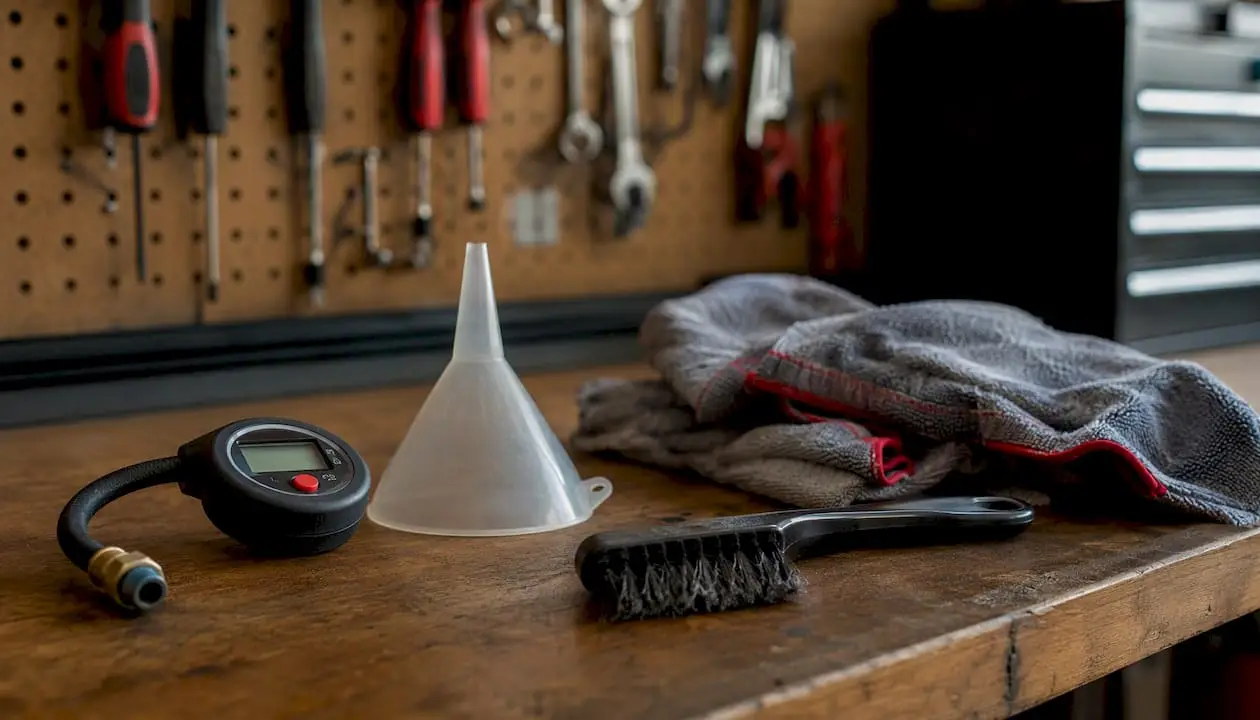
The minimal tool kit to keep at home: a quality tire pressure gauge, a small flashlight, a funnel for fluid top-offs, microfiber cleaning wipes, and a soft-bristle brush for battery terminals. Total cost is under $30 at any auto parts store.
Short-trip driving changes some of these frequencies. If your commute is mostly under 15 minutes each way, check oil condition monthly rather than quarterly, and test your battery every six months rather than annually.
Why short suburban trips are harder on your car than highway miles
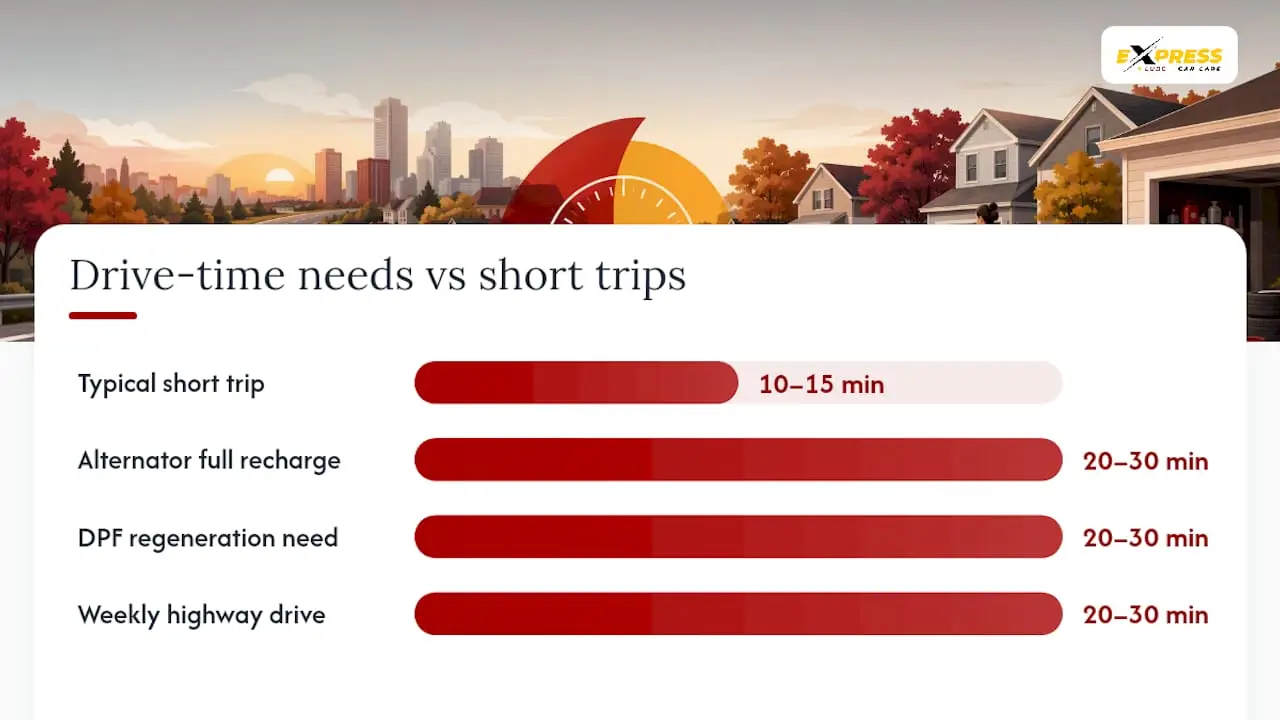
This is the part most commuters don’t expect. A 5-mile suburban commute with four stop signs and two traffic lights can be harder on your engine, battery, and brakes than a 30-mile highway run. Short trips under roughly 10–15 minutes often prevent the engine from reaching optimal operating temperature, which means moisture and fuel residue accumulate in the oil rather than burning off. Over time, that contamination degrades oil faster, promotes carbon buildup on intake valves and spark plugs, and shortens the effective life of your oil filter.
The battery takes a hit too. Every cold start draws a significant charge from the battery, and the alternator needs roughly 20–30 minutes of driving to fully replenish it. A commute that’s mostly stop-and-go traffic means the battery never fully recovers between starts, accelerating wear on the cells. Brakes face a similar pattern: frequent short-trip stop-and-go cycles increase brake pad wear compared to steady highway driving, where you brake far less often.
Diesel drivers have an additional concern: diesel particulate filter (DPF) regeneration requires sustained highway-speed driving to complete. Short suburban trips can interrupt the cycle repeatedly, eventually triggering a warning light and a costly forced regeneration at a shop.
Practical mitigation steps:
- Group errands: Combine multiple short trips into one longer outing rather than making three separate 5-minute drives.
- One weekly highway drive: Even 20–30 minutes at steady highway speed helps burn off oil moisture, allows the DPF to regenerate, and gives the battery a full recharge cycle.
- Shorten oil-change intervals: If your commute is mostly short trips, consider moving your oil change up by 1,000–2,000 miles from the standard interval. Check your owner’s manual for the “severe service” schedule, which typically applies to frequent short-trip driving.
- Test the battery more often in cold months: Cold temperatures compound the short-trip battery problem. Test your battery before November and again in February if you live in a climate with hard winters.
Document your driving patterns in a simple notes app or a service log. When you bring the car in, telling a technician “mostly 8-mile round trips, five days a week” gives them the context to recommend the right interval adjustments.
How to use the 30-60-90 rule for your commuter service schedule
The 30-60-90 rule gives you three milestone checkpoints — 30,000, 60,000, and 90,000 miles — where specific services are typically due. Think of it as a planning calendar, not a rigid prescription. Modern vehicles often extend some intervals well beyond these marks, while severe-duty driving (which includes frequent short-trip suburban commuting) can push others forward.
Your owner’s manual is the final word. The 30-60-90 frame is useful for budgeting and planning; the manual tells you the actual intervals for your specific engine, transmission, and climate.
What typically falls at each milestone:
- 30,000 miles: Cabin air filter, engine air filter, brake inspection, tire rotation, fuel filter (on older vehicles), spark plug inspection.
- 60,000 miles: Spark plug replacement (on most vehicles), brake fluid flush, coolant flush, transmission fluid check, timing belt inspection (if applicable).
- 90,000 miles: Timing belt or chain service, power steering fluid flush, differential fluid (on AWD/4WD vehicles), comprehensive brake system inspection.
For short-trip suburban commuters, treat yourself as a “severe service” driver for oil changes and battery checks.
Ballpark cost ranges for common services (prices vary by region and vehicle make):
- Oil change (conventional): $40–$75; synthetic: $70–$120
- Cabin air filter replacement: $20–$50 (parts and labor)
- Brake pad replacement (per axle): $150–$350
- Battery test: often free at a shop; replacement: $120–$250
- Coolant flush: $80–$150
- Tire rotation: $20–$50
A mileage-tracking app (your phone’s built-in odometer log, or a dedicated app like Fuelly) makes it easy to know exactly when you’re approaching each milestone. For a deeper breakdown, a car maintenance schedule by mileage reference maps specific services to specific intervals across a wide range of vehicles.
EVs and hybrids skip several of these items (no oil changes, no spark plugs), but still need tire rotations, brake fluid checks, cabin filter swaps, and battery-system cooling inspections on the manufacturer’s schedule.
Tire care and brake basics for stop-and-go suburban driving
Tires and brakes take the most direct punishment from suburban stop-and-go patterns. Staying ahead of both is the single highest-value habit in any commuter car care routine.
Tire care checklist
- Cold pressure: Check tire pressure before driving, not after. Heat from driving inflates the reading by 4–6 PSI and masks underinflation. The correct pressure is on the driver’s door jamb sticker, not the tire sidewall.
- Seasonal adjustment: Tire pressure drops roughly 1 PSI for every 10°F drop in temperature. Check pressure at the start of every cold season and again when temperatures rise in spring.
- Tread depth: Use the penny test monthly. For a more precise reading, a tread depth gauge costs about $5 and gives you a reading in 32nds of an inch. Replace tires at 2/32"; consider replacing at 4/32" if you drive in rain regularly.
- Sidewall inspection: Look for bulges, cuts, or cracking. A bulge means the internal structure is compromised — that tire needs replacement, not air.
- Rotation frequency: Rotate tires every 5,000–7,500 miles, or at every other oil change. Suburban stop-and-go driving wears front tires faster than rear tires on front-wheel-drive vehicles. A dependable tire rotation schedule extends tread life significantly.
- Alignment check: If the car pulls to one side or the steering wheel is off-center on a straight road, schedule an alignment. Misalignment accelerates uneven tread wear.
Brake warning signs
Brakes communicate clearly when something is wrong. The challenge is knowing which signals are urgent and which can wait a week.
| Warning sign | What it likely means | Urgency |
|---|---|---|
| High-pitched squeal when braking | Wear indicator contacting rotor | Schedule within 1–2 weeks |
| Grinding or metal-on-metal noise | Pads worn through; rotor damage | Immediate shop visit |
| Pulsing or vibration in pedal | Warped rotors | Schedule within 1 week |
| Soft or spongy pedal | Air in brake lines or fluid leak | Immediate shop visit |
| Car pulls to one side when braking | Uneven pad wear or stuck caliper | Schedule within 1 week |
| Brake warning light on | Low fluid or sensor fault | Same-day inspection |
When you call a shop, tell them your mileage since the last brake service, whether the symptom happens at low or high speeds, and that your driving is mostly short suburban trips. That context helps an ASE-certified technician prioritize the right inspection. For brake repairs in Plano, TX, Express Lube & Car Care’s brake service page explains what a full brake inspection covers.
What to keep in your car for suburban commuter emergencies
A suburban commuter’s emergency kit doesn’t need to be large. The goal is handling the three most common roadside situations — a flat tire, a dead battery, and a minor collision — without waiting an hour for roadside assistance.
Core kit (fits in a small trunk organizer):
- Spare tire or tire repair/inflator kit, plus a tire pressure gauge
- Jumper cables or a compact lithium jump starter (jump starters work without a second vehicle)
- Flashlight with fresh batteries or a rechargeable model
- High-visibility safety vest
- Multipurpose tool or basic screwdriver set
- Phone charging cable and a car charger
- Basic first-aid kit (bandages, antiseptic wipes, pain reliever)
- Bottled water (two bottles minimum)
- Pen and notepad for accident documentation
Pro Tip: Check kit contents monthly when you do your monthly car inspection. Batteries drain, water expires, and first-aid supplies get used without being replaced. A two-minute kit audit prevents the moment when you need something and it isn’t there.
Add climate-specific items based on your region: an ice scraper and a small snow brush in northern states, an extra bottle of coolant and a sunshade in hot southern climates like Texas.
When should you take your car to a shop?
Some symptoms are “watch it” situations. Others mean you should not drive the car until a technician has looked at it. Knowing the difference protects both your safety and your wallet.
Go to a shop the same day for:
- Any warning light that stays on after startup, especially check engine, oil pressure, or battery
- Grinding or metal-on-metal brake noise
- Smoke from under the hood or from the exhaust
- Visible fluid leak under the car (not condensation from the A/C drain)
- Soft or sinking brake pedal
- Sudden loss of power steering
Schedule within one week for:
- Brake squeal that occurs consistently
- Vibration in the steering wheel at highway speeds
- A battery that needed a jump start more than once in 30 days
- Oil that looks black and gritty at the monthly check
- Any warning light that appeared and then cleared on its own
Questions to ask at the shop:
- Are your technicians ASE-certified?
- Which items on this estimate are required for safety, and which are recommended but not urgent?
- Can you provide a digital inspection with photos?
- What is the warranty on parts and labor?
- What is the diagnostic fee, and will it be applied to the repair cost if I proceed?
Pro Tip: Always request an itemized written estimate before work begins. A reputable shop will provide one without hesitation. Ask for a recommended timeline on any non-urgent items so you can budget and schedule them separately.
A diagnostic fee is standard for complex electrical or engine issues, typically $80–$150. Most shops apply it toward the repair cost if you approve the work. For routine maintenance like oil changes or brake inspections, a diagnostic fee usually doesn’t apply. For a full breakdown of preventive vehicle maintenance services, that reference explains what each service covers and when to prioritize it.
What we’ve learned from working with suburban commuters
The commuters who keep their vehicles running longest aren’t the ones who spend the most on maintenance. They’re the ones who check the same five things every week without fail and bring the car in before a small symptom becomes a large repair. The math on that is straightforward: a $70 oil change done on schedule costs far less than a $3,000 engine repair caused by contaminated oil that ran too long.
Short-trip suburban driving is genuinely harder on a vehicle than most drivers realize. The research on short-trip engine wear confirms what experienced technicians see every day: moisture in the oil, accelerated battery wear, and brake pads that wear faster than the mileage would suggest. The fix isn’t complicated. It’s a slightly shorter oil-change interval, a weekly highway drive when you can manage it, and a battery test every fall.
The owner’s manual remains the most underused resource in most glove boxes. Every interval in this guide is a general framework. Your manual has the specific intervals for your engine, your transmission fluid, and your climate. Use both together.
Express Lube & Car Care keeps your commute on schedule
Busy commuters in Plano and Collin County get same-day service at Express Lube & Car Care without scheduling an appointment days in advance. Every service is performed by ASE-certified technicians, and qualifying work is backed by a 24-month/24,000-mile warranty — a level of coverage most quick-lube alternatives don’t match.
For commuters, the most relevant services are oil changes, brake inspections and repairs, battery testing and replacement, tire pressure checks and rotations, and digital vehicle inspections with photos and technician notes. The digital inspection gives you a clear picture of what needs attention now versus what can wait, so you’re never pressured into repairs you don’t need yet.
Check the current oil change and service specials for bundled pricing, and if your brakes are due, there’s a $30 off brake service coupon available for Plano-area drivers. Fleet and recurring customers can ask about priority scheduling options. Stop in or book online at Expresslubeplano.
Sources
The following sources informed this guide. Each is worth reading if you want to go deeper on a specific topic.
- Do short trips wear out an engine faster than long drives? | Jalopnik
- What is the 30-60-90 rule for car maintenance? | SlashGear
- New data shows the average commute has gotten longer — and why it matters | Inc.
- Commute vs personal car insurance | LogRock
FAQ
What is the 30-60-90 rule for car maintenance?
The 30-60-90 rule is a milestone framework that groups common service items at 30,000, 60,000, and 90,000 miles. It’s a useful planning tool, but your owner’s manual sets the actual intervals for your specific vehicle.
Is it cheaper to list your car as pleasure instead of commute for insurance?
Classifying a vehicle as pleasure rather than commute can reduce premiums by roughly 5–15%, but misrepresenting actual usage risks a denied claim. Update your policy accurately whenever your driving habits change.
What is the $3,000 rule for cars?
The $3,000 rule is an informal guideline suggesting you reconsider keeping a vehicle when a single repair estimate exceeds $3,000 on a car worth less than that amount. It’s a rough decision framework, not an industry standard, and your owner’s manual and a trusted ASE-certified technician are better guides for repair-versus-replace decisions.
Does a 40-minute commute count as commute use for insurance purposes?
Yes. Insurers classify vehicle use based on regularity, one-way distance, and annual mileage, not just commute length. A consistent 40-minute daily commute almost always qualifies as commute use, and hybrid schedules of even one to two days per week are often still classified that way by many carriers.