

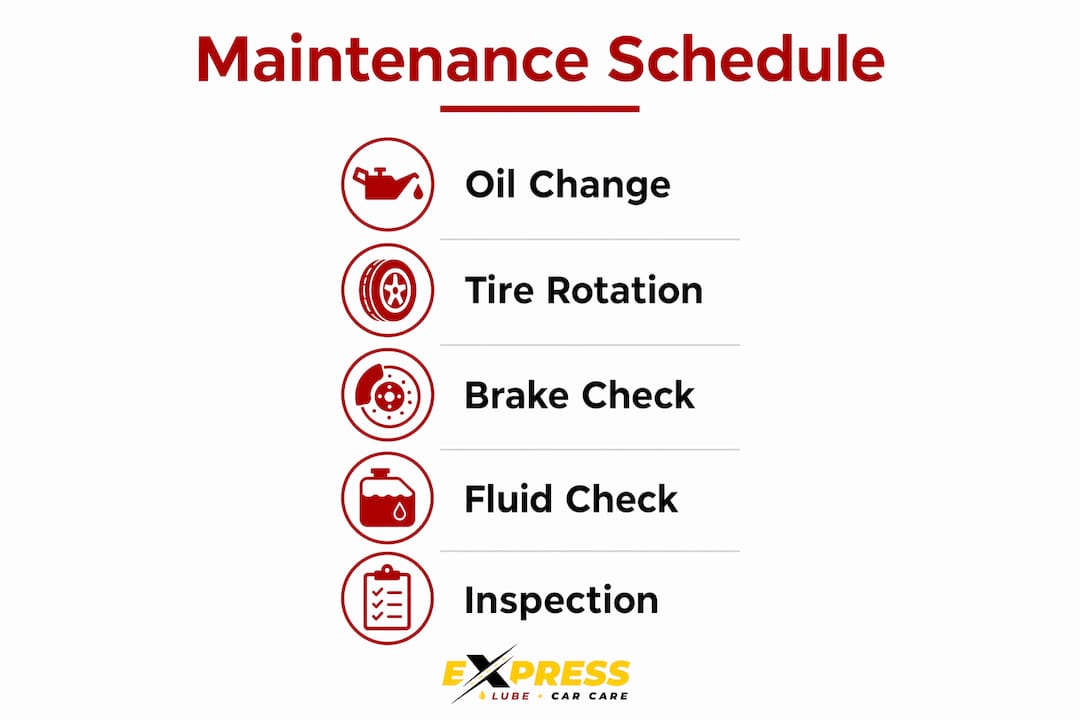
A dependable car care rotating schedule is a structured maintenance plan that cycles through critical vehicle services at set mileage or time intervals to prevent breakdowns and extend vehicle life. The industry standard term for this practice is a preventive maintenance schedule, and it covers everything from oil changes to brake inspections. The average vehicle age in the US is 12.6 years, which means consistent, milestone-based care is no longer optional for most drivers. Express Lube & Car Care sees this reality every day: vehicles that follow a rotating service routine arrive with fewer surprises and leave with longer service lives.
What key maintenance tasks belong in a dependable rotating car care schedule?
Basic maintenance covers 90% of vehicle longevity, with oil, tires, brakes, and fluids requiring the most consistent attention. That single fact should anchor every car maintenance schedule you build. Neglecting even one of those four categories creates a chain reaction: dirty oil accelerates engine wear, low brake fluid reduces stopping power, and uneven tires compromise handling.

The table below maps the most critical tasks to their recommended service intervals.
| Maintenance Task | Recommended Interval |
|---|---|
| Oil and filter change | Every 3,000–7,500 miles (check owner’s manual) |
| Tire rotation | Every 5,000–7,500 miles |
| Brake inspection | Every 12,000 miles or annually |
| Brake fluid flush | Every 2–3 years or 30,000 miles |
| Battery health check | Every 6 months |
| Coolant level check | Every 6 months |
| Cabin and engine air filters | Every 15,000–30,000 miles |
| Tire pressure check | Monthly |
Each interval above reflects a different wear rate. Oil degrades from heat and combustion byproducts, so it needs the most frequent attention. Brake fluid absorbs moisture over time, which lowers its boiling point and reduces pedal firmness. Air filters clog gradually and quietly, cutting fuel efficiency before any warning light appears.
Combining tasks at shared mileage milestones is the practical backbone of any rotational vehicle care plan. When your oil change and tire rotation fall at the same interval, you handle both in a single visit instead of two. That approach saves time and keeps your service record clean and easy to track.
How often should you rotate your tires and why is it vital?
Tire rotation is the single most cost-effective task in any automobile servicing routine. Rotating tires every 5,000 to 7,500 miles aligns with standard oil change schedules, making it easy to bundle both services. AWD and 4WD vehicles require more frequent rotations, often every 3,000 to 5,000 miles, because all four tires share drivetrain load and wear at different rates depending on terrain and torque distribution.
The consequences of skipping rotation go beyond uneven tread. Mismatched tread depths on AWD or 4WD vehicles can force the differential to compensate, and when the depth difference exceeds 2/32 of an inch, drivetrain repair costs can reach $2,000 to $8,000. That is an expensive outcome for a service that takes about 20 minutes at a dedicated shop.
Rotation patterns vary by drivetrain type:
- Front-wheel drive (FWD): Front tires carry steering and acceleration loads, so they wear faster. A forward cross or X pattern moves them to the rear.
- Rear-wheel drive (RWD): Rear tires take the propulsion load. A rearward cross pattern compensates.
- AWD and 4WD: All four tires wear differently. An X pattern or full rotation is standard, and intervals are shorter.
- Directional tires: These can only move front to back on the same side, not cross-axle, due to their tread design.
Regular rotation extends tire lifespan by 20% to 30% through balanced tread wear. That translates directly into fewer tire replacements per year and better fuel economy from properly inflated, evenly worn rubber.
Pro Tip: Keep your rotation receipts. Tire rotation documentation is often required to maintain tire mileage warranties. Missing records can void a claim when you need it most.
How to build a car maintenance schedule tailored to your vehicle
Your owner’s manual is the primary source for your vehicle’s maintenance intervals. Manufacturer recommendations account for your specific engine, drivetrain, and component tolerances in ways that generic schedules cannot. For drivers who have misplaced their manual, a VIN-based maintenance lookup identifies exact OEM service intervals and helps avoid unnecessary dealer upsells.
Once you have your baseline intervals, follow these steps to build a working schedule:
- Record your current mileage. Write down today’s odometer reading and note the last date of each major service. This is your starting point.
- Map tasks to mileage milestones. List every service from your owner’s manual alongside its interval. Group tasks that share the same mileage window.
- Align tire rotation with oil changes. Combining these two services at the same mileage interval cuts the number of shop visits in half.
- Set digital reminders. Use your phone’s calendar or a dedicated vehicle tracking app to alert you 500 miles before each milestone.
- Adjust for driving conditions. Severe conditions, including frequent towing, dusty roads, extreme heat, or stop-and-go city traffic, shorten most intervals by 25% to 50%.
The table below shows useful tools for tracking your automobile servicing routine.
| Tool Type | Best Use | Cost |
|---|---|---|
| Owner’s manual | OEM-specific intervals | Free (included with vehicle) |
| VIN lookup tool | Exact model-year schedule | Free online |
| Vehicle maintenance app | Mileage tracking and reminders | Free to low cost |
| Service history binder | Paper backup of all receipts | Free |
Severe driving conditions deserve special attention. If you commute more than 15 miles each way in heavy traffic, your engine oil breaks down faster than the standard interval assumes. The same applies to drivers in Texas heat, where coolant and battery health degrade more quickly than in moderate climates. A car maintenance schedule by mileage gives you a concrete framework for adjusting those intervals based on real-world use.
Pro Tip: Consult your owner’s manual before accepting any service recommendation at the counter. OEM-specific schedules protect you from overpaying for services your vehicle does not yet need.
Common mistakes that undermine your rotational vehicle care plan
The most common mistake drivers make is treating maintenance as optional until a warning light appears. Routine inspection and timely fluid replacement prevent wear from cascading into complex failures. By the time a dashboard alert triggers, the underlying issue has often been developing for thousands of miles.
A second frequent error is confusing tire rotation with wheel balancing. Rotation and balancing are distinct services. Rotation moves tires between positions to equalize tread wear. Balancing corrects weight distribution within a wheel-and-tire assembly to eliminate vibrations. Both are necessary, but they address different problems. Scheduling one does not substitute for the other.
Other mistakes worth avoiding:
- Accepting dealer service packages without review. Many bundled packages include procedures your owner’s manual does not call for at that mileage. Cross-reference every recommendation against your OEM schedule.
- Skipping service records. Undocumented maintenance weakens your warranty claims and reduces resale value. Keep every receipt, whether paper or digital.
- Ignoring unusual symptoms between scheduled visits. Vibrations at highway speed, pulling to one side, or a spongy brake pedal all signal that something needs attention before the next scheduled interval.
“Following manufacturer-recommended maintenance schedules protects resale value, fuel efficiency, and vehicle reliability.” — Car Maintenance Schedule Explained
If you notice any of those symptoms, do not wait for your next scheduled service. A complete guide to what maintenance your car needs can help you identify whether a symptom calls for an immediate inspection or can wait until your next mileage milestone.
Key Takeaways
A dependable car care rotating schedule built on manufacturer intervals, combined services, and documented records is the most cost-effective way to extend vehicle life and protect resale value.
| Point | Details |
|---|---|
| Bundle oil and tire services | Aligning both at the same mileage interval cuts shop visits and improves schedule adherence. |
| AWD/4WD needs shorter rotation intervals | Rotate every 3,000–5,000 miles to prevent differential damage costing up to $8,000. |
| Owner’s manual overrides dealer advice | OEM schedules prevent overspending on services your vehicle does not yet require. |
| Document every service | Receipts protect tire warranties and support resale value claims. |
| Adjust for severe conditions | Heat, towing, and stop-and-go traffic shorten most maintenance intervals significantly. |
Why consistent maintenance pays off more than most drivers realize
At Express Lube & Car Care, we have seen the full spectrum of vehicle condition, from cars maintained on a tight rotating schedule to vehicles that arrive with 15,000 miles on the same oil. The difference in engine condition is not subtle. Sludge buildup from degraded oil restricts oil passages, and by the time a driver notices a problem, the repair bill often exceeds what years of routine oil changes would have cost.
The argument against consistent maintenance is usually time or money. Both objections collapse under scrutiny. A tire rotation takes about 20 minutes. An oil change at a no-appointment shop takes roughly the same. The combined cost of both services is a fraction of what a single brake caliper replacement or differential repair runs. Preventive care is not an expense. It is a hedge against a much larger one.
What we find most underappreciated is the resale angle. Manufacturer-recommended schedules protect resale value in ways that drivers rarely calculate until they are standing at a dealership trade-in counter. A documented service history signals to any buyer or appraiser that the vehicle was treated with care. That signal has real dollar value.
The one piece of advice we give every driver: build your schedule around your owner’s manual, not around what sounds right or what a service counter recommends. Your manual was written for your specific engine, your specific drivetrain, and your specific tolerances. Everything else is a starting point for conversation, not a rule.
— Express Lube & Car Care
Keep your maintenance schedule on track with Express Lube & Car Care
Staying consistent with a rotating maintenance plan is easier when you have a shop that works around your schedule, not the other way around. Express Lube & Car Care in Plano serves drivers with no-appointment-needed service, certified technicians, and oil change and service specials designed to make routine care affordable and fast.
Whether you are due for an oil change, a tire rotation, or a brake inspection, Express Lube & Car Care handles all three under one roof. Military personnel and healthcare providers receive special discounts as part of the shop’s commitment to the community. Check the current service specials page to see what is available before your next visit, and bring your service records so the team can help you stay on your exact OEM schedule.
FAQ
What is a dependable car care rotating schedule?
A dependable car care rotating schedule is a structured plan that cycles through oil changes, tire rotations, brake inspections, and fluid checks at set mileage or time intervals. The goal is to address wear before it causes failures, extending vehicle life and protecting resale value.
How often should I rotate my tires?
Most vehicles need a tire rotation every 5,000 to 7,500 miles. AWD and 4WD vehicles require rotation more often, typically every 3,000 to 5,000 miles, to prevent differential damage from uneven tread wear.
Is tire rotation the same as wheel balancing?
No. Rotation and balancing are distinct services: rotation moves tires between positions to equalize tread wear, while balancing corrects weight distribution within the wheel assembly to eliminate vibrations. Both are necessary but address different issues.
How do I find the right maintenance schedule for my specific vehicle?
Start with your owner’s manual, which lists OEM-recommended intervals for your exact make, model, and engine. A VIN-based lookup tool also identifies your precise schedule if the manual is unavailable.
What happens if I skip routine maintenance?
Skipping routine services allows wear to compound. Degraded oil accelerates engine wear, low brake fluid reduces stopping power, and uneven tires increase blowout risk. Regular maintenance reduces breakdown risk by catching these issues before they cascade into costly repairs.