

When the AC compressor clutch won’t engage, the compressor never starts pumping refrigerant, and the air from your vents stays warm. The cause is usually one of four things: low refrigerant pressure that trips a protective switch, a blown fuse or bad relay, a wiring or control fault, or a worn clutch. The first three are cheap to find with the right tests. A technician can tell them apart in one visit. At Express Lube & Car Care in Plano, we diagnose this without an appointment.
TL;DR
- The clutch is an electromagnetic coupling. If the outer pulley spins but the center plate stays still, the compressor is not running.
- Low refrigerant is the most common reason, because a low-pressure switch blocks the clutch to protect the compressor.
- A blown fuse or failed relay is the next most common cause. Replace a fuse only with the same amp rating, and treat a fuse that blows again as a short that needs tracing.
- Topping off refrigerant does not fix a leak. Refrigerant work for pay must be done by a certified technician with recovery equipment.
- Our ASE-certified technicians can diagnose it same day, with no appointment needed.
Table of Contents
- What the compressor clutch does
- Why the clutch will not engage
- What you can safely check yourself
- Symptoms and what they point to
- How a shop finds the real cause
- Why a shop beats guessing
- What we do at Express Lube & Car Care
- Our perspective
- FAQ
- Sources
What the compressor clutch does
Your AC compressor is driven by the engine’s serpentine belt. The pulley on the front of the compressor spins whenever the engine runs, but the compressor itself should only work when you ask for cold air. The clutch is what connects the two.
A clutch has three main parts: the pulley, a coil of wire behind it, and a center plate (the hub) that sits just in front of the pulley face. When you press the AC button, the car’s controls send power to the coil. The coil becomes a magnet and pulls the hub flat against the spinning pulley. The hub turns, the compressor shaft turns, and refrigerant starts moving.
“Not engaging” means that last step never happens. With the engine running and the AC on, the pulley keeps spinning but the hub sits still, and the air stays warm. Some drivers also hear no click when they switch the AC on, which is normally audible near the front of the engine.
Two details matter for diagnosis. First, a healthy system is allowed to cycle the clutch on and off during normal use. Second, a clutch that engages but still gives warm air is a different problem, with a different repair path. A Mitchell On-Demand service reference notes that the engine computer deliberately disables the clutch in some conditions, such as wide-open throttle, very high engine speed, heavy power-steering load or an overheating engine. So a clutch that drops out for a moment under hard acceleration is not necessarily broken.
Why the clutch will not engage
The clutch needs three things at once: a request for AC, a safe refrigerant pressure, and working power to the coil. Take away any one and it stays disengaged. That is why the same symptom has many causes. Here they are in the order a technician usually considers them.
Low refrigerant pressure
AC systems carry a low-pressure switch or sensor. If refrigerant has leaked out and pressure falls too low, the switch stops the clutch from engaging. The compressor depends on refrigerant to carry its lubricating oil, so running it empty can damage it.
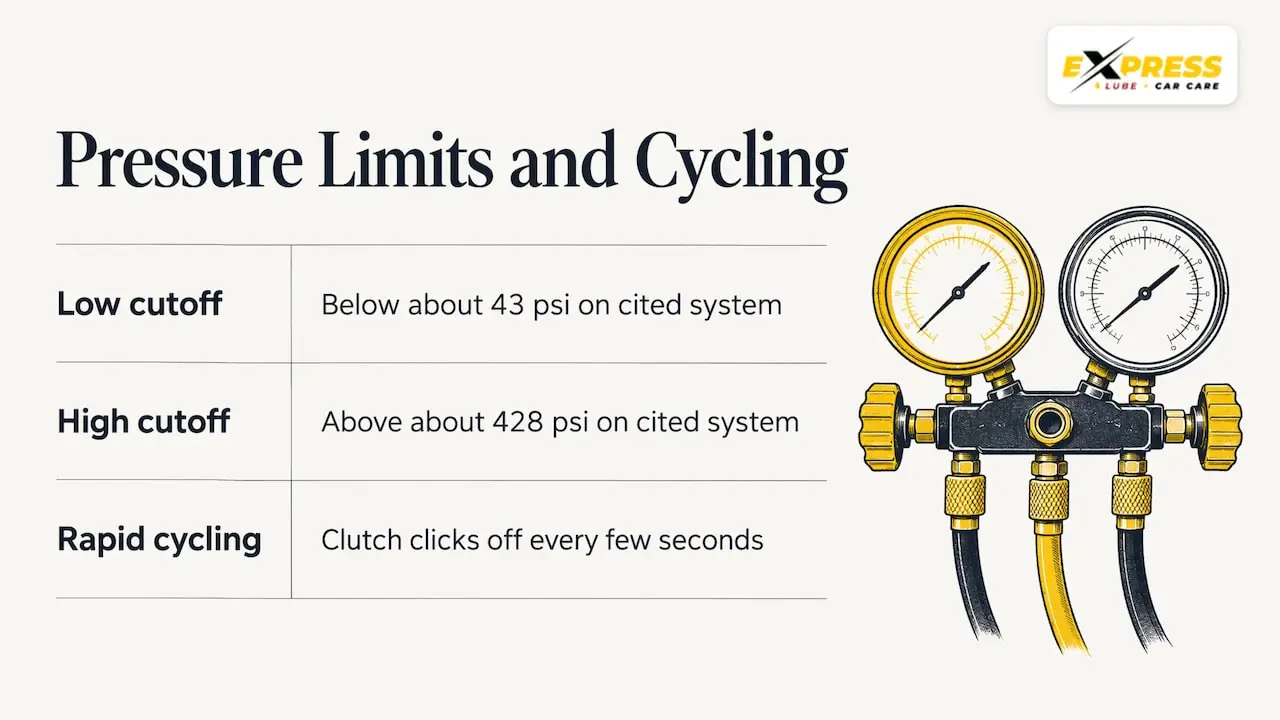
The same Mitchell reference describes the engine computer disabling the clutch when refrigerant pressure falls below about 43 psi or rises above about 428 psi on the system it covers. Exact limits differ by vehicle, but the principle is the same on most cars: too little or too much pressure and the clutch stays out.
A partly low system often shows a different pattern: the clutch clicks on, the system pressure drops quickly, and the clutch clicks off again every few seconds. Rapid cycling is a classic sign of low refrigerant rather than a bad clutch.
This is why the clutch is often the symptom, not the fault. If the clutch is blocked because refrigerant leaked out, replacing the clutch does nothing. Our guide to AC refrigerant leak symptoms explains how leaks show up, and our page on the AC dye test covers one common way a shop finds the source.
A blown fuse
The AC clutch circuit is protected by a fuse, often in the under-hood fuse box, and sometimes by a second fuse under the dash. A blown fuse means no power reaches the relay or the coil.
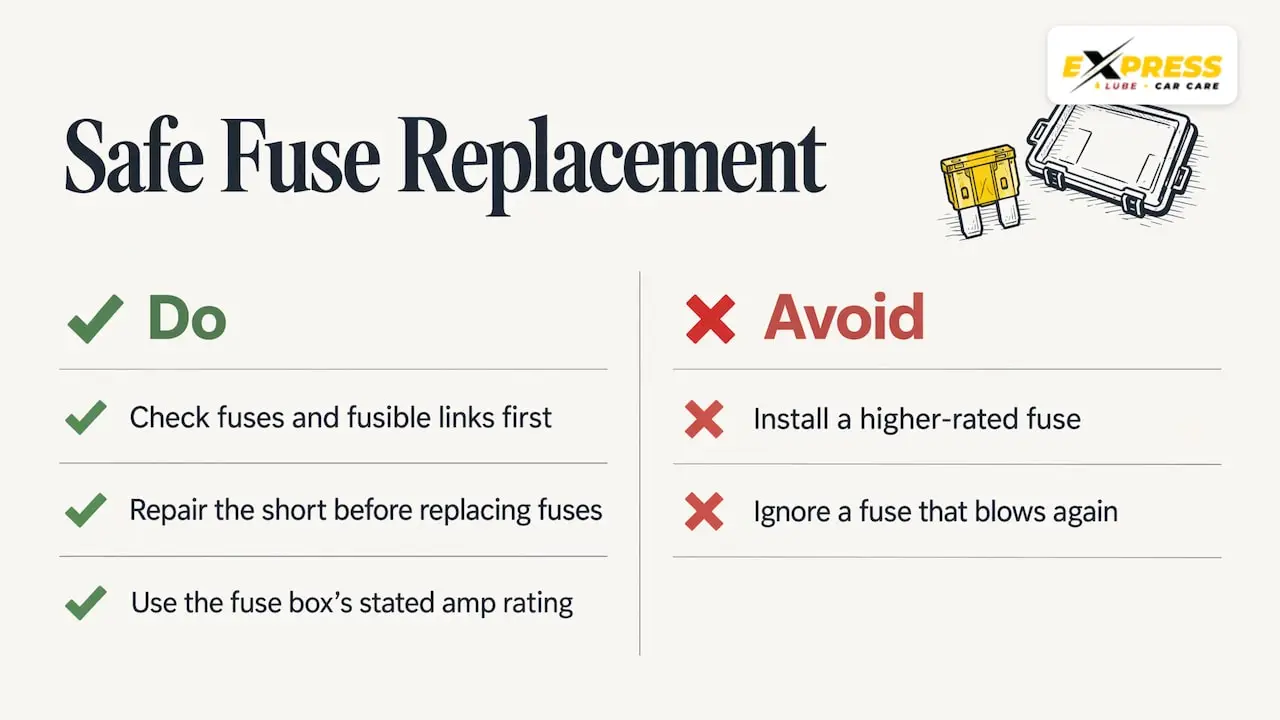
The point most people miss: a fuse blows for a reason. The Mitchell reference says to always check for blown fuses or fusible links first and to repair the short before replacing fuses. A trade publication from the mobile air conditioning industry, MACS Service Reports, describes a case on a 1994 Dodge Ram in which a 20-amp shared horn and AC fuse was blown. A new fuse restored the clutch, but the report is clear that a fuse that blows again points to a current-draw problem needing further diagnosis.
If you replace a fuse, use the same amp rating printed on the fuse box cover. A higher-rated fuse removes the protection the circuit relies on and can create a fire risk.
A failed relay
A relay is a small electric switch that lets a low-current signal turn on the higher current the clutch coil needs. Relays wear out. Depending on the vehicle, the relay is switched by the engine computer or directly by the pressure switches. That is one reason a technician starts at the fuse and relay, then follows the circuit.
Wiring, connectors and grounds
The clutch coil has a single wire connector near the compressor, and it sits in a hot, vibrating, dirty part of the engine bay. Corrosion, chafed insulation, a loose connector or a poor ground can all interrupt the circuit. Rodents chewing wire harnesses can also cause open circuits. Wiring faults are often intermittent: the AC works, then doesn’t, with no clear pattern.
A failed coil or worn clutch
The coil can burn out, which leaves an open circuit. The clutch can also fail mechanically. If the gap between the hub and pulley grows too wide from wear, the magnet can no longer pull the hub in. This is especially common when the system has been hot, because heat reduces the coil’s strength.
A Vehicle Service Pros article, on diagnosing a 2003 Honda Civic, describes a case where measuring the current in the clutch circuit pointed to an excessive air gap rather than an electrical fault. That kind of measurement is why a shop’s diagnosis is quicker than swapping parts.
Controls and sensors
The request for AC starts at the climate control panel and passes through the car’s computers. On older European models, for example, a BMW E31 climate control unit is where that request begins. If the panel, a sensor, or the body or engine computer does not send the signal, the clutch has nothing to act on. International’s published A/C electrical diagnostics list several of these inputs as possible reasons a clutch does not engage on that manufacturer’s trucks, including a missing request from the control head and active trouble codes. Scan-tool testing is how a shop confirms the computer is receiving what it needs.
High pressure on a hot day
If the clutch drops out in stop-and-go traffic on a hot afternoon and returns when you get moving, a high-pressure cutout may be working as designed. Causes include a weak condenser fan, a blocked condenser, or an overcharged system. This is common enough in Texas summers that it is worth mentioning to the technician when you describe the symptom.
What you can safely check yourself
You do not need tools to gather useful information. These checks are safe and take about ten minutes.
- Look and listen. Park, set the parking brake, and start the engine. Turn the AC to max cold with the fan on. Listen near the front of the engine for a click when you switch the AC on. Watch the compressor from a safe distance: does the center plate pull in and spin with the pulley, or does only the pulley turn? Keep hands, hair and clothing away from the belt and pulleys.
- Check the fuse. Use your owner’s manual or the fuse box cover diagram to find the AC or A/C clutch fuse. Pull it and look at the metal strip inside. If it is broken, replace it with a fuse of the same rating. If the new one blows right away, stop. Something is shorted.
- Note when it happens. Does it fail always, only when hot, only in traffic, or only after a long drive? This pattern is one of the most useful things you can tell a technician.
- Note the other symptoms. Is the air warm, or just not cold enough? Does the clutch click on and off every few seconds? Any hissing, grinding, burning smell or squealing belt?
- Check the cabin air filter and vents. A clogged filter weakens airflow but does not stop the clutch. Still, it rules one thing out. Our 5 minute triage for a car AC that isn’t cold walks through these basic checks.
Stop there. Testing coil voltage, jumping the clutch with a wire, or measuring coil resistance require a wiring diagram for your exact vehicle. The MACS publication points out that clutch circuit designs vary widely, even on older vehicles, so a procedure that is right for one car can damage another. Pushing a hub in by hand or hot-wiring the coil can also hide the real problem.
What not to do
- Don’t buy a recharge can and add refrigerant. If the clutch is blocked because of low pressure, adding refrigerant may start the compressor briefly, but the leak remains. The US EPA states that topping off or recharging does not permanently fix leaks, while repairing or replacing leaking parts gives longer-lasting results.
- Don’t vent refrigerant. The EPA says releasing refrigerant is prohibited, and anyone servicing a vehicle air conditioner for pay must be Section 609 certified and use approved recovery equipment.
- Don’t install a bigger fuse. See above.
Symptoms and what they point to
| What you notice | Most likely area | Next step |
|---|---|---|
| Pulley spins, hub still, warm air, no click | Low pressure, fuse, relay, wiring or coil | Shop diagnosis with gauges and electrical tests |
| Clutch clicks on and off every few seconds | Low refrigerant | Leak check before any recharge |
| Clutch works, then drops out in traffic on hot days | High-pressure cutout, condenser fan or airflow | Ask for a pressure and fan check |
| Fuse blows again after replacement | Short in the circuit | Do not keep replacing fuses; have the circuit traced |
| Clutch engages but air stays warm | Refrigerant-side or compressor problem | Full AC diagnosis, not only a clutch replacement |
| Grinding or squealing with AC on | Worn clutch bearing or compressor | Stop using the AC and have it inspected |
The last two rows matter. A clutch that engages is not proof the system is cooling, because a worn compressor can turn without building enough pressure. That is why a complete diagnosis checks pressures and vent temperature along with the clutch.
How a shop finds the real cause
A careful AC diagnosis follows the same order the circuit does:
- Confirm the symptom. The technician checks whether the hub actually fails to engage, and whether the belt and pulley are in good condition.
- Read the system pressures. Gauges show whether the refrigerant charge is high enough for the pressure switch to allow the clutch to engage. Because the pressure switch is a safety device, low pressure points to a leak search before anything else.
- Check the fuse and relay. If these test fine, power is reaching the circuit.
- Scan for codes and verify inputs. On newer vehicles the engine or body computer decides when to engage the clutch. A scan tool shows whether the computer is seeing the right pressure, temperature and request signals.
- Test power and ground at the clutch. If power and ground are present but the hub stays out, the coil or the air gap is at fault. If power is missing, the technician traces the circuit back toward the source.
- Repair the cause, not only the symptom. That may be a leak repair and recharge, a relay or wiring repair, a clutch or coil replacement, or a compressor replacement when the compressor itself has failed.
This is also why jumping straight to a new compressor is risky. Our article on stopping repeat AC compressor failures explains why finding the root cause first protects a new part.
Why a shop beats guessing
This problem is deceptive because a dozen parts can produce the same symptom. A fuse costs very little; a compressor does not. Replacing parts without testing is the most expensive way to find the answer. Testing needs gauges, a scan tool, wiring information for your vehicle and refrigerant recovery equipment, and the EPA requires certification to service the system for pay.
For most drivers in Plano, the simplest path is to get it tested the same day, before a small leak or a short turns into a failed compressor.
What we do at Express Lube & Car Care
We handle auto A/C and heating repair at our Plano shop, with ASE-certified technicians. You don’t need an appointment, and most services are completed the same day, which matters if you commute or are running a family schedule around school pickups and shifts. Our 30 minute diagnostic for an AC compressor not engaging covers what the visit involves.
We also see the ordinary reality of a Texas vehicle: the AC runs hard for much of the year, so a failing system affects your daily comfort and, for a family with children or a long commute, your safety on hot days. We work on passenger cars, SUVs and trucks, European vehicles and fleet vehicles. We offer discounts for military members and healthcare providers.

Repairs that qualify are backed by our 24-month/24,000-mile limited warranty, whichever comes first. Eligibility, limitations and exclusions apply, and not every repair is covered, so ask us what applies to your repair before you approve work. To get started, visit our services page or stop in.
Our perspective
When a driver tells us the compressor clutch isn’t engaging, the part they are pointing at is rarely the whole story. The clutch is the last link in a chain: a request from the controls, a safe pressure, a fuse, a relay, a wire, and finally the coil. Any weak link looks the same from the driver’s seat.
That is why we start with a diagnosis, not a parts swap. Checking pressures, fuses, relays and power at the clutch in sequence tells us which link is broken, and our digital vehicle inspections let us show you photos and technician notes rather than ask you to take our word for it.
We would rather you leave knowing why the clutch wasn’t engaging than leave with a new part that doesn’t solve it. If the answer is a leak, we say so. If it’s a fuse and a short, we say that. Our repairs that qualify carry our 24-month/24,000-mile limited warranty, subject to eligibility, limitations and exclusions.
Express Lube & Car Care
FAQ
Can a blown fuse stop the AC clutch from engaging?
Yes. If the AC clutch fuse is blown, no power reaches the relay or coil. Replace it with the same amp rating shown on the fuse box cover. If it blows again, there is a short in the circuit, and a technician should trace it rather than keep replacing fuses.
Why does my AC clutch click on and off every few seconds?
Rapid cycling usually means the refrigerant charge is low. Pressure drops quickly each time the compressor runs, and the pressure switch shuts the clutch off. The fix is to find and repair the leak, then recharge to the vehicle’s specification.
Can I just add refrigerant to get the clutch to engage?
Adding refrigerant may restart the compressor for a while, but it does not fix a leak, as the EPA explains. Charging a system that has an unknown leak also wastes refrigerant. A leak check first, then a repair and recharge, gives you a lasting result. Our guide to AC recharge in Plano explains the process.
Is it safe to drive with the AC clutch not engaging?
Usually yes, because the pulley can spin freely and the engine is unaffected. The exception is a squealing or grinding noise from the pulley or compressor, or a loose belt. In that case, have the vehicle inspected promptly, because a seized pulley can affect the belt that drives other parts of the engine.
Does the clutch fix cost less than a new compressor?
That depends on the vehicle and what the diagnosis finds. We do not publish set prices for this repair because the cause varies, so we diagnose first and explain your options before any work begins.
Sources
- Options for Recharging Your Air Conditioner, US EPA
- Regulatory Requirements for MVAC System Servicing, US EPA
- Mitchell On-Demand, A/C compressor clutch control
- MACS Service Reports, February 2015
- Vehicle Service Pros, Diagnosing an A/C issue on a 2003 Honda Civic
- International, Air Conditioning Electrical Diagnostics
- BMW E31 climate control unit listing