

An AC dye test finds a refrigerant leak by adding a small amount of fluorescent dye to your car’s air conditioning system. The dye travels with the system’s oil, escapes wherever refrigerant is leaking, and glows under a UV or blue light so a technician can see exactly where the problem is. It is one of the most common ways to track down a slow leak, but it is not the only one, and it is not always the first step.
If your air conditioning blows cool and then warm, or it has gradually lost its chill over a season, a leak is the most likely reason. This guide explains how the test works, how long you should expect to wait, why a good shop may start with an electronic detector, and what happens after the leak is found.
TL;DR
- A dye test adds fluorescent tracer to the A/C system, then uses a UV or blue light to find where it escapes. It works best on slow or intermittent leaks.
- The dye needs time to circulate. Some leaks show in minutes, while small ones can take days of normal driving to show up.
- A careful technician usually tries a certified electronic leak detector first and uses dye as a backup or a complement.
- Because the system holds refrigerant under pressure, dye injection and recharging belong in the hands of a trained, certified technician, not a parking-lot DIY kit.
- Dye shows where the leak is. It does not fix it. The repair, and any warranty on it, is a separate step.
Table of Contents
- What an AC dye test actually does
- Why a shop may sniff for the leak before using dye
- How long does AC dye take to work?
- What happens during an AC dye test at a shop
- Why this is a job for a certified technician
- Check before you add dye: warranty and factory dye
- After the dye: cleanup and avoiding false positives
- Common places a dye test finds leaks
- Why dye is not the same as a recharge
- Not every A/C problem is a leak
- Our perspective: find it, show it, then fix it
- What to do if you suspect an A/C leak
- Book your A/C check in Plano
- FAQ
- Sources
What an AC dye test actually does
Your car’s A/C is a sealed loop. Refrigerant moves through the compressor, condenser, evaporator and the lines and fittings between them, carrying compressor oil along with it. When a seal, hose, fitting or component develops a pinhole or a worn O-ring, refrigerant escapes as a gas, and a little oil seeps out with it.
A dye test takes advantage of that oil. According to the Mobile Air Conditioning Society (MACS), the process involves injecting an oil-compatible fluorescent additive, running the system so the dye circulates with the oil, and then using a UV or blue light with specialized eyewear to spot where the dye has escaped. The leak shows up as a bright glowing trace, usually green or yellow-green, on the part that is leaking.
The idea is simple. The execution has more to it than most online kits suggest, which is why the next sections matter.
Why a shop may sniff for the leak before using dye
Many drivers assume dye is always the first move. In practice, professional technicians often begin with an electronic leak detector, sometimes called a sniffer. The EPA notes that technicians can find refrigerant leaks most of the time when they use an electronic detector certified to the relevant SAE standard, though small leaks can be harder to pinpoint.
The MACS Service Report from October 2021 frames dye as a secondary or complementary tool. Electronic detection is immediate and does not put anything new into your system. Dye earns its place when a leak is too small or too intermittent for a sniffer to catch quickly.
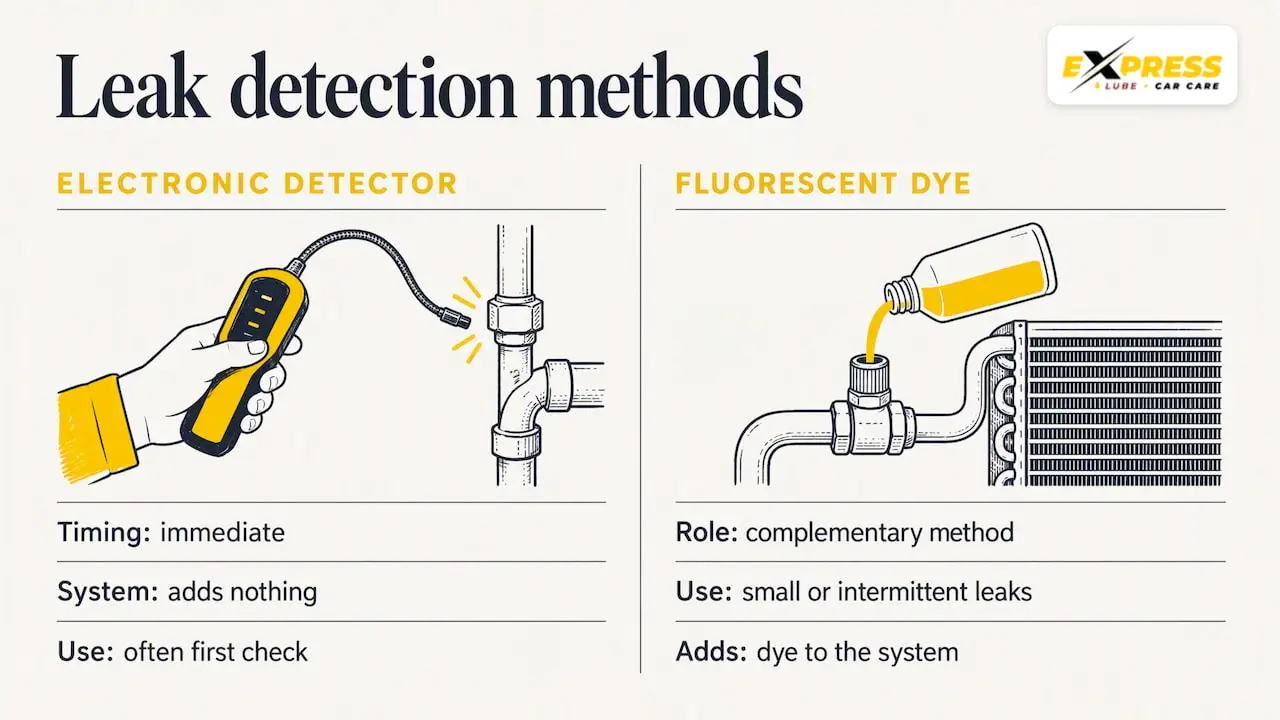
That is also the logic we follow at Express Lube & Car Care. We want the least invasive method that answers the question. If an electronic check finds the leak, there may be no reason to add dye. If it does not, dye gives us something we can see and show you.
Leak detection methods compared
| Method | How it works | Best for | Limits |
|---|---|---|---|
| Visual check | Looking for oily residue on lines, fittings and the compressor | Obvious, larger leaks | Misses hidden or small leaks |
| Electronic leak detector | A sensor picks up refrigerant gas at suspect points | First-pass checks, most leaks | Small or intermittent leaks can be hard to confirm |
| UV dye test | Fluorescent tracer escapes with oil and glows under UV light | Slow, small or intermittent leaks | Needs circulation time and a properly run system |
| Pressure and vacuum checks | Watches whether the system holds pressure | Confirming that a leak exists | Does not show where it is |
Most real-world diagnoses use two or more of these together.
How long does AC dye take to work?
The honest answer is that it depends on the leak and the vehicle.
- Larger leaks can show dye within minutes of running the system.
- Small leaks may need hours, or a few days of normal driving, before enough dye has reached the leak and collected where it can be seen.
- Intermittent leaks that only open up under certain temperatures or compressor loads may need a re-check after a drive cycle.
Part of the reason is how modern systems are built. MACS explains in its 2018 trace dye article that modern compressors are designed to keep most of the oil inside the compressor to improve efficiency. Since dye rides on the oil, it can take real time, and sometimes higher compressor speeds, for dye to reach a leak point.
The October 2021 report also points out that modern, energy-efficient systems carry very little oil to begin with. A technician who seems to be taking a while is often making sure the system is dosed correctly and run under the right conditions to push enough oil and dye through the circuit. Patience here usually means a more accurate answer, not a slower shop.
If you are told to come back for a re-check after a few days of driving, that is a normal part of the process for a slow leak, not a sign something went wrong.
What happens during an AC dye test at a shop
Every vehicle is different, but a typical visit follows this order.
- Symptom review. We ask when the cooling changed, whether it happens all the time or only at idle, and whether you have had a recharge before.
- Visual and electronic inspection. The technician checks lines, fittings, the compressor, the condenser at the front of the car, and the service ports, and uses an electronic detector where appropriate.
- System check. The technician confirms the system is operating and that the compressor engages. If the clutch is not engaging, that is its own diagnosis. Our guide on an AC compressor not engaging explains why.
- Dye injection. If dye is warranted, a measured amount of the right dye for your refrigerant type is added using proper equipment.
- Circulation. The A/C runs so the dye can move with the oil.
- UV inspection. With a UV or blue light and the right glasses, the technician scans the compressor, hose connections, condenser, evaporator drain area and service ports.
- Findings. The leak location is identified, and the repair options are explained before any work begins.
At our Plano shop, digital vehicle inspections with photos and technician notes mean you can see what the technician saw instead of taking it on faith.
Why this is a job for a certified technician
It is easy to find a dye kit online for the price of a sandwich. The kit is not the hard part. The system is.
An automotive A/C system contains refrigerant under high pressure. Ford’s owner guidance states that the refrigerant system should only be serviced by qualified, trained and certified personnel. Opening the system can cause injury, and refrigerant handling is regulated, so releasing it is not just wasteful but potentially unlawful.
There are practical reasons too:
- The wrong dye type, or too much of it, can cause problems in a system with a small oil capacity.
- Different vehicles use different refrigerants, including R-134a and the newer R-1234yf, and equipment and dye must match.
- Adding dye to a system that has not been properly evacuated and checked can hide the real issue rather than reveal it.
Our technicians are ASE-certified, and we handle A/C work with the right equipment for the refrigerant your vehicle uses.
Check before you add dye: warranty and factory dye
Two details are worth knowing before anyone adds dye to your system.
Some vehicles already have dye. The EPA’s guide to good leak testing notes that some manufacturers install dye at the factory, while others, including Toyota and Lexus, traditionally recommend electronic leak detection instead. If your car already has factory dye, a UV light alone may show the leak without adding anything.
Dye can affect some warranties. The same guide notes that some compressor warranties exclude coverage when aftermarket dye additives are introduced. If your vehicle is still under a manufacturer or extended warranty, check the terms or ask your dealer before dye goes in. A good shop will ask you about this first.
Also, dye is not a requirement. The EPA guidance describes it as a useful tool, not a mandatory step in A/C service.
After the dye: cleanup and avoiding false positives
Once the leak is found, the dye should not simply be left to wander. MACS technicians recommend cleaning dye off components after the leak is identified, so old residue does not cause false positives in later inspections. That matters if your car comes back for another A/C visit in a year or two.
The same MACS report notes that technicians are seeing leaks more often traced to the valve core inside the service port as manufacturers refine their systems. It is a small part, and a reminder that a leak is not always a big, expensive component.
Common places a dye test finds leaks
Dye tends to show up in a handful of familiar spots:
- Compressor shaft seal or body seams. Constant motion and heat wear on seals.
- Condenser. Sitting at the front of the vehicle, it takes road debris and stone strikes.
- Hose and line connections. O-rings harden and shrink over time.
- Service port valve cores. Small, inexpensive, and a known source of slow leaks.
- Evaporator. Harder to see, since it sits behind the dash. Dye may show up at the condensate drain instead.
The repair that follows depends entirely on where the leak is. Replacing an O-ring is a very different job from replacing a condenser or evaporator, which is why a confirmed leak location comes before any quote.
Why dye is not the same as a recharge
A recharge adds refrigerant. A dye test finds out why you needed one. If the leak is real and nobody fixes it, topping off the system just buys you a few weeks or months until the cold air fades again. If you have been recharging every spring, a leak diagnosis is the logical next step. We cover recharging in more detail in our guide to AC recharge in Plano, and the price side of newer refrigerant in our article on R-1234yf recharge costs.
We do not publish a flat price for an A/C dye test, because the right approach, the refrigerant type and the time needed vary by vehicle. We would rather quote after we have looked at your car.
Not every A/C problem is a leak
Warm air and a leak often go together, but they are not the same thing. Before you assume a dye test is what you need, consider the other possibilities:
- A compressor that is not engaging, due to an electrical fault or a low-pressure cutoff.
- A failing blower motor or blend door, which affects airflow and temperature rather than refrigerant.
- A clogged cabin air filter that weakens airflow.
- A condenser blocked by debris, or a cooling fan that is not running.
Our five-minute triage for a car A/C that is not cold walks through what you can observe safely, and our post on spotting a refrigerant leak lists the symptoms that point toward one.
A note on smells
A musty smell from the vents usually points to moisture and buildup in the evaporator housing or a dirty cabin filter, not a refrigerant leak. Our guides on musty car A/C and A/C smells and their causes cover the basics. For a broader look at tracing the source of odors before you try to mask them, this UK guide to diagnosing car odor is a useful general read, though the products it describes are sold in the UK.
Our perspective: find it, show it, then fix it
We see the same pattern in the Plano shop again and again. A driver has been topping off the A/C, sometimes with a can from an auto parts aisle, and every refill lasts a little less time. By the time the car comes to us, the question is no longer whether there is a leak. It is where, and how much has already been lost.
Our approach is built on three habits. First, use the least invasive method that answers the question, which often means an electronic check before any dye. Second, show you the evidence, with photos and technician notes from the digital inspection, so the repair recommendation rests on something you can see. Third, be straightforward about what dye can and cannot do. It tells us where the leak is. It does not tell us whether a failing compressor has other damage, and it does not make a repair unnecessary.
When a repair is done, qualifying work is backed by our 24-month/24,000-mile limited warranty, whichever comes first. Eligibility, limitations and exclusions apply, and not every repair or part qualifies, so we go over the terms with you for your specific job before you approve it.
— Express Lube & Car Care
What to do if you suspect an A/C leak
You do not need to wait for the heat to peak. Here is a sensible order of operations.
- Note the symptoms. Does the air go warm at idle, after a long drive, or all the time? Do you hear the compressor click on and off rapidly?
- Skip the stop-leak. Sealant products can cause trouble in a system that a technician will later need to service.
- Check your warranty. If the car is under a manufacturer or extended warranty, ask before anyone adds dye.
- Have it inspected by a certified technician. A visual check and an electronic test often find the leak without anything further.
- Ask for the leak location in writing or in photos before approving a repair.
If you are in Plano or elsewhere in Collin County and want a full overview of what we handle, our car A/C repair page and our guide to your vehicle’s cooling system are good starting points.
Book your A/C check in Plano
We offer A/C diagnostics and repair with no appointment required, and most services are completed the same day. We also offer discounts for military members and healthcare providers. If your A/C is losing its cool, stop by Express Lube & Car Care and we will find out why, explain what we find, and give you the options before any work begins.
FAQ
How much does an AC dye test cost?
It varies with the vehicle, the refrigerant it uses and how much time the diagnosis takes, so we do not publish a single price. Kits sold to consumers are cheap, but they do not include the equipment, training or refrigerant handling a proper test needs. We can quote after an initial inspection of your vehicle.
How do you check AC with dye?
A technician injects a measured amount of fluorescent dye into the system, runs the A/C so the dye circulates, and then scans components with a UV or blue light and special glasses. Bright glowing residue marks the leak. Because the system is under pressure and refrigerant is regulated, this should be done by a certified technician.
How do you get rid of AC dye?
The dye stays in the system with the oil, and it is harmless to normal operation when the correct amount is used. The technician should wipe residue off the outside of components after the leak is found so it does not cause false positives later. If you suspect too much dye was added, ask a shop to check the system.
Is a UV dye test the only way to find an AC leak?
No. Electronic leak detectors, visual inspection and pressure checks are all used. Technicians often try an electronic detector first, and use dye for small or intermittent leaks that are hard to confirm any other way.
Can I do an AC dye test myself?
We advise against it. The system holds refrigerant under high pressure, handling it is regulated, and the wrong dye or amount can cause problems. Ford’s guidance says only qualified, certified personnel should service the refrigerant system.
Sources
- MACS, trace dye article (ACtion, May 2018)
- MACS Service Report, October 2021
- MACS Service Report, January 2020
- EPA, Options for Recharging Your Air Conditioner
- EPA, Guide to Good Leak Testing
- Ford, Climate Control: Air Conditioning System Refrigerant
- Diamondbrite, guide to diagnosing car odor (UK)