

Choose AGM if your vehicle demands maintenance-free operation, runs a start-stop system, or carries a heavy electrical load from sensors and accessories. Choose a flooded battery if you want a lower upfront price for standard starting duty and don’t mind occasional maintenance. AGM batteries typically cost 40% to 100% more than flooded units, but often last longer and tolerate deeper discharges. When in doubt, check your owner’s manual or have a technician confirm the right fit before you buy.
TL;DR:
- AGM batteries are more resistant to vibration and extreme temperatures, making them ideal for off-road, powersports, or heavy electronic load vehicles.
- They support over 60,000 engine starts, significantly outlasting flooded batteries, which typically support fewer than 20,000 starts.
- AGM batteries require a specialized charger with an AGM setting to prevent damage, unlike flooded batteries that can often use standard chargers.
- Vehicles with factory-installed AGM batteries must stick with that chemistry, as switching to flooded types can stress the charging system and reduce lifespan.
- Omitting maintenance checks for flooded batteries is risky, while AGM batteries are sealed and need no electrolyte level inspection, making them more suitable for infrequent drivers or long storage periods.
Table of Contents
- AGM vs Flooded Battery: What Sets Them Apart
- How AGM and Flooded Batteries Perform Under Pressure
- Maintenance, Charging, and Lifespan Trade-Offs
- Matching the Battery to Your Vehicle and Driving Habits
- How to Tell If Your Battery Is AGM or Flooded
- Jump-Starting and Charging Without Damaging Your Battery
- What to Ask a Technician During a Battery Check
- Our Take: Buy for Your Vehicle, Not the Marketing Claims
- Get Your Battery Tested the Same Day, No Appointment Needed
- Sources
- FAQ
AGM vs Flooded Battery: What Sets Them Apart
The difference comes down to how each battery holds its electrolyte. A flooded battery, sometimes called a wet-cell or lead-acid battery, holds liquid sulfuric acid that moves freely around the lead plates. An AGM battery, short for absorbed glass mat, packs that same acid into a fiberglass mat sandwiched between the plates, then seals the whole thing shut.
That construction difference changes everything about how each battery behaves day to day. AGM batteries are sealed VRLA units that are maintenance-free and more resistant to vibration and extreme temperatures than flooded designs, since there’s no liquid to slosh, spill, or evaporate.
Flooded batteries work differently:
- Some models have removable vent caps, allowing you to check and top off electrolyte levels.
- Many modern flooded batteries are labeled “maintenance-free” even though they still use liquid electrolyte, just in a sealed case that limits evaporation.
- A cracked or overturned flooded battery can leak acid, while a sealed AGM battery is built to resist spills even under moderate impact.
For drivers who never think about their battery until it fails, that sealed AGM design removes one more thing to worry about.
How AGM and Flooded Batteries Perform Under Pressure
Starting power looks similar on paper. Both chemistries deliver comparable cold-cranking amps (CCA) when rated for the same group size, so a cold morning start isn’t automatically won by either type. The real separation shows up in how each battery handles repeated stress over time.
- Deep-discharge tolerance: AGM batteries recover better from partial discharges, which matters if you run winches, inverters, or after market audio systems.
- Cycle life: AGM batteries are engineered to support far more engine starts than standard flooded batteries, with figures cited above 60,000 starts for AGM against fewer than 20,000 for standard flooded units.
- Vibration resistance: the glass mat construction holds up better on rough roads, off-road trails, and powersports applications like ATVs and boats.
AGM batteries are built for more starts: industry figures cite more than 60,000 engine starts for AGM versus fewer than 20,000 for standard flooded batteries, a gap wide enough to matter for anyone running stop-start technology or heavy accessory loads.
Heat is the equalizer neither chemistry escapes. High heat shortens lifespan for every lead-acid battery, AGM included, even though AGM units tend to score higher in independent testing overall. If you live somewhere with brutal summers, expect to replace either type sooner than the label promises.
Maintenance, Charging, and Lifespan Trade-Offs
Sealed AGM batteries need no watering, ever. That’s a real convenience, especially for drivers who’d rather not pop the hood to check electrolyte levels every few months. Flooded batteries with removable caps may need occasional topping off with distilled water, though most modern flooded batteries marketed as “maintenance-free” rarely require it under normal use.
Storage habits separate the two chemistries sharply:
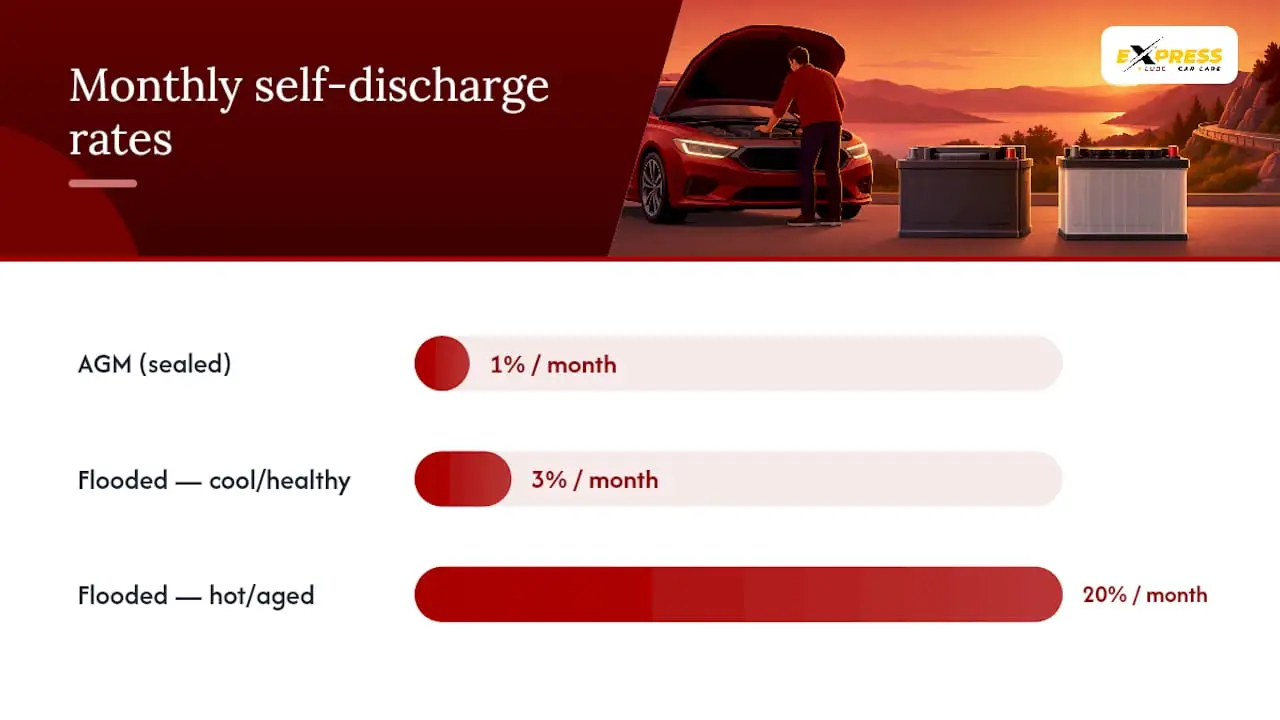
- AGM batteries hold charge longer, with self-discharge rates as low as 1% per month.
- Flooded batteries self-discharge faster, typically 3% to 20% per month depending on temperature and battery condition.
- A vehicle parked for weeks at a time favors AGM simply because it won’t drain as quickly while sitting idle.
Charging compatibility is where owners run into trouble. AGM batteries need a charger or alternator output tuned to their voltage limits; feeding one a high-rate charger built for flooded batteries can shorten its life or damage it outright.
Pro Tip: If your car sits unused for more than a couple of weeks at a time, a smart battery tender set to the correct chemistry mode prevents sulfation and keeps either battery type ready to start on the first turn of the key.
Weigh the 40% to 100% price premium for AGM against its longer service life and lower self-discharge, and for many drivers the math still favors AGM over the life of the vehicle. Our guide on prolonging car battery life covers more ways to stretch that investment further.
Matching the Battery to Your Vehicle and Driving Habits
- Start-stop vehicles and hybrids. These systems restart the engine dozens of times per trip, a workload flooded batteries weren’t designed for. Many factory-equipped start-stop vehicles actually use Enhanced Flooded Batteries (EFB), a step between standard flooded and full AGM, so confirm which one your car needs.
- Vehicles loaded with electronics. Heated seats, upgraded sound systems, dash cams, and navigation units draw power even with the engine off. AGM’s deep-discharge tolerance handles that drain better.
- Powersports and off-road vehicles. Boats, ATVs, and motorcycles subject batteries to constant jolting. AGM’s vibration resistance holds up longer under that kind of abuse.
- Budget-focused daily drivers. If your car is older, has minimal electronics, and you’re comfortable with occasional maintenance, a flooded battery still gets the job done for less money upfront.
- Infrequently driven vehicles. AGM’s slower self-discharge makes more sense for a weekend car or a vehicle that sits in storage for weeks.
If your vehicle came from the factory with an AGM battery, don’t switch to flooded to save money. Certain vehicles require AGM or EFB specifically, and swapping chemistry without confirming alternator compatibility can stress the charging system. Ask a technician before making that call.
How to Tell If Your Battery Is AGM or Flooded
Popping the hood tells you most of what you need to know. AGM batteries carry sealed tops with “AGM” or “VRLA” printed directly on the case, with no removable caps anywhere on top. Flooded batteries often have small removable vent caps and, in some cases, a visible electrolyte level line on the side of the case.
- Check the label first. Manufacturers print the chemistry type clearly on nearly every battery sold today.
- Look for vent caps. Their presence usually points to a flooded design; their absence points to AGM.
- Watch for corrosion or leakage around the terminals, a sign of a struggling battery regardless of chemistry.
- Never add water to a sealed battery. If it has no caps, it wasn’t designed to be opened.
If you’re still not sure, or the battery shows any swelling, cracking, or corrosion, a load test at a shop settles the question fast and tells you whether it’s time for a replacement. Our safe battery removal guide walks through the process if you need to pull it for a closer look.
Jump-Starting and Charging Without Damaging Your Battery
Standard jump-start steps apply to both chemistries: connect positive to positive, negative to a grounded metal point away from the battery, and never let the cables touch. AGM batteries add one caution. Use a smart charger with an AGM setting whenever possible; a high-rate charger built for flooded batteries can push voltage too high and shorten AGM life.
- Confirm correct polarity before connecting any cables.
- Use a charger with a dedicated AGM or VRLA mode for AGM batteries.
- Stop charging and call a shop if the battery feels hot, swells, or won’t hold a charge after a full cycle.
Pro Tip: A battery tender left on a maintenance setting during long storage does more to preserve battery life than simply leaving the battery to sit at rest.
What to Ask a Technician During a Battery Check
A proper battery appointment answers more than “does it start the car.” Bring these questions with you:
- What group size and CCA rating does my vehicle require?
- Is this an AGM, EFB, or standard flooded battery, and does that match what my vehicle came with?
- Is my alternator and charging system compatible with this battery type?
- What warranty terms come with the replacement?
A battery appointment typically includes a load test, a charging-system scan, and a physical inspection for corrosion or case damage. That combination catches problems a quick visual check misses, like an alternator that’s slowly cooking a battery through overcharging. If the diagnosis points to alternator trouble rather than the battery itself, our alternator failure guide explains what those symptoms look like. Same-day replacement makes sense once testing confirms the battery is the actual problem, and having ASE-certified technicians run that diagnosis means you’re not replacing a part that wasn’t broken.
Our Take: Buy for Your Vehicle, Not the Marketing Claims
Most battery marketing leans hard on AGM’s premium positioning, and the performance case is real. But the conventional advice, “always upgrade to AGM,” skips the part where compatibility matters more than chemistry. A flooded battery in a car designed for flooded batteries will serve you fine for years. An AGM battery crammed into a charging system tuned for flooded output can underperform or fail early, premium price tag and all.
The judgment this comes down to: match the battery to what your vehicle’s alternator and computer expect, then decide between AGM and flooded based on how you actually drive and where you park. Frequent short trips, heavy electronics, or long storage stretches tilt the case toward AGM. Straightforward commuting in an older vehicle with no factory AGM requirement doesn’t need the premium.
What we’d prioritize first isn’t the chemistry debate at all. It’s confirming what your vehicle was built to run, then checking the charging system before installing anything. A battery that’s charged incorrectly fails early no matter what it’s made of.
— Express Lube & Car Care
Get Your Battery Tested the Same Day, No Appointment Needed
Guessing at battery chemistry from a parts-store shelf is how drivers end up with the wrong fit for their charging system. Express Lube & Car Care runs a full load test, charging-system scan, and physical inspection on the spot, then tells you plainly whether you need AGM, EFB, or standard flooded based on what your vehicle actually requires, not what’s easiest to sell.
Same-day replacement is available once testing confirms the battery is the issue, and you don’t need to book ahead to get it done. Technicians check alternator compatibility before recommending a replacement, to avoid paying for a chemistry your charging system can’t support properly. Stop by for a battery test through our services page or head to our main service page to see current inspection options before your next long trip or Texas summer heat wave puts your battery to the test.
Sources
Claims in this guide draw on Consumer Reports’ testing on heat and battery lifespan, Interstate Batteries’ technical AGM guidance, and Battery Council International’s recycling data, which confirms lead-acid batteries reach a 98% recycling rate in the U.S. Our battery maintenance tips offer additional practical steps.
- How hot weather affects your car battery — Consumer Reports
- What is an AGM battery and what’s the big deal? — Interstate Batteries
- Consumer Reports coverage via 9News: Better car batteries
FAQ
Which battery is better, AGM or flooded?
Neither wins outright. AGM batteries perform better for maintenance-free use, deep discharges, and vibration resistance, while flooded batteries cost less upfront and work fine for standard starting duty in vehicles that weren’t factory-equipped for AGM.
What are the disadvantages of AGM batteries?
AGM batteries cost 40% to 100% more than flooded batteries and require a charger with an AGM-compatible setting. Using the wrong charger or installing one in a vehicle not designed for AGM can shorten its lifespan or stress the charging system.
How can I tell if I have a flooded battery or an AGM battery?
Check the top of the battery case: AGM batteries are sealed with “AGM” or “VRLA” printed on the label and have no removable caps, while flooded batteries often have small vent caps for topping off electrolyte. If you’re unsure, a technician can confirm the type during a quick inspection.
Is it okay to jump-start an AGM battery?
Yes, standard jump-start steps work for AGM batteries, including correct polarity and cable placement. The main caution is charging afterward: use a charger with an AGM setting rather than a high-rate charger meant for flooded batteries.
Can I replace a flooded battery with an AGM battery, or vice versa?
Only if your vehicle’s alternator and charging system support it. Some vehicles require AGM or EFB specifically, and switching chemistry without confirming compatibility can cause charging-system stress or a shorter battery life.