

The check engine light comes on during a Plano commute, and the car starts to shake at the next red light. Or it starts fine in the morning, then stumbles pulling onto the Dallas North Tollway. In the shop, those complaints often trace back to one small part with a big job: the ignition coil.
A bad ignition coil doesn’t always fail in a dramatic way. Sometimes it starts as a faint miss at idle, a little hesitation under load, or a fuel smell that wasn’t there before. The trouble is that modern vehicles can hide ignition problems well enough that simple driveway testing doesn’t always tell the full story. That’s where many DIY attempts go sideways.
Your Engine's Unsung Hero The Ignition Coil
The ignition coil acts as a step-up transformer. It takes the battery’s low voltage and converts it into the high voltage the spark plug needs to fire the air-fuel mixture inside the cylinder.
That job sounds simple. In practice, it has to happen fast, under heat, vibration, and constant load changes. Around Plano, that means cold starts in the morning, stop-and-go traffic on Central, and hard acceleration getting up to speed on the Tollway.
What the coil actually does
Many modern engines use a coil-on-plug setup. Each spark plug has its own coil mounted above it. That improves spark control, but it also creates a diagnostic trap. One weak coil can affect one cylinder while the engine still runs well enough to fool a quick driveway check.
A coil has one job. Deliver enough voltage, at the right moment, every time. If it gets weak, the plug may still fire some of the time, just not consistently enough for clean combustion.
That inconsistency can show up as:
- Hard starting, especially when the engine is under strain
- Uneven idle, when one cylinder contributes less than the others
- Poor acceleration, because combustion is incomplete under load
- Higher fuel use, because the engine has to work around the misfire
In the shop, DIY diagnosis often falls short. A multimeter can catch an obvious open circuit on some older systems, but many late-model coil problems only show up under load, at operating temperature, or during a live data test with a scan tool and scope. A coil can pass a basic resistance check and still fail in real driving.
Why this part deserves attention
Ignition coils are wear items. Heat, vibration, oil intrusion, worn spark plugs, and moisture all shorten their life. Some last a long time. Some do not. What matters more than mileage is how the coil performs under actual operating conditions.
A weak coil should not be brushed off as a minor miss. Continued misfires can wash fuel into the exhaust, strain the catalytic converter, and leave you with a bigger repair than the coil itself.
The practical takeaway is simple. If the engine has started running rough, guessing wastes time and money. Proper testing identifies whether the coil is the problem, or whether the cause is a plug, wiring issue, injector fault, or something the average meter will not catch.
Recognizing Telltale Signs of a Failing Ignition Coil
You pull away from a light on Preston Road, press the gas, and the car hesitates for a second before it catches up. Later, it idles rough in the drive-thru, then seems fine again on the next trip. That kind of on-and-off behavior is common with a weak ignition coil, and it is one reason coil problems get misdiagnosed so often.

The symptoms drivers notice first
A failing coil usually shows up through drivability complaints before anyone sees the part itself.
Common signs include:
- Misfiring, which feels like a stumble, buck, or sputter
- Rough idle, where the engine shakes more than normal at a stop
- Hesitation during acceleration, especially when merging onto Highway 75 or climbing speed with the A/C running
- Loss of power, because one cylinder is not contributing the way it should
- A flashing or steady check engine light, depending on how severe the misfire is
- Occasional stalling, if the problem gets bad enough
Some drivers also notice a raw fuel smell from the exhaust or a change in fuel economy. Neither one proves the coil is bad by itself, but both fit the pattern of incomplete combustion.
What the warning codes do, and do not, tell you
Misfire codes can point you in the right direction. A scan tool may show a random misfire code or a code tied to one cylinder. That helps narrow the search.
It does not confirm the coil.
In the shop, we see plenty of vehicles with a cylinder-specific misfire where the cause turns out to be a worn plug, oil in the plug tube, a wiring issue, or an injector problem. Swapping coils between cylinders is a common DIY check, and sometimes it helps. On many late-model vehicles, though, that shortcut misses heat-related or load-related failures that only show up while the engine is running under real conditions.
Practical diagnosis point: A cheap code reader tells you where the engine noticed a problem. It does not tell you why the problem happened.
When the symptoms show up matters
The pattern of the complaint tells us a lot.
A weak coil may show itself at idle, when the engine is hot after a long Plano summer drive, or under acceleration when cylinder pressure rises and the spark has to work harder. Moisture can make the problem worse too. After heavy rain or a wash, a marginal coil or cracked boot may leak spark before it reaches the plug.
That is why a vehicle can run rough in the morning, act normal at lunch, then misfire again on the way home. The failure is often conditional.
A basic multimeter test rarely catches that. On older systems, resistance checks could identify some obvious failures. On modern coil-on-plug systems, a coil can pass a simple ohms test and still break down under heat, load, or command timing changes. Professional diagnosis uses scan data, misfire counters, and in some cases a lab scope to see what the coil is doing while the engine is operating, not just while the car is parked with connectors unplugged.
A quick visual walkthrough helps show the kinds of symptoms many drivers notice before they know the cause:
Why waiting can turn one fault into several
A continuing misfire does more than make the engine feel rough. Unburned fuel can overheat the catalytic converter and create a much bigger repair than the original ignition problem.
That is the significant risk. Drivers put up with a small stumble because the car still starts and moves. Meanwhile, the engine and exhaust system keep absorbing the consequences.
If the car is shaking, hesitating, or flashing the check engine light, it is worth getting it tested before parts get replaced on a guess. That saves time, avoids buying coils you may not need, and gives you a clear answer based on how the vehicle performs under actual conditions.
What Really Causes an Ignition Coil to Go Bad
A lot of people assume coils fail from age alone. Sometimes they do. But many repeat failures happen because the underlying problem never got fixed.
That matters because replacing one coil without addressing the reason it failed can send you right back to the same repair.

Worn spark plugs put extra stress on the coil
The biggest cause many drivers miss is the spark plug itself. When a spark plug gap wears wider than it should, the coil has to produce more voltage to jump that gap. That extra strain builds heat and electrical stress inside the coil.
On paper, the failed part is the coil. In practice, the worn plug may have been overworking it for a long time.
According to this NGK technical explanation published by Underhood Service, the leading cause of ignition coil failure isn’t the coil itself but external stress, especially worn spark plugs with excessive gaps that force the coil to generate much higher voltage.
Oil and moisture contamination are common culprits
On many coil-on-plug engines, the coil sits down in a tube around the spark plug. If the valve cover gasket leaks, oil can collect in that area. Moisture intrusion can cause similar trouble.
Oil and moisture both create a harsh environment for ignition components. The coil boot can degrade, the spark can track where it shouldn’t, and the coil may burn out from repeated stress.
Heat and vibration matter more than people think
Plano drivers deal with plenty of heat, and underhood temperatures are already rough on electrical parts. Add vibration from everyday driving, and the coil housing, insulation, and internal windings all take a beating over time.
This doesn’t always leave obvious external damage. A coil can look decent on the outside and still break down under heat or load.
If a replacement coil fails again soon, the first question shouldn’t be “Was the new part bad?” It should be “What is overloading it?”
What a thorough diagnosis should include
When a vehicle comes in with a suspected bad ignition coil, the right process goes beyond swapping parts. A useful inspection usually includes:
- Spark plug condition. The plug tells a story about wear, fouling, and whether the coil has been overworked.
- Plug gap verification. Too much gap raises the voltage demand on the coil.
- Valve cover leak check. Oil in the plug well is a major warning sign.
- Connector and boot condition. Cracks, corrosion, and carbon tracking can mimic coil failure.
- Heat-related failure pattern. Some coils fail only after the engine warms up.
A coil is part of a system. Treating it like a stand-alone part is how temporary fixes happen.
How to Diagnose a Suspected Bad Ignition Coil
A lot of online advice gets oversimplified. Basic checks still have value, but on newer vehicles they often don’t close the case. A coil may test “fine” in the driveway and still misfire under heat, load, or specific engine commands.
That gap between old-school testing and modern diagnosis is what confuses many car owners.
Start with what you can see and hear
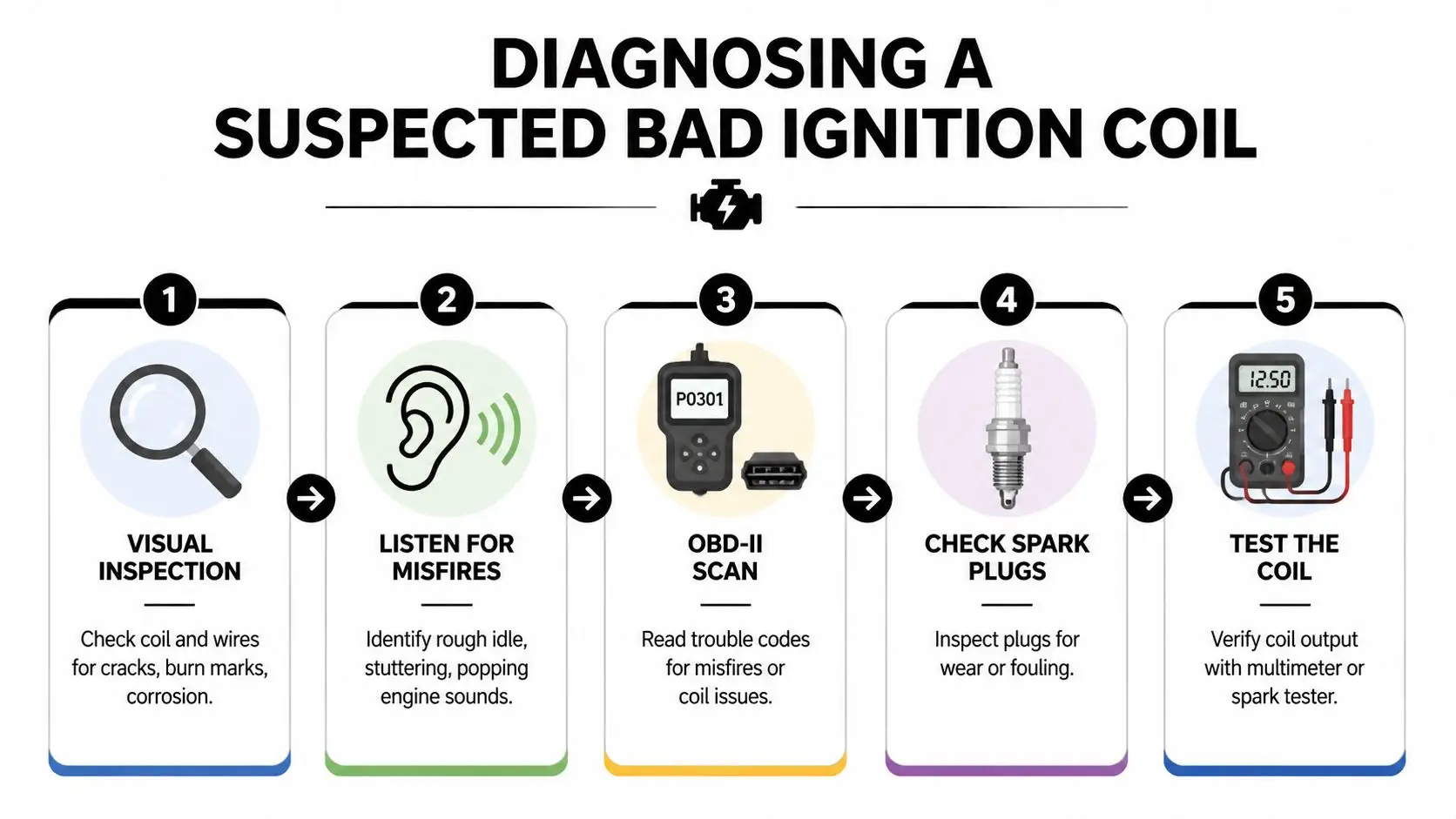
Begin with a safe visual inspection. If the engine has cooled and you can access the ignition area safely, look for cracked coil housings, damaged boots, corrosion at connectors, and signs of oil in the spark plug tubes.
Then listen to how the engine runs. A steady idle should sound even. A misfiring cylinder often creates a repeating stumble or popping note.
A simple first-pass checklist looks like this:
- Check for obvious coil damage such as cracks, burn marks, or loose connectors.
- Look around the plug well for oil or moisture contamination.
- Listen at idle for an uneven rhythm or intermittent stumble.
- Note when it happens. Cold start, hot restart, idle, and acceleration all point in different directions.
- Scan for trouble codes before replacing anything.
The OBD-II scan matters early, not late
A proper scan tool is one of the most useful starting points because it shows what the engine computer is seeing. If you want a clearer picture of what the warning light may mean before repair, this guide on check engine light diagnosis is a practical place to start.
A scan can reveal misfire activity, cylinder-specific patterns, and whether the fault is active now or stored from an earlier event. That’s much more useful than guessing from symptoms alone.
The old tests still have limits
People often ask about two common DIY methods: spark testing and multimeter resistance testing.
A spark test can sometimes show whether a coil is producing spark at all. On older systems, that can be a strong clue. But it may not tell you whether the coil is strong enough under actual driving load.
A multimeter test checks coil resistance. Again, that can help on some systems. The problem is that many modern coils don’t fail in a clean, measurable way on a simple resistance check.
Important distinction: A coil can pass a bench-style resistance test and still fail while the engine is running.
Why modern vehicles beat simple driveway diagnosis
Modern ignition systems are more tightly controlled by the engine computer than many DIY guides suggest. Some vehicles use coil designs and control strategies that don’t produce obvious resistance failures even when the coil is defective.
According to this technical discussion of modern coil testing, traditional multimeter tests often fail to diagnose modern ignition coils because many newer designs don’t show clear resistance failures even when defective, and professional OBD-II scanning is essential for catching intermittent misfires and faulty coils that basic tests miss.
That’s the diagnostic gap in plain language. The coil may only break down:
- When cylinder pressure rises
- When the engine reaches operating temperature
- When the computer commands a specific dwell pattern
- During brief intermittent events too quick to catch with a basic meter
A multimeter is a good tool. It’s just not the final word on late-model ignition problems.
What technicians do differently
In a shop, the process usually goes beyond code reading. A technician may compare live misfire data, inspect spark plugs, look for contamination, verify connector integrity, and in some cases move a suspect coil to another cylinder to see whether the misfire follows.
That workflow matters because it separates “possibly bad coil” from “confirmed coil issue with supporting evidence.”
A professional diagnostic approach often focuses on:
- Live data, not just stored codes
- Cylinder pattern tracking, to see whether one hole consistently drops out
- Related component inspection, especially spark plugs and leaks
- Operating conditions, because some faults appear only hot or under load
What works and what usually wastes time
Here’s the practical version.
| Method | What it can do | Where it falls short |
|---|---|---|
| Visual inspection | Finds cracks, oil, loose connectors, obvious damage | Won’t catch internal breakdown |
| Basic code reader | Flags misfire-related faults | May not show enough detail for a clear diagnosis |
| Spark tester | Confirms presence of spark on some setups | Doesn’t always reveal weak performance under load |
| Multimeter resistance check | Useful on some older designs | Many modern coils can still test “normal” |
| Professional scan and diagnostic routine | Identifies intermittent and cylinder-specific misfires more accurately | Requires proper equipment and interpretation |
The key takeaway is simple. Old methods can still help, but on modern vehicles they’re screening tools, not final proof.
Replacing a Bad Ignition Coil DIY vs Professional Service
Once the diagnosis points to a bad ignition coil, the next question is whether to replace it yourself or hand it off. The answer depends on the vehicle, your tool set, and whether the cause is isolated to the coil.
On some engines, coil replacement is straightforward. On others, access is tight, the intake may be in the way, or the primary risk is missing the reason the coil failed in the first place.
What DIY replacement usually involves
If the coil is easy to reach, the basic process is fairly direct. You disconnect the battery, unplug the electrical connector, remove the retaining fastener, pull the coil, inspect the plug well, and install the replacement correctly.
That sounds simple because the mechanical part often is. The part people underestimate is everything around it.
A DIY replacement usually works best when:
- The engine layout is accessible
- You already confirmed the faulty cylinder
- There’s no oil in the plug well
- The spark plugs are in known good condition
- You have the right tools, including a torque wrench if the application calls for one
If you’re already dealing with worn plugs, this guide on how often to change spark plugs helps connect the maintenance side of the problem.
When professional service makes more sense
Professional service earns its value when the problem isn’t just bolt-on replacement. A technician can check the plug gap, inspect for valve cover leaks, verify connector condition, and confirm that the misfire isn’t being caused by something else that happens to look like a coil fault.
That matters because a failing ignition coil can damage the engine computer or ignition control module, turning a $150 to $300 coil replacement into a $500 to $2,000+ repair, as described in this ignition failure cost discussion.
That’s also why preventive replacement during a tune-up can make sense on some vehicles, especially when coils are aging and access overlaps with other scheduled ignition work.
Cheap repairs get expensive when they solve the symptom and leave the cause behind.
For broader context on how ignition components are evaluated outside the typical repair shop setting, Quick Keys ignition expertise offers a useful perspective on ignition-related service decisions.
Ignition Coil Replacement DIY vs Express Lube Plano
| Factor | DIY Approach | Professional Service (Express Lube) |
|---|---|---|
| Diagnosis confidence | Depends on your scan tool and testing skill | More reliable when intermittent faults need deeper analysis |
| Tool needs | Ratchet, sockets, possible torque wrench, scanner, multimeter | Shop equipment already in place |
| Time investment | Can be quick or turn into a long afternoon | Usually faster if diagnosis is already underway |
| Risk of misdiagnosis | Higher, especially on newer vehicles | Lower when live data and system checks are used |
| Root-cause detection | Easy to miss plug wear, leaks, or connector issues | More likely to catch related problems |
| Best fit | Simple access, confirmed bad coil, experienced DIY owner | Modern vehicles, repeat failures, unclear symptoms |
A practical rule for deciding
DIY is reasonable when access is simple and the diagnosis is solid. Professional service is the safer move when the engine is packed tight, the misfire is intermittent, or the coil may be just one part of a bigger ignition issue.
That’s not about selling complexity. It’s about avoiding repeat repairs.
Your Plano Partner for Ignition System Health Express Lube & Car Care
Busy drivers don’t need a lecture when a car is missing and the check engine light is on. They need a straight answer, a solid diagnosis, and a repair path that makes sense for how they use the vehicle.
That’s where local service matters. Plano commuters, parents juggling schedules, and fleet drivers usually aren’t looking for a weekend project. They want the car to start cleanly, idle smoothly, and stay dependable in daily traffic.

What helps when the problem isn’t obvious
Modern ignition issues often need more than a quick parts swap. That’s why many Plano drivers start with a proper engine diagnostics service instead of guessing from symptoms.
ASE-certified technicians can check for the patterns basic tests miss. That’s especially useful when the misfire only shows up hot, under acceleration, or every few days.
Why convenience matters too
No-appointment service helps when the car starts acting up during the workweek and you can’t wait around for an opening. Fast turnaround matters, but so does clear communication about whether the coil itself failed or whether spark plugs, leaks, or another ignition issue created the problem.
For local drivers trying to manage repair costs, the available savings help too:
- $20 off oil change and additional services
- Discounts for military, first responders, and healthcare workers
- $20 off batteries with the Signature battery service
- $25 off oil changes on Ladies Day every Wednesday
Those offers don’t replace good diagnosis. They just make routine care and related service easier to keep up with.
Frequently Asked Questions About Ignition Coils
Is it safe to drive with a bad ignition coil
It’s risky. A vehicle with a misfiring coil may still move, but it can hesitate, stall, run rough in traffic, and send unburned fuel into the exhaust. If the engine is shaking, flashing the check engine light, or struggling under load, it’s smarter to stop driving it and have it checked.
If one ignition coil fails, should I replace all of them
Not always. If one coil has clearly failed, replacing that one may be appropriate. But the right decision depends on vehicle age, mileage, access, spark plug condition, and whether the others show signs of similar wear.
If the plugs are overdue or the coils are all the same age, it’s worth discussing a broader ignition service plan instead of treating each failure one at a time.
One failed coil doesn’t automatically mean the whole set is bad. It does mean the whole ignition system deserves a look.
How often should ignition coils be replaced
There isn’t one universal interval for every vehicle. Coil life varies by design, heat exposure, vibration, and the condition of the spark plugs and surrounding components.
A practical approach is to pay closer attention as mileage climbs, inspect the ignition system during tune-ups, and take symptoms seriously instead of waiting for a complete failure. Preventive replacement can make sense when coils are aging and the vehicle is already in for related ignition work.
Can a bad ignition coil feel like something else
Yes. Drivers often mistake a coil problem for bad gas, a fuel injector issue, or a general “engine hesitation” complaint. That’s why diagnosis matters. Several problems can create similar symptoms, and modern cars don’t always point clearly to the coil without scan data and inspection.
Why did my multimeter say the coil was fine
Because many newer coils don’t fail in a way a simple resistance test can catch. They may break down only when hot or under load. That’s one reason a car can still misfire even after a coil seems to “test okay” on the bench.
If your car is shaking at idle, hesitating on acceleration, or showing a check engine light that points to a misfire, Express Lube & Car Care can help you sort out whether you’re dealing with a bad ignition coil, worn plugs, or a larger ignition system issue. Stop by for a practical diagnosis and a repair plan that fits your vehicle and your schedule.