

You’re merging onto US-75, the light turns green, you give the car a little throttle, and then you catch it in the mirror. A dark puff from the tailpipe. Maybe it happens leaving a stoplight in Plano traffic. Maybe it shows up when you pull onto the tollway or climb speed with the A/C running hard in the afternoon heat. Either way, it gets your attention fast.
Black smoke coming from exhaust usually means one simple thing at the root: the engine is burning too much fuel and not enough air. In shop language, we call that running rich. The engine asked for a clean burn, but the mixture was off, so part of that fuel left as soot instead of useful power.
That matters for two reasons. First, you’re paying for fuel your engine didn’t use well. Second, the smoke isn’t just ugly. A Department of Energy study summarized by Trucking Info found that emissions from vehicles producing visible black smoke were approximately four times more toxic to respiratory health than emissions from normal vehicles.
Black smoke is the engine’s version of a warning light you can actually see.
Some black smoke shows up only under load. Some hangs around at idle. Some appears for a moment on startup and disappears. Those details matter, because they point toward different causes. A restricted air filter, a leaking injector, a bad sensor, a diesel DPF issue, or even a fuel-related problem that only shows up in certain Texas conditions can all leave the same basic clue.
That Puff of Black Smoke in Your Rearview Mirror
A lot of drivers assume the worst the first time they see it. That’s understandable. Smoke from any vehicle feels serious because it is. But black smoke is often more understandable than people think.
The tailpipe isn’t making smoke on its own. It’s just showing you the result of incomplete combustion. Fuel went into the engine, the burn wasn’t clean, and the leftovers came out as black soot. In plain terms, your vehicle is overfeeding itself or struggling to breathe.
In Plano, I’d pay close attention to when it happens. Morning startup after the car sat overnight feels different from a hard acceleration puff near Parker Road. Stop and go traffic, short trips, towing, or a heavy passenger load can all make a rich-running problem more obvious.
What the smoke is telling you
Here’s the fast read:
- A short puff under acceleration often points to a fuel or airflow issue that shows up when engine demand rises.
- Smoke that lingers at idle can suggest a more persistent mixture problem.
- Smoke in a diesel under load often raises suspicion around airflow, EGR, turbo response, or DPF-related restrictions.
- Smoke after maintenance changes can point toward a sensor contamination issue or a part that isn’t working the way it should.
What I don’t recommend is ignoring it because the car still “feels mostly fine.” A rich-running engine can drive well enough for a while. That doesn’t mean it’s healthy.
If the exhaust is black, some of your fuel budget is going straight out the tailpipe.
Why Your Engine Breathes Wrong and Creates Smoke
Think of an engine like a campfire. If you stack in too much wood and don’t give it enough air, the fire turns lazy and smoky. It doesn’t burn clean. You get dark smoke instead of steady heat.
An engine does the same thing with fuel and air. Give it the right balance, and combustion is clean and efficient. Give it too much fuel or too little air, and some of that fuel won’t burn completely. That leftover carbon shows up as black smoke coming from exhaust.
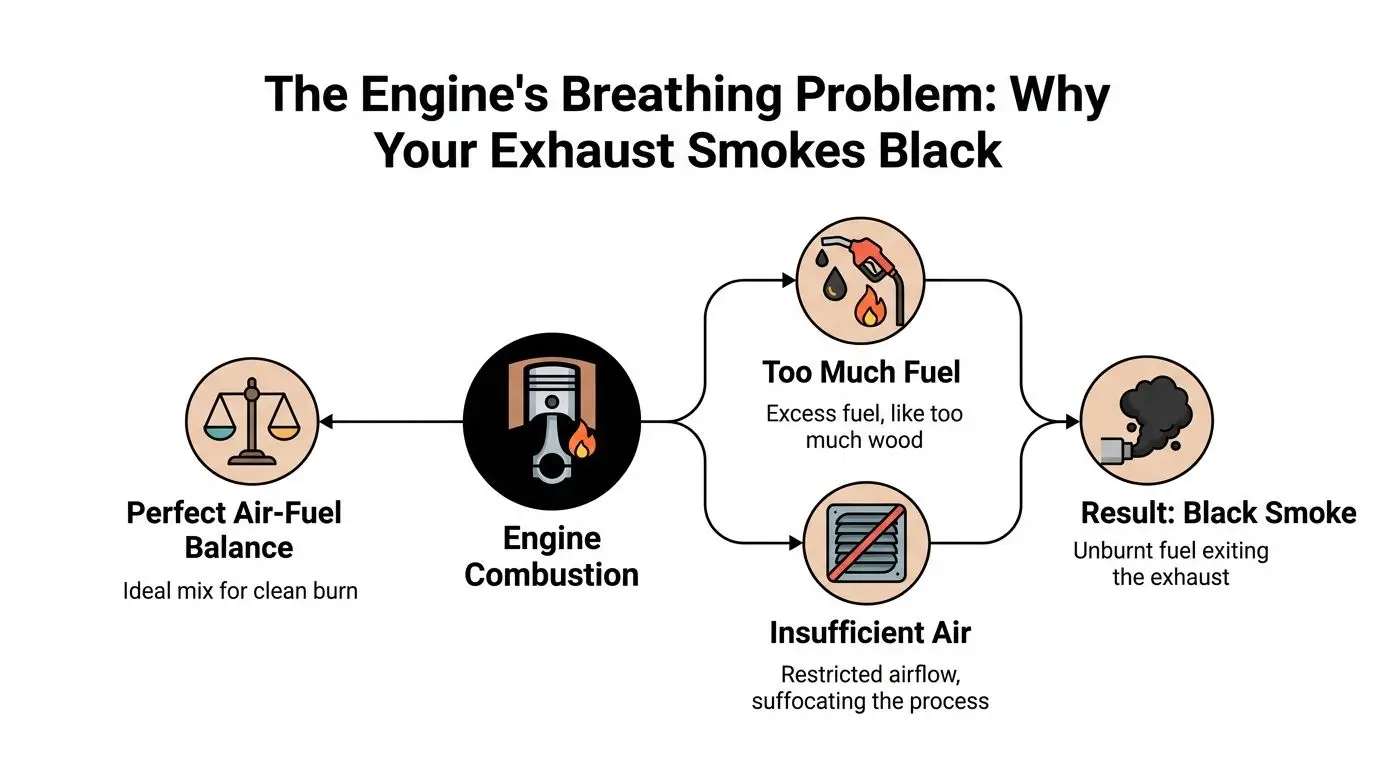
Too much fuel or not enough air
Most black smoke problems trace back to one of two failures:
- The engine got excess fuel. That can happen because an injector leaks, a sensor misreads airflow, or the computer commands too much fuel.
- The engine got restricted air. That can happen because the air filter is clogged, the intake path is dirty, or diesel airflow control parts aren’t doing their job.
Sometimes both happen together. That’s when the smoke gets heavier and the vehicle starts feeling sluggish, rough, or thirsty.
Why this costs money fast
Drivers often think of black smoke as an emissions issue first. It is that, but it’s also a direct fuel economy issue. A fleet analysis on smoke and fuel consumption found a distinct positive relationship between black smoke levels and fuel consumption, with fuel economy dropping from 3.4 km/L to 3.1 km/L as smoke density increased.
That’s why I describe black smoke as wasted combustion. You bought the fuel. The engine failed to turn all of it into work.
What clean combustion looks like
A healthy engine needs:
- Accurate air measurement
- Correct fuel delivery
- Good spark or compression at the right time
- Unrestricted exhaust flow
If one part of that chain gets weak, the rest of the system starts compensating. Modern engines are smart, but they’re not magical. If a sensor lies or a mechanical part sticks, the computer can only react to the bad information it receives.
Practical rule: Black smoke isn’t usually a mystery for long. If you track when it happens and test the air, fuel, and sensor side in order, the cause usually narrows down quickly.
The Top 7 Culprits Behind Black Exhaust Smoke
A Plano driver usually notices black smoke in one of three moments. Pulling onto Highway 75, climbing speed on the Dallas North Tollway, or accelerating away from a long light on Preston during summer heat. Those patterns matter because black smoke is load-related more often than random. The engine is being asked to work, and one part of the air-fuel process is falling behind.
The smoke may look similar in the mirror, but the root cause changes with engine type. Gasoline engines usually smoke black because they are running too rich. Modern diesels can do it from excess fuel, weak airflow, poor boost, or an emissions component that is no longer keeping up.
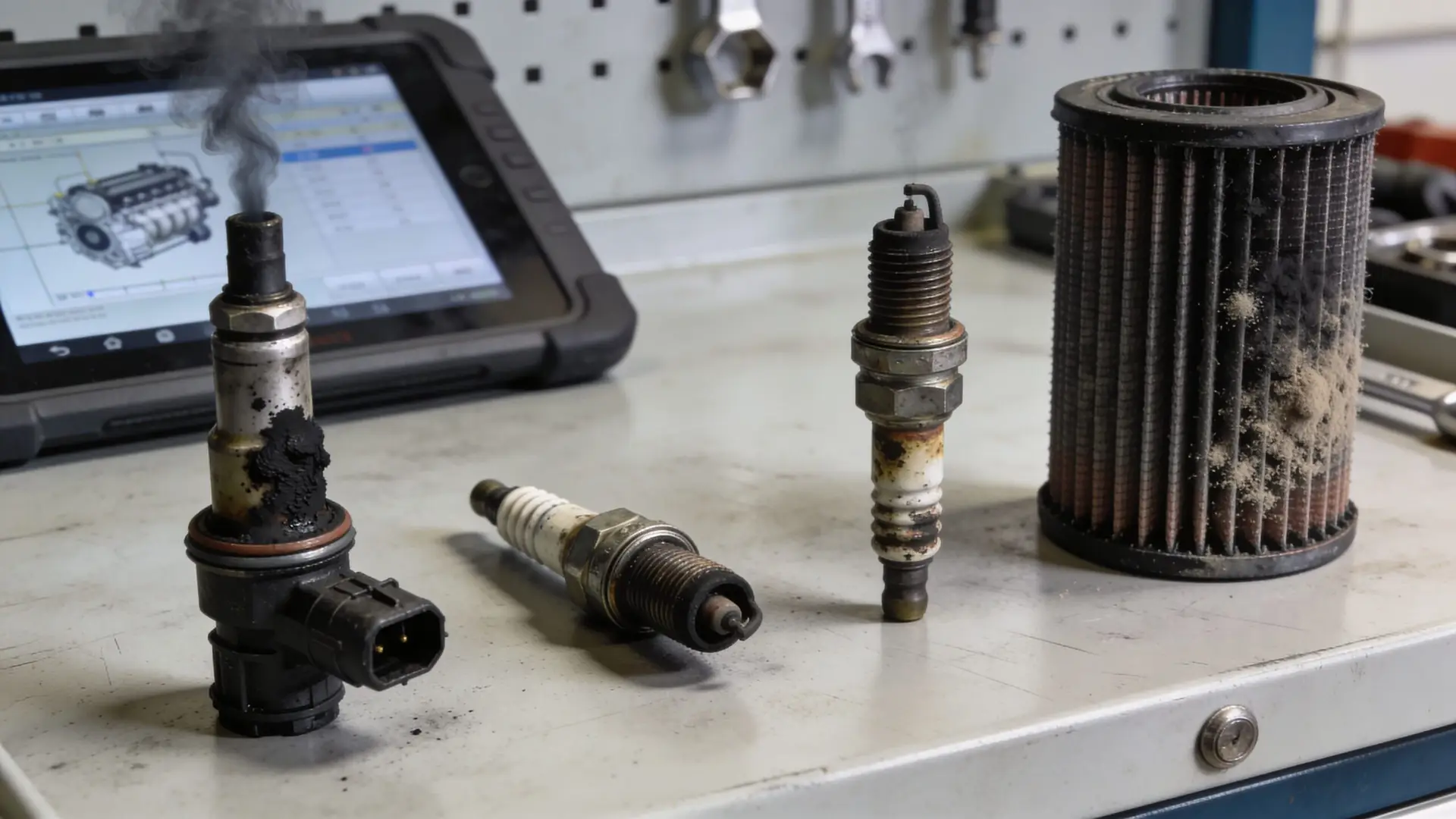
For gasoline engines
1. Dirty or restricted air filter
This is still one of the most common causes, and it is often the cheapest fix on the list. If the filter is packed with dust, leaves, or road grit, the engine cannot get the air volume it expects. Fuel delivery stays up, air supply falls off, and the mixture goes rich.
In Plano, I see this more after long pollen seasons, construction dust, and drivers stretching service intervals too far. A restricted filter may only cause a light puff at first, then become obvious during hard acceleration or highway merging.
2. Faulty MAF sensor
The mass air flow sensor measures incoming air so the computer can match fuel to it. If the sensor is dirty or reading low, the engine may add more fuel than it can burn cleanly. That can create black smoke, rough acceleration, and fuel mileage complaints at the same time.
A contaminated MAF is common after aftermarket oiled filters, intake repairs, or simple age. Plano stop-and-go driving does not help. Heat, dust, and short-trip use tend to leave a film on sensors long before they fail completely.
3. Leaking or poorly atomizing fuel injectors
Injectors have to do two jobs well. They must deliver the correct amount of fuel, and they must spray it in a fine pattern. When an injector dribbles, sticks, or leaks after shutoff, that cylinder runs rich and combustion gets dirty fast.
If you want a clearer owner-level explanation of what failing injectors look like, this guide to bad fuel injector symptoms is a useful reference.
4. Rich command from other fuel-control inputs
Sometimes the injectors and MAF are not the underlying problem. The engine computer may be reacting to bad information from another sensor, carbon buildup around the intake path, or a fuel-pressure issue that pushes more fuel through than intended. Gasoline direct-injection engines are especially sensitive here.
Effective diagnosis saves money. Replacing plugs, coils, and injectors without checking scan data often turns a single-fault repair into a pile of parts.
For modern diesel engines
Diesels need much tighter coordination between fuel delivery, airflow, turbo boost, and emissions hardware. When one piece lags behind, black smoke shows up most clearly under load. A truck that looks fine at idle can still pour smoke when towing, climbing, or accelerating onto a Plano freeway.
5. Dirty EGR valve or intake carbon buildup
The EGR system meters exhaust gas back into the intake to control combustion temperatures and emissions. When the valve sticks or the intake passages load up with carbon, the engine does not get the clean air charge it needs. Power drops off, throttle response gets dull, and black smoke often follows.
A lot of drivers describe this as the vehicle feeling lazy before it starts smoking heavily. That description is usually accurate.
6. Turbo or boost problems
A diesel depends on boost to pack enough oxygen into the cylinders. If the turbo is underperforming, the charge-air plumbing is leaking, or the boost control system is not responding properly, fuel delivery can outpace available air. The result is soot.
This fault is easy to misread from the driver’s seat. Weak boost can feel like injector trouble, transmission hesitation, or just a heavy vehicle on a hot Texas afternoon. In the shop, the fix may be as small as a split hose or as expensive as a failing turbocharger. That trade-off is why testing boost and airflow first matters.
7. DPF restriction or failed regeneration
A diesel particulate filter is supposed to trap soot and burn it off during regeneration. When that process stops happening correctly, exhaust flow gets restricted and soot problems get worse. Some vehicles will set warning lights first. Others show smoke, poor power, or repeated regen issues before the driver notices a message.
At that point, the repair path depends on how far the problem has gone. A recoverable filter may respond to proper diagnosis and service. A heavily loaded or damaged unit can turn into a much more expensive repair, especially if the original cause was ignored.
A diesel that smokes under load needs a test sequence, not guesswork. Check airflow, boost, EGR operation, fault codes, and regeneration history in order.
The Texas-specific wrinkle
North Texas weather adds its own layer to smoke complaints. High heat stresses sensors and intake parts. Humid mornings can change how a borderline engine behaves. Long idling with the A/C blasting, followed by a hard pull into traffic, is a common setup for a brief black puff.
That is why I tell Plano drivers to pay attention to timing, not just color. Smoke on cold start points in one direction. Smoke only during acceleration points in another. Smoke with low power, poor mileage, or a check engine light gives the shop a much shorter path to the right repair.
Simple Checks You Can Do in Your Driveway
You don’t need a full shop setup to gather useful clues. The goal at home isn’t to guess the repair. It’s to build a clean symptom story so diagnosis goes faster and you don’t spend money replacing parts that weren’t the problem.
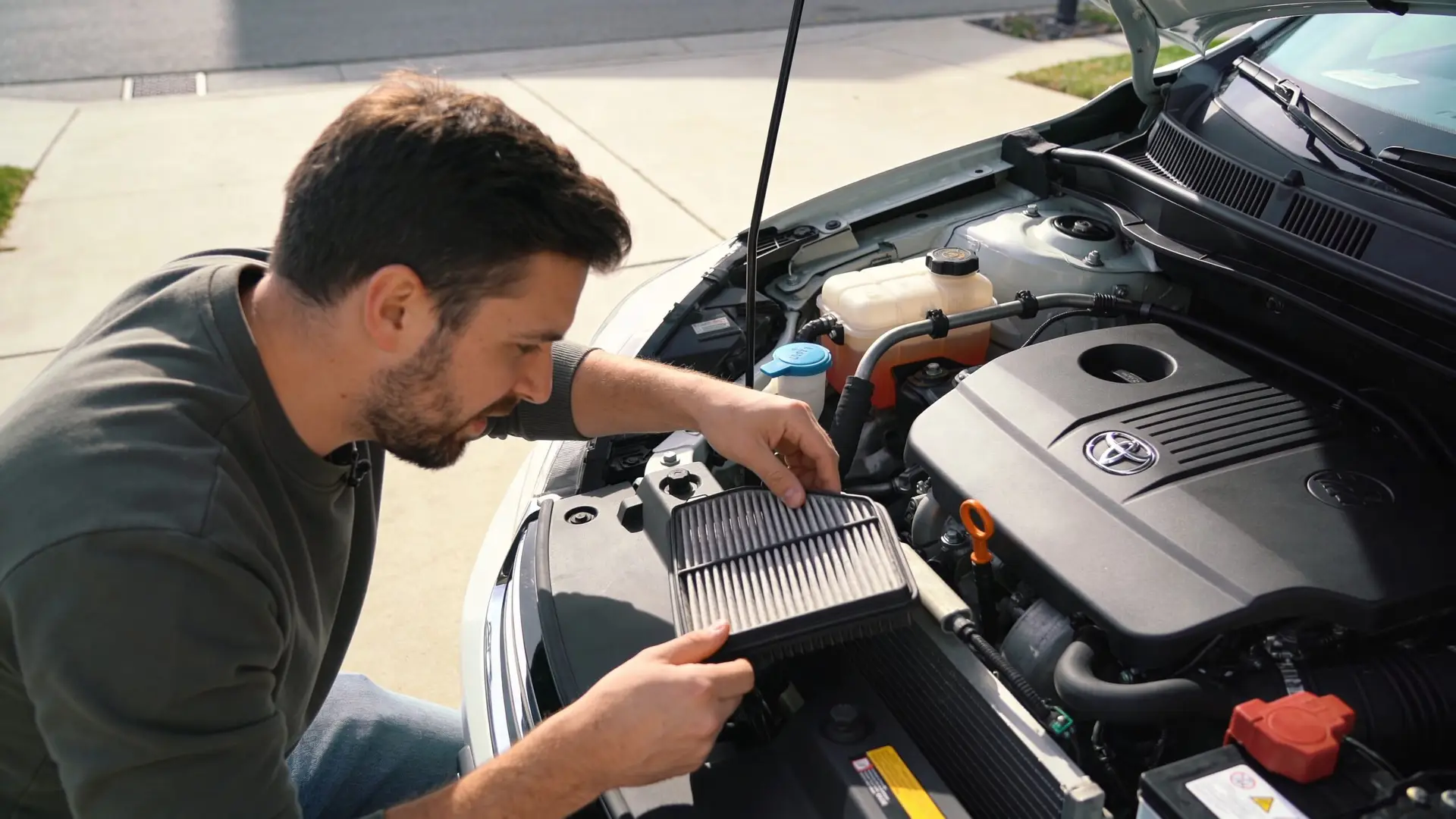
Start with the easiest visual checks
Open the hood with the engine off and cool. Then work through the basics.
- Check the air filter first. If it’s heavily dirty, packed with debris, or looks neglected, you may have found a simple airflow restriction.
- Look for disconnected intake tubing. A loose clamp or cracked intake boot can confuse airflow readings.
- Inspect obvious vacuum and breather hoses. Brittle rubber, splits, and loose fittings can upset how the engine meters air.
- Look for signs of soot around diesel intake or charge pipes. That can hint at leakage or buildup issues.
If your vehicle has been acting fuel-starved as well, this overview of clogged fuel filter symptoms can help you separate smoke complaints from fuel supply complaints.
Pay attention to when the smoke happens
This part helps more than people realize. Write it down in your phone if needed.
- Only on startup
- Only under hard acceleration
- At idle after warmup
- After long stop and go traffic
- After filling up with fuel
- With the check engine light on or off
Those patterns steer the next test. A startup puff can point one direction. A load-related diesel smoke issue points another.
Don’t tell the shop only “it smokes.” Tell them when, how often, and what the engine was doing when it happened.
A short video like this can help you understand what to watch for before you head in for service.
Listen and smell
You can learn a lot without touching anything.
Listen for these clues
- Hissing under the hood can suggest an intake leak.
- Uneven idle can point toward a mixture problem.
- Turbo whistle changes on a diesel may suggest boost-related trouble.
- Hard starting can support a fuel-delivery issue.
Notice the smell
Black smoke often comes with a raw fuel smell. That doesn’t confirm the exact cause, but it supports the rich-running diagnosis.
What not to do at home
Skip the parts cannon. Don’t replace a MAF sensor, injectors, oxygen sensors, and filters just because internet lists mention them. Modern engines overlap symptoms heavily.
Also skip cleaning sensitive sensors with the wrong chemical. A MAF sensor can be damaged by rough handling or the wrong spray. If you’re not sure, stop at the inspection stage and let a technician take it from there.
Professional Repairs and Typical Costs in Plano
By the time a black smoke complaint reaches the shop, the goal changes. The question is no longer “what are the common causes?” It is “which system failed on this vehicle, and what is the least expensive accurate fix?”
That matters in Plano, where a lot of vehicles spend their week in stop and go traffic on Central Expressway, then get pushed hard merging onto Dallas North Tollway or hauling kids and gear across town in summer heat. Those conditions can expose a weak sensor, dirty intake path, sticking injector, or diesel aftertreatment problem faster than easy highway cruising will.
What a real diagnostic visit looks like
A solid diagnosis starts with confirmation, not parts replacement. In the bay, a technician usually road-tests the vehicle if the symptom is safe and repeatable, then checks scan data to see whether the engine is running rich, under-reporting airflow, over-fueling under load, or struggling with restricted exhaust flow.
A proper black smoke diagnosis usually includes:
- OBD-II code scan and live data review for fuel trims, airflow readings, boost data, injector balance clues, and related faults
- Visual intake and exhaust inspection for collapsed ducts, loose boots, soot trails, damaged clamps, and restrictions
- Fuel system testing when injector leak, pressure, or spray pattern issues are suspected
- Diesel soot load and regeneration checks when a DPF or EGR fault is part of the complaint
On many diesel trucks and SUVs, a forced regeneration or targeted cleaning may solve the problem if the filter is still serviceable. Once the DPF is overloaded, melted, or contaminated, replacement gets expensive fast.
At a local shop such as Express Lube & Car Care, the first diagnostic hour often saves the most money. It separates a maintenance-level repair from a larger fuel, turbo, or emissions repair before you approve work you may not need.
If you want a broader view of how labor, testing, and parts affect the final bill, this engine repair cost guide for Plano drivers gives useful context.
Common repairs and estimated costs
Repair cost depends on access, engine design, and what testing proves. A dirty air filter on a gasoline sedan is a very different job than injector work on a turbo diesel. The smoke looks similar from the tailpipe. The repair path often is not.
Here is the practical way I’d frame it for a Plano driver calling the shop:
| Problem Area | Common Repair | Estimated Cost Range |
|---|---|---|
| Air intake restriction | Air filter replacement, intake inspection, housing cleanup | Lower-cost service on most vehicles |
| MAF sensor issue | Sensor cleaning or replacement after testing | Moderate, depending on sensor location and part quality |
| Fuel injector fault | Injector cleaning, flow testing, or replacement | Moderate to high, especially on direct-injection or diesel systems |
| Intake leak or hose issue | Replace cracked boot, loose clamp, or damaged line | Lower to moderate, depending on access |
| Carbon buildup in GDI engine | Intake valve cleaning service | Moderate service cost |
| Diesel EGR problem | EGR cleaning or component replacement | Moderate to high |
| Turbo or boost fault | Charge-air leak repair, actuator diagnosis, turbo-related repair | Moderate to high, sometimes much higher if the turbo has failed |
| Saturated diesel DPF | Forced regeneration, chemical cleaning, or DPF replacement | Cleaning is often moderate. Replacement can be a major repair |
There is a real trade-off between fixing the symptom quickly and fixing the cause correctly. Clearing codes, tossing in an additive, or replacing a sensor because it is easy to reach can get a vehicle out the door for a day or two. It does not hold up if the actual problem is a leaking injector, split intercooler boot, or restricted filter.
What works and what usually doesn’t
The repairs that stick are the ones tied to test results. If airflow readings are off and the sensor fails response testing, address the sensor or the air leak. If smoke shows up only under boost and there is oil mist around a charge pipe connection, inspect the turbo plumbing before condemning injectors. If a diesel has high soot load and failed regens, check why the system stopped regenerating before quoting the filter.
Good diagnosis can feel slower at the counter. It is usually faster and cheaper by the time the repair is done.
Your Next Step Your Local Plano Auto Experts
If your vehicle is putting out black smoke, the smartest next step is to stop treating it like a minor annoyance. The symptom may come from something small, but it can also point to a richer-running condition that keeps wasting fuel and can stress other components if you keep driving it that way.
For Plano drivers, convenience matters almost as much as the repair itself. Drivers often lack the time to leave work, wait weeks for an opening, and bounce between an oil change shop and a repair shop. A no-appointment-needed facility that can handle both maintenance and deeper diagnostics makes the process simpler.
What matters when you choose a shop
Look for a shop that can do more than read a code and sell a part. You want:
- ASE-certified technicians who understand both gasoline and diesel smoke diagnostics
- Modern scan tools that show live data, not just stored codes
- Clear recommendations that separate confirmed faults from possible next steps
- Practical turnaround for busy commuters and family vehicles
Local value matters too. Express Lube Plano offers ongoing savings that can help if your smoke complaint turns into overdue maintenance at the same visit. That includes $20 off oil change and additional services for military, first responders, and healthcare workers, $20 off batteries with the Signature battery service, and $25 off oil changes on Ladies Day every Wednesday.
When not to wait
Move faster if any of these apply:
- The smoke is getting heavier
- The check engine light is on
- The engine feels weak or stumbles
- Fuel economy dropped noticeably
- You drive a diesel that now feels restricted under load
A black smoke problem usually gets cheaper when it’s diagnosed early. It rarely gets cheaper by hoping it clears up on its own.
Frequently Asked Questions About Exhaust Smoke
Is it safe to drive with black smoke coming from exhaust
Treat black smoke as a warning, not a nuisance.
A short trip across Plano might not leave you stranded, but it can turn a manageable repair into a more expensive one. A rich-running engine can foul spark plugs, load up the catalytic converter, dilute engine oil with fuel, and on some diesels, shorten DPF life. If the smoke showed up during a hot afternoon commute on Central Expressway or while merging onto the President George Bush Turnpike, the extra load and heat can make the problem show itself faster.
If the engine runs rough, power drops, or the check engine light is flashing, stop driving and have it towed.
Will my car fail a Texas inspection for black smoke
It can.
Black smoke usually means the engine is running rich or not getting enough air, and those same faults often trigger emissions-related trouble codes or incomplete monitor readiness. Even before the computer side becomes a problem, visible smoke tells an inspector something is off.
The practical move is to fix the cause first, drive enough for the monitors to reset, and go into inspection with a clean-running engine.
Does fuel type really make a difference
Sometimes, but fuel is rarely the first place I land unless the pattern fits.
If the smoke started right after a fill-up, only happens on cold starts, or comes and goes without any obvious drivability problem, bad or contaminated fuel is worth considering. In Plano, I also pay attention to cars that sit for long stretches in summer heat, then get driven on short errands. That combination can expose weak combustion quality faster than steady highway driving.
Start with the simple check. Try a different reputable fuel station on the next tank and avoid guessing with multiple additives. If the smoke stays the same, move on to actual diagnosis instead of chasing fuel quality.
What’s the difference between black, blue, and white smoke
Smoke color points the diagnosis in different directions.
Black smoke usually means too much fuel or not enough air. Blue smoke points to oil getting into the combustion chamber. White smoke can be normal condensation for a minute or two, or it can point to coolant entry if it lingers and has a sweet smell.
A quick phone video helps more than many drivers realize. Capture the startup, a few light revs, and whether the smoke appears only under throttle. That gives a technician a better starting point than “it smokes sometimes.”
Can an oil change fix black smoke
Usually no.
An oil change does not repair a bad mass airflow sensor, leaking injector, stuck EGR issue, restricted air intake, or diesel aftertreatment fault. It can still be useful if the oil is fuel-diluted from a rich condition, because fresh oil protects the engine while the underlying problem gets diagnosed.
For Plano drivers trying to keep costs under control, that matters. Spending money on maintenance that does not match the fault is frustrating. A focused diagnostic test is usually cheaper than replacing parts based on a guess.
If you want a local shop to confirm the cause, Express Lube & Car Care handles smoke complaints, check engine diagnosis, and repair recommendations in one visit.