
When it comes to vehicle safety, your braking system is non-negotiable. While brake pads and rotors get most of the attention, the hydraulic fluid that powers them is equally critical. So, how often does your car need a brake fluid flush to maintain peak performance and safety?
The generally accepted guideline for most vehicles is a complete brake fluid flush every 2 to 3 years or approximately every 30,000 miles—whichever milestone you reach first. This interval isn't arbitrary; it's a crucial preventative measure based on the chemical properties of brake fluid and its role in your car's safety.
Understanding the Science: Why Brake Fluid Needs Changing
Brake fluid is a hydraulic fluid, meaning its primary job is to transfer the force you apply at the brake pedal into pressure at the wheels, stopping the car. To do this effectively, it must be incompressible. However, brake fluid has a significant vulnerability: it is hygroscopic, meaning it naturally absorbs moisture from the surrounding atmosphere.
Even within a sealed brake system, microscopic pores in hoses and seals allow water vapor to enter over time. This moisture contamination progressively lowers the fluid's boiling point.
This drop in boiling point creates the risk of a dangerous condition called "brake fade." During heavy or prolonged braking—like descending a steep hill or in stop-and-go traffic—the fluid can heat up past its now-lowered boiling point. The water within it turns to steam, creating compressible gas bubbles in the lines. When you press the pedal, these bubbles compress instead of transferring force, causing the pedal to feel "spongy" and dramatically increasing your stopping distance when you need it most.
Adhering to the Standard Service Interval
For the average driver in Plano, following the 2-3 year or 30,000-mile recommendation is the most effective way to ensure safety. This schedule is designed to remove old, moisture-laden fluid before its boiling point drops to a dangerous level. This proactive service is a cornerstone of vehicle reliability, a topic we explore further in our guide on essential car maintenance.
This timeframe is backed by industry data. Automotive engineering studies have demonstrated that brake fluid can absorb enough water to become unsafe in as little as 24 months. For a typical DFW commuter driving 12,000–15,000 miles annually, this timeline aligns perfectly with the recommended service interval.
This flowchart helps visualize the decision-making process for this vital service.
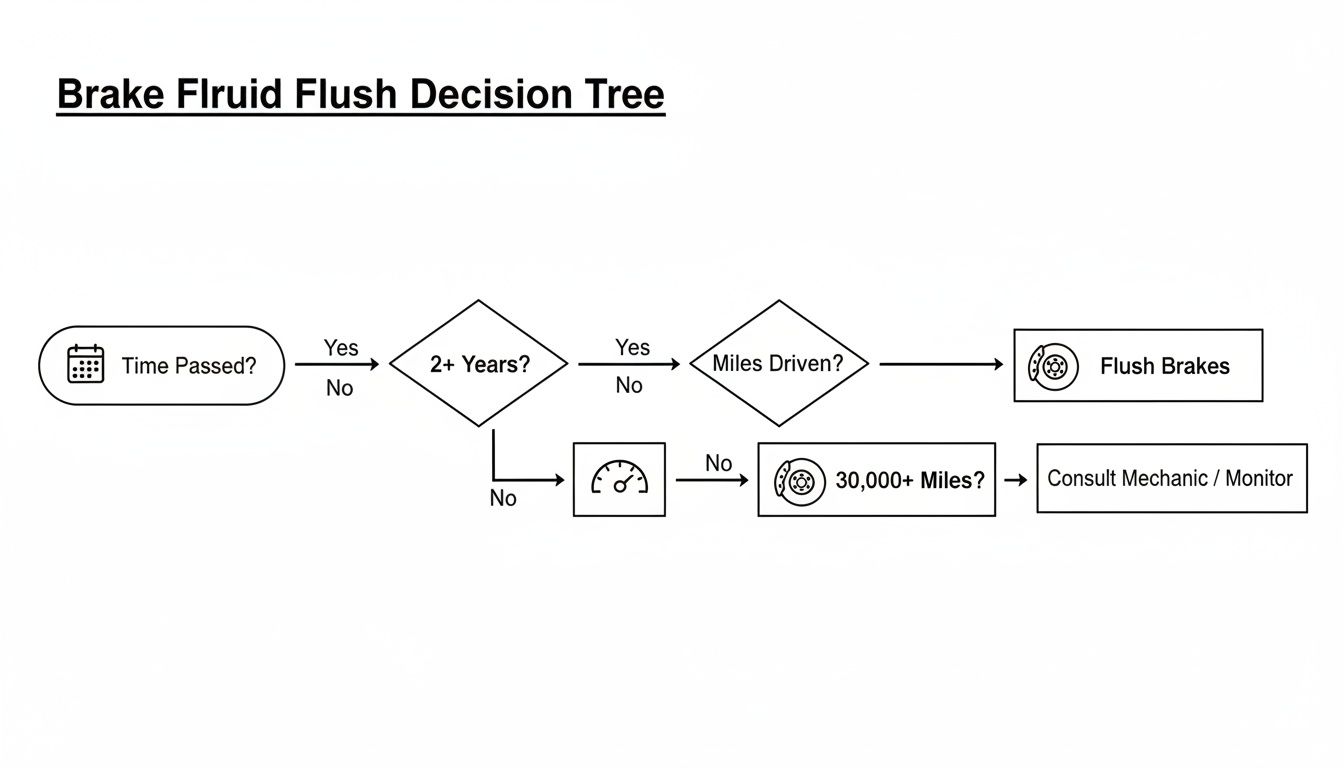
The key principle is that both time and mileage are critical factors. Even a low-mileage vehicle that is rarely driven is still susceptible, as the fluid inside continuously absorbs ambient moisture.
Quick Guide to Brake Fluid Flush Intervals
To provide a clearer understanding of how driving conditions influence the service schedule, here is a reference table tailored for North Texas drivers.
| Driving Condition | Recommended Time Interval | Recommended Mileage Interval |
|---|---|---|
| Normal Commuting (Plano/DFW) | Every 2 years | Every 24,000 – 30,000 miles |
| High-Humidity Climate | Every 2 years, or sooner if tested | Every 24,000 miles |
| Aggressive Driving / Towing | Every 18-24 months | Every 20,000 miles |
| Low Mileage / Infrequent Use | Every 2 years, regardless of miles | N/A (time is the key factor) |
This table illustrates that a universal recommendation isn't always sufficient. While these guidelines are a solid starting point, your specific driving habits and environment play a significant role in maintaining a safe braking system.
What a Brake Fluid Flush Actually Does for Your Car
Many drivers mistakenly believe a brake fluid service is a simple "top-off," but this is a dangerous misunderstanding. A proper flush is a comprehensive hydraulic system renewal.
Consider this analogy: you wouldn't brew fresh coffee by pouring hot water over yesterday's used grounds. The same logic applies to your braking system.
Simply adding new fluid to the reservoir leaves behind all the accumulated contaminants—moisture, microscopic metal particles, and degraded rubber—circulating in the lines. A professional brake fluid flush involves a full-system procedure to drain 100% of the old, contaminated fluid and replace it with fresh, new fluid.
The Physics Behind Your Stopping Power
Your vehicle's braking system is a feat of hydraulic engineering. Brake fluid is formulated to be incompressible, meaning it transfers force without losing energy. When you press the brake pedal, this force is transmitted instantaneously through the fluid to the brake calipers, which then actuate the pads to create friction and stop your vehicle.
For this process to work flawlessly, the fluid must remain pure. The primary enemy is water. As brake fluid absorbs moisture, its boiling point drops significantly. When the fluid gets hot from braking, this water can vaporize into steam. Since steam is highly compressible, it introduces "play" into the system, resulting in a spongy pedal feel and a severe reduction in braking efficiency.
A study by the Society of Automotive Engineers (SAE) found that after just two years, brake fluid can absorb enough moisture to lower its boiling point by over 150°F. This significant degradation underscores why this service is so critical for safety.
Why a Full Flush Is the Only Effective Method
Completely draining and replacing the fluid is the only way to restore its high boiling point and protect internal metal components like brake lines and calipers from corrosion. You can learn to identify contaminated fluid in our guide on how to check your brake fluid.
Ultimately, a complete flush ensures your brakes deliver the firm, immediate response necessary for safe driving.
Beyond The Sticker: What Really Affects Your Brake Fluid Flush Schedule
While the 2 to 3-year rule of thumb is a solid baseline, it doesn't account for individual circumstances. Several critical factors can shorten this interval, making a personalized maintenance plan essential for keeping your brakes responsive and reliable.
Consider the manufacturer's recommendation as a starting point. Your optimal schedule will be influenced by your environment, driving style, and the specific fluid your vehicle requires. Understanding these variables empowers you to make informed maintenance decisions that protect your braking system.
Your Daily Driving Habits
Not all miles are equal. Your driving style directly impacts your brake fluid's lifespan. A driver who primarily cruises on the highway subjects their brakes to far less stress than someone navigating stop-and-go city traffic.
The typical DFW commute, for example, is demanding on brakes. The constant acceleration and deceleration generate significant heat. This heat not only wears down pads and rotors but also accelerates the chemical breakdown of brake fluid and increases its vulnerability to moisture-related boiling.
Key Takeaway: If your daily driving involves heavy traffic, towing, or aggressive braking, you should shorten your brake fluid flush interval. This proactive measure ensures your fluid maintains its integrity under high-stress conditions.
The North Texas Climate
Your geographical location plays a larger role than you might think. Because brake fluid is hygroscopic, it absorbs moisture from the air. Here in North Texas, the humid climate means there is a higher concentration of water vapor in the atmosphere for the fluid to absorb.
This constant exposure to humidity can cause the fluid to become contaminated with water more rapidly than in a dry, arid climate. Consequently, a two-year-old vehicle in Plano may have more moisture in its brake lines than a four-year-old vehicle in a desert region.
Not All Brake Fluids Are The Same
The type of brake fluid specified for your car is a major factor. Most modern vehicles use glycol-based fluids, primarily DOT 3 and DOT 4. While they serve the same function, their chemical properties and performance characteristics differ.
- DOT 3: The long-standing standard, especially in older vehicles. It is effective but has a lower boiling point and absorbs moisture more readily than newer formulations.
- DOT 4: Used in most modern cars, DOT 4 has a higher boiling point to cope with the heat generated by systems like ABS and traction control. It offers superior performance but still requires regular replacement.
- DOT 5.1: Another glycol-based fluid with an even higher boiling point, typically found in high-performance or heavy-duty vehicles subjected to extreme braking conditions.
It is crucial to always use the specific fluid type recommended in your owner’s manual. Using the wrong type can compromise braking performance and damage sensitive system components.
Brake Fluid Type Comparison
The differences between common brake fluids are rooted in their chemical composition and performance ratings. Their boiling points are a key metric. Here’s a technical breakdown:
| Fluid Type | Base | Typical Dry Boiling Point | Recommended Change Interval |
|---|---|---|---|
| DOT 3 | Glycol-Ether | 401°F (205°C) | Every 2 years |
| DOT 4 | Glycol-Ether/Borate-Ester | 446°F (230°C) | Every 2-3 years |
| DOT 5.1 | Glycol-Ether/Borate-Ester | 518°F (270°C) | Every 2-3 years |
As the DOT number for glycol-based fluids increases, so does the boiling point, indicating better performance under thermal load. However, higher-performance fluids can sometimes be more hygroscopic, making timely replacement equally important.
Telltale Signs Your Brake Fluid Needs Immediate Attention
While routine maintenance is the best practice, your vehicle often provides clear warning signs when its brake fluid is old, contaminated, and requires an immediate flush. Recognizing these symptoms is a critical aspect of responsible car ownership. Ignoring them can lead to system failure and costly repairs.
A Spongy or Soft Brake Pedal
This is the quintessential sign of compromised brake fluid. A properly functioning brake pedal should feel firm and offer consistent resistance. If the pedal feels soft, "spongy," or travels further toward the floor than usual, it is a major red flag.
This spongy sensation is almost always caused by water contamination. During braking, heat turns this water into steam. Unlike liquid fluid, steam is a gas and is easily compressed. When you press the pedal, the force you apply compresses these gas bubbles instead of being transmitted to the brake calipers. The result is a dangerous loss of stopping power.
Critical Insight: A spongy brake pedal indicates a failure within the hydraulic system. Your ability to stop has been significantly compromised, and the vehicle requires immediate professional inspection.
Changes in Stopping Performance
In addition to pedal feel, pay close attention to your vehicle's braking behavior. Old, contaminated fluid can cause a noticeable degradation in performance that worsens over time.
Key indicators include:
- Increased Stopping Distance: The vehicle takes longer to come to a complete stop, forcing you to apply the brakes earlier and with more force.
- ABS Light Illumination: The Anti-lock Braking System (ABS) warning light may illuminate. The ABS module is highly sensitive to hydraulic pressure changes and can detect fluid-related problems.
- Unusual Noises or Smells: While often linked to worn pads, contaminated fluid can cause brakes to overheat. A sharp, burning smell after braking can indicate that the fluid is failing to manage heat effectively. For more information, see our guide on other signs you might need new brakes.
Visual Clues in the Reservoir
One of the simplest diagnostic checks is a visual inspection of the brake fluid reservoir. This is typically a small, translucent plastic tank located in the engine bay, near the firewall.
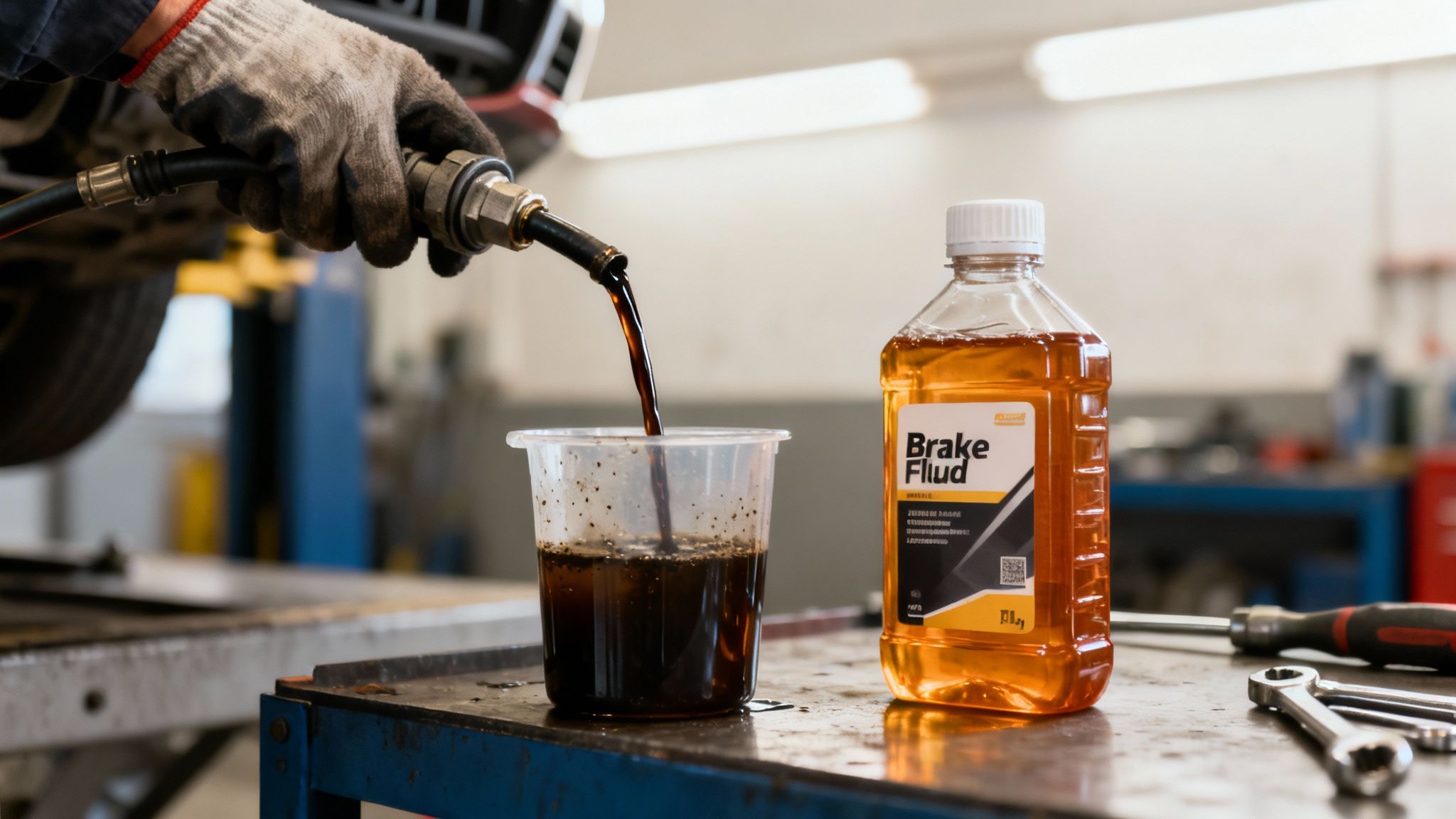
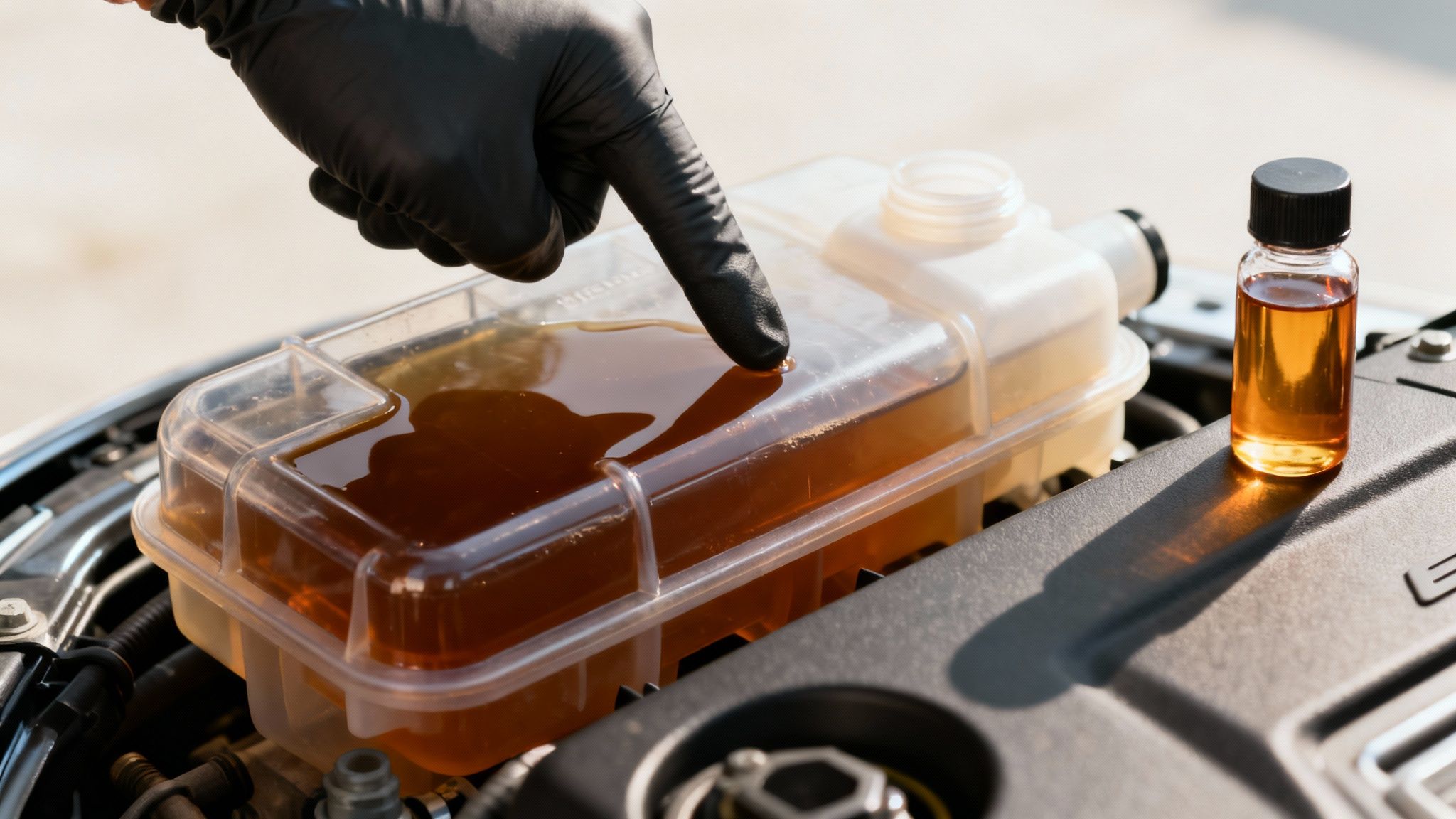
Fresh brake fluid is translucent and has a light amber or golden hue. Over time, as it absorbs moisture and accumulates debris from degrading hoses and seals, it will darken. If the fluid in the reservoir appears dark brown or black, it is severely contaminated and long overdue for a complete flush.
The Hidden Costs of Neglecting Your Brake Fluid
It can be tempting to postpone maintenance items like a brake fluid flush, especially if the car appears to be stopping normally. However, this is a classic "pay a little now or a lot later" scenario. Neglecting this fundamental service can lead to some of the most complex and expensive repairs a vehicle can require.
Think of old, moisture-laden brake fluid as a corrosive agent, slowly damaging the entire braking system from the inside.
A Domino Effect of Corrosion
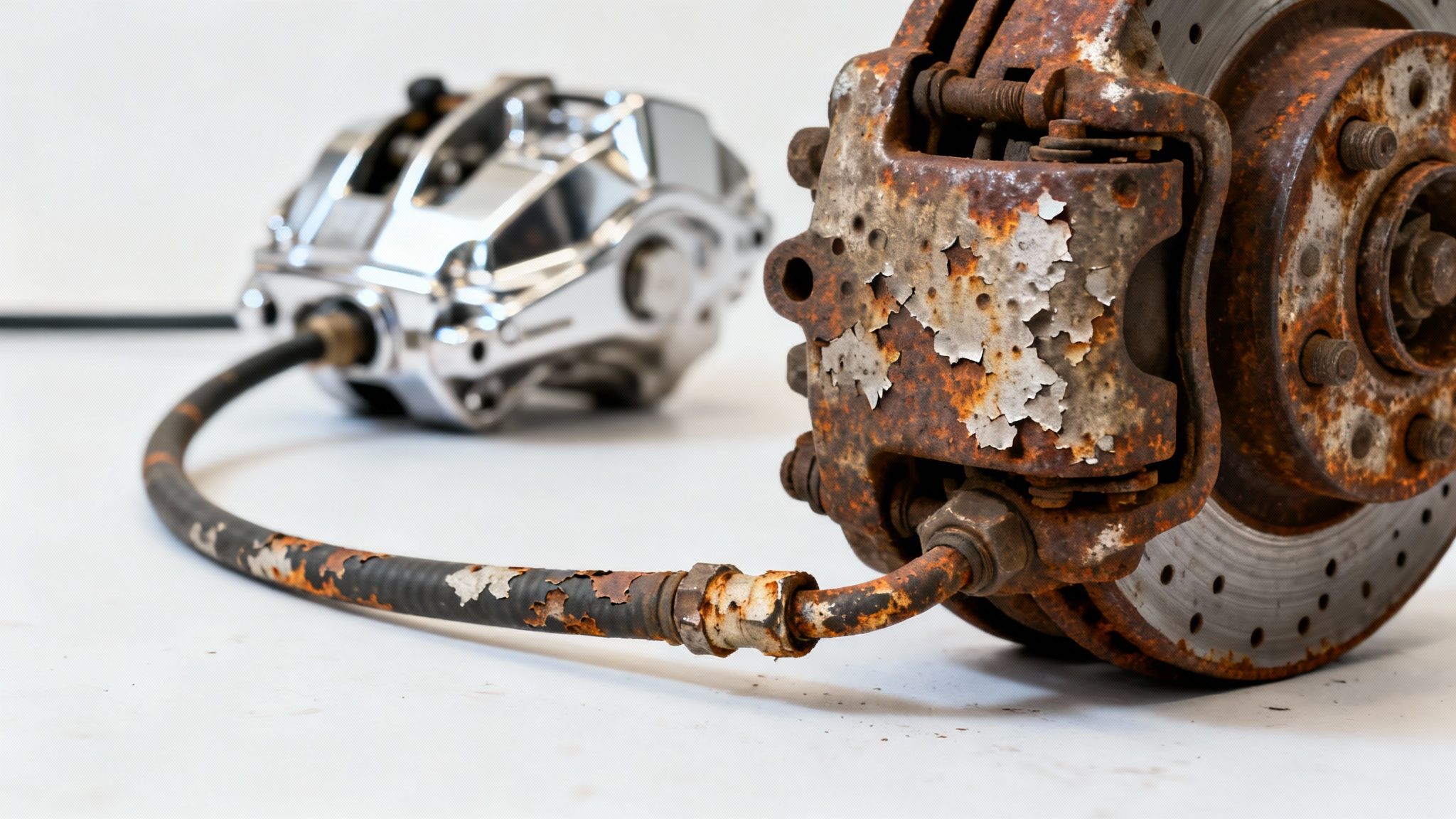
Once water contaminates brake fluid, it begins to corrode the internal metal surfaces it contacts. This is not merely a cosmetic issue; it initiates a chain reaction that can lead to systemic failure.
The key components at risk include:
- Brake Lines: The steel tubes that carry fluid can rust from the inside out, eventually weakening to the point of leaking or bursting under pressure.
- Calipers: Corrosion can cause caliper pistons to seize, leading to uneven braking, premature pad wear, or a complete loss of function at that wheel.
- Master Cylinder: As the heart of the hydraulic system, internal corrosion can damage its precision seals, causing a loss of hydraulic pressure and brake failure.
The most costly component vulnerable to damage is the ABS module. This sophisticated computer controls wheel lock-up during emergency stops. Its intricate network of tiny valves and passages is easily clogged and destroyed by rust particles and other debris from old fluid. Replacing a failed ABS module is a major repair that can cost well over a thousand dollars.
A scheduled brake fluid flush is not an upsell; it is an inexpensive insurance policy against catastrophic brake system failure. The cost of a flush is negligible compared to replacing a corroded ABS module or seized calipers.
Comparing Costs: A Small Service vs. A Major Repair
When you analyze the numbers, the choice becomes clear. A professional brake fluid flush in the U.S. typically costs between $100 and $225.
This minor investment protects you from repair bills that can easily reach into the thousands. Deferring this service is a false economy that gambles with both your safety and your finances. For a deeper dive, see this automotive brake fluid market analysis.
Trusting Your Brakes to Certified Plano Experts
Knowing when to get a brake fluid flush is important, but ensuring the service is performed correctly is paramount. Your braking system is the most critical safety feature on your vehicle, and its service should only be entrusted to qualified professionals.
A professional flush requires specialized pressure-bleeding equipment to force every drop of old, contaminated fluid and any trapped air bubbles out of the lines, calipers, and master cylinder. Without this equipment, residual contaminants will immediately compromise the new fluid, rendering the service ineffective.
Why Certified Technicians Matter: An ASE-certified technician has undergone rigorous testing and demonstrated expertise in complex vehicle systems. They understand the specific procedures, pressures, and fluid types required for your vehicle, ensuring the job is done safely and correctly, protecting both your warranty and your well-being.
Your Local Solution for Brake Safety in Plano
At Express Lube & Car Care, our ASE-certified technicians possess the expertise and state-of-the-art equipment to perform a brake fluid flush to the highest standard. We use only premium brake fluids that meet or exceed your manufacturer's specifications, restoring the firm, responsive brake pedal you depend on.
We are committed to making essential safety services accessible and convenient for the Plano community. Our shop is always no-appointment-needed, allowing you to stop by at your convenience. We are also pleased to offer special discounts to thank those who serve our community.
- Military & First Responders: Ask about our exclusive service discounts.
- Ladies Day: Every Wednesday, ladies receive $25 off their oil change service.
Choosing Express Lube & Car Care means choosing confidence. We provide transparent pricing, honest technical advice, and professional service that keeps you and your family safe. Drive with peace of mind knowing your brakes were serviced by Plano's trusted experts.
A Few Common Questions About Brake Fluid
Let's address some frequently asked questions to help you feel more knowledgeable about maintaining your vehicle's most important safety system.
Can't I Just Top It Off Instead of a Full Flush?
While adding fluid to the reservoir may seem like a quick fix for a low level, it does not address the underlying problem: contamination. Think of it like adding a glass of fresh water to a gallon of muddy water—the entire gallon remains dirty.
Moisture and debris are already circulating throughout your brake lines. Topping off will not remove them. A complete system flush is the only way to purge the old, compromised fluid and replace it with fresh fluid that can properly protect your entire braking system.
Does My Manufacturer Really Say I Need This?
Yes. Virtually every vehicle manufacturer includes a brake fluid exchange as part of their scheduled maintenance program. You should always consult your owner's manual for the precise interval, but the industry-standard recommendation for most vehicles is every 2-3 years.
What's the Big Deal Between DOT 3 and DOT 4 Fluid?
The primary difference is their boiling point. DOT 4 fluid is engineered to withstand higher temperatures before boiling, which is a critical advantage for modern vehicles equipped with heat-generating ABS and traction control systems.
While both are glycol-based, they are not always interchangeable. Adhering to your manufacturer's recommendation is the safest way to ensure your braking system performs exactly as it was designed to.
For professional brake service you can trust, visit Express Lube & Car Care. Our ASE-certified technicians in Plano ensure your brakes are in top condition, giving you peace of mind on the road. Stop by today—no appointment needed! https://www.expresslubeplano.com