
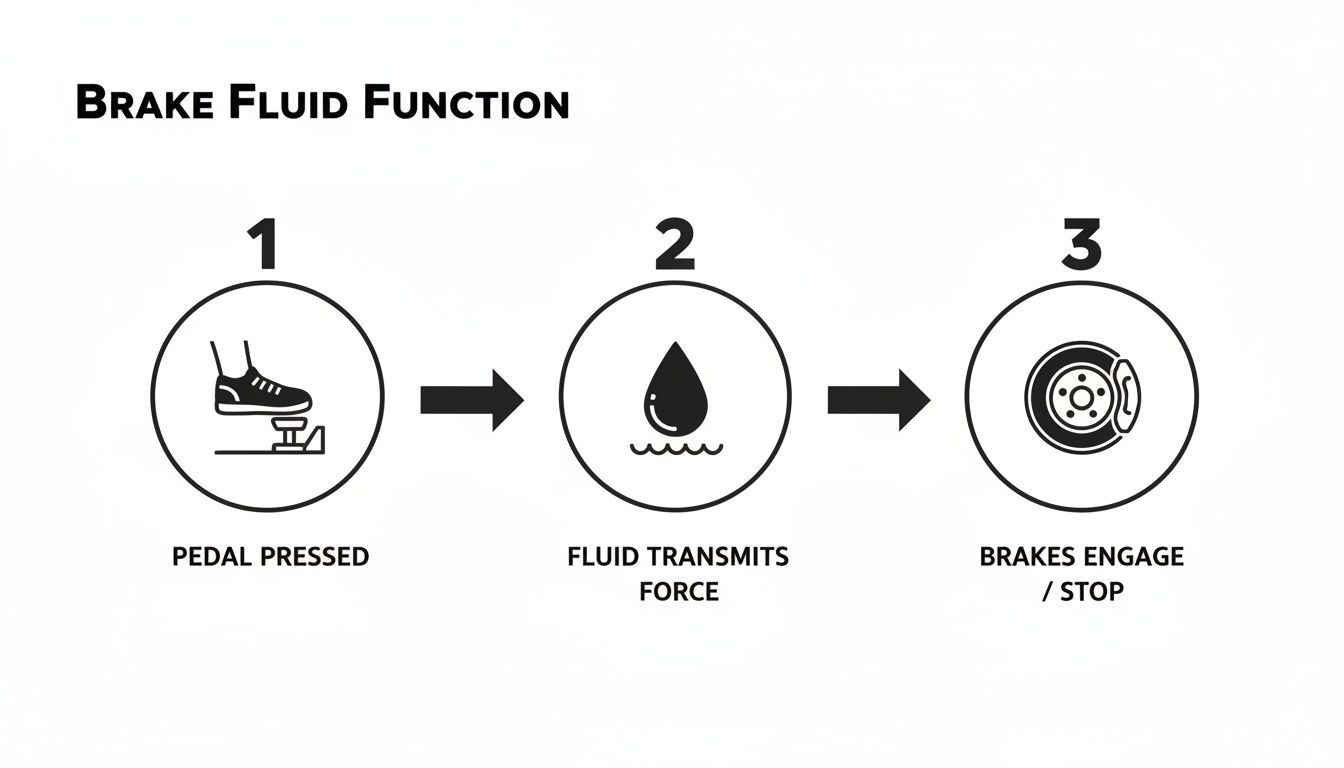
Before you can check your brake fluid, it's essential to understand its critical role. It is the unsung hero of your braking system, responsible for transferring the force from your foot on the brake pedal to the wheels. Simply put, neglecting it is not an option. Old or contaminated fluid can lead directly to brake failure.
The Science Behind Why Your Brake Fluid Matters
Think of brake fluid as the hydraulic medium flowing through your car's braking system. Every time you slow down, this fluid is subjected to immense pressure and heat.
When you press the brake pedal, this specialized fluid is forced through a network of lines and hoses, creating the hydraulic pressure needed to clamp the brake pads onto the rotors. If that fluid is not clean and effective, the entire process is compromised, placing you in a dangerous situation—especially for drivers in Plano navigating busy roads like the Dallas North Tollway.
This is precisely why regular inspection is non-negotiable. Over time, brake fluid, which is naturally hygroscopic, absorbs moisture from the surrounding air. This water contamination is highly detrimental, as it significantly lowers the fluid's boiling point.
If the fluid boils under the heat of braking, it creates compressible vapor bubbles in the brake lines. This leads to a phenomenon known as "brake fade," which manifests as a spongy feeling when you press the pedal—or worse, the pedal sinking to the floor with a complete loss of stopping power.
Understanding Different Brake Fluid Classifications
When you visit an auto parts store, you will encounter various classifications, such as DOT 3, DOT 4, and DOT 5.1. It is crucial to understand they are not interchangeable. Each type possesses a specific chemical composition and boiling point, engineered by your vehicle's manufacturer to function optimally with its braking system.
- DOT 3: A common glycol-based fluid found in a vast number of passenger cars.
- DOT 4: Also glycol-based, but formulated with additives to achieve a higher boiling point. It is often specified for vehicles with modern electronic systems like ABS and traction control.
- DOT 5.1: A high-performance glycol-based fluid with an even higher boiling point, designed for more extreme operating conditions.
- DOT 5: The exception in this group. It is a silicone-based fluid and must never be mixed with glycol-based fluids. Doing so can cause severe damage to rubber seals and other system components.
Using the incorrect fluid type can have severe consequences, including damaged seals, corroded components, and a compromised ability to stop safely. Always consult your owner's manual to confirm the correct fluid specification for your car.
Brake Fluid Types at a Glance
Navigating the different DOT ratings can be complex. This quick-reference table provides a concise overview of the most common types.
| Fluid Type | Base | Typical Boiling Point (Dry) | Commonly Used In |
|---|---|---|---|
| DOT 3 | Glycol | ~401°F (205°C) | Most standard passenger cars and light trucks. |
| DOT 4 | Glycol | ~446°F (230°C) | European vehicles, high-performance cars, and vehicles with ABS. |
| DOT 5.1 | Glycol | ~518°F (270°C) | Racing applications and vehicles requiring very high performance. |
| DOT 5 | Silicone | ~500°F (260°C) | Classic cars, military vehicles; not for systems designed for glycol. |
Remember, this is a general guide. Your owner's manual remains the definitive source for your vehicle's requirements.
The importance of timely service cannot be overstated. Mechanical failures, including brake system issues, are tied to a significant number of traffic incidents, highlighting the direct link between maintenance and road safety.
This is not merely a suggestion; it is a globally recognized safety standard. In fact, industry data shows that approximately 67% of vehicles worldwide have a mandated brake fluid replacement schedule of every 24 months. You can explore more data on the automotive brake fluid market on industryresearch.biz.
Maintaining all your vehicle's fluids is a cornerstone of responsible ownership, which is why understanding the full scope of professional fluid exchange services is highly beneficial for the long-term health of your car.
How to Safely Check Your Brake Fluid at Home
Now that you understand the function of brake fluid, you are prepared to perform a visual inspection. This simple, two-minute task is a preventative measure that can save you from significant issues. Consider it a preliminary health screening for your vehicle's most critical safety system.
First, prioritize safety. Always park your vehicle on a level surface and allow the engine to cool completely before proceeding. You should never work in a hot engine bay.
Locating and Inspecting the Reservoir
Once the engine is cool, open the hood and locate the brake fluid reservoir. It is a small, translucent plastic tank, typically mounted on the master cylinder toward the rear of the engine bay on the driver's side. Most reservoirs have a yellow or black screw-on cap marked with a brake symbol, making them easy to identify.
You will notice "MIN" and "MAX" lines marked on the side of the tank. The fluid level should be situated between these two markers. If it is approaching the "MIN" line, it requires attention.
A low fluid level typically indicates one of two conditions:
- Your brake pads are wearing down, which requires more fluid to reside in the brake calipers to compensate for the reduced pad thickness.
- There is a leak in the system—a serious safety issue that demands immediate professional diagnosis.
Why Fluid Color Is a Key Indicator
Checking the fluid level is only the first step. A more thorough assessment involves examining the fluid’s color, which provides insight into its condition. This can be done by looking through the side of the semi-transparent reservoir.
New brake fluid has a light, translucent amber color. Over time, as it absorbs moisture and accumulates contaminants, it will darken.
If your brake fluid appears dark brown or black, it is a significant warning sign. This indicates it is contaminated with debris and moisture, which has drastically lowered its boiling point and overall effectiveness.
Dark, contaminated fluid can no longer properly protect your braking system from rust and corrosion, and it places you at a much higher risk of brake failure, particularly during hard stops or long downhill descents.
While you are under the hood, it is an excellent opportunity to inspect your other fluids. For those interested, we offer another guide on how to check your transmission fluid that follows a similarly clear and instructional approach.
Warning Signs That Your Brake Fluid Needs Attention
Your vehicle communicates potential problems through various sensory cues. When it comes to a system as critical as your brakes, it is vital to be attentive. Any change in how your brake pedal feels, sounds, or responds is a direct signal that something is amiss. Recognizing these symptoms is key to maintaining road safety.
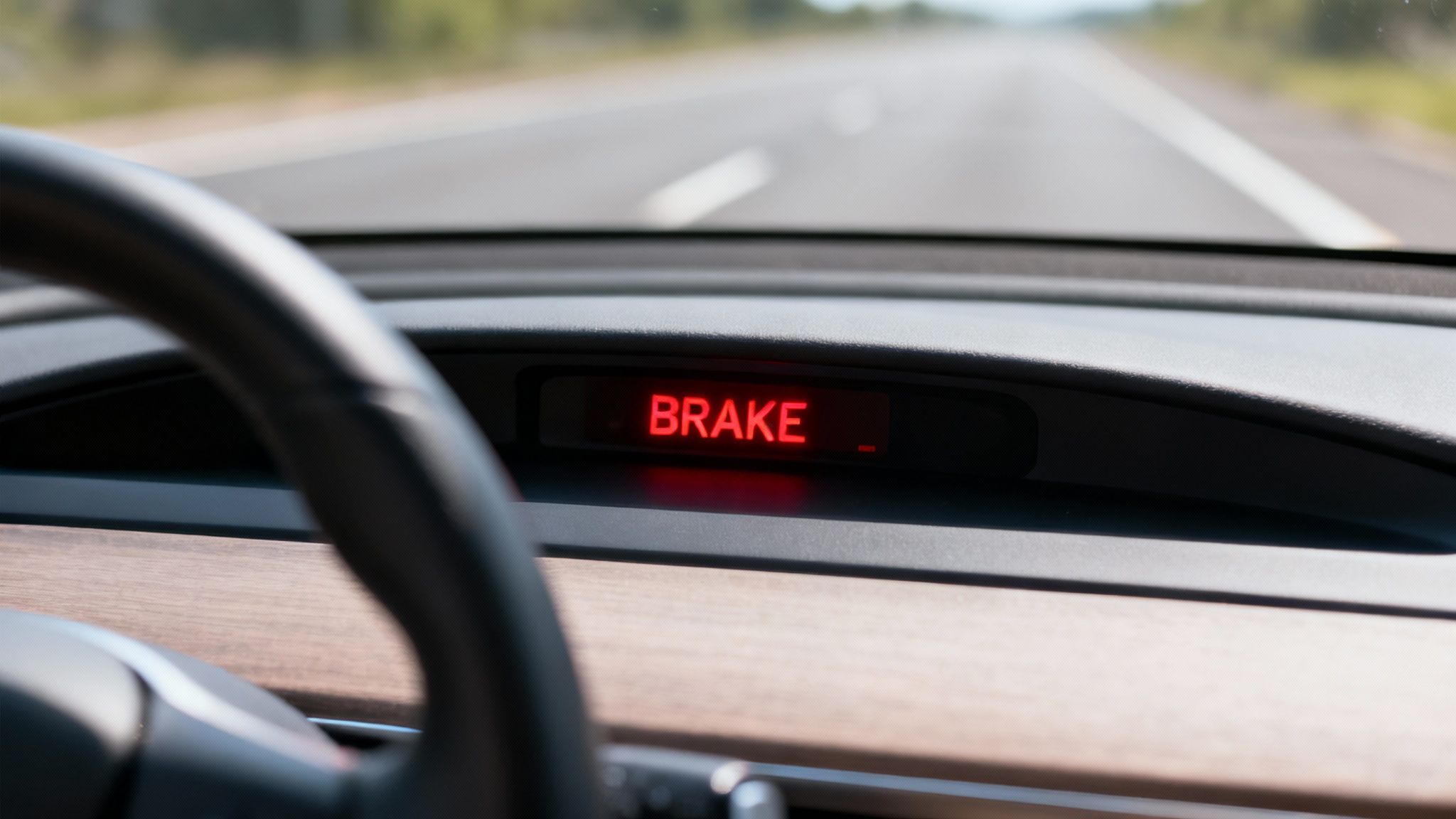
The most explicit warning is the brake light illuminating on your dashboard. This indicator is connected to sensors that monitor hydraulic pressure and fluid levels. If it activates, your vehicle is signaling an urgent need for inspection. Do not ignore it.
Tactile and Auditory Warning Signs
Beyond the dashboard light, the most valuable clues often come from what you feel with your foot and hear with your ears. If you notice any of the following, it is time for immediate action.
- A "Spongy" or Soft Brake Pedal: This is the classic symptom of compromised fluid. When you press the pedal, instead of feeling firm, it feels mushy or sinks toward the floor. This loss of resistance indicates that air or moisture has entered the hydraulic lines, which severely reduces stopping power.
- Increased Stopping Distance: If your vehicle is taking longer to come to a complete stop, this gradual loss of performance is often caused by old, contaminated fluid that cannot generate the necessary hydraulic pressure to actuate the brakes effectively.
- Anomalous Noises: While grinding and squealing often point to worn brake pads, these noises can also be related to fluid issues causing improper function of calipers or pistons. Knowing how long brakes typically last can help you troubleshoot whether the issue is with the pads or the hydraulic system.
Any noticeable change in brake feel or performance should be treated as a serious safety concern. These are not issues that resolve on their own; they are direct calls to action for a professional inspection.
Visual Clues Under the Hood
A visual inspection under the hood can often confirm your suspicions. When you check brake fluid, a dark, murky color is an immediate indicator of contamination. Fresh fluid is a clean, light-amber color. Over time, it collects particulate matter and moisture, turning it a dark brown or black.
This discoloration signifies that the fluid can no longer protect the brake system from corrosion or withstand the intense heat generated during braking. If your fluid resembles used motor oil, a brake fluid flush is long overdue. Ignoring these signs not only risks expensive repairs to components like the ABS module but also jeopardizes your safety.
Topping Up Fluid vs. a Complete Brake Flush
A common question we receive is, "Can I just add more brake fluid?" While topping off a low reservoir may seem like a simple solution, it is merely a temporary fix that masks a larger underlying issue.
A dropping fluid level is not a normal occurrence. It is a clear indicator that something within the braking system requires attention. Almost always, the cause is one of two things: either your brake pads are worn (causing the calipers to retain more fluid to compensate for the distance) or there is a potentially dangerous leak in the system.
Adding new fluid to the reservoir does not address either of these root causes.
The Problem with Only Topping Up
When you simply add fluid, you are introducing a small amount of clean fluid into a system filled with old, contaminated fluid. That existing fluid remains saturated with moisture and debris, which will continue to corrode your brake lines, calipers, and the expensive ABS module from the inside out.
It is a shortcut that fails to address the long-term health and safety of the braking system.
Topping off brake fluid is analogous to adding a cup of clean water to a gallon of dirty water. The entire mixture remains contaminated, and the underlying problem causing the fluid loss is left unresolved.
Why a Brake Flush Is the Correct Solution
A brake fluid flush is the only proper method for servicing the hydraulic system. This procedure is not about adding fluid; it involves a complete replacement of the old fluid.
Using specialized equipment, a technician purges every last drop of the old, moisture-laden fluid from the entire network—from the master cylinder, through all brake lines, and out of each caliper's bleeder valve.
Only then is the system refilled with brand-new, clean fluid that meets your vehicle’s precise OEM specifications. This process achieves two critical goals:
- It restores the brake fluid's high boiling point, ensuring maximum stopping power.
- It eliminates the moisture and contaminants that cause internal corrosion and component failure.
Consider it a necessary detoxification for your brakes, not an optional service. It is a vital maintenance procedure that ensures your safety. The demand for proper brake service is substantial—the global market for automotive brake fluid is valued at over USD 1.1 billion and is projected to grow. You can review more data on this industry trend and its impact on automotive service centers on fortunebusinessinsights.com. Proper maintenance is a significant responsibility, and it should be treated as such.
Why a Professional Brake Service Is a Prudent Decision
Knowing how to check your brake fluid is a valuable skill for any vehicle owner, but performing a full brake service is a more complex undertaking. Modern vehicles are equipped with sophisticated systems like Anti-lock Brakes (ABS) and Traction Control, which makes brake maintenance a task best entrusted to trained professionals. This is not merely a matter of convenience—it is a matter of safety.
A single error during a brake service, such as introducing a small air bubble into the lines or using the incorrect type of fluid, can have catastrophic consequences. What may appear to be a straightforward task can quickly result in a soft, ineffective brake pedal or, in a worst-case scenario, complete brake failure when it is needed most.
The Expertise of an ASE-Certified Technician
This is where the value of an ASE-certified technician becomes evident. These professionals are not simply exchanging fluids; they are diagnosing the health of the entire braking system. They possess the specialized training and equipment required to service intricate components that are beyond the scope of a typical home mechanic.
For instance, technicians use tools like pressure bleeders to flush the system. This equipment ensures that all old, contaminated fluid is forced out without introducing air into the hydraulic lines—a critical step that is nearly impossible to perform correctly with DIY methods.
More importantly, a professional can identify underlying problems that a visual check would miss. A qualified technician might notice:
- Early signs of a leak in a concealed brake line.
- Uneven wear on brake pads, which could indicate a malfunctioning caliper.
- Corrosion on critical components that could lead to future failure.
Global Supply Chains and Local Service
Even the brake fluid itself is part of a massive global market. The Asia-Pacific region produces and consumes approximately 40-50% of the world's brake fluid. This means supply chains, chemical formulations, and pricing for the fluids used in Plano are influenced by global factors. For a local service center, maintaining an inventory of the correct high-quality fluids for every make and model is a significant operational responsibility. You can learn more about the global brake fluid market on marketgrowthreports.com.
When you bring your vehicle to a professional shop, you are not just paying for a fluid change. You are investing in the technician's experience, their specialized tools, and the assurance that the job was performed to precise manufacturer standards.
For drivers in and around Plano, a trusted local shop like Express Lube & Car Care serves as your partner in vehicle safety. A professional service guarantees your brakes are not just functional—they are restored to peak performance, providing you with genuine confidence every time you drive. That peace of mind is invaluable.
Common Questions About Brake Fluid Maintenance
If you have a foundational understanding of checking brake fluid, that's excellent. However, it is normal to have further questions. Brake systems can seem complex, but knowledge is the key to maintaining your safety on the road.
Here are the answers to some of the most frequent questions we encounter from drivers.
Can I Mix Different Types of Brake Fluid?
No, you absolutely should not. Mixing different types of brake fluid is one of the most hazardous mistakes a vehicle owner can make.
First, DOT 5 fluid is silicone-based and is chemically incompatible with glycol-based fluids like DOT 3, DOT 4, or DOT 5.1. If combined, the fluids can congeal into a gel-like substance, potentially causing a sudden and complete brake failure.
Even mixing different glycol-based fluids is inadvisable. For example, while you can technically add DOT 4 fluid to a DOT 3 system, doing so immediately degrades the performance characteristics of the higher-specification DOT 4 fluid, negating its benefits.
The golden rule: Always use the exact fluid type specified in your owner's manual. If you are ever in doubt, allow a professional to handle it. The risk is not worth it.
What Happens If I Drive with Low Brake Fluid?
Operating a vehicle with low brake fluid is a serious safety risk. A low fluid level is a critical warning sign that indicates one of two potential problems:
- Your brake pads are worn. As friction material wears away, the brake caliper pistons must extend further, which draws more fluid from the reservoir to fill the increased volume.
- You have a leak. This is the more dangerous scenario. A leak in the hydraulic system can lead to a sudden, catastrophic loss of braking power while driving.
If the dashboard brake warning light illuminates, or if you inspect the reservoir and find the level is low, your immediate next stop should be a trusted mechanic. Do not delay.
How Often Should I Change My Brake Fluid?
Most vehicle manufacturers recommend a complete brake fluid flush every two years or approximately 30,000 miles, whichever occurs first. This interval is based on time as much as mileage.
Because brake fluid is hygroscopic, it continuously absorbs moisture from the atmosphere. Over a two-year period, this water contamination lowers the fluid's boiling point and begins to corrode internal brake components. Adhering to this service schedule is one of the most effective measures you can take to ensure your vehicle's long-term safety and reliability.
When it's time for a professional brake inspection or a fluid flush, you need a team you can trust. The ASE-certified technicians at Express Lube & Car Care in Plano are here to make sure your vehicle is safe and ready for the road. Stop by anytime—no appointment needed—for honest advice and expert service you can count on. Visit us online at https://www.expresslubeplano.com to learn more.