

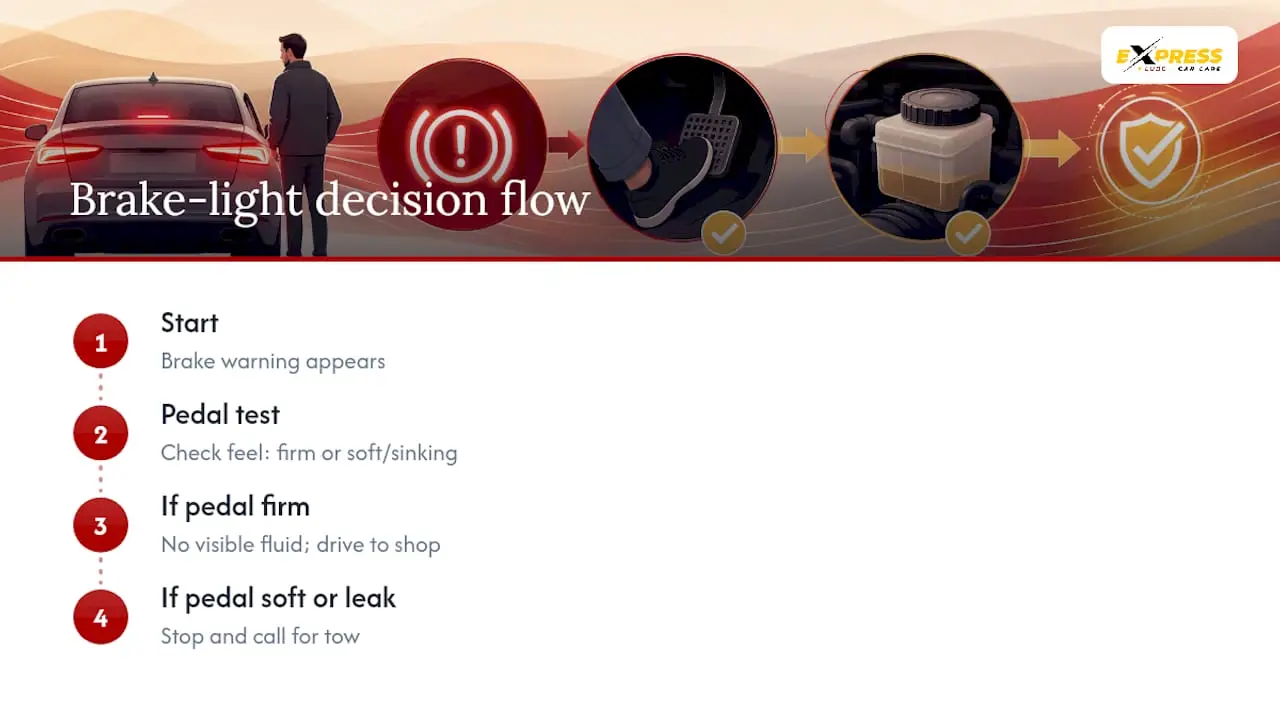
Your brake warning light means the brake system needs attention, ranging from a harmless parking-brake reminder to a critical hydraulic failure. Check two things immediately: how the pedal feels (normal versus soft or sinking) and whether you see fluid under the car. Normal pedal and no leak means drive carefully to a shop; a soft pedal or visible leak means pull over and arrange a tow.
TL;DR:
- Most brake warning lights are caused by simple issues like a partially engaged parking brake or low brake fluid due to pad wear, which often require minimal repairs.
- A soft or sinking pedal along with visible fluid leaks indicates a hydraulic problem that necessitates immediate towing to prevent complete brake failure.
- Visible brake fluid leaks at wheels, lines, or the master cylinder should prompt a prompt repair estimate that typically ranges from $150 to $500 depending on the severity.
- The pedal feel is the critical factor: a normal, firm pedal usually allows for a safe, careful drive to a shop, while a soft or sinking pedal warrants stopping and calling for a tow.
- Diagnostic costs at most shops, including fluid top-offs and inspections, generally range from $40 to $150, with more extensive repairs costing between $150 and $900 or more.
Table of Contents
- Why Is My Brake Light On? Common Causes Explained
- What to Check Right Now if the Brake Light Is On
- Should You Keep Driving With the Brake Light On?
- What Does It Cost to Fix a Brake Warning Light?
- How to Talk to a Shop About a Brake Warning Light
- How Express Lube & Car Care Handles Brake Warning Diagnostics
- Our Take: Stop Guessing and Start Checking
- Get Your Brakes Checked Today
- Sources
- FAQ
Why Is My Brake Light On? Common Causes Explained
Brake warning lights trace back to a handful of usual suspects, and most are easier to fix than drivers assume.
The parking brake is the first thing to rule out. A partially engaged lever or a faulty parking-brake switch can trigger the light even when the brake is fully released, so double-check before assuming the worst.
Low brake fluid is one of the most common reasons the light comes on, and it’s not always a leak. As pads wear down, the calipers extend further and fluid naturally drops in the reservoir. A true leak shows up as wet spots or drips near a wheel, along brake lines, or under the master cylinder at the firewall.
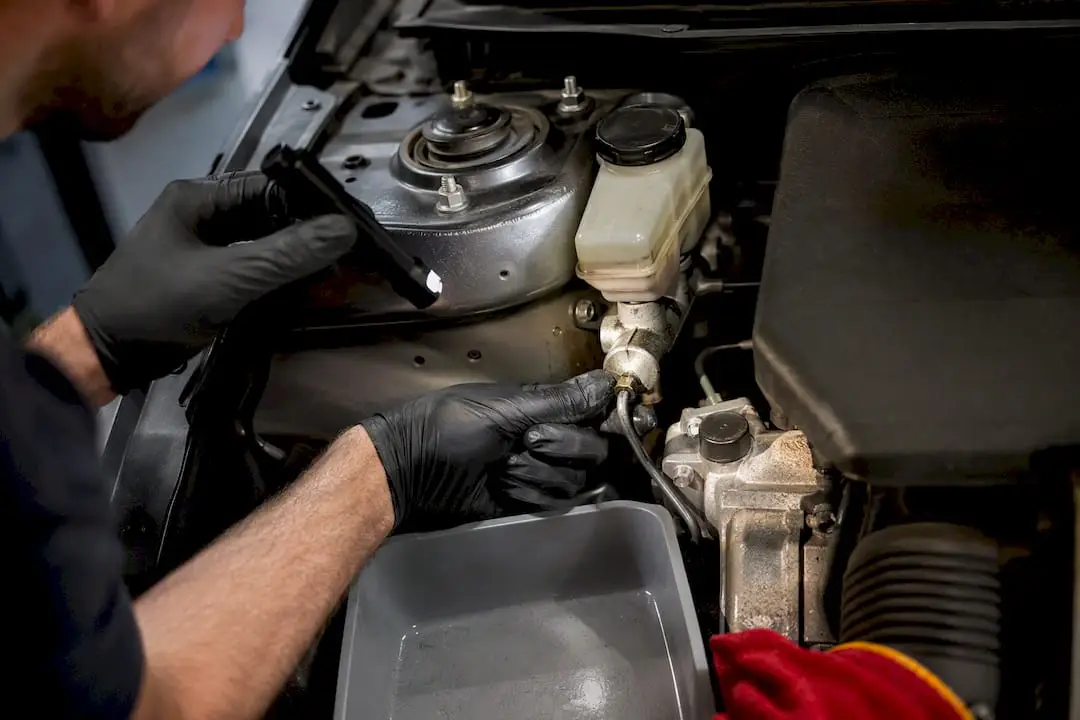
Worn pads themselves rarely trigger the brake warning light directly, but they contribute to the low-fluid condition that does. A squealing wear indicator is usually a separate signal worth taking seriously on its own, covered in our brake pad wear indicator guide.
A sinking or gradually softening pedal points toward the master cylinder or a hydraulic pressure imbalance between the front and rear circuits. If your brake light and ABS light illuminate together, the fault often involves a pressure-proportioning issue or a module problem rather than something simple.
Some causes are purely electrical. A tired sensor, corroded wiring, or a flickering dash bulb can mimic a brake failure without any actual loss of stopping power.
- Parking brake engaged or switch malfunctioning
- Low brake fluid from pad wear or a leak
- Visible leaks at wheels, lines, or master cylinder
- Worn pads reducing reservoir fluid over time
- Master cylinder or hydraulic imbalance
- ABS or electronic brake-control faults
- Sensor, wiring, or instrument-cluster glitches
Pro Tip: If the light flickers only during hard stops or sharp turns, your fluid level is likely sitting right at the borderline. Get it checked before it becomes a steady warning instead of an occasional one.
What to Check Right Now if the Brake Light Is On
Work through these steps in order before deciding whether to drive.
- Release the parking brake fully. Push it all the way down or release the lever completely, then wait a few seconds to see if the light clears.
- Check the brake fluid reservoir. Pop the hood, find the reservoir near the firewall, and look at the fluid level against the MIN and MAX lines printed on the side.
- Test the pedal. Press it firmly with the engine running. Normal feel means firm resistance a few inches down. Spongy feel means it compresses further than usual before catching. Sinking means it drifts toward the floor under steady pressure, which is a sign of a hydraulic leak or air in the lines.
- Look under the car and at each wheel. Fresh fluid looks slightly oily and clear to amber. Check the pavement where the car was parked overnight.
- If you decide to drive to a shop, ease into it. Accelerate gently, brake early and gradually, and stick to lower-speed roads instead of the highway.
Roughly 40% to 150 dollars covers a simple fluid top-off and inspection, which is often all a borderline warning needs.
Should You Keep Driving With the Brake Light On?
The pedal test from the previous section is what actually determines your next move, not just the light itself.
Likely safe for a short, careful drive to a shop:
- Light is on, parking brake is fully released, pedal feels normal, no leak visible
Stop the car and arrange a tow immediately:
- Pedal feels soft or sinks toward the floor
- You spot fluid leaking anywhere under the vehicle
- Brake light AND ABS light are on together
- You hear grinding or feel a pull to one side under braking
A red brake warning combined with a soft or sinking pedal signals a hydraulic problem serious enough that you should stop rather than continue. Continuing to drive on a known leak risks a sudden, total loss of braking with no warning before it happens.
Pro Tip: If you must reach a shop and the pedal feels iffy, downshift to use engine braking and minimize how often you rely on the brake pedal itself.
What Does It Cost to Fix a Brake Warning Light?
Repair costs depend heavily on what’s actually wrong, so treat these as general ranges rather than a quote for your vehicle.
- Parking brake switch or adjustment: $0 to $200, often the cheapest fix if the switch itself is misaligned or worn
- Fluid top-off and inspection: $40 to $150, appropriate when low fluid traces back to normal pad wear
- Leak repair: $150 to $500, depending on whether it’s a line, fitting, or seal
- Pads and rotors: $300 to $700, common when worn pads are behind the low-fluid reading in the first place
- Master cylinder replacement: $250 to $550, needed when the pedal sinks under steady pressure
- ABS-related repairs: $150 to $900 or more, since wheel-speed sensor faults are often quicker and cheaper than hydraulic repairs, though they can disable ABS until resolved
These are representative ranges reported across common repair scenarios, and your actual cost depends on your vehicle’s make and model, parts quality, local labor rates, and how much of the system needs attention. A flush or fluid service on its own carries its own separate cost, detailed in our brake fluid flush cost breakdown.
How to Talk to a Shop About a Brake Warning Light
A quick, clear phone call gets you a faster diagnosis and a more accurate estimate.
- Decide tow versus drive using the pedal-feel rule. Soft or sinking pedal, or any visible leak, means towing. Normal pedal and no leak usually means a short, careful drive works.
- Describe exactly what you saw and felt. Mention which lights came on, how the pedal felt, any noises like grinding or squealing, and whether you drove in or had the car towed.
- Ask for a specific inspection sequence. Request a fluid-level check, a leak search, a pad-wear inspection, and an ABS or electronic scan for stored codes if the ABS light was also on.
- Ask about turnaround and documentation. Find out how long diagnosis takes, how the estimate process works, and whether the shop provides digital photos of what they find.
For a fuller list of warning signs worth mentioning up front, our guide on signs your vehicle needs new brakes covers symptoms beyond the dashboard light itself.
How Express Lube & Car Care Handles Brake Warning Diagnostics
Our certified technicians follow the same logical sequence outlined above: fluid-level check first, then a leak inspection, then pad-wear evaluation, then an electronic scan if ABS codes are suspected. That order matters because simple physical checks catch many common warnings faster and cheaper than jumping straight to electronics.
Express Lube & Car Care offers no-appointment-needed service, so a brake light that comes on during your morning commute doesn’t have to wait for a scheduled slot later in the week. Every inspection includes digital photos and technician notes, so you see exactly what we found rather than taking our word for it. Worn brake dust buildup around the wheels can also mask what’s happening at the caliper, and proper brake dust removal helps keep inspections accurate between visits.
Our Take: Stop Guessing and Start Checking
Most drivers treat a brake warning light as a single, undifferentiated alarm. That’s the wrong mental model. The light is a symptom, not a diagnosis, and the two checks that matter most, pedal feel and visible fluid, take less than two minutes and tell you almost everything you need to know about urgency.
Where conventional advice falls short is the blanket instruction to “get it checked immediately” without distinguishing between a $0 parking-brake adjustment and a hydraulic failure that could leave you without brakes at a stoplight. Both trigger the same light. They do not deserve the same response.
Our honest recommendation: do the pedal test before you do anything else. A normal, firm pedal with no fluid on the ground buys you time to drive carefully to a shop. A soft or sinking pedal buys you nothing. Stop, and call for a tow. That single distinction, more than any list of possible causes, is what should drive your next move.
Get Your Brakes Checked Today
Express Lube & Car Care takes the guesswork out of a brake warning light with no-appointment-needed service, so you can drive in the same day the light comes on instead of waiting for a scheduled slot. Our ASE-certified technicians run a full diagnostic, fluid check, leak search, pad inspection, and ABS scan, backed by digital photos so you know exactly what’s happening before any work begins.
If your brake light is on right now, head to our brake repair services in Plano page to see what’s covered, or use the $30 off brakes coupon to save on your visit. Book online, call ahead, or simply drive in, and bring along any notes on when the light appeared and how the pedal felt. That handful of details helps our technicians get you back on the road faster.
Sources
- Why Is My Brake Warning Light On? Causes, Fixes, and Costs – The Motor Guy
- Brake Warning Light: What It Means & How To Fix It – Power Stop
- Engineerskill
FAQ
Is It Okay to Drive With the Brake Light On?
It depends on the pedal feel. If the pedal feels normal and you see no fluid leak, a short, careful drive to a shop is generally acceptable, but a soft or sinking pedal means you should stop and arrange a tow.
Why Is My Brake Light On but My Brakes Feel Fine?
A normal-feeling pedal with the light still on often points to a sensor, wiring fault, or a fluid level sitting right at the low threshold, and it still warrants professional inspection since the light monitors safety systems you can’t always feel.
How Urgent Is a Brake Warning Light?
Urgency depends on what accompanies it. A light alone with a firm pedal is worth checking soon, while a soft pedal, visible leak, or a simultaneous ABS light signals a problem serious enough to stop driving immediately.
What Causes the Brake Light to Come On on the Dashboard?
The most frequent causes are an engaged parking brake, low brake fluid from pad wear or a leak, a master cylinder issue, or an ABS and electronic fault, and Express Lube & Car Care checks all of these during a standard brake diagnostic.
Why Won’t My Brake Light Turn Off After I Release the Parking Brake?
This usually points to a stuck or faulty parking-brake switch rather than the brake itself, though it can also indicate the fluid level has dropped below the sensor threshold and needs a technician’s look.