
Your car may still drive, but something feels off. On the way down Preston or sitting in traffic near 75, it hesitates before going into gear, shifts a little harder than it used to, or gives you that faint burnt smell after a long hot drive home.
That's usually when people start asking about car transmission fluid.
I get it. Most drivers think of transmission fluid as one more liquid under the hood, somewhere below oil and coolant on the worry list. But your transmission depends on that fluid every second the vehicle is moving. When the fluid is right and in good shape, the car feels smooth and predictable. When it's old, low, or the wrong type, the transmission can start telling on itself.
For Plano drivers, this matters more than many people realize. Heat, stop-and-go traffic, short errands, and long commutes all put extra stress on the transmission. A lot of the same logic that applies to charging systems and heat-related wear also shows up elsewhere in the car, which is why articles on alternator charging voltage and electrical load can feel surprisingly familiar once you start thinking in systems.
Your Guide to Car Transmission Fluid
A neighbor asks me the same question in different ways all the time.
“Why is my car shifting weird?”
“Do I really need transmission service?”
“My owner's manual says lifetime fluid. So am I supposed to leave it alone?”
Those are fair questions, because transmissions have gotten more complicated. Years ago, many drivers thought of fluid service as something you did only after a problem showed up. That mindset doesn't work well on modern vehicles.
Why this fluid deserves more respect
Your transmission is one of the hardest-working assemblies in the vehicle. It has to manage engine power, road speed, gear changes, and heat. The fluid inside isn't there just to keep parts wet. It helps the whole unit function correctly.
Practical rule: If a transmission starts acting differently, fluid condition and fluid type belong near the top of the checklist.
Plano driving adds its own twist. Long summer heat, stoplights, school pickup lines, and crawling commuter traffic can all make a transmission run hotter and work harder. That doesn't automatically mean your car has a problem. It does mean fluid health matters.
The question most drivers are really asking
Car owners aren't typically trying to become transmission experts. They want to know three things:
- What does car transmission fluid do
- How do I know if mine needs attention
- Does “sealed for life” mean never service it
That last one causes the most confusion. “Sealed” doesn't mean the fluid can't age. It usually means checking and servicing it takes a more specific procedure, often without a simple dipstick.
By the end of this guide, you'll have a practical way to think about it, without the mystery.
What Transmission Fluid Actually Does
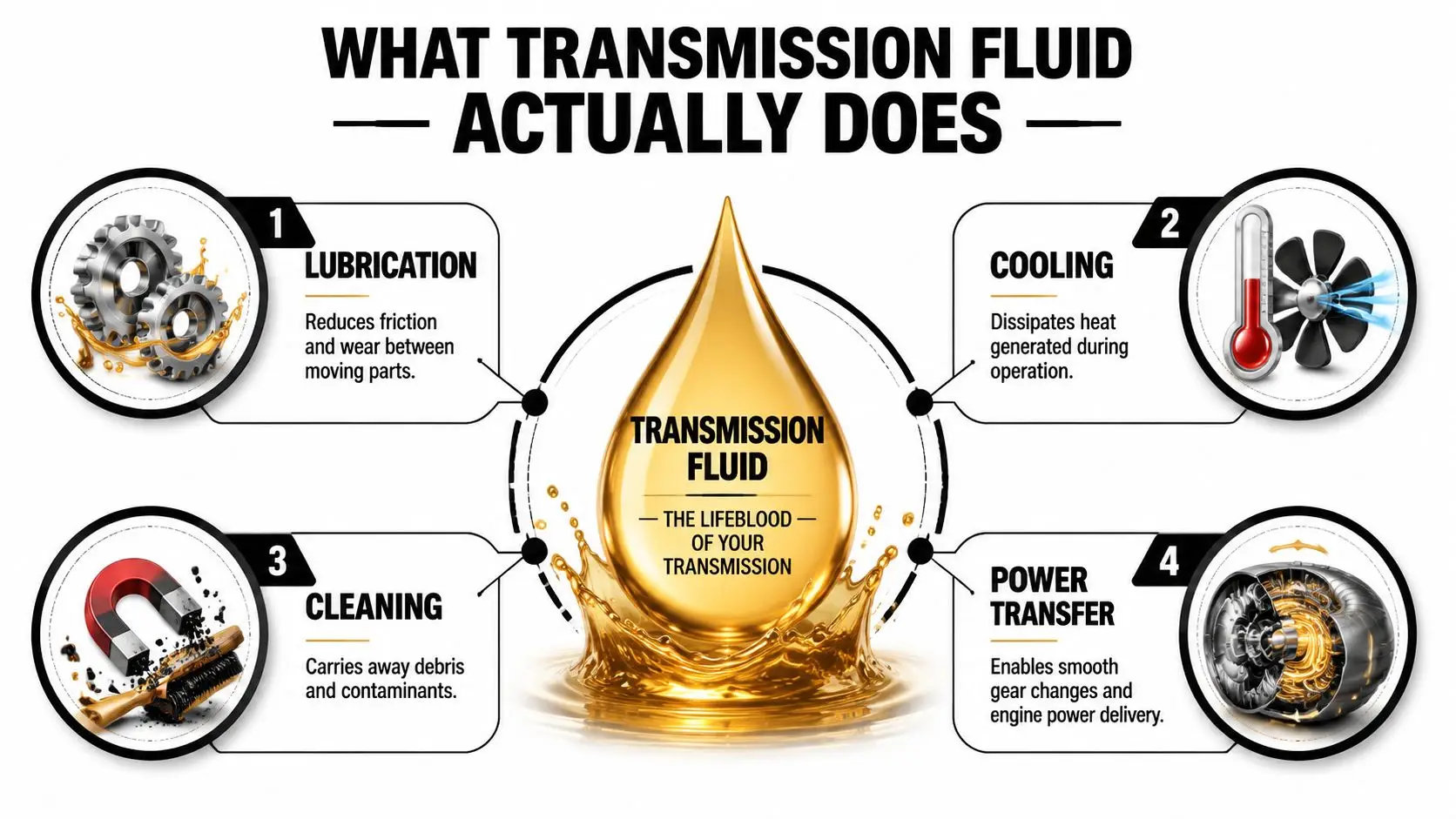
Car transmission fluid is a highly specialized hydraulic lubricant, not just a simple oil. Modern automatic transmission fluid is formulated to lubricate gears, operate the torque converter, control valve bodies, and manage clutch friction. New ultra-low-viscosity formulations also reflect an industry shift toward efficiency, as explained in UTI's overview of what transmission fluid does in modern vehicles.
The body's circulatory system provides an apt comparison. Blood doesn't do one job. It carries, cools, supports, and helps keep systems alive. Transmission fluid works a lot like that inside an automatic transmission.
It moves power
In an automatic transmission, fluid does more than lubricate. It also works as a hydraulic medium. That means the transmission uses fluid pressure to apply components and make gear changes happen.
If that sounds abstract, use this example. When you shift from Park into Drive, the transmission has to respond quickly and smoothly. Fluid pressure is a big part of what makes that possible.
It reduces friction and wear
There are moving parts inside the transmission that need a protective film between them. Without that film, metal parts rub harder, create more heat, and wear faster.
That's one reason calling it “just oil” misses the point. A motor oil and a transmission fluid can both lubricate, but the transmission fluid also has to behave correctly under pressure and during clutch engagement.
It carries heat away
Heat is one of the biggest enemies of any transmission. Every shift, every crawl through traffic, every uphill pull asks the fluid to absorb and move heat.
In Texas, this cooling role matters a lot. If the fluid breaks down, the transmission loses some of its ability to manage temperature. That can start a chain reaction where shifting gets worse as temperatures rise.
It helps keep the inside clean
Fluid also helps suspend and carry contaminants so they can be managed by the system instead of collecting everywhere inside.
Here's the simplest way to remember it:
- Power transfer keeps shifts happening
- Lubrication protects moving parts
- Cooling manages heat load
- Cleaning helps control internal contamination
Healthy fluid supports the transmission from several directions at once. That's why one fluid problem can show up as heat, harsh shifting, noise, or wear.
Decoding the Different Types of Transmission Fluid
One of the fastest ways to damage a transmission is assuming all fluids are close enough. They aren't.
Automatic transmission fluid
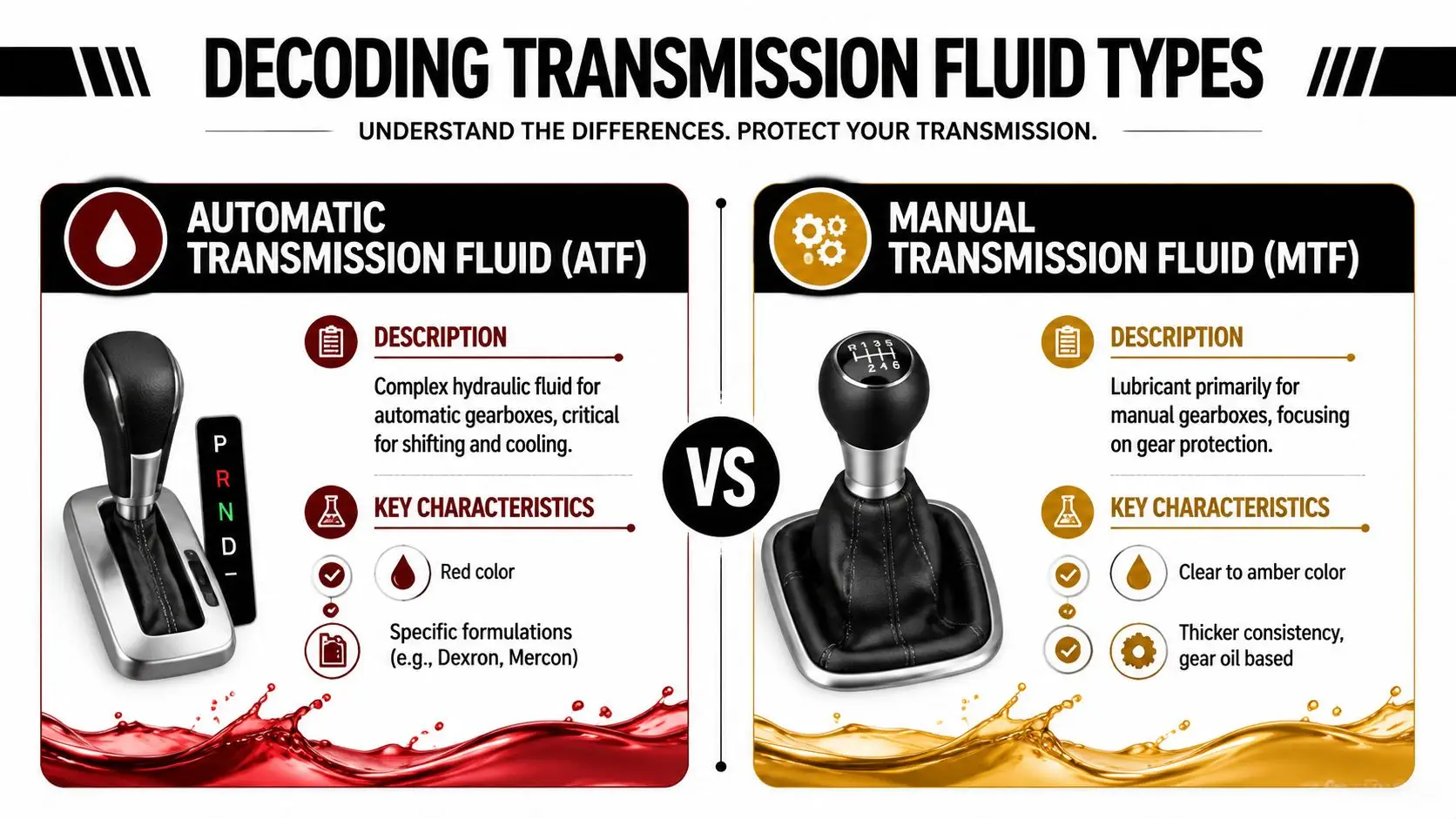
ATF is built for automatic transmissions, and it has a demanding job. It has to lubricate parts, manage heat, and deliver the right friction behavior so clutches and bands engage the way the transmission was designed to engage.
Modern ATF is not interchangeable across all vehicles because the specification is tied to viscosity, friction behavior, and thermal stability. Ford and GM use ultra-low-viscosity fluids such as MERCON ULV and DEXRON ULV in newer transmissions, and those fluids are not backward compatible with earlier versions, as explained in this breakdown of OEM-specific automatic transmission fluid specs.
That's where a lot of trouble starts. A bottle may say “multi-vehicle,” “compatible,” or “universal,” but the key question is whether it meets the exact specification your transmission calls for.
Manual transmission fluid
A manual transmission usually needs a different kind of lubricant because its internal design and operating demands are different. The fluid focus is more on gear protection than hydraulic shifting behavior.
That's why manual transmission fluid and automatic transmission fluid shouldn't be treated as substitutes for each other. They may look similar to a non-tech, but they're built around different mechanical needs.
CVT fluid
A CVT, or continuously variable transmission, is its own category. It doesn't operate like a traditional stepped automatic or a manual gearbox, so the fluid requirements are specific.
If you own a vehicle with a CVT, incorrect fluid selection can prove costly. CVT fluid isn't a “close enough” product.
A simple comparison
| Transmission type | Fluid need | Why it matters |
|---|---|---|
| Automatic | ATF matched to OEM spec | Shift quality and clutch behavior depend on it |
| Manual | Manual transmission fluid or gear-type lubricant as specified | Protects gears and synchronizers properly |
| CVT | CVT-specific fluid | Supports a completely different operating design |
How to choose the right fluid
Use this order:
Read the owner's manual
That's the first and best source for your exact spec.Check the manufacturer fluid callout
Names matter. DEXRON VI, MERCON LV, ATF+4, and other labels aren't interchangeable by default.Match the transmission, not the shelf label
Don't buy based on color, brand familiarity, or a “works in most cars” promise.
If the transmission was engineered around a specific friction package and viscosity, the fluid choice is part of the repair, not a minor detail.
Warning Signs Your Transmission Fluid Needs Attention
Most drivers don't catch transmission problems with a scan tool. They catch them with their eyes, hands, and nose.
What you can see
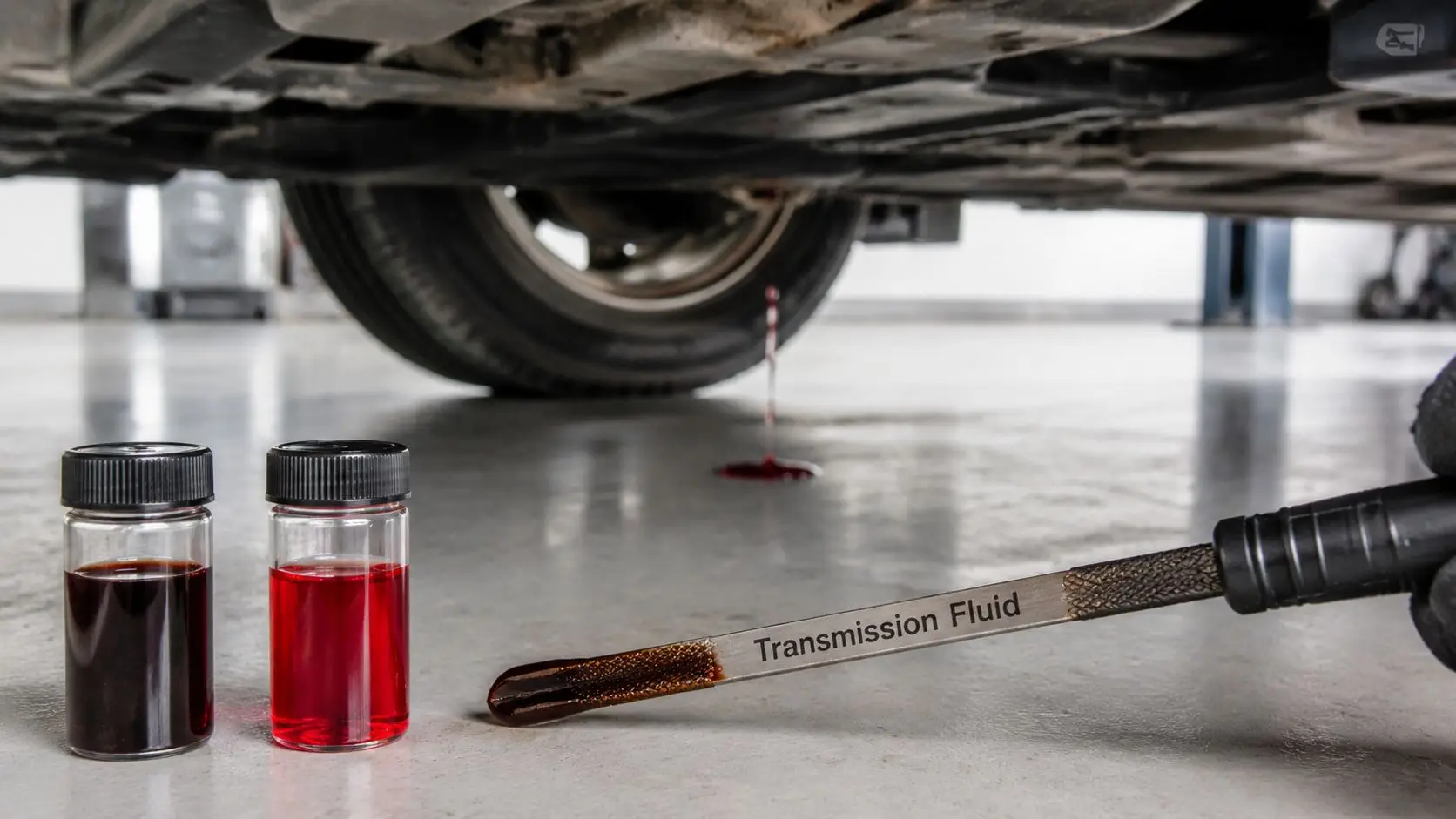
Start with the easy stuff. Look under the vehicle after it's been parked. A reddish or brownish fluid spot deserves attention.
If your vehicle has a transmission dipstick, the fluid itself can tell you a lot. Fresh fluid is often in the red or pink family. Older fluid gets darker. Once it looks muddy, very dark, or scorched, I stop calling it healthy.
What you can feel
A transmission usually speaks through behavior before it fails outright.
Watch for:
- Delayed engagement when you shift into Drive or Reverse
- Slipping where engine speed rises but the car doesn't move as firmly as it should
- Rough or sudden shifts that weren't there before
- Hesitation during acceleration in normal traffic
If you're dealing with those symptoms, this article on common causes of transmission slipping is a useful next read.
Degraded or wrong-spec ATF can raise operating temperatures and accelerate varnish buildup because its performance depends on thermal stability and the correct frictional characteristics. In older applications, the wrong friction package can even prevent proper clutch engagement, according to Castrol's guide to ATF uses and fluid behavior.
What you can smell
Burnt transmission fluid has a sharp, acrid smell. If a customer tells me, “It smells hot after my commute,” I pay attention.
That smell doesn't prove the transmission is failing, but it does suggest the fluid has been under stress. In Plano heat, that's not something I'd ignore for long.
A solid outside perspective also helps if you're comparing symptoms. Pete Nelson Automotive has some useful expert auto repair advice on transmission issues that lines up well with what we see in everyday service.
Here's a quick visual explainer if you want to see examples of what to look for:
Checking and Servicing Your Transmission Fluid
You leave work in Plano, crawl through stop-and-go traffic on a 100-degree afternoon, and your transmission spends that whole commute building heat. Then someone tells you the fluid is “sealed for life,” so there is nothing to check and nothing to service.
That idea causes a lot of confusion.
In the shop, “sealed” usually means there is no dipstick and the unit uses a specific checking procedure. It does not automatically mean the fluid lasts forever under Texas heat, short trips, long idling, and daily traffic. For many Plano drivers, those conditions fit severe service much more than the easy highway use behind many “lifetime” claims.
If your vehicle has a dipstick
Older vehicles, and some newer ones, still let you check fluid the traditional way. The process is not identical on every car. Many require the transmission to be warmed up, the engine running, and the shifter placed in Park or Neutral before you read the level.
Start with the owner's manual. If you want a step-by-step refresher before you check it yourself, this guide on how to check transmission fluid level walks through the basics clearly.
Look at more than the level, too. Healthy fluid is doing the transmission's daily housekeeping, cooling parts, carrying away fine wear material, and helping clutches grab the way they should. If the level is low, the fluid looks dark, or it smells burnt, that is a sign to stop guessing and verify the condition and the cause.
If your transmission is sealed
A sealed unit usually needs the vehicle to sit level, the fluid to be checked within a narrow temperature range, and the exact factory-specified fluid. That is why DIY mistakes happen so easily. Too much fluid can cause problems. Too little can cause problems. The wrong fluid can change how the transmission shifts even if the level is correct.
A sealed transmission works a lot like a modern cooling system. You can still service it, but you need the right access points, the right procedure, and the right conditions. That is the part people miss when they hear “sealed.”
Service intervals depend on the vehicle and your driving
There is no single mileage number that fits every transmission.
Some vehicles have a clear service interval in the manual. Others use softer language such as inspect, monitor, or service under severe use. That is where Plano driving matters. If your week includes hot-weather commuting, repeated short trips, school pickup lines, towing, delivery driving, or long stretches of idling with the A/C running, you should read the severe-service section, not just the normal-service line.
That is the practical way to handle the sealed-for-life myth. Follow the manual first, then adjust your caution level for real-world use.
DIY or professional service?
A basic drain-and-fill can be reasonable for a vehicle with a simple design, clear factory instructions, and easy level verification. It becomes a different job when the pan has to come off, the filter needs inspection, the fluid temperature must be monitored, or the transmission has no dipstick.
Professional service usually makes more sense when:
- The transmission is sealed and procedure-sensitive
- The factory fluid specification is very specific and easy to get wrong
- You want the pan, magnet, and old fluid checked for clues about wear or contamination
- You drive in severe Plano conditions and want a decision based on fluid condition, not a generic “lifetime” label
For another practical shop-level perspective, these Express Lube Haltom transmission insights do a good job explaining why fluid condition matters before the transmission starts acting up.
Express Lube & Car Care is one local option that provides transmission fluid and filter service according to manufacturer specifications. What matters most is that whichever shop you choose follows the exact spec and procedure for your transmission.
Your Trusted Partner for Transmission Care in Plano
Plano drivers deal with conditions that blur the line between “normal” and “severe” service. A lot of vehicles spend their lives in heat, traffic, short trips, and long idling stretches. That matters when you're deciding what to do with car transmission fluid, especially on newer vehicles.
Many OEMs treat transmission fluid as “lifetime” under normal service, but severe-use conditions like hot climates, towing, stop-and-go commuting, and short-trip driving can shorten fluid life. Industry guidance also notes that neglected fluid can contribute to overheating and early failure, which is why a professional condition check and the correct service procedure matter for sealed transmissions, as discussed in this video on sealed-for-life transmission fluid decisions.

A simple decision framework for Plano drivers
If you're trying to decide what to do, keep it simple:
Follow the owner's manual first
If the manual gives a service interval or inspection schedule, start there.Upgrade your caution level for Texas driving
Heat and traffic count. If your driving is mostly short trips, commuting, or heavy stop-and-go use, don't assume “lifetime” means ignore it forever.Pay attention to behavior changes
Rougher shifting, hesitation, leaks, or burnt odor all justify a closer look.Use a professional for sealed units
These transmissions often need more than a casual top-off.
Sealed for life doesn't mean immune to heat, contamination, or wear. It usually means the service method is more controlled.
What local drivers usually want from a shop
They want someone who understands newer transmissions, uses the correct manufacturer-specified fluid, and gives straight answers. They also want convenience, because nobody in Plano wants a simple maintenance visit to turn into a full-day project.
That's why ASE-certified technicians, modern diagnostics, and no-appointment-needed service matter. Honest recommendations matter too. So does fair pricing, especially when routine maintenance is competing with everything else in the family budget.
For many drivers, the practical extras help. Express Lube Plano offers savings for military members, first responders, and healthcare workers, plus a Ladies Day special every Wednesday. Those details don't replace good workmanship, but they do make it easier to keep up with maintenance before problems get expensive.
If your vehicle is shifting differently, overdue for service, or you're stuck wondering whether a sealed transmission should be checked, Express Lube & Car Care can help you sort it out with ASE-certified service, manufacturer-spec fluids, and straightforward recommendations that fit the way Plano drivers use their cars.