

A fleet maintenance program is a written, structured system for scheduling, tracking and managing preventive and corrective work across every vehicle you operate. Motive describes it in the same terms. The goal is simple: fewer surprise breakdowns, safer vehicles and costs you can predict. Whether you run three work vans or thirty trucks, the program rests on the same parts: a vehicle list, service schedules, inspections, repair procedures and records.
This guide walks through each part in plain terms, with the choices a Plano or Collin County fleet manager actually faces.
TL;DR
- A fleet maintenance program is a written plan covering a vehicle list, preventive schedules, inspections, corrective repairs and records.
- Start from each manufacturer’s recommendations, then shorten intervals for severe use such as heavy loads, stop-and-go driving or Texas heat.
- Name one person, not a team, as accountable for each part of the plan, and stagger service dates so vehicles are not out at the same time.
- Keep every invoice, inspection and repair record; they show what is working and what keeps failing.
- A local shop with same-day, no-appointment service can keep downtime short. Warranty eligibility, limitations and exclusions apply.
Table of Contents
- What a fleet maintenance program includes
- Choosing a maintenance strategy
- How to build the plan, step by step
- Setting schedules for different vehicles and conditions
- Fleet maintenance best practices that prevent breakdowns
- Records and metrics worth tracking
- What fleet maintenance costs
- Our perspective: what makes a fleet program last
- How Express Lube & Car Care supports Plano fleets
- FAQ
- Sources
What a fleet maintenance program includes
An Oregon Department of Transportation handbook on vehicle preventive maintenance programs lists the core pieces of a documented program: a written plan, preventive service schedules, inspections, corrective repairs, and records that track maintenance activity and cost. The same handbook states the purpose clearly. It aims to keep vehicles in good repair, enough of them available for daily demand, safe, regularly serviced, and maintained at reasonable cost.
That applies well beyond public transit. A landscaper, a home-health provider, a delivery business and a contractor all need the same thing: vehicles that start in the morning and do not fail on the road.
In practice, a program answers five questions:
- Which vehicles are covered? Every unit, with its details on one list.
- What gets done, and when? Oil changes, brake checks, tire rotations, fluid service, belts and hoses.
- Who is responsible? A named person for scheduling, approving repairs and keeping records.
- How are problems found? Driver reports, regular inspections and diagnostic checks.
- How is it recorded? Invoices, inspection results and costs, kept in one place.
IBM notes that a comprehensive program also helps an organization address compliance, extend vehicle life and manage parts. For a small fleet, the compliance and parts pieces may be modest, but the habit of writing things down is the same.
Choosing a maintenance strategy
Most fleets blend three approaches. Which one leads depends on the vehicle, its age and what a failure costs you.
| Strategy | How it works | Best for | Main risk |
|---|---|---|---|
| Preventive | Service at set mileage or time intervals, whether or not a problem shows | Most fleet vehicles, especially those in daily service | Servicing too early wastes money; too late invites failures |
| Condition-based | Service when inspection results or diagnostic readings show wear | Vehicles with varied use, where mileage alone misleads | Needs consistent inspections and good records |
| Corrective (run to failure) | Repair after something breaks | Low-cost, non-critical parts with no safety impact | Unplanned downtime, and sometimes a bigger repair |
Preventive work should be the backbone. Safety-related systems such as brakes, tires, steering and suspension should never be left to run to failure. Condition-based decisions add precision: a van that idles at job sites all day wears differently than one that runs highway miles, even if the odometers match.
Corrective repair still has a place. Every fleet will have breakdowns. The difference is that a program gives you a plan for them: who approves the repair, where the vehicle goes and how quickly it is back on the road.
How to build the plan, step by step
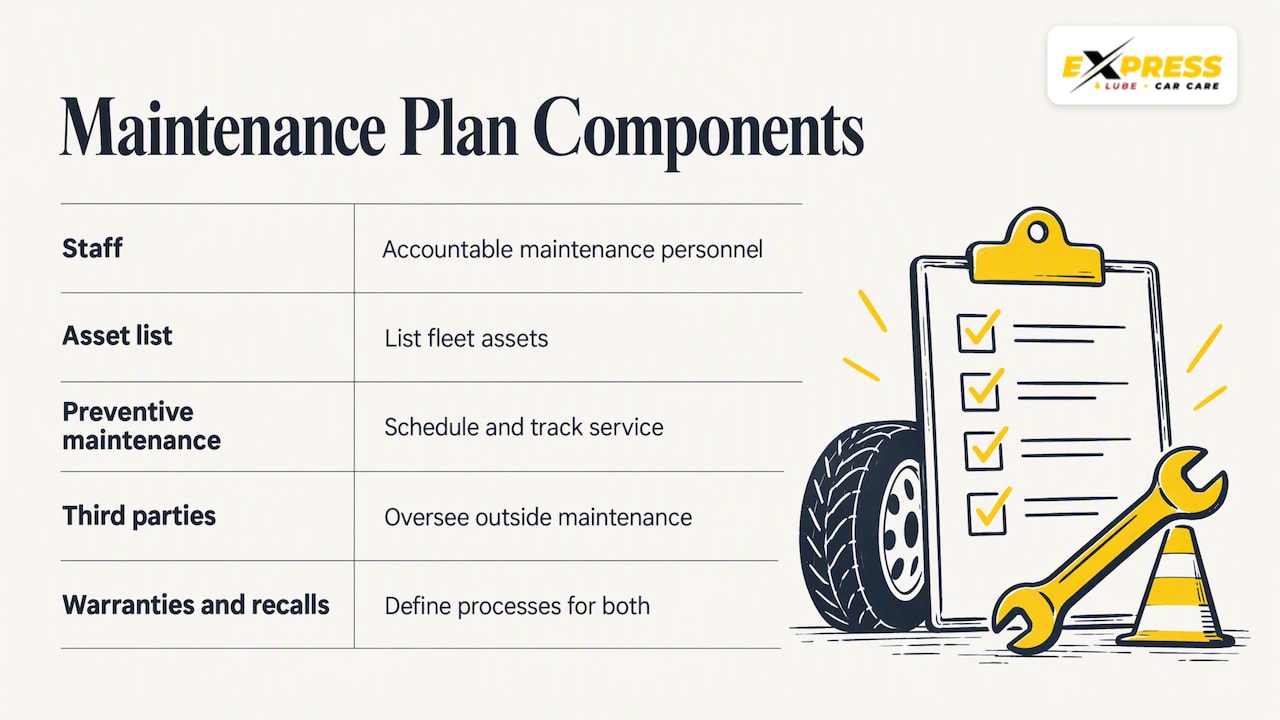
The New York State DOT’s guide to vehicle maintenance plans says a plan should describe accountable staff, an asset list, how preventive maintenance is scheduled and tracked, third-party oversight, and processes for warranties and recalls. Here is how to turn that into something workable.
Step 1: Build a vehicle register
List every vehicle with its fleet number, make, model, year, current odometer reading or engine hours, and compliance dates. MapTrack’s scheduling guide recommends exactly this kind of master register. Add the VIN, tire size and the oil specification the manufacturer calls for. These details save time every time a vehicle comes in.
Group vehicles by type and by how critical they are. A technician’s van that earns revenue every day deserves tighter intervals than a spare pickup used twice a month.
Step 2: Assign named owners
Name individuals in each role rather than a department. MapTrack’s guidance on this is blunt: when a role belongs to a person, accountability is unambiguous. One person schedules service, one approves repairs above a set amount, and one keeps the records. In a small business, that may be the same person, and that is fine as long as it is written down.
Step 3: Set service schedules
Start with the owner’s manual for each vehicle. The Oregon handbook says to base schedules on manufacturer recommendations and adjust for seasonal and environmental factors, using time or mileage triggers. We cover that in more detail in the next section.
Step 4: Define how problems are reported
Drivers see problems first. Give them a simple way to report a pull in the steering, a soft brake pedal, a warning light or a new noise, and make clear that reporting early is expected. A short walk-around checklist at the start of each shift catches tire damage, leaks and burned-out lights. Our vehicle safety inspection checklist is a good starting point for what to look at.
Step 5: Choose a repair partner
Decide in advance where each vehicle goes for routine service and for repairs. Consider location, turnaround, the range of work one shop can handle, whether the shop documents what it finds, and what warranty it offers. One shop that handles oil changes, brakes, tires, diagnostics and cooling system work means fewer handoffs and a cleaner service history.
Step 6: Plan for recalls and warranties
Assign someone to check for open recalls and to track which repairs and parts are still under warranty. Otherwise you may pay for work that someone else owes you.
Setting schedules for different vehicles and conditions
The single most useful rule is that intervals vary by vehicle. A cargo van, a diesel pickup and a European sedan used for client visits do not share one schedule.
Time-based or meter-based. MapTrack explains that time-based scheduling suits low-utilization vehicles, while meter-based scheduling (miles or hours) fits high-utilization equipment. A truck that sits for weeks still needs fluids and tires checked on a calendar. A route vehicle that logs 1,500 miles a week should be scheduled by mileage.
Typical intervals. Motive lists common intervals such as oil changes every 5,000 miles and brake inspections every 10,000 miles. Treat those as a planning example, not a rule. Many newer vehicles call for different oil intervals depending on oil type and driving conditions, and the manual governs. For help on this, see our explanation of oil change interval types.
Severe conditions. A planning checklist from Mid-Plains-style fleet guidance notes that vehicles operated in severe conditions may need more frequent maintenance. Think of frequent short trips, heavy loads, towing, dusty job sites and long idle times. Many manufacturers define these “severe service” conditions in the manual, so check yours.
Stagger the work. Fleetio advises staggering service dates for similar assets so several vehicles are not out of commission at once. It also suggests building buffer time into the calendar for scheduling delays and vendor coordination. If five identical vans reach 5,000 miles in the same week, spread them across several days.
A sample layout for a small mixed fleet:
| Vehicle type | Trigger | Routine items |
|---|---|---|
| Daily-use work van | Mileage, per manual | Oil and filter, tire rotation and pressure, brake inspection, fluid levels |
| Light-use pickup | Calendar, per manual | Fluids, battery test, tire condition, belts and hoses |
| Towing or heavy-load truck | Shortened interval for severe use | Brakes, transmission and drivetrain, cooling system, suspension |
| Older or high-mileage unit | Condition-based plus calendar | Diagnostics, leaks, steering and suspension, electrical |
For a deeper look at the oil side, read our fleet oil change schedule guide. It covers how to set intervals vehicle by vehicle.
Fleet maintenance best practices that prevent breakdowns
The Federal Motor Carrier Safety Administration’s vehicle maintenance guidance points to a few habits: monitor recalls, train staff, check and coordinate inspection reports, and make sure defects are repaired before vehicles are operated. FMCSA also advises watching manufacturer recalls through NHTSA and asking manufacturer service representatives about service bulletins.
Put those into daily practice:
- Do not operate with a known defect. A report that says brakes feel soft should lead to an inspection that day, not next week.
- Watch tires closely. One industry guide reports that tire violations are the leading cause of out-of-service citations at roadside inspections. Even for fleets that are not federally regulated, that is a reminder to check pressure, tread and sidewalls often.
- Look for patterns. If the same vehicle, part or driver keeps showing up in repair records, find the cause. Tracking recurring vehicle issues is one of the easiest ways to stop repeat failures that pull vehicles out of service.
- Keep preventive work on schedule. Regular maintenance helps stop small issues from turning into failures that ground vehicles and strain budgets, as the same UpKeep guide puts it.
- Use a written routine for scheduling. A structured approach to routine vehicle service makes it easier to hit your service targets consistently.
Our article on why fleet oil changes reduce downtime and costs goes through how the most basic service affects uptime.
Records and metrics worth tracking
A program you cannot measure is hard to improve. The FMCSA guidance says to track driver vehicle inspection reports, roadside inspection results, maintenance and repair records, vehicle identification, and records of staff training and communication. Then use them to find process breakdowns.
The Oregon handbook adds a retention rule for public transit agencies: keep maintenance records, including invoices and in-house reports, for the vehicle’s whole life and for three years after disposal. Private fleets are not bound by that handbook, but the habit is sound. Records support warranty claims, resale value and insurance questions.
For most Collin County small and mid-size fleets, a modest set of measures is enough:
- Percentage of scheduled services completed on time
- Days out of service per vehicle, per quarter
- Repeat repairs on the same system within a short period
- Maintenance cost per vehicle and per mile
- Open inspection findings that have not yet been repaired
A spreadsheet works for a handful of vehicles. Larger fleets often move to software, but the software only helps if the underlying schedule and data are right.
What fleet maintenance costs
There is no honest single number. Cost depends on vehicle type, age, mileage, how hard the vehicle works and how much you do preventively. A work van that gets its oil, brakes and tires handled on time will have a different cost profile than an older truck repaired only when it fails.
What you can do is control the factors:
- Plan the work. Scheduled service is generally easier to budget than emergency repairs and tow bills.
- Separate routine costs from capital costs. The Oregon handbook, for example, says fuel, oil and fluids bought for inventory, shop supplies and repairs from insured accidents should not be treated as capitalized maintenance. Ask your accountant how your own books should treat them.
- Count downtime. A vehicle sitting in a shop is also a missed job, a late delivery or a rental cost.
- Ask about volume arrangements. Our piece on why bulk oil change discounts work for fleets explains how fleet pricing can work.
We do not publish set prices for fleet work, because it depends on the vehicles and the services you need. The practical step is to describe your fleet and request a quote.
Our perspective: what makes a fleet program last
We see fleet programs fail for ordinary reasons. The plan is too complicated, nobody owns it, or a vehicle goes back on the road with a finding nobody followed up on.
So we favor a short, honest plan. Know your vehicles. Follow the manufacturer’s intervals, and tighten them where the work is harder. Inspect often, and treat every inspection finding as something to be closed out, not filed away. We perform digital vehicle inspections with photos and technician notes, so a manager can see what the technician saw without standing in the bay. Our technicians are ASE-certified, and we handle most services the same day with no appointment required, which matters when a vehicle is part of someone’s income.
One more point: a fleet is mostly people. Drivers who feel comfortable reporting a small noise save you from the big repair. Make reporting easy and never penalize it.
— Express Lube & Car Care
How Express Lube & Car Care supports Plano fleets
We maintain and repair fleet vehicles at our Plano shop, from oil changes and preventive maintenance to brakes, tires, diagnostics, cooling systems, A/C, batteries, steering and suspension, and Texas emissions and commercial inspections. Fleets get a single place for routine service and repairs, with a written record of what was found and done.
Qualifying repairs are backed by our 24-month/24,000-mile limited warranty, whichever comes first, and qualifying suspension repairs by our Lifetime Suspension Warranty. Eligibility, limitations and exclusions apply, and not every repair is covered, so ask us what applies to your job.
To set up fleet service, see our Plano fleet management services page, review the full list of services, or read about preventive maintenance service types before you build your schedule.
FAQ
What is a fleet maintenance program?
It is a structured system for scheduling, tracking and managing both preventive and corrective maintenance across a group of vehicles. A good one includes a vehicle list, service schedules, inspections, repair procedures and records. It also names who is responsible for each piece.
How often should fleet vehicles be serviced?
It depends on the vehicle and how it is used, so start with the manufacturer’s schedule. Vehicles in severe conditions, such as heavy loads, towing or constant short trips, may need service more often. Low-use vehicles should be scheduled by calendar, and high-use ones by mileage.
What is the difference between a fleet maintenance plan and a program?
People often use the terms interchangeably. A plan is usually the written document, with the vehicle list, schedules and responsibilities. The program is the plan in action: the inspections, repairs, record keeping and review that keep it going.
Do Texas passenger vehicles need annual safety inspections?
Ordinary noncommercial passenger vehicles do not need a yearly safety inspection in Texas. Emissions testing applies in certain counties, and commercial vehicles have their own inspection rules. We offer Texas emissions and commercial inspections, and you should confirm what applies to each of your vehicles with the state before relying on this answer.
Can a local shop run maintenance for my fleet?
Yes, many small and mid-size fleets do exactly that. What matters is that the shop handles the services your vehicles need, records what it finds and can turn work around quickly. Contact us with your vehicle list and we can talk through what a service routine would look like.
Sources
- Vehicle Preventive Maintenance Program Handbook, Oregon DOT
- Agency Guide to Vehicle Maintenance Plans, New York State DOT
- Safety Management Cycle for the Vehicle Maintenance BASIC, FMCSA
- Fleet Maintenance Programs: How to Build One, Motive
- What Is Fleet Maintenance?, IBM
- How to Set Up a Fleet Maintenance Schedule, MapTrack
- Fleet Preventive Maintenance Plan: Schedule & Checklist, Fleetio
- Fleet Maintenance Planning Checklist
- What Is Fleet Maintenance?, UpKeep
- Fleet management best practices, Nomora
- Fleet maintenance for vocational fleets