

Fleet oil changes are the single most effective preventive maintenance action for reducing unplanned vehicle downtime. When engine oil degrades, it stops lubricating, cooling, and cleaning internal components. The result is accelerated wear, sludge buildup, and eventually engine failure. Understanding why fleet oil changes reduce downtime means understanding what happens inside an engine when that oil is ignored.
How do routine oil changes impact fleet vehicle performance and downtime?
Engine oil performs three jobs simultaneously: it lubricates moving metal parts, carries heat away from the combustion chamber, and suspends contaminants until the filter traps them. When oil breaks down, all three functions weaken at once. Metal surfaces grind against each other, temperatures spike, and sludge accumulates in oil passages.

The consequences are not gradual. Degraded oil causes wear metal buildup that accelerates bearing failure. Overheating from poor thermal transfer warps cylinder heads. Sludge blocks oil passages and starves critical components. Each of these failures takes a vehicle off the road for days, not hours.
The benefits of regular oil changes go beyond lubrication. Fresh oil restores viscosity, removes combustion byproducts, and gives the filter a clean slate. For a fleet running 20 or 50 vehicles, that consistency across every engine is what keeps schedules intact.
- Lubrication failure causes metal-on-metal contact, leading to bearing and piston damage
- Thermal breakdown of degraded oil allows engine temperatures to exceed safe operating limits
- Sludge accumulation blocks oil passages and triggers oil pressure warnings or shutdowns
- Contamination buildup from fuel dilution and combustion gases accelerates internal corrosion
- Filter saturation forces dirty oil to bypass the filter entirely through the relief valve
Pro Tip: Track oil color and viscosity at each change. Black, gritty oil that smells of fuel is a sign of contamination, not just age. That observation alone can flag a fuel injector problem before it becomes a $10,000 repair.
The role of oil changes in engine longevity is direct. Fleets that skip or delay changes do not save money. They defer a small cost and accept a much larger risk.
Condition-based vs. fixed-interval oil changes: which reduces downtime more?
Fixed oil change schedules, such as every 15,000 miles or every 90 days, are a starting point. They are not a solution. Standard manufacturer intervals often fail fleets because they cannot account for heavy loads, extreme heat, fuel quality variation, or stop-and-go urban routes. A truck running highway miles in mild weather is not the same as one idling on a construction site in Texas in july.
Condition-based oil monitoring uses oil analysis, telematics, and sensor data to determine when oil actually needs changing. The difference in outcomes is significant.
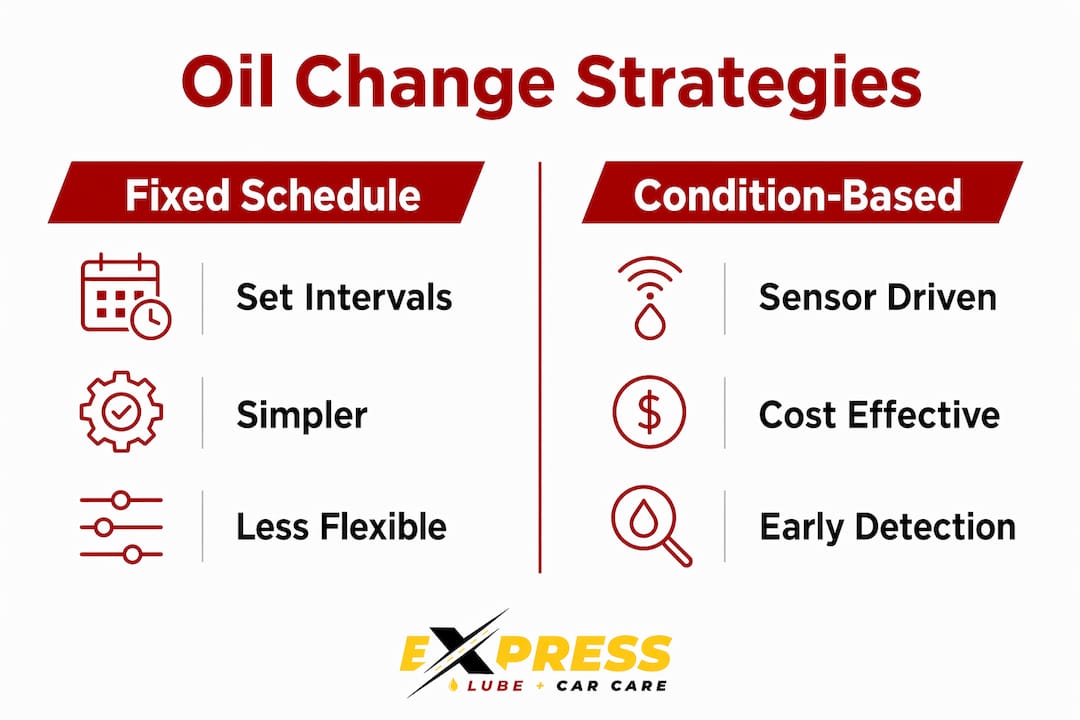
| Approach | Interval flexibility | Cost outcome | Failure detection |
|---|---|---|---|
| Fixed schedule | Rigid, time or mileage based | Wastes oil life or misses failures | Reactive only |
| Condition-based | Tailored to actual oil state | Reduces waste and prevents failures | Proactive, weeks in advance |
Prairie States Transportation shifted from fixed schedules to condition-based oil changes and saved $847,000 in the first year. Their drain intervals extended by 2.4 times. That is not a marginal improvement. It means fewer service events, less labor, and less oil purchased annually.
Oil analysis also catches what visual inspections miss. Oil analysis uncovered early wear and contamination patterns that fixed schedules overlooked entirely, preventing engine failures that average $47,000 each to repair. Catching a bearing issue at the analysis stage costs a fraction of that.
“Oil management is a strategic maintenance decision, not mere routine procurement. Wrong oil decisions lead to massive future repair bills.” — Fleet Oil Management and Engine Performance
Experts confirm that arbitrary time-and-mileage schedules waste expensive oil life and miss early contamination signs unique to each vehicle’s operating environment. The data supports moving away from the calendar and toward the condition of the oil itself.
How does outsourcing fleet oil changes reduce downtime and costs?
Outsourcing fleet oil changes to mobile service providers solves a problem that most fleet managers underestimate: the opportunity cost of pulling vehicles off the road during business hours for routine maintenance. Mobile services perform oil changes during off-hours, nights, or weekends, so vehicles are ready when drivers need them.
The financial case is clear. Outsourcing fleet oil changes to mobile services cuts total maintenance costs by 15–30%. A 50-truck fleet using this approach recovered more than 175 hours of lost productivity annually. That is more than four full work weeks returned to operations.
Here is how outsourcing creates that value:
- Off-hours scheduling keeps vehicles in service during revenue-generating hours
- Eliminated infrastructure costs remove the need for oil storage tanks, waste disposal contracts, and dedicated shop space
- Freed technician time allows in-house mechanics to focus on complex repairs rather than routine oil changes
- Consistent documentation from professional service providers creates audit-ready maintenance records
- Synthetic oil upgrades improve fuel economy by 0.5–3%, compounding savings across a large fleet
Outsourcing eliminates infrastructure costs and recovers shop time, allowing focus on complex repairs and improving overall fleet maintenance efficiency. For fleet managers evaluating total cost of ownership, that calculation includes avoided investments in oil storage, waste disposal infrastructure, and the high opportunity cost of in-service downtime.
Pro Tip: When evaluating a mobile oil change provider, ask for a sample maintenance report. A quality provider delivers per-vehicle service records with oil type, filter part number, mileage, and technician notes. That paper trail protects you during warranty claims and resale.
A commercial oil change service built for fleets handles scheduling, reporting, and oil specification in one package. That is a different product than a standard consumer oil change.
What factors determine the right oil change interval for your fleet?
No single interval fits every fleet. The correct oil change frequency depends on how each vehicle actually operates, not what the owner’s manual assumes. Operating stressors like constant idling, loads over 80%, and engine bay temperatures over 100°C drastically accelerate oil degradation and require shorter, tailored intervals.
The following factors directly affect how quickly oil breaks down:
- Load intensity: Vehicles running near maximum payload generate more heat and combustion byproducts, degrading oil faster
- Idle time: Extended idling dilutes oil with unburned fuel and increases soot contamination without building mileage
- Ambient temperature: High heat accelerates oxidation; extreme cold thickens oil and increases startup wear
- Dust and dirt exposure: Construction, agricultural, and off-road fleets pull contaminants through air intakes, contaminating oil faster
- Fuel quality: Low-quality diesel with higher sulfur content increases acid formation in oil
Oil viscosity is the most direct measure of oil health. Understanding oil viscosity and how it changes under operating stress is the foundation of any condition-based program. Synthetic oils resist viscosity breakdown better than conventional oils and perform reliably at both temperature extremes.
| Oil type | Heat resistance | Extended drain capability | Best application |
|---|---|---|---|
| Conventional | Moderate | Limited | Light duty, mild climates |
| Synthetic blend | Good | Moderate | Mixed duty cycles |
| Full synthetic | High | Strong | Heavy duty, extreme conditions |
Using the wrong viscosity grade does not cause immediate failure. However, incorrect oil specifications lead to costly repairs averaging $3,000–$8,000 later, including turbocharger bearing seizure and accelerated ring wear. The cost of choosing the right oil is negligible compared to that outcome.
What steps should fleet managers take to reduce downtime through oil management?
Reducing vehicle downtime through oil management is a process, not a single decision. Fleet managers who achieve measurable results follow a structured approach that combines monitoring, scheduling, and service selection.
-
Start an oil sampling program. Pull oil samples from each vehicle at every change and send them to a lab for wear metal analysis. This baseline data reveals which engines are healthy and which are trending toward failure.
-
Install telematics with oil life monitoring. Modern telematics platforms track engine hours, idle time, load cycles, and temperature data. That information feeds directly into oil life algorithms that flag when a specific vehicle needs service.
-
Segment your fleet by duty cycle. Group vehicles by how they operate: highway, urban, heavy load, or idle-heavy. Each group gets its own interval. A highway delivery van and a construction site support truck should never share the same oil change schedule.
-
Evaluate mobile oil change providers. Request references from fleets of similar size. Confirm the provider uses OEM-approved oil specifications and delivers digital service records. Verify their technicians hold ASE certifications or equivalent credentials.
-
Train drivers on early warning signs. Drivers are the first line of detection. Teach them to report oil pressure warning lights, unusual exhaust smoke, or oil smell in the cab immediately. Early reporting converts a potential breakdown into a scheduled repair.
Monitoring wear metals in oil samples gives fleets 6–8 weeks of advance warning before catastrophic engine failures. That lead time is the difference between a planned shop visit and an emergency roadside breakdown.
Pro Tip: Set a calendar reminder to review your oil analysis reports quarterly as a group, not just vehicle by vehicle. Patterns across your fleet reveal systemic issues like a bad fuel batch, a supplier sending the wrong oil grade, or a specific engine model that needs shorter intervals.
Condition-based oil monitoring reduced unplanned fleet downtime by 67% in documented logistics operations, with up to 6–8 weeks of advance warning before engine failures. That is the ceiling for what intelligent oil management can deliver.
Key Takeaways
Condition-based oil management, not fixed schedules, is the most effective method for reducing fleet downtime and controlling maintenance costs.
| Point | Details |
|---|---|
| Oil condition drives downtime | Degraded oil causes sludge, overheating, and bearing failure that take vehicles off the road for days. |
| Condition-based intervals outperform fixed schedules | Fleets like Prairie States Transportation cut maintenance costs by 30% and extended drain intervals by 2.4 times. |
| Oil analysis provides advance warning | Wear metal sampling delivers 6–8 weeks of warning before catastrophic engine failures, enabling planned repairs. |
| Outsourcing recovers productivity | Mobile oil change services recover 175+ hours of lost productivity annually in a 50-truck fleet. |
| Oil specification errors are expensive | Wrong viscosity grades lead to repairs averaging $3,000–$8,000, including turbocharger damage. |
What we have learned from managing fleet oil programs
The most common mistake we see fleet managers make is treating oil changes as a commodity task. They set a mileage interval, hand it to a dispatcher, and assume the job is done. That approach works until it doesn’t, and when it fails, it fails expensively.
The fleets that consistently achieve high uptime share one habit: they treat oil condition data the same way they treat fuel cost data. They track it, analyze it, and act on it before a problem becomes a breakdown. A logistics operation that prevented $340,000 in engine failure costs over 18 months did not do it with better luck. They did it by reading their oil.
The other lesson is that outsourcing is not a sign of a lean maintenance budget. It is a sign of a well-run operation. When your in-house technicians are not changing oil, they are diagnosing transmission issues, inspecting brake systems, and handling the work that actually requires their skill. That reallocation of labor is where real efficiency gains live.
Oil management is not a line item. It is a decision that compounds across every vehicle in your fleet, every month, for the life of those assets. Treat it accordingly.
— Express Lube & Car Care
Fleet oil change services at Express Lube & Car Care
Express Lube & Car Care serves commercial fleets in the Plano area with fast, certified oil change services that fit your schedule, not the other way around. No appointment is needed, and certified technicians handle every service with the same attention to specification and documentation that fleet managers depend on.
Fleet operators can take advantage of current oil change and service specials designed to lower per-vehicle maintenance costs without cutting corners on oil quality. Full synthetic options are available for heavy-duty applications, and every service includes a documented record for your maintenance files. Visit Express Lube & Car Care or check available oil change specials to keep your fleet running on schedule.
FAQ
Why do fleet oil changes reduce downtime specifically?
Fresh oil maintains engine lubrication, removes contaminants, and prevents sludge buildup that causes unexpected failures. Condition-based programs add early warning capability, catching wear patterns weeks before a breakdown occurs.
How often should fleet vehicles get oil changes?
The correct interval depends on duty cycle, load, idle time, and oil type. Heavy-duty or high-idle vehicles need shorter intervals than highway vehicles, and condition-based oil analysis determines the exact timing more accurately than mileage alone.
What is the cost of skipping or delaying fleet oil changes?
Delayed oil changes lead to engine failures averaging $47,000 each in repair costs. Incorrect oil specifications alone cause repairs averaging $3,000–$8,000, including turbocharger damage and accelerated ring wear.
Does synthetic oil reduce fleet downtime compared to conventional oil?
Full synthetic oil resists viscosity breakdown at high temperatures and extends drain intervals reliably in heavy-duty applications. Fleets using synthetic oils also see fuel economy improvements of 0.5–3%, adding a secondary cost benefit.
What is condition-based oil monitoring for fleets?
Condition-based oil monitoring uses oil sampling, wear metal analysis, and telematics data to determine when each vehicle actually needs an oil change. It replaces fixed schedules with data-driven decisions, reducing both unnecessary changes and missed failures.