

The first step in diagnosing any potential transmission issue begins not with tools, but with your senses. Your ability to observe your vehicle's behavior is the most powerful initial diagnostic tool you possess. The process starts by listening for unusual noises, feeling for abnormal vibrations, and looking for physical evidence like leaks.
These foundational checks provide the most critical clues for understanding the health of your transmission.
Decoding Your Car's Transmission Warning Signs
Long before a dashboard warning light illuminates, your vehicle often provides subtle signals that a problem is developing. Learning to interpret these early indicators is a crucial skill for any car owner. Think of it as your car communicating in its own mechanical language—the sooner you comprehend it, the more likely you are to avoid a costly and complex repair.
A healthy transmission operates almost invisibly, providing smooth, quiet power delivery. Any deviation from this baseline is significant. The initial signs of trouble are almost always new sounds or physical sensations that disrupt the vehicle's normal, seamless operation.
What to Listen For
Acoustic changes are frequently the first symptom of a transmission problem. These sounds can range from high-pitched whines to low, guttural clunks, but they almost always signify that a mechanical component is under stress or failing. It is imperative not to ignore these auditory warnings.
Listen carefully for these key sounds:
- Whining or Humming: A high-pitched whine that modulates with engine speed can indicate a problem with the torque converter or a restriction in the transmission's hydraulic system, such as a clogged filter. This sound may be faint initially but typically intensifies over time.
- Clunking or Banging: An abrupt, loud clunk when shifting from Park into a drive gear often points to excessive play in the driveline, such as worn universal joints (U-joints) or failing transmission mounts. If this sound occurs between gears while driving, it may signal a more severe internal mechanical issue.
- Buzzing Noise: A consistent buzzing sound that was not previously present could be symptomatic of a malfunctioning internal solenoid or indicate that the transmission fluid level is low, causing the hydraulic pump to cavitate or work under strain.
Providing a technician with specific information is invaluable. A vague statement like "it's making a weird noise" is difficult to act upon. In contrast, describing a "high-pitched whine that increases in pitch during acceleration" offers a clear diagnostic starting point.
To help you correlate symptoms with potential causes, the following table provides a useful reference.
Common Transmission Symptoms and Potential Causes
| Symptom You're Experiencing | What It Sounds or Feels Like | What It Could Mean |
|---|---|---|
| Whining or Humming | A high-pitched noise that changes with engine speed. | Low fluid, failing torque converter, clogged filter. |
| Clunking or Banging | A loud, abrupt noise when shifting gears. | Worn U-joints, bad transmission mounts, internal damage. |
| Shuddering or Shaking | Feels like driving over rumble strips, often at specific speeds. | Torque converter issues, worn clutch packs. |
| Delayed Shifting | A long pause or engine revving before the gear engages. | Low fluid level, slipping clutches, faulty solenoids. |
| Rough or Hard Shifts | Gear changes feel jerky and violent instead of smooth. | Low or burnt fluid, solenoid problems. |
| Burning Smell | A sweet, acrid smell, different from oil or antifreeze. | Overheating transmission fluid, a potential leak. |
This table serves as an excellent preliminary guide, but a professional inspection is often required to confirm the root cause with certainty.
What to Feel While Driving
In addition to auditory cues, tactile feedback transmitted through the steering wheel and chassis can reveal much about the transmission's condition. The primary function of a transmission is to transfer power smoothly. Any interruption to that smooth delivery is a significant red flag. For a more detailed breakdown, our guide on the early signs of transmission failure goes into greater depth.
Be alert for these key physical sensations:
- Shuddering or Shaking: A vibration akin to driving over a rumble strip, especially if it occurs at a consistent speed, is a classic symptom of a torque converter clutch issue or worn internal clutch packs.
- Delayed or Hesitant Shifting: If you notice a discernible lag or a flare in engine RPM before the transmission engages the next gear, it is a textbook sign of low hydraulic pressure (often from low fluid) or internal clutches that are beginning to slip.
- Rough or Hard Shifts: When gear changes become harsh or abrupt instead of seamless, the cause could range from failing shift solenoids to dangerously low or thermally degraded transmission fluid.
Early detection of these symptoms provides the best opportunity to prevent a minor issue from escalating into a catastrophic transmission failure. During your next drive, reduce distractions to listen and feel for these indicators. Your vehicle may be communicating a problem that, if addressed promptly, can save you significant time and expense.
Inspecting Your Transmission Fluid Like a Pro
Beyond listening and feeling for issues, one of the most informative diagnostic procedures you can perform is a thorough inspection of the automatic transmission fluid (ATF). The ATF is the lifeblood of the system; it lubricates moving parts, dissipates heat, and provides the hydraulic pressure necessary for gear changes. The color, odor, and level of the ATF offer a detailed narrative of the transmission's internal condition.
To begin, you must obtain an accurate reading. For most vehicles, this requires the engine to be running and warmed to its normal operating temperature. Park on a level surface, apply the parking brake, and allow the engine to idle for several minutes. Many manufacturers also recommend cycling the shifter through all gears before the check; it is always wise to consult your owner's manual for the specific procedure for your vehicle.
Locating and Reading the Dipstick
With the engine warm and running, open the hood and locate the transmission fluid dipstick. It is typically situated toward the rear of the engine bay and often has a distinctively colored handle (e.g., red, yellow, or orange) to differentiate it from the engine oil dipstick.
Extract the dipstick, wipe it clean with a lint-free cloth, reinsert it fully, and then withdraw it again to take the reading. You are assessing two key parameters:
- Fluid Level: The dipstick will feature markings such as "FULL" and "ADD," or a crosshatched area, indicating the correct operating range. An insufficient fluid level is a critical issue that leads to overheating and inadequate lubrication.
- Fluid Condition: This is where careful observation is paramount. Examine the fluid on the dipstick. Note its color, clarity, and odor. Look for the presence of metallic particles or other contaminants.
This initial three-part check—listening, feeling, and looking—is your first and most effective line of defense against severe transmission damage.
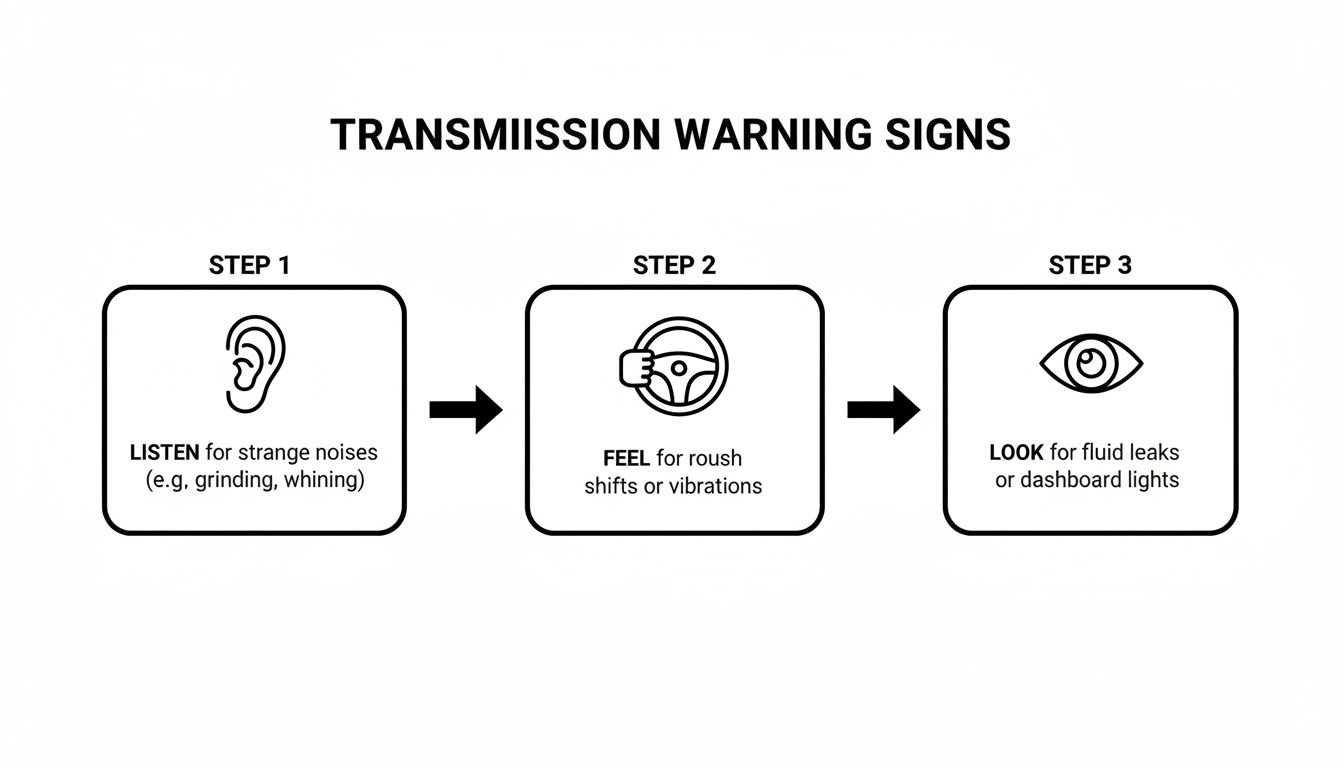
Consider your senses to be the vehicle's most effective early-warning system. Identifying an anomaly now can prevent significant complications later.
What Healthy vs. Unhealthy Fluid Tells You
The condition of the ATF provides a direct window into the health of the transmission's internal components. The ideal state is a bright, translucent red fluid (or the specific color designated by your vehicle's manufacturer). Any deviation from this standard indicates an underlying issue.
Here is a guide to interpreting fluid condition:
- Bright Red & Clear: Optimal. The fluid is in good condition and performing its functions correctly.
- Light Brown or Muddy: The fluid is aging and beginning to lose its effectiveness due to oxidation. While not an immediate crisis, a fluid service should be scheduled.
- Dark Brown or Black: This is a serious warning sign. The fluid is heavily oxidized, thermally degraded, and likely contaminated with friction material from worn clutches. It is no longer providing adequate protection.
- Milky or Foamy Pink: This almost invariably indicates coolant contamination, typically from a breach in the transmission cooler integrated into the radiator. This is an emergency situation that can cause rapid and catastrophic transmission failure.
One of the most revealing indicators is a burnt, acrid odor, similar to burnt toast. This smell signifies that the fluid has been severely overheated, compromising its chemical structure and ability to protect internal components.
Overheating is the leading cause of automatic transmission failure. It is estimated that excessive heat contributes to approximately 90% of all automatic transmission failures. Once the fluid temperature exceeds 220–250°F, it begins to break down rapidly, and its capacity to lubricate and cool critical components like clutch packs diminishes significantly.
If your fluid is low, dark, or has a burnt odor, your transmission requires immediate attention. Adhering to manufacturer-recommended service intervals is crucial; you can learn more about when to change transmission fluid in our detailed guide. Addressing a fluid-related issue early is the most effective way to prevent catastrophic failure and a substantial repair invoice.
Digging for Clues with an OBD2 Scanner
The check engine light on your dashboard serves as a direct communication from your vehicle's onboard computer system. When it illuminates due to a transmission fault, it often represents the first indication of an electronic or sensor-related problem. An affordable On-Board Diagnostics (OBD2) scanner is an invaluable tool in this scenario.
Using an OBD2 scanner is a straightforward process. Every vehicle manufactured for sale in the U.S. since 1996 is equipped with an OBD2 port, typically located under the dashboard on the driver's side. To use the scanner, you simply plug it into the port, turn the ignition key to the "On" position (without starting the engine), and command it to retrieve the stored codes.
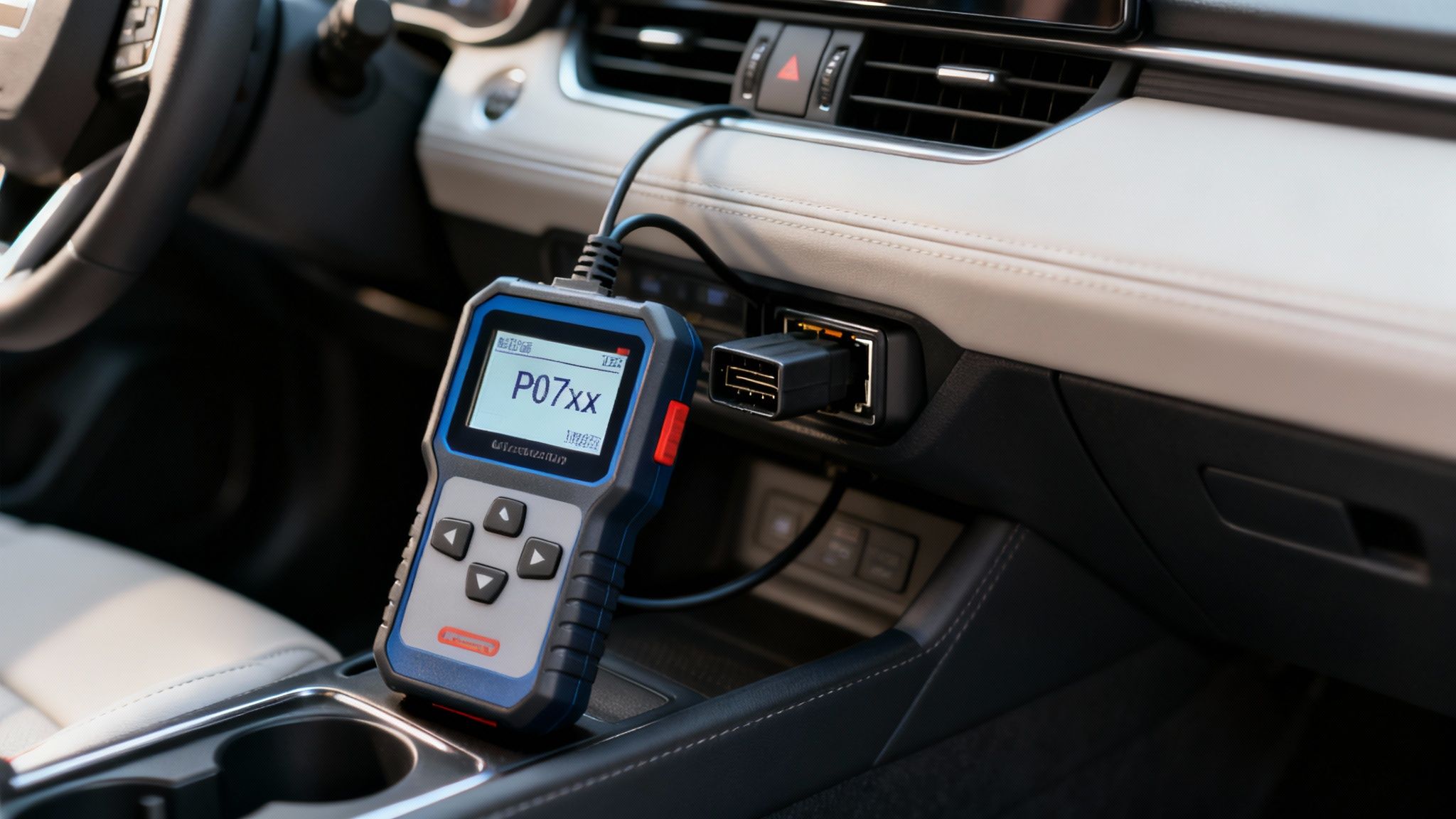
These codes are known as Diagnostic Trouble Codes (DTCs), and they provide the initial data for any electronic diagnosis. They are standardized across manufacturers, meaning a P0700 code signifies the same general fault on a Ford as it does on a Honda.
Cracking the Transmission Code
When a transmission issue is suspected, you are looking for a specific family of DTCs. Among the thousands of potential codes, those pertaining to the transmission and torque converter almost exclusively begin with the prefix "P07xx."
The presence of a code in this range confirms that the vehicle's computer has detected a fault within the transmission's electronic control system, which could stem from a faulty sensor, a malfunctioning solenoid, or another electronic component.
Here are a few common transmission-related DTCs:
- P0700 – Transmission Control System Malfunction: This is a generic code that serves as a general alert. It indicates that the Transmission Control Module (TCM) has detected a fault and usually appears in conjunction with more specific codes.
- P0715 – Input/Turbine Speed Sensor Circuit Malfunction: This code points to an issue with the sensor that measures the rotational speed of the transmission's input shaft. A failure in this sensor's circuit will result in erratic and improper shifting.
- P0751 – Shift Solenoid 'A' Performance or Stuck Off: Shift solenoids are electro-hydraulic valves that direct the flow of transmission fluid to engage or disengage gears. If a solenoid fails or becomes stuck, it can result in the loss of one or more gears.
It is critical to understand that a DTC is not a final diagnosis. A code like P0751 indicates a fault within that solenoid's circuit, but it does not specify whether the problem lies with the solenoid itself, the wiring, the connector, or the TCM. The code is a vital piece of evidence that directs a technician toward the source of the problem. Our article on what causes the check engine light can provide more context.
Have a Smarter Conversation at the Shop
Arriving at a repair facility armed with specific trouble codes transforms the diagnostic conversation. It elevates your report from a subjective "My car is shifting weird" to a data-driven "My car is shifting weird, and I've retrieved a P0715 code for the input speed sensor." This level of detail enables a technician to begin their diagnosis more efficiently and demonstrates that you are an informed vehicle owner.
A trouble code represents the beginning of the diagnostic narrative, not the conclusion. It is the "what" that guides a skilled technician to uncover the "why." Using a scanner provides you with the first chapter of that story.
This knowledge also serves as a form of consumer protection. One industry study revealed that approximately 5.5% of used vehicles at U.S. auctions had concealed transmission codes. With the average transmission repair cost around $4,000, these undisclosed issues represent an estimated $1.6 billion in potential repair liabilities. Performing a quick scan yourself can uncover problems that might otherwise remain hidden until they escalate into a major expense.
Taking Your Car for a Diagnostic Road Test
In some cases, the most effective way to understand a transmission's behavior is to observe it under real-world operating conditions. Following fluid checks and an OBD2 scan, a structured road test can help isolate and replicate the problem, providing invaluable diagnostic information. This is not a casual drive but a focused procedure designed to gather specific data.
The objective is to collect detailed, replicable information. Simply telling a mechanic "it feels weird" is insufficient. However, providing a statement like, "it hesitates shifting from 2nd to 3rd gear under light acceleration, but only after the engine is fully warmed up," is diagnostically significant. This level of detail can save a technician hours of diagnostic time.

Prioritize safety above all else. Select a familiar route with minimal traffic, such as a quiet residential area or an empty industrial park. Your full attention must be on the vehicle's behavior, not on navigating traffic.
How to Set Up the Test Drive
A successful diagnostic drive requires a systematic approach. The goal is to put the transmission through its full range of operations to observe its response under various loads and conditions.
Begin with a stationary test. With your foot firmly on the brake pedal, move the gear selector through each position—Park, Reverse, Neutral, Drive, and any lower gears. Pause in each position for several seconds.
- Listen for clunks: Do you hear a jarring "bang" or feel a harsh jolt as a gear engages?
- Feel for delays: Is there a latency of more than a second or two before you feel the gear engage?
- Check for strange noises: Is there a whine or buzz in one gear that is absent in others?
This simple stationary test can immediately point to issues like low hydraulic pressure, a malfunctioning shift solenoid, or worn transmission mounts. Note which specific gear selection causes the problem.
Watching How It Shifts Under Different Conditions
Once moving, focus on the quality of the upshifts and downshifts. You need to observe how the transmission behaves under different throttle inputs, as this directly affects hydraulic line pressure and the demands placed on internal components.
First, accelerate from a complete stop with very light throttle. Pay close attention to the shift points. Does the engine RPM flare up between gears, as if the transmission is briefly in neutral? This is a classic symptom of slipping clutches.
Next, perform a moderate acceleration, similar to merging into traffic. Are the shifts smooth and precise, or do they feel harsh and abrupt? A hard, jerky shift can be symptomatic of a faulty pressure control solenoid or an issue within the vehicle's control module logic.
Finally, if it is safe to do so, apply more significant throttle. Does the transmission hesitate to downshift when power is demanded? Does it begin to shudder or vibrate under the increased load?
Pro Tip: A shudder or vibration that feels like driving over rumble strips is a classic indicator of a failing torque converter lock-up clutch. This phenomenon typically occurs under light acceleration at speeds between 30-50 mph.
Do not neglect to test the downshifts. As you coast to a stop, the downshifts should be nearly imperceptible. If you feel the vehicle lurching or clunking as it shifts down through the gears, this is another critical piece of the diagnostic puzzle. By following this methodical approach, you can transform a vague issue into a clear set of symptoms and learn how to diagnose transmission problems effectively.
Knowing When to Call a Professional Technician
While a hands-on diagnostic approach can be highly informative, it is essential to recognize the boundary between prudent DIY investigation and a potentially costly mistake. Understanding your limitations is as crucial as knowing how to check your transmission fluid. Proceeding without the proper tools, equipment, or expertise can escalate a manageable repair into a catastrophic failure.
Modern transmissions are not simple mechanical devices; they are complex systems integrating hydraulics, planetary gear sets, and sophisticated electronic controls. A professional technician possesses not only more advanced tools but also specialized diagnostic equipment that can communicate directly with your vehicle's Transmission Control Module (TCM).
Identifying the Absolute Red Flags
Some symptoms are not subtle warnings but urgent alerts that demand immediate professional attention. If you encounter any of the following, cease further diagnosis, put away your tools, and contact a reputable repair facility. These signs often indicate severe internal damage that requires an expert evaluation without delay.
These are the non-negotiable red flags:
- Major Fluid Leaks: A few drops of fluid on your garage floor warrant inspection, but discovering a large puddle of red or brown fluid constitutes an emergency. This indicates a significant breach in a seal, gasket, or line. Driving the vehicle under these conditions can lead to fluid starvation and cause the transmission to destroy itself within miles.
- Loud Metallic Grinding or Banging: While a whine is a concern, loud, metallic grinding, clanking, or banging noises during operation are signs of imminent mechanical failure. These sounds typically mean that hard parts, such as gears or bearings, are disintegrating inside the transmission case.
- Complete Refusal to Engage Any Gear: If you shift into Drive or Reverse and the vehicle fails to move—with the engine simply revving—you are likely facing a major internal failure. Possible causes include a failed torque converter, a broken input shaft, or a complete loss of hydraulic pressure.
A professional diagnosis is often the most cost-effective first step. It is an investment in accuracy that prevents you from wasting money on incorrect parts or causing additional damage by attempting a repair that fails to address the root cause.
Attempting to repair these issues without professional expertise is a high-risk endeavor. Misdiagnosis can easily lead to a much larger repair bill than you would have faced initially.
The Complexity of Modern Transmissions
The automotive repair landscape has evolved significantly. The global transmission repair market is projected to grow from roughly USD 141.7 billion in 2025 to about USD 203.7 billion by 2032. A significant driver of this growth is the increasing complexity of modern automatic, Continuously Variable (CVT), and dual-clutch transmissions, which are heavily reliant on software and sensors. You can see more details on this trend over at fortunebusinessinsights.com.
These advanced systems can exhibit failures that are entirely electronic in nature and invisible to a visual inspection. Issues such as a faulty mechatronics unit or a software glitch cannot be diagnosed without a professional-grade scan tool capable of reading manufacturer-specific data streams.
Why a Pro Diagnosis Saves You Money
While it may seem counterintuitive, paying a professional for a proper diagnostic service can be the most economical part of the entire repair process. A skilled technician can accurately differentiate between a simple, inexpensive external repair and a major internal failure requiring a complete rebuild.
Consider this real-world scenario: your vehicle is shifting harshly, and your basic OBD2 scanner provides a generic pressure control solenoid code. You might be tempted to purchase and replace the solenoid. A professional, however, might use advanced tools to determine that the actual issue is a frayed wire in the harness leading to the solenoid or that a simple TCM software update is required—both of which are far less costly solutions.
Ultimately, knowing when to seek professional help is a fundamental part of learning how to diagnose transmission problems. It is the recognition that sometimes, the most intelligent course of action is to entrust the vehicle to an expert.
Common Questions About Transmission Diagnostics
Transmission problems can be daunting due to the complexity of the system. When something feels amiss, many questions naturally arise. Here are clear, educational answers to the inquiries we hear most frequently from drivers.
Can a Transmission Fail Without Any Warning Signs?
While rare, it is possible for a transmission to fail suddenly without prior overt warnings. More commonly, the initial warning signs are subtle and easily dismissed, such as a slight hesitation during a shift or an intermittent, unusual noise.
This underscores the importance of being familiar with your vehicle's normal operating characteristics. An OBD2 scanner can sometimes detect "pending" trouble codes before the check engine light is triggered, offering a valuable early warning. However, a catastrophic mechanical failure, such as a snapped internal band or a punctured transmission line causing rapid fluid loss, can certainly lead to a sudden breakdown.
If you ever discover a large puddle of bright red or dark brown fluid beneath your vehicle, stop driving immediately and have it towed. Operating a vehicle for even a few miles with low transmission fluid can cause irreparable damage.
Is It Better to Repair or Replace an Old Transmission?
This is a critical decision with no universal answer. The best course of action depends on the specific nature of the problem, the vehicle's age and mileage, its overall condition, and its value to you.
A targeted repair is almost always the more economical choice if the fault lies with an external or easily accessible component. Examples include:
- Faulty sensors or solenoids: These can often be replaced without removing the entire transmission assembly.
- Leaking seals or gaskets: Replacing a leaking transmission pan gasket, for instance, is a routine procedure for a qualified technician.
- Bad transmission mounts: These can cause significant clunking noises but do not indicate a failure of the transmission's internal workings.
Conversely, if the diagnosis reveals major internal damage in a higher-mileage vehicle, a rebuilt or remanufactured transmission is often the superior long-term solution. These units are typically re-engineered to correct original design flaws and come with a warranty, providing significant peace of mind. A professional technician can accurately diagnose the failure and present you with clear options and associated costs to help you make an informed decision.
How Much Does a Transmission Diagnosis Cost in Plano?
The cost of a diagnosis is determined by the depth of investigation required. An initial diagnostic service is generally affordable and includes a visual inspection, a fluid level and condition check, and a scan with a professional-grade OBD2 tool to retrieve any stored trouble codes.
In some cases, this initial step is insufficient to pinpoint the root cause. A more in-depth diagnosis might involve a technician performing a specific road test, measuring hydraulic line pressures with specialized gauges, or removing the transmission pan to inspect for metallic debris and other evidence of internal wear.
While it may seem like an additional expense, a thorough and accurate diagnosis ultimately saves you money. It ensures that the problem is correctly identified from the outset, preventing you from paying for unnecessary repairs. Many reputable shops will apply the diagnostic fee toward the final cost of the repair if you authorize the work.
Will a Transmission Fluid Change Fix My Shifting Problems?
In some instances, yes. If the issue is minor and caused by old, thermally degraded fluid—such as a slight shudder or occasional rough shifts—a complete fluid and filter service can yield a noticeable improvement. Fresh fluid restores the proper lubricating, cooling, and hydraulic properties required for smooth operation.
However, it is crucial to understand that a fluid change is a maintenance procedure, not a remedy for mechanical damage. If clutch packs are already burnt or other hard parts are worn beyond their service limits, new fluid will not reverse the damage. This is why a proper diagnosis is essential; you must determine if a fluid service is the appropriate solution or if it could potentially exacerbate a problem in a severely neglected transmission.
When you need clear answers and expert service you can trust, Express Lube & Car Care is here to help. Our ASE-certified technicians have the diagnostic tools and experience to pinpoint the exact cause of your transmission troubles and recommend the right fix. Stop by today for a professional diagnosis and drive with confidence. Learn more at https://www.expresslubeplano.com.