

You pull into a quick-lube bay, hand over your keys, and settle into the waiting area thinking, “It's just an oil change.” From the customer side, it can look simple. A few minutes later, the car is back on the ground, the sticker is updated, and you're on your way.
Behind the bay door, a proper oil change isn't simple at all. It's a repeatable process built around oil change equipment that makes the service cleaner, faster, and much less likely to go wrong. A shop can have a good technician, but if that technician is working with the wrong lift, a poor drain setup, or the wrong filter tool, the job gets slower and the risk goes up.
That matters because oil service is a huge, durable part of vehicle maintenance. The U.S. oil change service market was valued at USD 8.2 billion in 2024 and is projected to reach USD 14.8 billion by 2034, with more than 29,000 service businesses supporting that work, according to Market.us research on the U.S. oil change service market. A market that large doesn't run on guesswork. It runs on bay design, fluid handling, tool control, and process discipline.
Drivers who want a broader maintenance perspective can also benefit from learning how service intervals vary across systems, not just engines. A useful example is this guide to hydraulic oil change frequency, which shows how fluid life depends on equipment type, operating conditions, and maintenance standards.
Behind the Bay Door What Really Happens During an Oil Change
A professional oil change starts before a drain plug is loosened. The vehicle has to be identified correctly, the oil type confirmed, the capacity checked, and the filter style matched. Some cars use a spin-on filter. Others use a cartridge system with a cap that needs a specific socket. Some can be serviced efficiently from below. Others are better suited to top-side extraction.
The job is really a process, not a pour and fill
Customers usually notice speed. Technicians notice control.
In a well-equipped bay, the vehicle goes up safely, the old oil is captured without splashing across the floor, the correct filter tool is selected, and the new oil goes in through a measured dispensing system instead of a stack of random bottles. That sequence reduces mistakes because every piece of equipment is doing a specific job.
Practical rule: Fast service only works when the bay is organized enough to avoid shortcuts.
A sloppy setup creates familiar problems. Drain plugs get rounded. Filter housings get cracked. Oil gets spilled on splash shields and crossmembers. The tech spends extra time cleaning up a mess that proper equipment would have prevented.
Good equipment protects more than shop efficiency
Customers often assume professional tools mainly help the shop move cars through the line. They do help with workflow, but the bigger point is consistency. When the same service is performed over and over, consistency protects the engine, protects the underbody from leaks, and protects the shop from avoidable failures.
A proper bay also supports inspection. Once the vehicle is in the air, the technician can see seepage around a pan gasket, check for damage around the drain area, and catch issues that are hard to spot with the car sitting on the ground.
That's what's really happening behind the bay door. The oil is getting changed, yes. But just as important, the vehicle is being handled with equipment designed to make that routine service dependable every time.
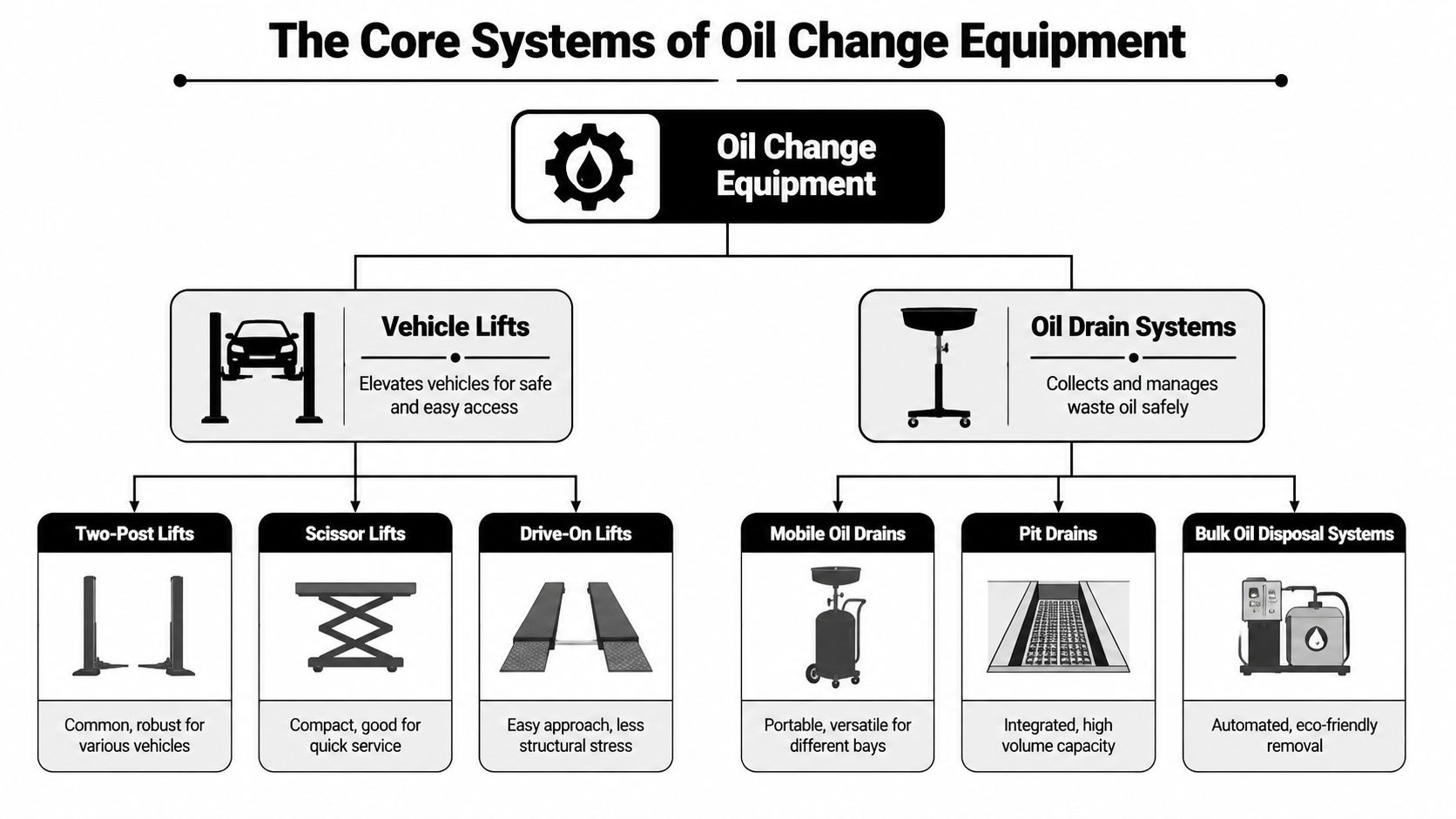
The Core Systems Lifts and Fluid Drains
A professional oil change bay is a lot like a commercial kitchen. A skilled cook can make dinner on a camp stove, but a restaurant uses the right equipment because speed, safety, and repeatability matter. Auto service works the same way.
The two foundational systems are vehicle lifts and oil drain equipment. If either one is poor, the whole service suffers.
Why lifts change everything
For home service, a jack and jack stands may be the practical minimum. For professional work, a lift changes the job from awkward to controlled. The technician gets stable, immediate access to the drain plug, filter housing, splash shields, and inspection points under the vehicle.
Different shops use different lift styles depending on the bay layout and service mix:
| Lift type | Where it works well | Main advantage |
|---|---|---|
| Two-post lift | General repair and underbody access | Open access to the underside |
| Scissor lift | Tight quick-service spaces | Compact footprint |
| Drive-on lift | Easy vehicle approach | Simple loading and stable positioning |
A lift also improves technician ergonomics. Instead of crouching under a half-raised vehicle or working around jack points, the tech can position the car at a usable height and see the work clearly. Better visibility usually means cleaner work.
A shop that invests in proper lifting equipment is usually investing in process, not just convenience.
Open drain pans are basic. Managed drain systems are better
The second core system is fluid collection. At the simplest level, used oil needs to leave the engine and land in a pan. In a professional bay, that basic task gets upgraded into a controlled handling process.
Shops often use mobile drain units, caddies, or integrated waste-oil collection systems because they help with:
- Spill control: Waste oil goes into a contained vessel instead of an open pan that can splash or slosh.
- Bay cleanliness: A cleaner floor reduces slip risk and keeps contamination down.
- Workflow: The drain unit can be rolled where it's needed instead of forcing the technician to carry open containers around the shop.
- Waste handling: Used oil can move into storage and disposal systems without repeated manual pouring.
The distinction between amateur and professional equipment becomes clear. An open drain pan works, but it doesn't manage the rest of the process very well. A modern drain system treats used oil like a material that needs to be captured, moved, and stored safely from the moment it leaves the engine.
When customers see a clean, orderly bay, they're often seeing the result of good fluid management equipment doing its job.
Precision Tools for a Perfect Service
The large equipment gets the car in the air and captures the old oil. The smaller tools decide whether the service is precise or careless, determining if a routine job stays routine or turns into a stripped thread, a cracked filter cap, or a leak that shows up after the customer gets home.
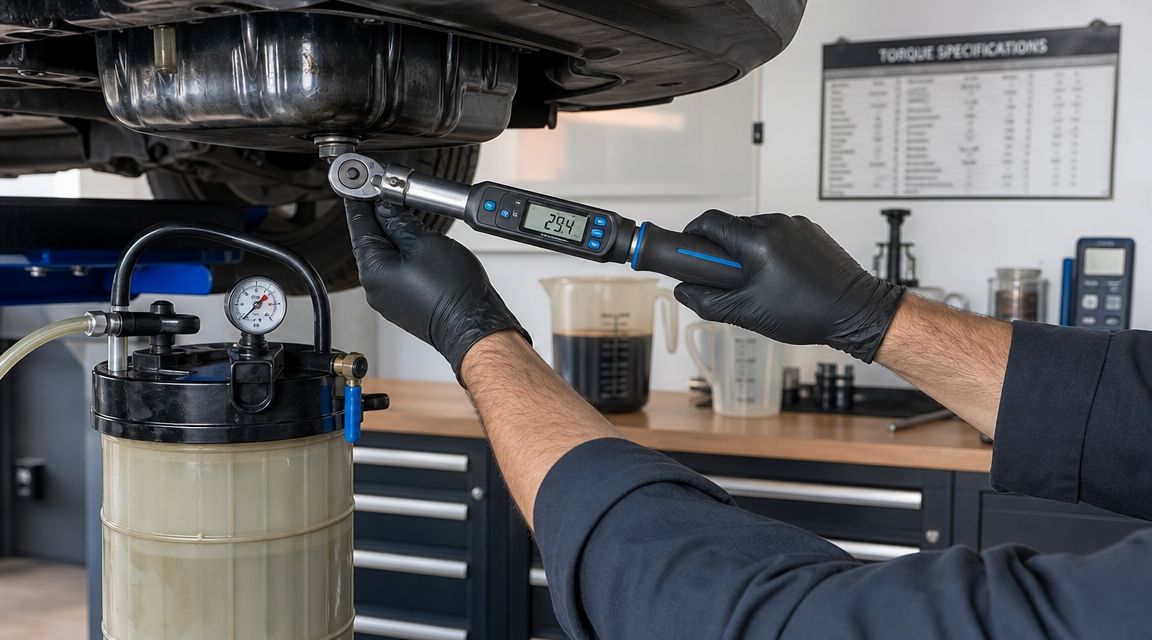
A proper oil change requires vehicle-specific tools, including a torque wrench, because drain plugs and filter housings must be tightened to manufacturer specifications. Over-tightening can damage threads or crack housings, while under-tightening can cause leaks, as explained in AutoZone's guide to oil change tools.
The right filter wrench matters
Not every oil filter comes off the same way. Shops keep several styles on hand because one universal wrench usually means damage sooner or later.
Common examples include:
- Cap sockets: Best for cartridge filter housings that need an exact fit.
- Claw-style wrenches: Useful when access is tight and the filter body is exposed.
- Strap or band wrenches: Helpful on some spin-on filters where controlled grip matters.
Using pliers on a plastic cartridge cap is the kind of shortcut that creates an expensive comeback. The cap gets chewed up, the hex deforms, and the next service becomes harder than it should be.
Torque is not guesswork
A drain plug doesn't need to be “good and tight.” It needs to be correct. That's a very different standard.
A torque wrench lets the technician tighten the plug or housing to spec instead of relying on feel, which varies from person to person. If you want a plain-language explanation of technique, this guide on how to apply torque correctly is a useful companion to what happens in a professional bay.
For drivers who want to understand the full procedure, including the relationship between the oil and filter service, this overview of changing oil and filter properly adds helpful context.
If a technician reaches for the wrong tool, the job usually doesn't fail immediately. It fails later, when the plug seeps or the next filter service becomes a fight.
Metered dispensing beats pouring from bottles
Professional shops also rely on controlled oil dispensing systems. Instead of opening individual containers and estimating by sight, technicians can use metered guns, reels, and bulk storage setups designed to deliver the correct amount cleanly.
That improves the service in several ways:
- Accuracy: The technician can deliver the intended fill amount with less chance of overfilling or coming up short.
- Cleanliness: Less dripping around the fill hole and engine cover.
- Efficiency: The oil is ready at the bay instead of being handled bottle by bottle.
Precision tools rarely look dramatic. But they're often the difference between a proper service and one that creates trouble later.
How Pro Equipment Improves Speed and Vehicle Safety
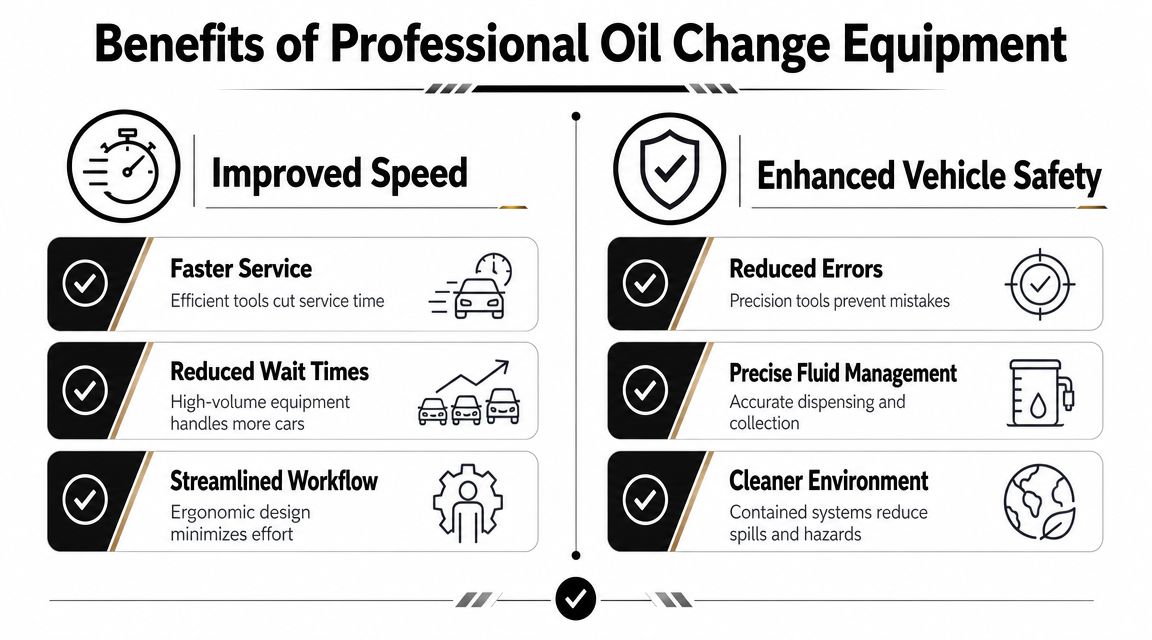
Customers usually judge an oil change by how long it takes and whether the car leaves without a problem. Those are fair standards. The important point is that both outcomes depend heavily on the shop's equipment.
Modern vehicles no longer follow the old 3,000-mile rule. Manufacturer recommendations now average about 10,000 miles, according to this review of the 3,000-mile oil change myth. When visits are less frequent, each one matters more. The service has to be efficient, but it also has to be right.
Speed comes from workflow, not rushing
A well-equipped bay shortens the service by reducing wasted motion.
A lift gets the vehicle up quickly and puts the drain area at working height. A proper drain unit is already in position. The correct filter wrench is within reach. The new oil comes from a dispensing system instead of a pile of bottles that must be opened, poured, and cleaned up afterward.
That isn't rushing. It's removing avoidable delays.
Drivers who want a customer-side look at timing can read more about how long an oil change typically takes. The short version is that speed is most reliable when the bay is built for the task.
Safety shows up in the details
Vehicle safety during an oil change doesn't only mean “the car didn't fall.” It includes every small choice that affects whether the engine stays sealed and properly filled after service.
A professional setup improves safety by reducing common mistakes:
- Correct support: The vehicle is lifted and held securely.
- Correct fitment: The right tool matches the filter housing or plug design.
- Correct tightening: Components are tightened to specification instead of by feel.
- Correct fluid handling: Used oil is captured cleanly, and new oil is dispensed with control.
There's also technician safety. A cleaner floor, better access, and contained waste handling reduce slips, awkward working positions, and accidental contact with hot oil. Shops that protect their staff usually produce better work because the whole process is more disciplined.
Better oil change equipment doesn't just make the job faster. It makes the fast job repeatable without gambling with your engine.
Red Flags to Watch for at an Oil Change Shop
A lot of drivers assume they can't tell much by looking at a service bay. In reality, you can spot quite a bit in a minute or two. The condition of the equipment tells you how the shop handles routine work, and routine work is where discipline should be easiest to see.
Professional shops have to manage spill risk, proper vehicle support, and waste oil disposal, a higher standard of care highlighted in this safety and compliance discussion from the Western Placer Waste Management Authority. If those basics look shaky, it's reasonable to question everything else.
What a customer can see right away
You don't need to inspect the whole shop. A few visible clues are enough.
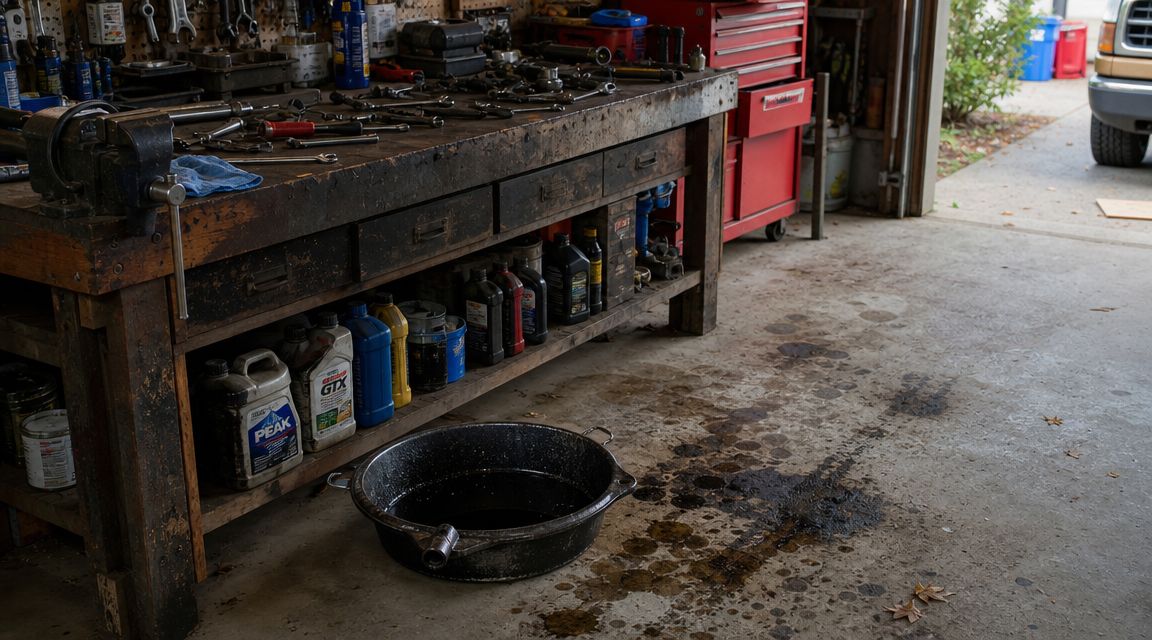
- Oil on the floor: A drip or two can happen. Persistent wet spots, stained work areas, or dirty puddling suggest poor fluid control.
- Open waste containers: Used oil should be handled in a contained system, not left exposed in random buckets or pans.
- Improvised lifting: If a quick-service shop seems to rely on makeshift support methods instead of proper lifting equipment, that's not a good sign.
- Tool misuse: Adjustable pliers or generic gripping tools on filter housings often mean the technician doesn't have the correct service tools.
- Cluttered bays: Disorder slows work and increases the chance of skipped steps, contamination, and damaged parts.
Mess usually means process problems
A messy bay isn't just an appearance issue. It often points to weak habits.
If the shop can't keep the drain area clean, it may also be careless about wiping sealing surfaces, checking old gaskets, or verifying for leaks after refilling. Those are the kinds of small steps that separate a clean service from a comeback.
For example, some drivers ask whether a filter always gets changed with the oil. The answer depends on the service plan and the vehicle, but it should never be guesswork. This discussion of changing oil without changing the filter helps explain why the shop should be able to give a clear reason for its recommendation.
A professional bay doesn't have to look fancy. It does have to look controlled.
If the equipment looks worn out, mismatched, or poorly maintained, it's fair to wonder whether the same approach is being applied to your vehicle.
The Express Lube Plano Commitment to Quality Equipment
Good oil service depends on two things working together. The shop needs the right equipment, and the technicians need the training to use it properly every time. One without the other leaves gaps.
At Express Lube Plano, that standard starts with state-of-the-art vehicle lifts, integrated fluid management systems, and a full range of specialized service tools matched to modern vehicles. That setup supports clean work, accurate fills, proper access under the vehicle, and the kind of controlled process customers expect when they need a no-appointment oil change done correctly.
The people matter just as much as the hardware. ASE-certified technicians use that equipment to perform routine oil service, inspections, and broader maintenance with the same emphasis on safety and consistency. That combination is what allows a shop to work quickly without turning “quick” into careless.
Why equipment investment reflects service standards
When a shop spends money on bay equipment, fluid handling, and tool coverage, it's making a statement about how it wants repairs and maintenance performed. Preventive upkeep matters for equipment in every industry, and a resource on preventative care for commercial equipment warranties is a good reminder that reliable service depends on maintaining the tools that do the work.
That same mindset applies in automotive service. A clean lift, a functioning drain system, a calibrated torque wrench, and organized tooling all support the same promise. The vehicle gets serviced safely, efficiently, and with less room for error.
Customers don't need to memorize every wrench or drain system in the bay. They just need to know what professional oil change equipment does for them. It protects the car, supports a faster visit, and makes routine maintenance feel dependable instead of uncertain.
If you want a fast, no-appointment oil change backed by ASE-certified technicians and professional-grade equipment, visit Express Lube & Car Care. The team serves Plano drivers with careful maintenance, honest service, and the kind of bay setup that helps get the job done right the first time.