

If your car hits a pothole hard, the parts most likely to be hurt are the tire, the wheel (rim), the shocks and struts, and the steering and suspension linkage. Some damage shows right away as a flat tire or a dented rim. Much of it does not: a bent part or a damaged tire can look fine and still make the car pull, shake or wear its tires unevenly. The safest move is to pull over, look the car over, and have a technician inspect anything that feels different, before a small problem becomes an expensive one.
This guide covers what to do in the first minutes, the signs of a bent rim and of suspension damage, when to stop driving, what repairs tend to cost, and how to think about insurance and a claim against the road owner.
TL;DR
- Pull over safely after a hard hit and check all four tires and wheels for bulges, dents, cracks and leaks. Then note any new vibration, pulling or noise.
- A cracked rim, a bulge in the tire sidewall or a fluid leak means stop driving and get the car towed or switch to the spare.
- Damage you cannot see is common. A tire can be hurt inside, and suspension or steering parts can bend without any outward sign, so a professional inspection is worth it even when the car looks fine.
- Take photos of the road and the damage, and get a written estimate before deciding whether to pay yourself or involve insurance.
- We can inspect your wheels, tires, steering and suspension without an appointment and document what we find with photos and technician notes.
Table of Contents
- What to do right after you hit a pothole
- Signs of pothole damage you can notice while driving
- Bent rim symptoms: how to tell if a wheel took the hit
- Tire damage you cannot see from the outside
- Suspension and steering damage after a pothole
- When pothole damage means stop driving
- What pothole repairs can cost
- Should you pay yourself or file with insurance?
- Can you get the city or state to pay?
- Our perspective on pothole damage
- What a post-pothole visit looks like
- Getting your car looked at
- Preventing pothole damage in the first place
- FAQ
- Sources
What to do right after you hit a pothole
The first few minutes matter because they tell you whether the car is safe to keep driving.
- Slow down and pull over safely. Choose a flat, level spot away from traffic if you can. State Farm’s pothole guide advises stopping to look for visible damage such as flat tires or bent rims, and paying attention to new noises, vibrations or handling changes like pulling or wobbling.
- Look at all four tires. Consumer Reports recommends checking both front and rear tires if the car shakes, shimmies or pulls to one side after the hit.
- Check under the car. Look for dripping fluid. If fluid is leaking, Haynes Manuals says not to keep driving.
- Look at the dashboard. A new warning light after an impact is a reason to have the car checked.
- Document it. Photograph the pothole, the nearby street sign or landmark, and any damage. You will want this whether you pay yourself, call your insurer or contact the road owner.
If the car drives normally afterward, you are not necessarily in the clear. Consumer Reports notes that a wheel may have lost a balance weight or a suspension part may be damaged even when no tire damage is visible, so it advises having a mechanic check the car either way.
Signs of pothole damage you can notice while driving
Pothole force travels from the tire into the wheel, then into the steering and suspension parts. MOOG’s technical article describes this path, through shock absorbers, springs, tie rod ends and control arms. That is why damage can show up in several places at once.
Watch for these changes in the days after a hit:
- The car pulls to one side on a straight, flat road.
- The steering wheel is off-center or feels loose.
- A new vibration at highway speed, in the steering wheel or the seat.
- A thump, clunk or rattle over bumps that was not there before.
- Uneven tire wear, such as one edge wearing faster than the rest.
- The car sits lower in the front or rear, or bounces more than usual.
- A slow air leak in one tire.
None of these proves a particular part has failed. They are reasons to book an inspection.
Bent rim symptoms: how to tell if a wheel took the hit
The wheel is the first solid part to meet the edge of a pothole, so rim damage is one of the most common results. A bent or cracked rim often gives itself away this way:
- A steady vibration that gets stronger as speed climbs, often felt in the steering wheel when a front wheel is bent.
- A tire that keeps losing air even though the tire itself has no puncture, because a bent rim lip can break the seal where the tire sits.
- A visible dent, flat spot or crack on the inner or outer lip, or on a spoke.
- A wobble you can see if you watch the tire while someone drives slowly past.
Spotting rim damage by eye is not always easy. MOOG points out that chips in wheels can be very small, hidden in spokes, or covered in brake dust and road grime. The inner edge of the wheel, which faces the car, is the part people never look at and often the part that took the hit.
A cracked rim is a safety matter. Haynes says driving on one is a considerable risk because the wheel could pop off. If you see a crack, do not keep driving on it.
A wheel that is bent can also be mistaken for a tire that is out of balance. Our article on telling wheel alignment from wheel balance problems explains how the symptoms differ, which helps you describe what you feel when you bring the car in.
Tire damage you cannot see from the outside
The tire cushions the blow, which means it can be hurt even when the rubber looks perfect. Look at the sidewall, the side of the tire between the tread and the wheel, for a bulge or bubble. Haynes says a bulge means the tire’s integrity is compromised, and the right move is to change to the spare before going any further.
Internal damage is the harder case. Michelin’s tire inspection guidance says a tire needs an internal inspection, with the tire removed from the wheel, after any impact hard enough to cause internal damage, including a hard pothole hit. Broken internal cords, separated layers and liner damage cannot be seen from the outside, and Michelin recommends professional inspection after any significant impact.
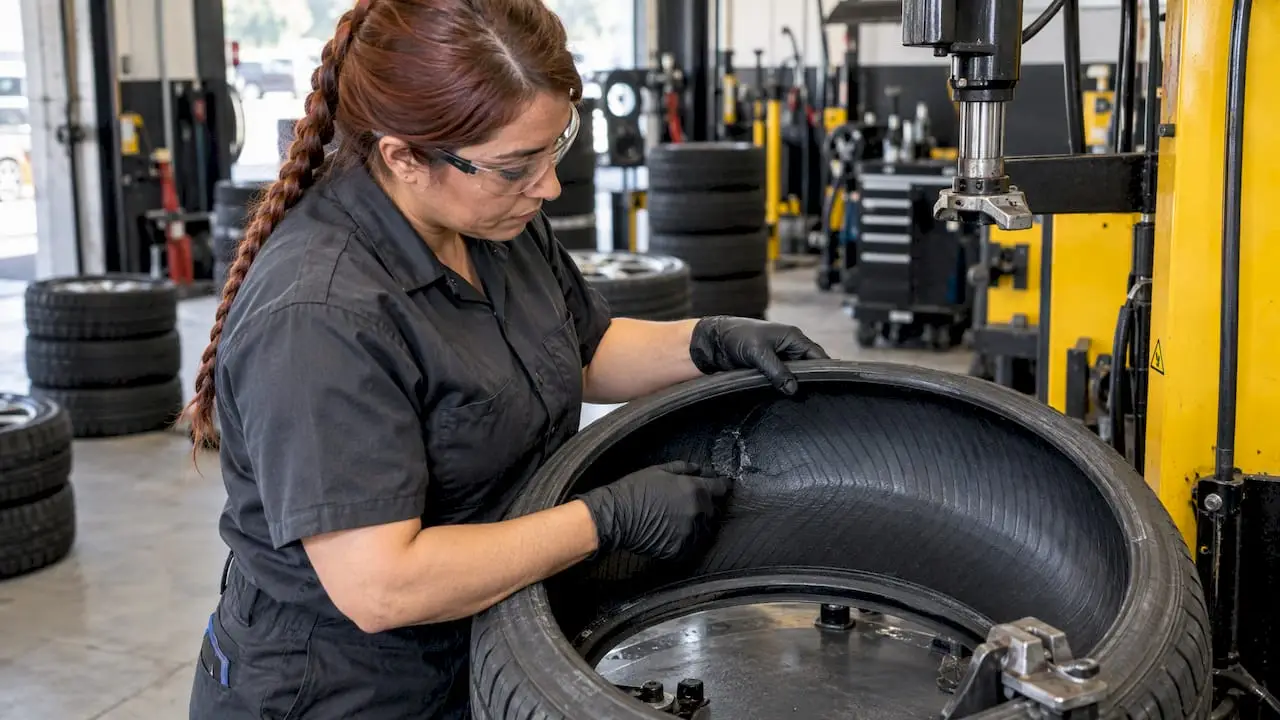
That is the practical reason to have a tire looked at after a jarring hit, even if it holds air. If the tire does have a puncture or leak, whether it can be repaired depends on where the damage is. Our guide to tire plug versus patch repairs explains why a proper repair involves removing the tire from the wheel. Consumer Reports adds that a pothole flat usually cannot be handled with a temporary sealant kit, so without a spare you may need a tow.
If you notice one edge of a tire wearing faster than the rest in the weeks after a hit, see our guide to matching uneven tire wear patterns to likely causes.
Suspension and steering damage after a pothole
Suspension is the system of shocks, struts, springs and linkage that keeps the tires on the road and the ride controlled. Steering parts connect your steering wheel to the front wheels. A pothole hit can bend, loosen or wear these parts.
Monroe says a pothole hit rocks the entire suspension system and can cause early wear to shocks and struts. It lists signs such as excessive bouncing, bottoming out, swaying when turning, front-end dive when braking, the car sitting lower at one end, and uneven tire wear.
Consumer Reports’ Mike Crossen, lead technician at its Auto Test Center, says steering and suspension parts can be bent or loosened, that alignment may be thrown off and wear the tires, and that in severe cases a subframe or body structure may be affected.
Things worth knowing about this kind of damage:
- It can build slowly. MOOG notes that repeated jolts speed up wear on steering and suspension parts. One bad hit on top of years of rough roads may be the final push.
- Symptoms overlap. A pull, a shake and uneven wear can come from a bent wheel, a worn tie rod, a weak strut or a combination. A hands-on inspection sorts this out.
- Low cars are more exposed. MOOG says low-ride-height cars are more likely to suffer undercarriage scrapes, leaks or exhaust damage.
For a closer look at specific symptoms, see our guides to signs of bad shocks and struts, steering rack warning signs and what causes steering wheel vibration. If you want the car inspected, our steering and suspension repair service covers this work.
When pothole damage means stop driving
Some findings are not a wait-and-see situation. Stop and arrange a tow or a spare tire swap if you notice any of these:
| What you find | Why it matters | What to do |
|---|---|---|
| Crack in the wheel | The wheel could fail, per Haynes | Do not drive on it; tow |
| Bulge or bubble in the sidewall | The tire’s structure is compromised | Put on the spare; have the tire inspected |
| Fluid leaking under the car | Driving on can cause more damage | Stop and tow |
| Car pulls hard or the steering feels loose | Steering or suspension parts may be damaged | Slow down, avoid highways, get inspected promptly |
| Brakes feel different, or the pedal sinks | Brake components or lines may be hurt | Do not drive; tow |
| Loud grinding or banging from a corner | A part may be broken or rubbing | Pull over and have it inspected |
Any condition that could affect steering, braking or the tires deserves a professional inspection before you drive further. If you are unsure, treat it as unsafe and call for a tow. Driving a damaged car on the highway to save a tow fee can cost far more.
What pothole repairs can cost
Costs vary by vehicle, by the parts involved and by how many were damaged, so treat the figures below as published ranges from national sources rather than a quote.
Consumer Reports, citing AAA data, reports that about 1 in 10 drivers a year has pothole damage serious enough to need repair, at an average of about $600 per repair. A Wall Street Journal analysis puts shock and strut repairs at up to $900 on average, and says damage to several components can push the bill well above $1,000.
A few things drive the total up or down:
- How many parts are involved. A single tire is a different job from a tire, a wheel and a strut on the same corner.
- Your vehicle. European makes, trucks and larger SUVs often use bigger or more specialized wheels, tires and suspension parts.
- Waiting. A bent part that keeps wearing your tires can turn a one-part repair into a repair plus new tires.
Because costs depend on the vehicle and the damage, the most reliable number is a written estimate after an inspection.
Should you pay yourself or file with insurance?
Pothole damage is usually handled under collision coverage, not liability. Kin Insurance explains that damage from potholes or rough pavement, such as suspension or tire damage, is typically covered by collision insurance, that you can file regardless of fault, and that most drivers choose deductibles between $250 and $1,000. The deductible is the amount you pay before insurance pays.
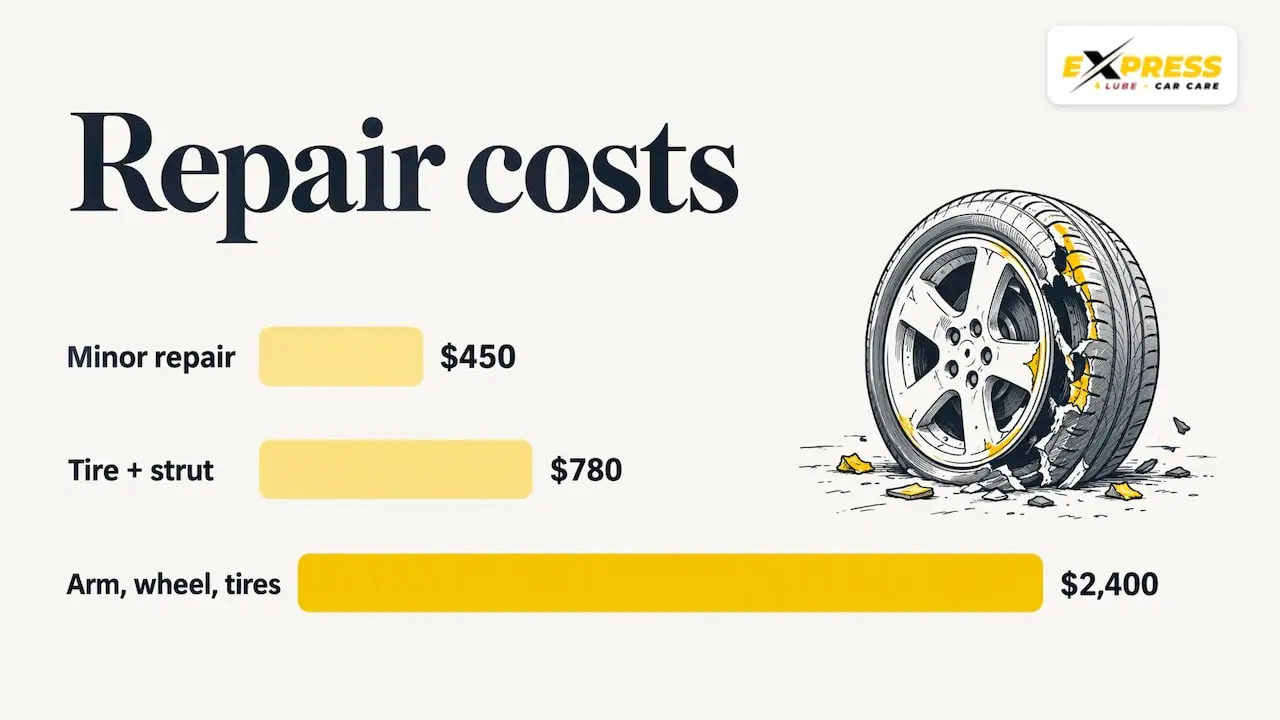
The math is simple. If your repair is $450 and your deductible is $500, a claim pays you nothing. The WSJ’s Kara McGinley advises that for minor pothole damage it is usually better to pay out of pocket, since a claim goes on your insurance record, and that claims make sense when the repair costs significantly more than the deductible.
A worked example:
- Estimate A: one tire and a strut, $780, with a $500 deductible. A claim would pay roughly $280 before any effect on your record. Many drivers would pay it themselves.
- Estimate B: a bent control arm, a cracked wheel and two damaged tires, $2,400, with a $500 deductible. A claim could be worth discussing with your agent.
Tires also deserve a note. Consumer Reports says insurance may cover hard parts such as suspension components but typically not wear-and-tear items like tires. If you bought a road hazard warranty with your tires, read what it covers, since the customer typically still pays for mounting, balancing and disposal.
Your insurance agent can tell you what your own policy covers and how a claim could affect your premium. Bring them a written estimate and photos.
Can you get the city or state to pay?
Sometimes, but it is harder than most drivers expect. Rules differ by state and city, and in Texas, cities generally keep governmental immunity unless a state law waives it. The Texas Municipal League’s legal Q&A explains that the Texas Tort Claims Act waives that immunity only for certain situations and that a city is entitled to receive notice of a claim within a set period. Because the details depend on who owns the road and on the facts, ask the city or a licensed attorney about your specific case instead of relying on a general rule. Other states differ: Michigan, for example, only accepts pothole claims on state trunklines and requires a lawsuit for claims of $1,000 or more, according to MDOT.
Whatever route you consider, the evidence is the same, and it is worth gathering early:
- Photos of the pothole with something for scale, plus the street, direction and time
- Photos of the tire, wheel and any other damage
- A written inspection report and estimate
- Receipts for repairs and towing
If you spot a pothole in Plano, you can report it to the city. The City of Plano has encouraged residents to submit reports through Fix It Plano, which helps get it patched before it catches the next driver.
Our perspective on pothole damage
Most of the pothole cases we think about follow the same pattern: the driver felt the hit, the car seemed fine, and a few weeks later something started to feel off. By then the cause is harder to trace, and the tires may already show the effect.
That is why we treat an inspection after a hard hit as a routine step, not a sign something is wrong. Our ASE-certified technicians can look over the tires, wheels, steering and suspension, and our digital vehicle inspections put what they find in front of you with photos and technician notes. You see the part, you read the note, and you decide with the facts in hand. That record is also useful if you later talk to your insurer or the road owner.
We serve busy families, commuters, military members, first responders and healthcare workers who cannot lose a day waiting on a shop. We take walk-ins with no appointment needed, and most services are completed the same day. For fleets, a hit that goes unchecked on one vehicle can turn into downtime later, so we handle fleet maintenance and repair too.
Repairs we perform are backed by a 24-month/24,000-mile limited warranty on qualifying repairs, whichever comes first, and qualifying suspension repairs carry our Lifetime Suspension Warranty. Eligibility, limitations and exclusions apply to both, and not every repair or part is covered, so ask us about your specific repair.
Express Lube & Car Care
What a post-pothole visit looks like
If you bring your car in after a hit, here is what we look at and why:
- Tires: sidewalls, tread wear patterns and air retention. A tire with suspected internal damage may need to come off the wheel for a proper look.
- Wheels: the inner and outer lips, spokes and the seal where the tire seats.
- Shocks and struts: leaks, worn mounts and ride behavior.
- Steering and suspension linkage: tie rods, control arms and anything that could be loose or bent.
- Undercarriage: fluid leaks and visible damage to exhaust or protective panels.
You leave with a clear list of what is urgent, what can wait and what is fine. Maintenance and repair needs vary by vehicle, so we compare findings against what your vehicle needs, not a generic checklist. Our tire sales and service team can handle tire replacement if an inspection shows a tire cannot stay in service.
Getting your car looked at
If you hit a pothole and the car feels different, stop in. You do not need an appointment, and our full list of services is on our services page. Tell the technician what you felt, which wheel took the hit if you know, and when it happened. If the car is not safe to drive, arrange a tow instead. We would rather see the car on a flatbed than on the shoulder of the Dallas North Tollway.
Preventing pothole damage in the first place
You cannot avoid every pothole, but a few habits reduce the harm:
- Keep tires at the pressure listed on your door jamb. Underinflated tires are easier to pinch against the rim. Check pressure monthly and before long trips.
- Leave more following distance, especially after rain, when puddles can hide a hole.
- Brake before the hole, not in it. Braking compresses the front suspension and can make the hit worse. Ease off the brake just before impact so the suspension can absorb it.
- Do not swerve suddenly. Avoiding a pothole by darting into the next lane or toward a curb creates its own risks.
- Keep worn shocks, struts and tires in good shape. Worn parts absorb less and break more easily.
FAQ
Can a pothole damage a car without any visible sign?
Yes. A tire can have broken internal cords or layers that cannot be seen from outside, and suspension or steering parts can bend or loosen without a visible mark. Michelin recommends a professional inspection after any significant impact. If the car pulls, vibrates or wears a tire unevenly afterward, have it checked.
How do I know if I have a bent rim?
Common signs are a vibration that gets stronger with speed, a tire that loses air with no puncture, and a visible dent or crack on the wheel lip. Small chips can be hidden by brake dust or sit on the inner edge. A technician can inspect the wheel and tire together.
Is it safe to drive after hitting a pothole?
It depends on what you find. A cracked wheel, a sidewall bulge, a fluid leak or a change in braking or steering means stop driving and get a tow or switch to the spare. If everything looks and feels normal, drive gently and have the car inspected soon.
Does insurance cover pothole damage?
Collision coverage typically covers pothole damage such as tire or suspension damage, after your deductible. Many repairs cost less than a common $500 deductible, so many drivers pay themselves. Ask your insurance agent about your policy, and get a written estimate first.
Can I get the city to pay for pothole damage?
In Texas, cities generally keep immunity unless state law waives it, and notice deadlines apply, so results depend on the facts and who owns the road. Take photos, keep your estimate and receipts, and ask the city or an attorney about your case.
Sources
- State Farm: Safety Tips for Avoiding Costly Pothole Damage
- Consumer Reports: Pothole Survival Guide
- Haynes Manuals: What To Do After Hitting a Pothole
- MOOG: Your car and potholes
- Monroe: Pothole Damage to Shocks
- Michelin: Tire Inspection Guide
- Wall Street Journal: Car insurance for pothole damage
- Kin Insurance: Collision car insurance
- Michigan MDOT: Damage claim
- City of Plano: Pothole repair and Fix It Plano