

A failing steering rack usually announces itself through clunking or grinding when you turn, a wheel that feels loose or heavy, fluid spots under the front of the car, or a vehicle that drifts to one side. Any of these deserves a prompt professional look, because the rack is the part that turns your wheel input into the movement of the front tires. This guide explains what each sign means, what else can cause it and how a shop sorts one from the other.
TL;DR
- The most common steering rack symptoms are noise when turning, play or a dead spot in the wheel, hard steering, leaking fluid and pulling to one side.
- Worn tie rods, low fluid or a leaking hose can mimic a bad rack, so a hands-on inspection should come before any parts are ordered.
- Leaking fluid, noticeable play or sudden heavy steering are safety issues. Do not put them off.
- Internal wear or failed seals usually mean replacing the rack. External problems can sometimes be repaired.
- Repair needs and intervals vary by vehicle, so follow your owner’s manual and a technician’s inspection findings.
Table of Contents
- What the steering rack does
- Nine steering rack symptoms to know
- Rack, tie rods, pump or fluid: how to tell them apart
- How a shop checks a steering rack
- Repair or replace?
- When to stop driving and get it checked
- Get your steering checked in Plano
- Keeping the steering system healthy
- FAQ
- Sources
What the steering rack does
In most modern cars, SUVs and light trucks, the steering wheel turns a small gear (the pinion) that moves a toothed bar (the rack) side to side. The rack connects to the front wheels through the tie rods. Many vehicles add hydraulic assist, with fluid pressure making the rack easier to move, while others use an electric motor for the same job.
That is why symptoms show up in so many forms. Noise, looseness, heaviness and leaks can all trace back to the same assembly, and several of them can also trace back to neighboring parts.
Nine steering rack symptoms to know
1. Clunking, rattling or squeaking when you turn
A knock or rattle that you can feel through the wheel is one of the classic signs. A federal service bulletin filed with NHTSA describes a clunk, squeak or rattle from the steering rack and pinion that may be felt through the steering wheel. Sounds from parking-lot speeds, such as turning into a space, are especially worth noting.
Noise alone does not prove the rack is at fault. Worn tie rods, sway bar links and strut mounts can all knock. If the sound is more of a groan or grind, our guide to grinding noise when turning the steering wheel walks through the likely causes.
2. Excess play or a dead spot in the wheel
You turn the wheel a little and nothing happens for a moment. Or the car wanders, and you make constant small corrections to keep it straight. MOOG, a steering parts manufacturer, says excessive free play can make steering feel loose and cause wandering, and that it warrants immediate investigation because neglect can lead to tire wear, difficult steering or part separation.
Play is also the symptom most often caused by something other than the rack. Worn tie rod ends are a frequent culprit, which is why we describe them in a separate guide on tie rod symptoms.
3. Steering that feels heavy or tight
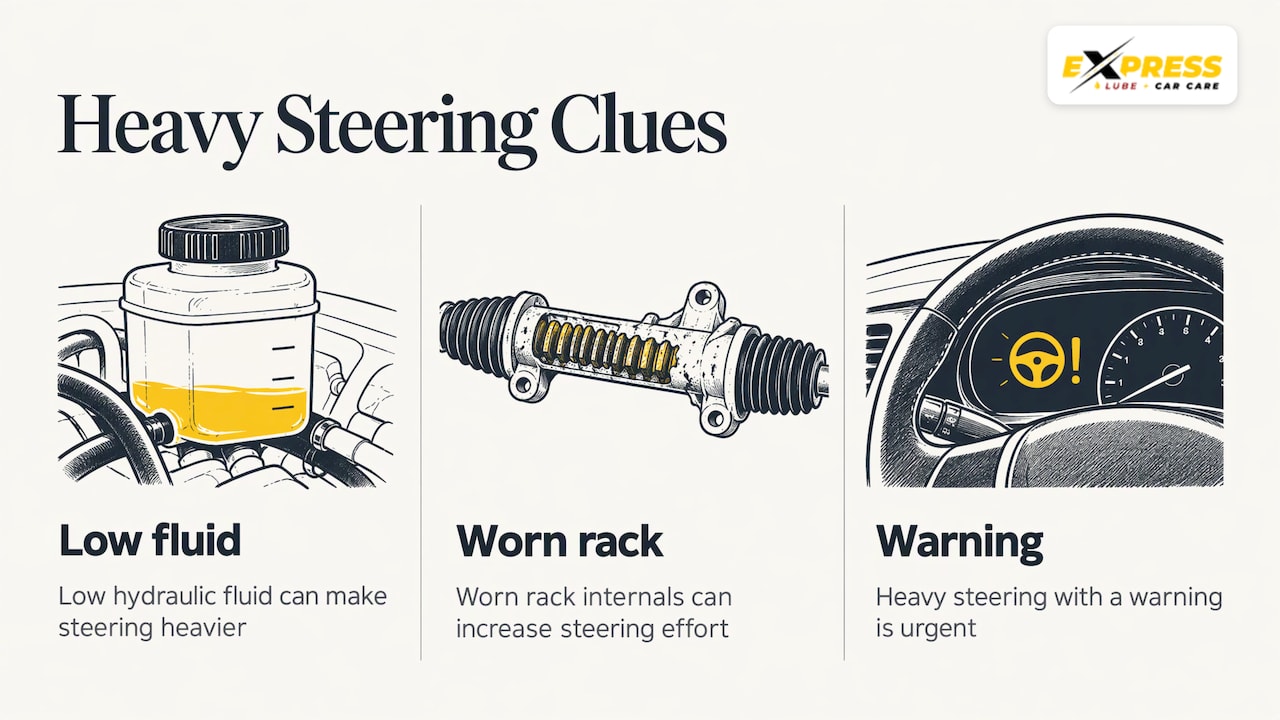
If the wheel takes noticeably more effort, especially at low speeds, the rack, the hydraulic pressure or the fluid level could be involved. A hydraulic system with low fluid or lost pressure will feel heavier, and so will a rack with worn internals.
Newer vehicles with electric assist can show this too. In a federal investigation of certain 2023 Tesla Model 3 and Model Y vehicles, owners reported increased steering effort or an inability to turn, a reduced-assist warning and a notchy feel. The point for any driver: if a warning message appears together with heavy steering, treat it as urgent.
4. Fluid leaking near the front wheels
Power steering fluid is often reddish or brownish, and a leak can leave spots under the front of the car. A rack leak commonly shows up as fluid in or around the rubber bellows (the boots at each end of the rack). One trade publication notes that a lot of fluid inside the bellows indicates the rack is leaking.
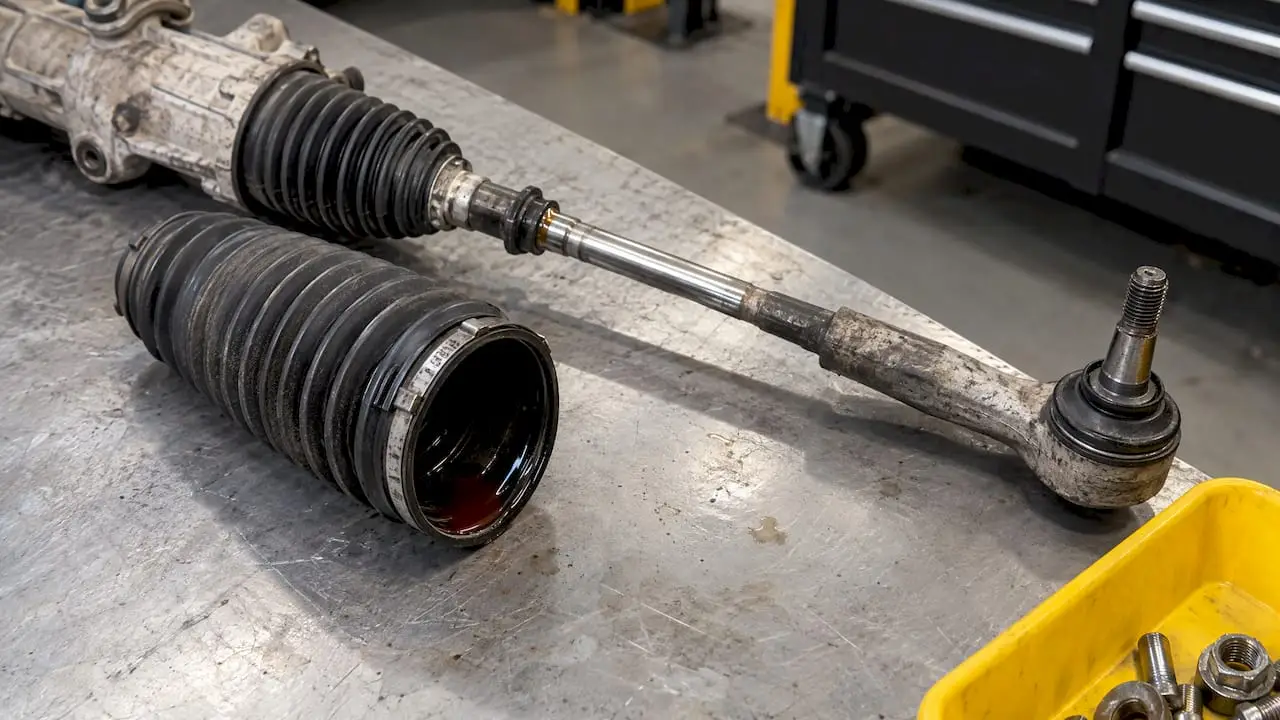
For some General Motors hydraulic-steering vehicles from 2005 to 2014, a manufacturer bulletin says fluid in the left tie-rod boot indicates a leak that requires replacing the gear assembly. That is specific to those vehicles. Other makes differ, which is one reason a vehicle-specific inspection matters.
A leak can also come from a hose, a fitting or the pump. Our article on power steering leak tests explains how a shop pinpoints the source.
5. A whine or groan when turning
A whine that rises as you turn the wheel often points to low fluid or an issue in the hydraulic system. Check the level first if your vehicle has a reservoir, using the steps in our guide on how to check power steering fluid. If the level is low, the fluid went somewhere, and finding that leak is the real task. Topping off repeatedly without finding the source only delays the repair.
6. Pulling or drifting to one side
A car that drifts when you let the wheel relax is not automatically a rack problem. Tire pressure, uneven tire wear, alignment and brake drag are more common explanations, so start with why a car pulls to the right. A rack becomes a suspect when the pull comes with other signs, such as play, noise or heaviness that is worse in one direction.
7. Vibration through the steering wheel
Vibration is more often a tire balance, wheel or brake issue than a rack issue. When it appears alongside looseness or noise on turns, the technician will look at the steering components too. See our overview of what causes steering wheel vibration for the usual list.
8. Uneven or fast tire wear
Worn steering parts can let the front wheels sit slightly out of position, so the tire edges wear faster than the center. If a tire shows a sawtooth or one-sided wear pattern, have the steering and suspension checked along with the alignment. Our piece on signs your car needs an alignment covers how those signs overlap.
9. A steering wheel that is off-center or slow to return
If the wheel does not settle back to straight after a turn, something in the steering system is binding or worn. It may be the rack, a joint or a suspension component. This one is easy to dismiss and hard to diagnose by feel, so mention it when you book an inspection.
Rack, tie rods, pump or fluid: how to tell them apart
Because the symptoms overlap, the table below shows where each one most often leads. It is a starting point, not a diagnosis.
| Symptom | Often points to | Also check |
|---|---|---|
| Clunk or knock on turns | Rack mounts or internal wear | Tie rod ends, sway bar links, strut mounts |
| Play or dead spot | Worn rack or tie rods | Wheel bearings, ball joints |
| Heavy steering | Low fluid, pressure loss or rack wear | Pump, belt, electric assist system |
| Fluid spots, bellows wet | Rack seals or hoses | Pump, fittings, reservoir |
| Whine when turning | Low fluid, pump | Belt, aerated fluid |
| Pulling to one side | Alignment, tires | Brakes, rack (if other signs) |
How a shop checks a steering rack
A proper inspection does not start with a part number. It usually follows this order:
- Listen and feel. The technician road tests the vehicle and notes when the noise, heaviness or pull happens.
- Check the fluid. On hydraulic systems, level, color and condition tell a lot. Foamy or dark fluid points to a problem upstream.
- Do a dry park check. With the vehicle’s full weight on its wheels, the steering is rocked back and forth to reveal play in the steering linkage.
- Inspect from underneath. On a lift, the technician looks at the bellows, tie rods, hoses, fittings and mounts for wetness, tears and looseness.
- Pinpoint leaks. When the source is unclear, the system can be cleaned and run with fluorescent dye so the leak shows up clearly. A manufacturer bulletin describes this clean, dye and run approach for some GM vehicles.
- Review the findings. Our shop uses digital vehicle inspections with photos and technician notes, so you can see what was found before you decide.
This order matters because a loose-feeling wheel can come from worn tie rods instead of the rack. Finding that out first can avoid replacing a part that was fine.
Repair or replace?
The answer depends on where the problem is. Based on common repair practice, external issues such as a worn tie rod, a leaking hose or a loose fitting can often be repaired on their own. Internal gear wear or failed hydraulic seals usually mean replacing the full rack, since the work to open one up is similar to the work to swap it, and a whole assembly is the more dependable fix.
A few things shape the estimate:
- Vehicle type. Rack design and access differ widely between a compact sedan, a full-size truck and a European model.
- Hydraulic or electric assist. Electric systems may involve sensors and software in addition to the mechanical parts.
- Related parts. Tie rods, boots or hoses found worn during the inspection may be replaced at the same time.
- Alignment afterward. Replacing steering components changes front-end geometry, so ask your technician what is needed after the work.
We do not publish a fixed price for steering work, because it depends on the vehicle and what the inspection finds. Ask for a written estimate before work begins.
When to stop driving and get it checked
Steering is not a system to wait on. Have the vehicle inspected promptly if you notice:
- Fluid actively dripping or a wet bellows
- Noticeable play, wandering or a dead spot in the wheel
- Sudden heavy steering or a steering warning message on the dash
- A clunk that is getting louder or more frequent
If the wheel suddenly becomes very hard to turn, or you lose confidence that the car will go where you point it, pull over when safe and arrange a tow instead of driving to the shop. Driving on a badly leaking or loose rack risks losing steering control, as well as damaging the pump and tires.
What we see at the counter
Most drivers who come in worried about a steering rack are describing one of two things: a noise they can feel in the wheel, or a car that no longer feels planted on the road. Our approach is to inspect before recommending. Our technicians are ASE-certified, and our digital inspections come with photos and notes, so you see what we see.
That matters here because the rack is not always the cause. We would rather show you a worn tie rod boot or a leaking hose and fix the right part than replace a rack that did not need it. When a rack does need replacing, we want you to understand why before you approve the work.
We do same-day service for most repairs and take walk-ins without an appointment. Qualifying repairs carry our 24-month/24,000-mile limited warranty, whichever comes first, and qualifying suspension repairs carry our Lifetime Suspension Warranty. Eligibility, limitations and exclusions apply to both, so ask us about the terms for your specific repair.
Express Lube & Car Care
Get your steering checked in Plano
If any of the signs above sound familiar, our team can inspect the rack, tie rods, hoses and fluid, then explain what we find. Details on what we cover are on our steering and suspension repair page.
We serve drivers across Plano and Collin County, including families, commuters, military members, first responders, healthcare workers, European vehicle owners and fleet managers. No appointment is needed, and we offer discounts for military and healthcare providers. You can see the full list of what we work on at our services page or stop by the shop.
Keeping the steering system healthy
No one can promise a specific lifespan for a steering rack, because it varies with the vehicle, driving conditions and how early problems are caught. These habits help:
- Check power steering fluid at the intervals in your owner’s manual, if your vehicle uses it.
- Look at the ground where you park for new spots.
- Notice changes in effort, noise or centering and report them early.
- Have tie rod ends, boots and hoses looked at during routine service. Our oil change and preventive maintenance visits are a good time to ask for a look at the front end.
- Follow the manufacturer’s recommendations on fluid service. If a fluid change is due, see how a power steering flush works.
FAQ
What are the first signs of a bad steering rack?
The earliest signs are usually a faint clunk or rattle when turning, slight play in the wheel, or small fluid spots under the front of the car. They are easy to ignore because the car still drives. Report them early, since a minor leak or loose component is simpler to deal with than a failed one.
Can I drive with a bad steering rack?
It depends on the symptom, but a leaking rack, noticeable play or heavy steering is a safety issue and should be inspected right away. If steering suddenly becomes very hard or unpredictable, stop in a safe place and arrange a tow. Fluid loss can also damage the pump.
Can a steering rack be repaired without replacing it?
Sometimes. External problems such as a worn tie rod, a leaking hose or a loose fitting can often be repaired separately. Internal gear wear or failed seals typically call for replacing the rack, since partial repairs can be unreliable.
Why does my steering rack make noise only when turning?
Turning loads the rack, tie rods and mounts, so worn parts show themselves then. A clunk or rattle may come from the rack, but tie rods, sway bar links and strut mounts can make similar sounds. An inspection on a lift usually separates them.
How is a steering rack leak different from other power steering leaks?
A rack leak typically shows as fluid in the bellows or around the rack ends, while hose, fitting and pump leaks appear in other places. Shops often clean the area and add dye to trace the source. Our guide to power steering leaks explains the process.
Sources
- Steering Rack and Pinion: Rattle, Squeak or Clunk Noise (NHTSA technical service bulletin)
- Loose Steering: Causes and Symptoms (MOOG Parts)
- ODI Resume, Tesla Model 3 and Y steering complaints (NHTSA)
- Power Steering Racks: Leak Diagnosis and Repair (Tech Shop Magazine)
- GM service bulletin 07-02-32-002N on power steering gear leaks
- How To Diagnose Rack and Pinion Steering (AA1Car)